Adapter or Adaptor: Which Spelling Is Correct?
If you have ever written adapter or adaptor and stopped to wonder whether one of them is wrong, you are not alone. Both spellings appear in dictionaries, books, product descriptions, technical documents, and everyday English. That makes this pair especially confusing: unlike some spelling questions, there is no simple “right versus wrong” answer. The good news is that both adapter and adaptor are correct spellings. The main difference is regional and stylistic preference, rather than meaning. Adapter is the more common spelling in American English and is also widely used in British English. Adaptor is a traditional variant, particularly common … Read more


On a Call or In a Call: Which Is Correct?

Should you say “I’m on a call” or “I’m in a call”? If you have ever paused before writing a work message such as “Sorry, I’m ___ a call,” you are not alone. Both expressions seem logical because English uses on and in in many different ways. We say “in a meeting,” “on the phone,” “in a conversation,” and “on a video call.” That mixture can make this small preposition choice surprisingly confusing. The good news is that the answer is simple for most everyday situations: “on a call” is the standard and most natural choice when you mean that … Read more

To Fast or Too Fast: Which Is Correct?

Have you ever written “to fast” and wondered whether it should actually be “too fast”? You are not alone. These two expressions look almost identical, but the tiny difference between to and too changes the grammar, meaning, and even the entire sentence. The confusion happens because to and too sound alike in many varieties of English. When we hear someone say “too fast,” there is no visual clue telling us which spelling to choose. As soon as we write the sentence, however, the difference becomes important. The good news is simple: “too fast” is usually the phrase you need when … Read more

Suite or Sweet or Sweat: What’s the Difference?

If you have ever written “suite,” “sweet,” or “sweat” and suddenly wondered whether you picked the right word, you are not alone. These three English words sound alike in many accents, but their meanings are completely different. One can describe a hotel room, one can describe something sugary or pleasant, and the other refers to moisture produced by your body. That makes suite or sweet or sweat a classic English vocabulary confusion. The problem becomes even trickier because suite and sweet are pronounced almost exactly the same, while sweat can have a pronunciation that surprises English learners. The good news … Read more

Froze or Frozen: Which Is Correct?

If you have ever written “I have froze” or wondered whether to say “the lake froze” or “the lake was frozen,” you are not alone. Froze or frozen is a common English grammar question because both words come from the same verb, freeze, but they do different jobs in a sentence. The basic answer is simple: froze is the simple past form of “freeze,” while frozen is the past participle. However, that small difference affects the grammar around them. You use froze for a completed action in the past, while frozen normally appears with an auxiliary verb such as have, … Read more

Become or Became: Which One Is Correct?

If you have ever wondered whether to write “become” or “became,” you are dealing with a very common English grammar question. Both words come from the same verb, become, but they do not work in the same way. The difference is mainly about tense and sentence structure. Compare these two sentences: Both are correct, but they describe different situations. In the first sentence, become refers to an action or change that the speaker wants to happen. In the second, became tells us that the change happened in the past. The confusion becomes greater because become is an irregular verb. Its … Read more

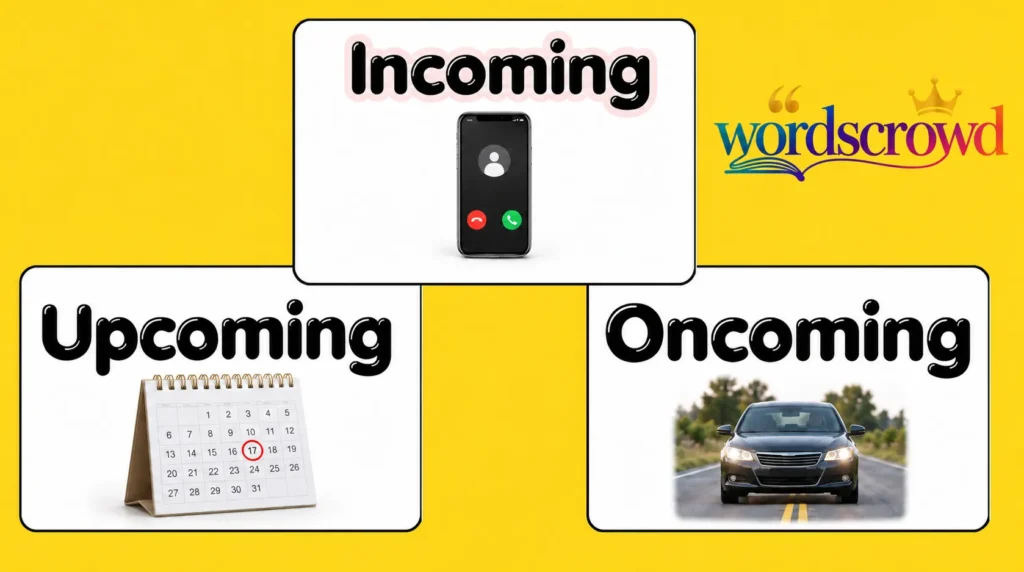
Incoming or Upcoming or Oncoming: What’s the Difference?

English has a funny habit of making three words look almost interchangeable when they are actually pointing in different directions. Incoming, upcoming, and oncoming all contain coming, and all can describe something that is approaching in some sense. That is why learners—and even fluent speakers—sometimes hesitate before choosing the right word. But the distinction becomes much easier once you focus on what is coming, where it is coming, and how you are viewing it. Incoming usually means something is arriving into a place, system, position, or role. An incoming call is a call you receive. An incoming flight is a … Read more