Have you ever said, “I watched a beautiful painting,” when you meant “I looked at a beautiful painting”? Or wondered whether you should say “see a movie,” “look at a movie,” or “watch a movie”?
You’re not alone. See vs look vs watch is one of the most common vocabulary questions for English learners. These three verbs are closely related because they all involve your eyes. However, they describe different ways of using your vision.
The difference becomes easier when you think about attention. Sometimes your eyes notice something without you trying. Sometimes you deliberately turn your eyes toward something. And sometimes you keep your attention on something as it moves or happens.
That’s where see, look, and watch come in.
Although these verbs can sometimes describe the same situation, they are not always interchangeable. Choosing the wrong one can make a sentence sound unnatural, especially in everyday conversations, professional emails, and academic writing.
In this guide, you’ll learn the exact difference between see, look, and watch, how to use each verb, which prepositions they need, and how native English speakers use them in real-life situations.
Quick Answer
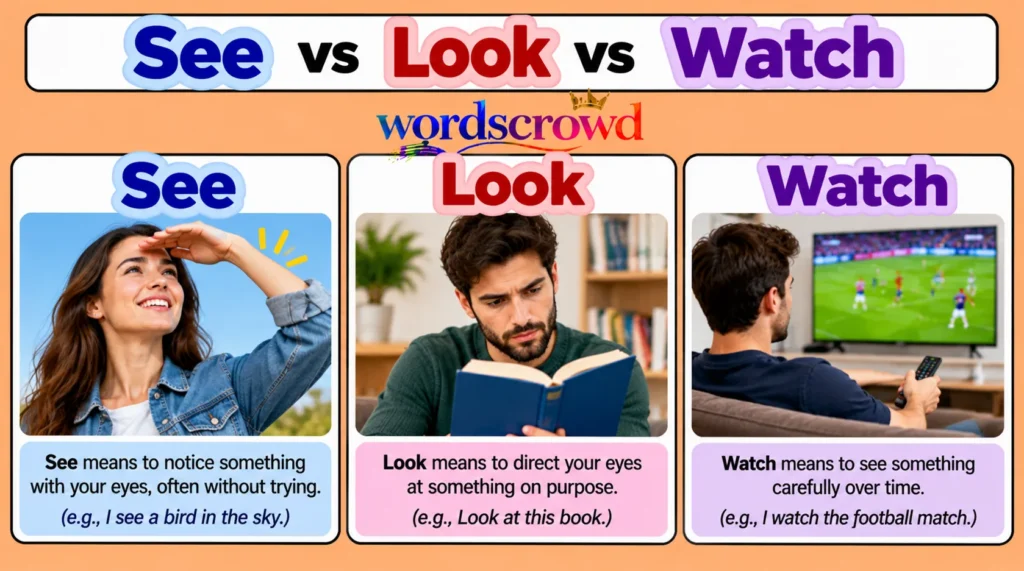
- See means to notice something with your eyes, often without trying.
- Look means to deliberately direct your eyes toward something.
- Watch means to pay attention to something for a period of time, especially when it moves or changes.
Easy example:
- I can see a bird in the tree.
- Look at that beautiful bird!
- I watched the bird fly away.
All three verbs are correct, but each describes a different kind of visual attention.
See vs Look vs Watch: Comparison Table
The easiest way to understand these three verbs is to compare their meanings, grammar, and everyday uses.
| Feature | See | Look | Watch |
|---|---|---|---|
| Main meaning | Notice with your eyes | Direct your eyes | Observe over time |
| Part of speech | Verb | Verb / Noun | Verb / Noun |
| Pronunciation | /siː/ | /lʊk/ | /wɒtʃ/ (UK), /wɑːtʃ/ (US) |
| Main idea | Visual perception | Visual direction | Sustained attention |
| Intention | Often unintentional | Usually intentional | Usually intentional |
| Movement required | No | No | Often, but not always |
| Common preposition | None in basic usage | At | No preposition in basic usage |
| Example | I see a car. | Look at the car. | Watch the car move. |
| Movies | See a movie | Look at a screen | Watch a movie |
| Television | See the TV | Look at the TV | Watch TV |
| Formality | Neutral | Neutral | Neutral |
| Continuous form | Seeing | Looking | Watching |
| Past tense | Saw | Looked | Watched |
| Past participle | Seen | Looked | Watched |
| Common mistake | Confusing it with watching | Forgetting “at” | Using it for every visual action |
Remember: See is about perception, look is about directing your eyes, and watch is about sustained attention.
1. What Does See Mean?
See means to notice or become aware of something through your eyes. It usually describes the ability to perceive something visually rather than the action of deliberately directing your attention toward it.
For example:
- I can see the mountains from my bedroom.
- Did you see that shooting star?
- She saw a man standing outside.
- I can’t see anything in the dark.
In these sentences, the person receives visual information. They are not necessarily making an effort to observe something.
Definition of See
According to everyday English usage, see describes visual perception: the ability to notice or recognize something with your eyes.
It can also mean understanding, meeting someone, or experiencing something, depending on the context.
Origin of See
The verb see comes from Old English sēon, meaning to perceive with the eyes or understand.
Its roots go further back to Germanic languages. Related forms appear in several languages, reflecting the long history of this basic human action.
Over time, see developed additional meanings beyond physical vision.
For example:
- I see what you mean. (Understand)
- I’ll see my doctor tomorrow. (Meet)
- Let’s see what happens. (Find out)
Grammar of See
See is an irregular verb.
| Verb Form | Example |
|---|---|
| Base form | See |
| Present | See / Sees |
| Past | Saw |
| Past participle | Seen |
| Present participle | Seeing |
Examples:
- I see the problem.
- She sees a rainbow.
- We saw a movie yesterday.
- Have you seen my phone?
- I’m seeing my dentist tomorrow.
Notice that the past participle is seen, not saw.
Incorrect: I have saw that movie.
Correct: I have seen that movie.
When Should You Use See?
Use see when you want to describe visual perception, recognizing something, or becoming aware of something.
1. When something appears in your vision
- I can see the ocean.
- She saw a cat near the door.
- We can see the stars tonight.
2. When you notice something unexpectedly
- Did you see that?
- I saw something strange in the garden.
- He didn’t see the car coming.
3. When talking about visual ability
- I can’t see without my glasses.
- Can you see the board?
- She can see clearly now.
4. When talking about meeting someone
- I’m going to see my friend.
- The manager wants to see you.
- I saw my teacher yesterday.
5. When talking about understanding
- I see your point.
- Now I see why you’re upset.
- I don’t see the problem.
See in Professional and Academic English
See is common in business, education, and formal writing.
Examples:
- Please see the attached document.
- We can see a clear difference in the results.
- The researchers saw an increase in participation.
- As you can see in Figure 2, the results are different.
In professional emails, “Please see attached” is widely understood, although “Please find the attached report” or “I’ve attached the report for your review” may sound more natural in some situations.
In academic writing, see is also used to direct readers toward references, tables, figures, and supporting information.
Example:
“See Table 3 for a detailed comparison.”
Common Mistakes With See
Mistake 1: Using saw instead of seen
Incorrect: I have saw your message.
Correct: I have seen your message.
Why? The present perfect requires the past participle seen.
Mistake 2: Confusing see with look
Incorrect: See at that beautiful house!
Correct: Look at that beautiful house!
Why? When asking someone to direct their eyes toward something, use look at.
Mistake 3: Using see when watch is more appropriate
Less natural: I saw the entire football match.
More natural: I watched the entire football match.
Why? Watched emphasizes paying attention throughout the event.
Quick tip: If something enters your vision or you notice it, choose see.
2. What Does Look Mean?
Look means to direct your eyes toward someone or something intentionally.
Unlike see, which often happens naturally, look usually involves an action. You make a decision to focus your eyes in a particular direction.
For example:
- Look at the sky!
- She looked at her phone.
- He looked through the window.
- Look carefully before crossing the road.
In these sentences, someone deliberately directs their eyes toward something.
Definition of Look
Look describes the action of directing your eyes toward something to see, examine, or observe it.
It can also describe someone’s appearance.
Examples:
- You look happy.
- That dress looks beautiful.
- He looks tired today.
Here, look means to appear or seem rather than physically direct your eyes.
Origin of Look
The verb look comes from Old English lōcian, meaning to use one’s eyes or direct one’s gaze.
Its historical development is connected with the idea of observing, watching, and paying attention.
Today, look has several meanings in modern English, including:
- Directing your eyes.
- Examining something.
- Searching for something.
- Appearing a certain way.
- Taking care of or considering something in certain expressions.
Grammar of Look
Look is a regular verb.
| Verb Form | Example |
|---|---|
| Base form | Look |
| Present | Look / Looks |
| Past | Looked |
| Past participle | Looked |
| Present participle | Looking |
Examples:
- I look at the pictures.
- She looks beautiful.
- He looked outside.
- They are looking for a new house.
Look At vs Look For vs Look After
One important part of using look correctly is understanding its prepositions.
Different prepositions can completely change the meaning.
| Expression | Meaning | Example |
|---|---|---|
| Look at | Direct your eyes toward something | Look at the moon. |
| Look for | Search for something | I’m looking for my keys. |
| Look after | Take care of someone or something | She looks after her brother. |
| Look into | Investigate something | We will look into the issue. |
| Look up | Search for information | Look up this word. |
| Look out | Be careful | Look out! A car is coming. |
| Look through | Examine or browse | I looked through the magazine. |
| Look forward to | Feel excited about something upcoming | I look forward to meeting you. |
These expressions are called phrasal verbs or multiword expressions, depending on their grammatical structure.
When Should You Use Look?
Use look when someone intentionally directs their eyes toward something.
1. When asking someone to notice something
- Look at that sunset!
- Look at this picture.
- Look over there!
2. When examining something
- She looked at the document carefully.
- He looked at the map.
- I looked at the results again.
3. When searching for something
- I’m looking for my wallet.
- They are looking for a new employee.
- We looked for the missing dog.
4. When describing appearance
- You look amazing.
- The food looks delicious.
- He looks nervous.
5. When giving instructions
- Look straight ahead.
- Look both ways before crossing.
- Look carefully at the question.
Look in Professional and Academic English
Look is widely used in workplace communication.
Examples:
- Could you look at this report?
- Please look into the customer’s complaint.
- Let’s look at the available options.
- We need to look carefully at the data.
In academic writing, look at can introduce an examination of a subject.
Example:
“This study looks at the relationship between sleep and memory.”
For more formal academic writing, consider alternatives such as examines, investigates, analyzes, or explores when they better describe the research method.
Common Mistakes With Look
Mistake 1: Forgetting the preposition at
Incorrect: Look the picture!
Correct: Look at the picture!
Why? In this meaning, look normally takes at before the object.
Mistake 2: Using look instead of see
Less natural: I looked a bird in the garden.
Correct: I saw a bird in the garden.
Why? Seeing a bird describes noticing it. Looking at a bird describes directing your eyes toward it.
Mistake 3: Confusing look for with look at
Incorrect: I’m looking at my lost phone.
Correct: I’m looking for my lost phone.
Why? Looking for means searching. Looking at means directing your eyes toward something.
Quick tip: If you deliberately point your eyes toward something, choose look.
3. What Does Watch Mean?
Watch means to look at something carefully for a period of time, especially when it is moving, changing, or developing.
It usually involves sustained attention.
For example:
- I watch television every evening.
- We watched the children playing.
- She watched the football match.
- He watched the rain falling outside.
Unlike see, which often happens without intention, watch suggests that you are actively paying attention.
Unlike look, which can describe a quick glance, watch usually emphasizes observing something over time.
Definition of Watch
Watch means to observe something carefully or continuously, often to follow its movement, progress, or development.
It can also mean to monitor, protect, or remain alert.
Examples:
- Watch your step.
- Watch the baby while I cook.
- The security guard watches the entrance.
- We watched the weather forecast.
Origin of Watch
Watch comes from Old English wæccan, meaning to remain awake or stay alert.
Historically, the word was associated with guarding, keeping watch, and staying awake to observe possible danger.
This history helps explain modern expressions such as:
- Watch out!
- Keep watch.
- Watch over someone.
- Watch your belongings.
The modern meaning expanded to include observing entertainment, sports, movement, and events.
Grammar of Watch
Watch is a regular verb.
| Verb Form | Example |
|---|---|
| Base form | Watch |
| Present | Watch / Watches |
| Past | Watched |
| Past participle | Watched |
| Present participle | Watching |
Examples:
- I watch football.
- She watches movies.
- We watched a documentary.
- They are watching the game.
When Should You Use Watch?
Use watch when you pay attention to something for a period of time.
1. Watching movies and television
- I watch movies on weekends.
- She watches TV after dinner.
- We watched a documentary last night.
2. Watching sports
- He watches cricket every Sunday.
- They watched the football final.
- I watched the tennis match until the end.
3. Watching movement
- Watch the bird fly.
- We watched the children playing.
- She watched the train leave the station.
4. Watching changes or developments
- Scientists watched the temperature rise.
- We watched the situation closely.
- The doctor watched the patient’s condition.
5. Watching for danger
- Watch out for cars.
- Watch your step.
- The guard watched for suspicious activity.
Watch in Professional and Academic English
Watch is useful when describing monitoring, observation, and ongoing developments.
Business examples:
- We are watching market trends closely.
- The team watched customer behavior during the launch.
- Please watch for updates from the management team.
Academic examples:
- Researchers watched how the participants responded.
- The scientists watched the chemical reaction.
- Students watched the experiment carefully.
In scientific writing, observe or monitor may be more precise when describing a formal research method.
Common Mistakes With Watch
Mistake 1: Using watch with the wrong preposition
Incorrect: I watched at the movie.
Correct: I watched the movie.
Why? Watch normally takes a direct object when it means viewing something.
Mistake 2: Using watch for a quick visual perception
Less natural: I watched a flash of lightning.
More natural: I saw a flash of lightning.
Why? A flash is usually too brief to suggest sustained observation.
Mistake 3: Using watch when look is more natural
Less natural: Watch at this picture.
Correct: Look at this picture.
Why? When asking someone to direct their eyes toward a still image, look at is the natural expression.
Quick tip: If you follow something with your eyes over time, choose watch.
See vs Look vs Watch: Key Differences Explained
Now that you understand each verb, let’s compare them in everyday situations.
The main difference is the amount and type of attention involved.
1. Seeing Is Not the Same as Looking
You can see something without looking directly at it.
Imagine you’re walking down the street. You notice a dog sitting near a shop.
You didn’t intentionally search for the dog. It simply entered your field of vision.
That’s seeing.
But when you turn your head and focus on the dog, you’re looking at it.
Example:
- I saw a dog outside.
- I looked at the dog.
The first sentence describes visual perception. The second describes deliberate attention.
2. Looking Is Not the Same as Watching
Looking can happen quickly. Watching usually continues for longer.
Imagine someone points toward a plane.
- Look at that plane!
- We watched the plane disappear into the clouds.
The first sentence tells someone where to direct their eyes.
The second describes following the plane as it moves.
3. Seeing Is Not the Same as Watching
Seeing can happen accidentally. Watching normally requires attention.
For example:
- I saw the football match on television while walking past the room.
- I watched the entire football match with my friends.
The first sentence describes noticing the match. The second means you followed it.
4. The Same Object Can Use All Three Verbs
One object can appear with see, look, and watch depending on what you want to communicate.
Consider a bird:
- I saw a bird in the garden.
- I looked at the bird.
- I watched the bird build its nest.
The bird stays the same. Your visual action changes.
5. Quick Glance vs Long Observation
| Situation | Best Verb |
|---|---|
| Noticing a stranger | See |
| Turning toward a stranger | Look at |
| Following a stranger’s movements | Watch |
| Noticing lightning | See |
| Looking at a photograph | Look at |
| Following a football match | Watch |
| Recognizing someone | See |
| Examining a document | Look at |
| Monitoring a machine | Watch |
Grammar Rules for See, Look, and Watch
Understanding the meaning is only half the job. You also need to know how these verbs behave in English sentences.
1. Direct Objects and Prepositions
The three verbs do not follow exactly the same grammatical pattern.
| Verb | Common Pattern | Example |
|---|---|---|
| See | See + object | I see a bird. |
| Look | Look at + object | Look at the bird. |
| Watch | Watch + object | Watch the bird. |
This is one of the most useful rules to remember.
However, look can appear without at when it has no direct object or uses another construction.
Examples:
- Look outside.
- Look carefully.
- Look for your phone.
- Look into the matter.
2. Can You Use See, Look, and Watch in Continuous Tenses?
Yes, but their meanings and naturalness depend on context.
| Verb | Present Continuous | Example |
|---|---|---|
| See | Seeing | I’m seeing my doctor tomorrow. |
| Look | Looking | I’m looking at the screen. |
| Watch | Watching | I’m watching a movie. |
There is an important distinction with see.
When see means ordinary visual perception, it is commonly a stative verb.
Less natural: I’m seeing a beautiful mountain right now.
More natural: I can see a beautiful mountain right now.
However, seeing is perfectly natural when it means meeting someone, dating someone, or experiencing something.
Examples:
- I’m seeing my dentist tomorrow.
- She’s seeing someone.
- We’re seeing excellent results.
3. See, Look, and Watch in Different Tenses
| Tense | See | Look | Watch |
|---|---|---|---|
| Present | I see it. | I look at it. | I watch it. |
| Past | I saw it. | I looked at it. | I watched it. |
| Future | I will see it. | I will look at it. | I will watch it. |
| Present continuous | I am seeing my doctor. | I am looking at it. | I am watching it. |
| Present perfect | I have seen it. | I have looked at it. | I have watched it. |
| Past perfect | I had seen it. | I had looked at it. | I had watched it. |
4. Can See vs Look vs Watch
The word can changes how the sentence works.
- I can see the mountains. (I have the ability to perceive them.)
- I can look at the mountains. (I am able to direct my eyes toward them.)
- I can watch the mountains. (I can observe them over time.)
Each sentence is grammatically correct, but the intended meaning changes.
5. See Someone vs Look at Someone vs Watch Someone
These expressions can communicate different social situations.
- I saw Sarah at the supermarket. (I noticed or encountered her.)
- I looked at Sarah. (I directed my eyes toward her.)
- I watched Sarah. (I observed her for some time.)
Be careful: “I watched Sarah” can sound unusual or intrusive without a clear context because it suggests sustained observation.
25 Real-Life Examples of See vs Look vs Watch
Here are original examples from everyday conversations, work, school, travel, and social media.
Everyday Conversation
- I can see your house from here.
- Look at those beautiful clouds!
- We watched the sunset together.
- Did you see my glasses anywhere?
- Look behind the door.
- I watched the children playing in the park.
School and Education
- I can see the answer on the board.
- Look at question number five.
- We watched a science experiment in class.
- Have you seen the new English textbook?
Business and Professional Communication
- Please see the attached document.
- Could you look at this proposal before the meeting?
- We are watching the company’s performance closely.
- I saw your email this morning.
- Let’s look at the budget again.
Social Media and Technology
- Did you see my latest Instagram post?
- Look at this hilarious meme!
- I watched your entire YouTube video.
- Have you seen that viral TikTok trend?
- Stop scrolling and watch this video!
Travel and Daily Life
- We saw the Eiffel Tower during our trip.
- Look at the view from this hotel!
- I watched the waves crashing against the shore.
- She saw a rainbow after the rain.
- We watched the train leave the station.
Common Mistakes With See, Look, and Watch
Even advanced English learners sometimes mix up these verbs.
Here are the mistakes worth avoiding.
| Incorrect Sentence | Correct Sentence | Explanation |
|---|---|---|
| Look the sky! | Look at the sky! | Use at with look in this meaning. |
| I watched at the TV. | I watched TV. | Watch takes a direct object here. |
| I saw at him. | I looked at him. | Use look at for directing your gaze. |
| I have saw it. | I have seen it. | Seen is the past participle. |
| I am see a bird. | I can see a bird. | See is usually stative for visual perception. |
| Watch this picture! | Look at this picture! | Look at is natural for a still image. |
| I looked a movie. | I watched a movie. | Watch is natural for viewing a movie. |
| I watched a shooting star suddenly. | I suddenly saw a shooting star. | See suits an unexpected brief sight. |
Mistake 1: Saying “Look Me”
Incorrect: Look me!
Correct: Look at me!
When you want someone to direct their eyes toward you, use look at.
However, “Look me up” is correct in a different context. It means to search for your information or contact you.
Mistake 2: Saying “See at This”
Incorrect: See at this picture.
Correct: Look at this picture.
You can say “See this picture?” in casual conversation, but when giving someone an instruction to direct their eyes toward it, look at is usually more natural.
Mistake 3: Saying “Watch at the Movie”
Incorrect: We watched at the movie.
Correct: We watched the movie.
Watch does not normally require at before its direct object.
Mistake 4: Using Watch for Everything
Incorrect or less natural: I watched a bird suddenly fly past.
Better: I saw a bird suddenly fly past.
Watch suggests continued attention. See is better for a brief visual event.
Special Cases: When Can These Words Be Interchanged?
Although see, look, and watch have different meanings, some situations allow more than one verb.
The context determines the best choice.
1. See a Movie vs Watch a Movie
Both expressions are correct.
See a movie often means going to the cinema or experiencing a film.
Example:
“Let’s see a movie tonight.”
Watch a movie emphasizes viewing the film itself.
Example:
“Let’s watch a movie at home.”
The difference is subtle. In everyday English, both can describe the same activity.
2. See TV vs Watch TV
These expressions are not equally natural in every situation.
- I watch TV every evening. (Normal viewing habit.)
- I can see the TV from here. (The television is visible.)
- Did you see that on TV? (You noticed a particular program or event.)
When discussing the activity of viewing television, watch TV is the standard choice.
3. Look at a Painting vs See a Painting
Both are correct, but they communicate different ideas.
- I saw a beautiful painting at the museum. (I encountered it.)
- I looked at a beautiful painting for ten minutes. (I deliberately examined it.)
If you want to describe careful attention to artwork, you can also use the verb admire.
4. See a Game vs Watch a Game
Both can be natural.
- Did you see the game last night?
- Did you watch the game last night?
The first may mean whether someone saw or experienced the event. The second more clearly emphasizes viewing the game.
For sports, watch is often the clearest choice when discussing the activity of following a match.
5. Look at a Person vs Watch a Person
Both are grammatically correct.
- She looked at me. (She directed her eyes toward me.)
- She watched me. (She observed my actions for some time.)
The second sentence can suggest more sustained attention.
Memory Tricks: How to Remember See, Look, and Watch
Still mixing them up? Try these simple memory tricks.
SEE = NOTICE
Your eyes detect something.
Example: I see a rainbow.
LOOK = DIRECT
You choose where your eyes go.
Example: Look at the rainbow.
WATCH = FOLLOW
You pay attention as something happens.
Example: Watch the rainbow fade.
The Three-Step Visual Test
Imagine you are standing near a window.
- You see a bird outside.
- You look at the bird.
- You watch it fly away.
That’s the entire difference in one simple situation.
Another Easy Trick
Remember these three questions:
- Did my eyes simply notice it? Use see.
- Did I deliberately direct my eyes toward it? Use look.
- Did I follow it over time? Use watch.
(FAQs)
1. What is the main difference between see, look, and watch?
See means noticing something with your eyes. Look means deliberately directing your eyes toward something. Watch means paying attention to something over time, especially when it moves or changes.
2. Is it see at or look at?
The natural expression is look at when you want to direct your eyes toward something.
For example: “Look at that beautiful building!”
However, see usually takes a direct object without at: “I can see that building.”
3. Do you see a movie or watch a movie?
Both are correct. See a movie often refers to experiencing a film, especially at a cinema. Watch a movie emphasizes viewing it, commonly at home or on a screen.
4. Why do we say watch TV instead of look at TV?
Watch TV describes the activity of viewing television programs. Look at the TV describes directing your eyes toward the television set itself.
For example, “I watch TV every night” and “Look at the TV screen” are both natural.
5. Can you see something without looking at it?
Yes. You can notice something in your field of vision without deliberately directing your eyes toward it.
For example: “I saw a cat while walking home.”
You did not necessarily look directly at the cat.
6. Is watch stronger than look?
Not exactly. Watch usually suggests longer or more sustained attention, while look can describe a brief glance or deliberate examination.
For example, you can look at a photograph for a second or watch a bird for several minutes.
7. Is see a stative verb?
Yes, when see describes ordinary visual perception, it is generally a stative verb.
For example: “I can see the mountains.”
However, seeing can be used in continuous forms with other meanings, such as meeting someone or dating someone.
8. What is the difference between look and watch in English grammar?
Look usually describes directing your eyes toward something, while watch describes observing something over time.
Look commonly uses at before a noun: “Look at the screen.”
Watch generally takes a direct object: “Watch the screen.”
9. Which is more natural: I saw you or I watched you?
“I saw you” means you noticed or encountered someone.
“I watched you” means you observed that person for some time.
The second expression can sound more intense, so context matters.
Final Verdict: See vs Look vs Watch
The difference between see, look, and watch is simple once you understand how visual attention works.
All three verbs are correct English words, but they describe different actions.
| Word | Use It When | Example |
|---|---|---|
| See | You notice something with your eyes. | I see a bird. |
| Look | You deliberately direct your eyes somewhere. | Look at the bird. |
| Watch | You observe something over time. | Watch the bird fly. |
Here is the easiest way to remember:
- See = Your eyes notice.
- Look = Your eyes focus.
- Watch = Your eyes follow.
When choosing between these verbs, think about what is happening rather than simply replacing one word with another.
If something appears in front of you, use see. If you want someone to direct their attention toward something, use look at. If you want to describe following an action or event, use watch.
Once you understand this difference, your English will sound more natural in conversations, emails, school assignments, and everyday writing.
Now you know the difference. See the opportunity, look at the details, and watch your English improve!

Elon Parker is a dedicated writer at Wordscrowd, creating clear, informative, and engaging content for readers.
With a focus on useful information, Elon aims to make every article simple, reliable, and easy to understand.