Response or respond—which word should you use? They look closely related because they come from the same word family, but they do different jobs in a sentence. One is usually a noun, while the other is a verb.
That small grammatical difference matters. You can respond to an email, but you can also send a response to an email. You can respond to a question, but your response can be clear, short, polite, funny, or detailed. The meaning is connected, but the grammar is not interchangeable.
This is why learners sometimes write sentences such as “Thank you for your respond” or “I will response tomorrow.” The intended meaning is easy to understand, but the word form is incorrect.
The good news is that the distinction is simple once you know what each word does. In this guide, you’ll learn the difference between response and respond, how to pronounce them, where each belongs in a sentence, how they work in professional and everyday English, common mistakes to avoid, and plenty of real-life examples.
Quick Answer
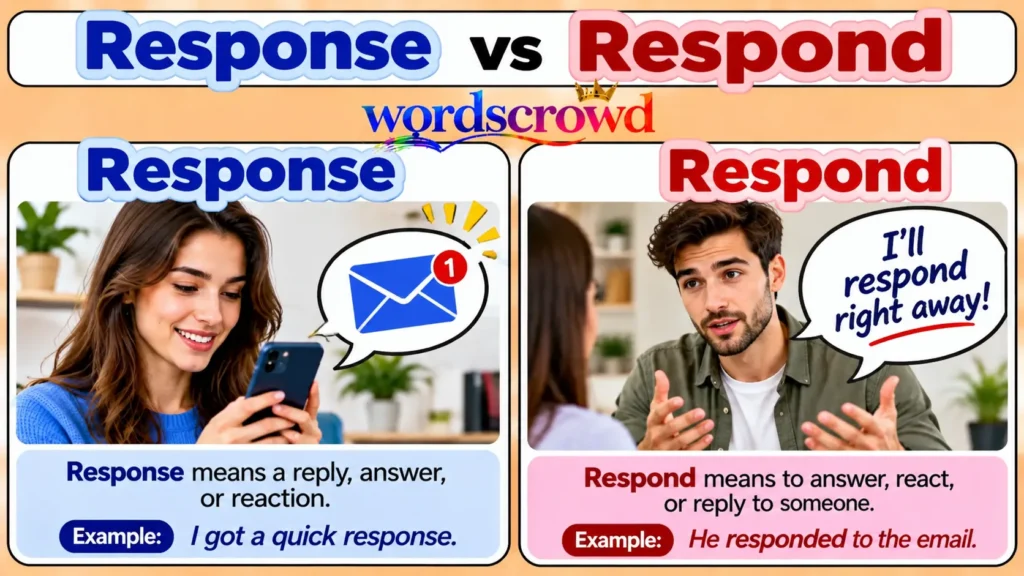
Response is usually a noun meaning an answer, reaction, or reply.
Respond is a verb meaning to answer, reply, or react.
- Noun: “I received your response.”
- Verb: “Thank you for responding.”
- Noun: “Her response was helpful.”
- Verb: “She responded quickly.”
Easy rule: If you need an action, use respond. If you need the answer or reaction itself, use response.
Response or Respond: Comparison Table
| Feature | Response | Respond |
|---|---|---|
| Part of speech | Noun | Verb |
| Basic meaning | An answer, reply, or reaction | To answer, reply, or react |
| Pronunciation | /rɪˈspɒns/ or /rɪˈspɑːns/ | /rɪˈspɒnd/ or /rɪˈspɑːnd/ |
| Main function | Names a thing or result | Describes an action |
| Example | “Your response was clear.” | “Please respond soon.” |
| Common collocations | quick response, written response, emotional response | respond to a question, respond to an email |
| Formality | Neutral to formal | Neutral to formal |
| Everyday use | Very common | Very common |
| Professional use | Very common | Very common |
| Academic use | Common | Common |
| Typical pattern | a response to something | respond to something |
| Can describe an action? | Not normally | Yes |
| Can be plural? | responses | No ordinary plural form |
| Common mistake | Using it as a verb | Using it as a noun |
| Memory trick | Response = reply | Respond = reply/do |
Tip: Think of respond as the action and response as the result. You respond; you give or receive a response.
What Does “Response” Mean?
Response is a noun. It refers to an answer, reply, reaction, or way of reacting to something.
For example:
- “I am waiting for your response.”
- “Her response was polite.”
- “The company issued a response to the complaint.”
- “His response to the question was correct.”
In each sentence, response names something. It is the answer or reaction itself.
Response as a Noun
The most important grammatical fact is simple:
Response = noun
A noun can name a person, place, thing, idea, event, or concept. In this case, response names an answer or reaction.
Compare:
“She responded immediately.”
Here, responded describes what she did.
Now compare:
“Her response was immediate.”
Here, response names the answer or reaction she gave.
The two sentences communicate nearly the same general idea, but their grammatical structures are different.
Common Meanings of “Response”
Response can have several closely related meanings.
1. An Answer or Reply
This is probably the most common meaning.
“I am still waiting for his response.”
The response is the answer he will give.
2. A Reaction
A response can also be a reaction to an event, situation, statement, or stimulus.
“The audience’s response was enthusiastic.”
Here, the response is not necessarily a verbal answer. It is the audience’s reaction.
3. An Official Reply
In business, government, education, and professional communication, response often means an official or formal reply.
“The company released a response to the allegations.”
4. A Biological or Physical Reaction
The word can also appear in scientific and medical contexts.
“The body produced a strong immune response.”
This meaning is more specialized, but it follows the same basic idea: a reaction to something.
The Grammar of “Response”
Because response is a noun, it can appear with determiners and adjectives.
Examples:
- a response
- the response
- my response
- her response
- a quick response
- a thoughtful response
- several responses
- many responses
It can also be plural:
“We received several responses.”
This is a useful clue. If you can naturally put a, the, my, your, or several before the word, you are probably dealing with the noun response.
Common Collocations With “Response”
Native speakers frequently use response in combinations such as:
- quick response
- immediate response
- positive response
- negative response
- strong response
- emotional response
- written response
- official response
- detailed response
- short response
- public response
- customer response
- emergency response
- response time
- response rate
- response team
- response to a question
- response to an email
- response to criticism
These combinations are useful because they show how response behaves naturally in real English.
“Response” in Professional Writing
Response is particularly common in workplace communication.
For example:
“Thank you for your response.”
This is a standard and professional sentence.
You might also write:
“We appreciate your prompt response.”
Or:
“I am writing in response to your email.”
That last structure is especially useful in formal correspondence.
“Response” in Academic English
Academic writing often uses response when discussing answers, reactions, or written work.
Examples:
“Students were asked to provide a written response.”
“The survey recorded a positive response from most participants.”
“The response to the research question was discussed in the final section.”
In these sentences, response functions as a noun.
What Does “Respond” Mean?
Respond is a verb. It means to answer, reply, or react to something.
Examples:
- “Please respond to my email.”
- “She responded politely.”
- “He did not respond to the question.”
- “The manager responded quickly.”
Here, respond describes an action.
Respond as a Verb
The most important rule is:
Respond = verb
A verb tells us what someone or something does, did, or will do.
For example:
“Please respond by Friday.”
The action is responding.
“She responded to the customer.”
Again, responding is the action.
Different Forms of “Respond”
Because respond is a verb, it changes according to tense and grammatical structure.
| Form | Example |
|---|---|
| Base form | respond |
| Third-person singular | responds |
| Past tense | responded |
| Present participle | responding |
| Infinitive | to respond |
Examples:
- “I respond to messages quickly.”
- “She responds within an hour.”
- “He responded yesterday.”
- “They are responding now.”
- “We need to respond carefully.”
“Respond” Usually Uses “To”
One of the most important usage patterns is:
respond to + something/someone
Examples:
- respond to an email
- respond to a question
- respond to a request
- respond to criticism
- respond to a customer
- respond to a message
- respond to an invitation
- respond to an emergency
For example:
“Please respond to my message.”
Not:
“Please respond my message.”
The preposition to is normally required when you identify what or whom someone is responding to.
“Respond” in Professional English
Respond is extremely common in business communication.
For example:
“Please respond to this email at your earliest convenience.”
“We will respond to your request within two business days.”
“I wanted to respond to your concerns.”
It is professional without being unnecessarily formal.
“Respond” in Everyday Conversation
The verb is equally natural in casual English.
“Why didn’t you respond to my text?”
“He never responded.”
“She responded with a smile.”
“How did your friend respond?”
Notice that respond does not always involve spoken words. A person can respond with an action, expression, gesture, or emotion.
Response or Respond: The Key Difference
The difference can be reduced to one grammatical question:
Are you naming the answer/reaction, or describing the act of answering/reacting?
- Response = the answer, reply, or reaction
- Respond = the act of answering, replying, or reacting
Compare these pairs:
“I appreciate your response.”
“I appreciate you responding.”
Both can work, but the first uses the noun and the second uses the verb form.
Another pair:
“She gave a quick response.”
“She responded quickly.”
The meaning is closely related, but the grammar changes.
A Simple Formula
Remember:
Person + responds + to something
“Maria responded to the email.”
But:
Person + gives/sends/receives + a response
“Maria sent a response to the email.”
This distinction solves most response or respond questions.
Response or Respond: Grammar Explained
Understanding the parts of speech makes the difference much easier.
Response Is a Noun
Because response is a noun, it can be:
- a subject
- an object
- the object of a preposition
- modified by an adjective
- made plural
Examples:
Subject:
“Her response was unexpected.”
Object:
“I read his response.”
After a preposition:
“In response to your request, we have updated the document.”
With an adjective:
“We received a detailed response.”
Plural:
“The survey produced hundreds of responses.”
Respond Is a Verb
Because respond is a verb, it can show tense and agreement.
Present:
“I respond quickly.”
Third-person singular:
“She responds quickly.”
Past:
“They responded yesterday.”
Continuous:
“We are responding to the issue.”
Infinitive:
“He needs to respond.”
The “-se” vs “-d” Memory Pattern
The spelling can also help.
Response ends in -se and is a noun.
Respond ends in -d and is a verb.
This is not a universal rule for English words, but for these two words it is a useful memory aid.
Pronunciation: Response vs Respond
The two words sound similar at first, but their endings are different.
Response
Response: /rɪˈspɒns/ in many British pronunciations and /rɪˈspɑːns/ in many American pronunciations.
The final sound is similar to “spons.”
response → ri-SPONSS
Respond
Respond: /rɪˈspɒnd/ in many British pronunciations and /rɪˈspɑːnd/ in many American pronunciations.
The final sound is a d sound.
respond → ri-SPOND
Pronunciation Memory Trick
Think:
response = S sound
respond = D sound
The words are related, but their endings make them easy to distinguish when spoken carefully.
How “Response” and “Respond” Developed
The two words belong to the same word family and are historically connected.
Both ultimately trace back through French to Latin respondere, meaning roughly to answer, reply, or answer back.
English developed related forms from this family, including:
- respond
- response
- responsive
- respondent
- responsibility-related formations in broader historical development
The shared origin explains why the words have such similar meanings.
But English often creates related words with different grammatical roles. That is exactly what happened here.
Respond developed as the verb.
Response functions as the noun.
This is common in English word families:
- decide → decision
- inform → information
- explain → explanation
- describe → description
- respond → response
The forms are connected, but they cannot simply replace one another.
Response or Respond in Different Contexts
In Emails
Use respond when talking about the action:
“Please respond to this email.”
Use response when talking about the reply itself:
“Thank you for your response.”
In Text Messages
“Why didn’t you respond to my text?”
But:
“I finally got a response.”
At Work
“The manager responded to the complaint.”
But:
“The manager’s response was professional.”
In School
“Students must respond to all five questions.”
But:
“Each response should be approximately 100 words.”
In Academic Writing
“The participants responded to the survey.”
But:
“Their responses were analyzed.”
In Customer Service
“We will respond to your request within 48 hours.”
But:
“Thank you for your response.”
In Social Media
“She responded to the comment.”
But:
“His response received thousands of likes.”
In Everyday Conversation
“How did he respond?”
But:
“I didn’t like his response.”
20 Real-Life Examples of Response or Respond
Here are original examples showing how the two forms work naturally.
- Conversation: “How did your sister respond when you told her the news?”
- Email: “Thank you for your response to my previous email.”
- Business: “Our team will respond to your request shortly.”
- School: “Write a short response to the reading passage.”
- Academic: “Participants responded to the questionnaire anonymously.”
- Text message: “He saw my message but didn’t respond.”
- Customer service: “We received your response and will review it.”
- Social media: “She responded to the comment with a laughing emoji.”
- Professional writing: “The company issued a formal response.”
- Daily conversation: “I didn’t know how to respond.”
- Interview: “The candidate gave a thoughtful response.”
- Workplace chat: “Please respond when you have a moment.”
- Complaint: “The manager’s response addressed every concern.”
- Emergency situation: “The team responded quickly to the alarm.”
- Classroom: “Students should respond in complete sentences.”
- Survey: “We received more than 500 responses.”
- Friendship: “She responded kindly to my apology.”
- News: “The politician gave a brief response to the question.”
- Technology: “The website responds slowly during peak hours.”
- Formal letter: “I am writing in response to your recent inquiry.”
Common Mistakes With Response and Respond
The most common errors happen when writers use the noun where a verb is needed or the verb where a noun is needed.
Mistake 1: “Thank you for your respond.”
❌ Wrong: “Thank you for your respond.”
Why?
After your, you need a noun. Respond is a verb.
✅ Correct: “Thank you for your response.”
Mistake 2: “Please response to my email.”
❌ Wrong: “Please response to my email.”
Why?
After please, the sentence needs a base-form verb. Respond is the verb.
✅ Correct: “Please respond to my email.”
Mistake 3: “I will response tomorrow.”
❌ Wrong: “I will response tomorrow.”
Why?
After will, English uses the base form of a verb.
✅ Correct: “I will respond tomorrow.”
Mistake 4: “I received your respond.”
❌ Wrong: “I received your respond.”
Why?
Your requires a noun here.
✅ Correct: “I received your response.”
Mistake 5: “She response quickly.”
❌ Wrong: “She response quickly.”
Why?
The verb is respond, and in the third-person singular present tense it becomes responds.
✅ Correct: “She responds quickly.”
Mistake 6: Forgetting “to”
❌ Less natural/incorrect in standard usage: “He responded my question.”
✅ Correct: “He responded to my question.”
The usual construction is respond to.
Response vs Respond: Better Alternatives
Sometimes you can avoid repeating the same word by changing the sentence structure.
Instead of:
“She gave a response.”
You could write:
“She answered.”
Instead of:
“He responded to the question.”
You could write:
“He answered the question.”
Instead of:
“We received a response.”
You could write:
“We received a reply.”
However, response and reply are not always perfect substitutes. Response can describe a broader reaction, while reply often suggests a direct answer or communication.
For example:
“The audience’s response was enthusiastic.”
Here, reply would not normally work.
Response vs Reply: Are They the Same?
They are closely related, but there is a small difference in emphasis.
A reply usually means an answer to something that someone has said or written.
A response can mean an answer, but it can also mean a broader reaction.
Compare:
“I sent a reply to her email.”
This strongly suggests a direct written answer.
“The crowd’s response was overwhelming.”
This describes a reaction, not necessarily a verbal answer.
That is why response has a slightly wider range of meaning.
Formal vs Informal Usage
Both response and respond are neutral words. Neither is inherently slang or excessively formal.
They work comfortably in:
- casual conversation
- text messages
- emails
- workplace writing
- academic writing
- journalism
- customer service
- official documents
However, particular phrases can sound more formal.
For example:
“I am writing in response to your inquiry.”
This is more formal than:
“I’m responding to your question.”
Likewise:
“Thank you for your prompt response.”
is a polished professional expression.
In casual conversation, you might simply say:
“Thanks for getting back to me.”
US English vs UK English
There is no major American-versus-British difference between response and respond.
Both words are standard in:
- American English
- British English
- Canadian English
- Australian English
- other major varieties of English
The spelling remains the same.
Pronunciation can vary slightly because vowel sounds differ between accents, but the grammatical distinction does not change.
So you do not need to choose response for American English and respond for British English, or vice versa.
Quick rule: The choice depends on grammar and meaning, not geography.
Professional Writing: Which Word Should You Use?
Both are useful, but the choice depends entirely on sentence structure.
Use “respond” when you need an action
- “Please respond by Friday.”
- “We will respond shortly.”
- “The manager responded to the complaint.”
- “I need to respond to this message.”
Use “response” when you need the answer or reaction
- “Thank you for your response.”
- “We received your response.”
- “Her response was detailed.”
- “The response was positive.”
Useful Business Expressions
These phrases are natural and professional:
- prompt response
- timely response
- written response
- official response
- respond to your request
- respond to your inquiry
- respond to your concerns
- respond as soon as possible
- in response to
- thank you for your response
Academic Writing: Response or Respond?
Academic writing uses both words frequently.
Use respond when describing what participants, students, researchers, or subjects do:
“Participants responded to six questions.”
Use response when discussing the answers or reactions:
“The participants’ responses were recorded.”
This distinction is especially important in research writing.
Example
“Participants were asked to respond to three statements. Their responses were then compared.”
Notice how naturally the two words work together:
respond = action
responses = answers produced by that action
Memory Tricks for Response or Respond
Memory Trick 1: Action vs Answer
Think:
Respond = do
Response = thing
You respond.
You give a response.
Memory Trick 2: The “-se” Noun
Remember:
Response = noun
If you’re talking about the actual answer, choose response.
Memory Trick 3: The “To” Test
If you can say:
“I need to ___ to the email.”
The blank needs respond.
“I need to respond to the email.”
If you can say:
“I received your ___.”
The blank needs response.
“I received your response.”
Memory Trick 4: Ask One Question
Ask yourself:
“Am I doing it or naming it?”
- Doing it → respond
- Naming it → response
Word Family: Respond, Response, Responsive, Respondent
Understanding the related words can make the distinction even easier.
Respond
Verb:
“Please respond.”
Response
Noun:
“I received a response.”
Responsive
Adjective:
“The customer service team was responsive.”
Here, responsive means quick or willing to respond.
Respondent
Noun:
A respondent is a person who responds, especially in a survey, legal matter, or formal process.
“Each respondent completed the survey.”
These words share the same basic word family but have different grammatical roles.
Common Collocations You Should Know
Natural English often depends on common word combinations.
Response Collocations
- quick response
- immediate response
- positive response
- negative response
- strong response
- emotional response
- official response
- written response
- detailed response
- prompt response
- customer response
- emergency response
- response time
- response rate
- response team
Respond Collocations
- respond to an email
- respond to a question
- respond to a request
- respond to criticism
- respond to a complaint
- respond to a message
- respond to an invitation
- respond quickly
- respond politely
- respond appropriately
- respond directly
- respond immediately
- respond effectively
Learning these patterns can help you choose the correct word without thinking about complicated grammar rules.
Can “Response” Be Used as a Verb?
In standard modern English, response is normally a noun.
Do not use it as the ordinary verb form of respond.
❌ “Please response to my email.”
✅ “Please respond to my email.”
Likewise:
❌ “I will response soon.”
✅ “I will respond soon.”
The correct verb is respond.
Can “Respond” Be Used as a Noun?
In standard English, respond is normally a verb.
Do not use it as the ordinary noun for an answer or reply.
❌ “I received your respond.”
✅ “I received your response.”
The noun is response.
When Should You Use “Response”?
Use response when the sentence refers to:
- An answer
- A reply
- A reaction
- An official statement
- A written answer
- A physical or emotional reaction
- A research participant’s answer
- A measurable reaction or result
Examples:
“Her response was honest.”
“We received 300 responses.”
“The emergency response was immediate.”
“His emotional response surprised everyone.”
When Should You Use “Respond”?
Use respond when the sentence describes:
- Answering someone
- Replying to an email
- Reacting to an event
- Answering a question
- Dealing with a request
- Taking action after something happens
Examples:
“Please respond today.”
“She responded to the invitation.”
“The team responded quickly.”
“He responded to the criticism calmly.”
FAQ: Response or Respond
Is “response” a noun or a verb?
Response is a noun. It refers to an answer, reply, reaction, or result of reacting. For example, “Thank you for your response.”
Is “respond” a noun or a verb?
Respond is a verb. It means to answer, reply, or react. For example, “Please respond to my message.”
Which is correct: “Please response” or “Please respond”?
“Please respond” is correct. After “please,” you normally need the base form of the verb. Respond is the verb; response is the noun.
Which is correct: “your response” or “your respond”?
“Your response” is correct. The possessive determiner your is followed by a noun in this construction, and response is the noun.
Is “respond to” grammatically correct?
Yes. Respond to is the standard construction when you identify the person, message, question, request, or situation being answered or reacted to.
For example:
“She responded to my email.”
Can “response” mean “reaction”?
Yes. Response can mean a reaction as well as an answer or reply. For example, “The audience’s response was enthusiastic.”
Is “response” more formal than “respond”?
Not exactly. They are different parts of speech, so comparing their formality directly is misleading. Both are normal in casual, professional, and academic English.
What is the difference between “response” and “reply”?
Both can mean an answer, but response has a broader meaning. It can describe a general reaction, while reply more often refers to a direct answer, especially in communication.
Final Verdict: Response or Respond?
The choice between response or respond is not really a matter of which word is “more correct.” Both are correct, but they perform different grammatical jobs.
Use respond when you need a verb describing the action of answering or reacting:
“Please respond to my email.”
Use response when you need a noun describing the answer, reply, or reaction itself:
“Thank you for your response.”
The easiest rule to remember is:
You respond. You give, receive, send, or receive a response.
So:
- ✅ “I will respond tomorrow.”
- ✅ “I received your response.”
- ✅ “Please respond to my question.”
- ✅ “Her response was helpful.”
- ❌ “Please response to my email.”
- ❌ “Thank you for your respond.”
Once you recognize respond as the verb and response as the noun, the difference becomes straightforward. Whether you’re writing an email, answering a teacher, replying to a customer, completing academic work, or chatting with a friend, this simple distinction will help your English sound accurate and natural.