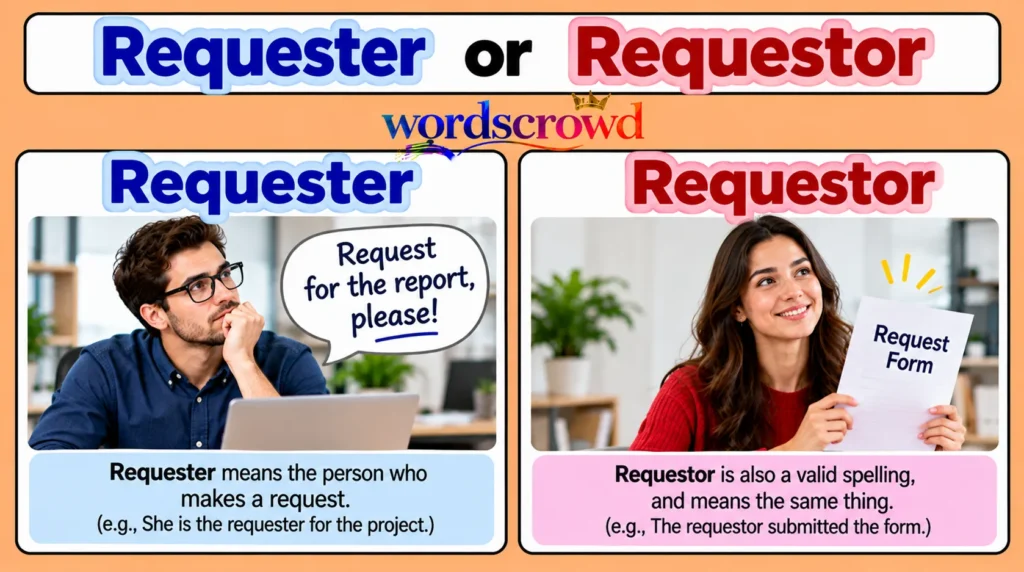
Requester or requestor—which spelling should you use?
If you have ever written a business email, legal document, software specification, public-records request, or formal report, you may have paused over this small but surprisingly confusing choice.
Both requester and requestor appear in real English, both are understandable, and both refer to someone—or something—that makes a request.
So is one wrong?
No. Both are legitimate words.
However, they are not equally common or equally natural in every context.
Requester is the standard, widely used choice for general English, while requestor is an established variant that can appear more often in technical, legal, administrative, or specialized contexts.
Major dictionaries support this distinction. Merriam-Webster lists requester and gives requestor as an alternative form, while Cambridge Dictionary defines requester and explicitly notes requestor as another form.
That means the real question is not simply, “Which one is grammatically correct?” The better question is:
Which spelling sounds most natural and appropriate for the context?
In this guide, you will learn the difference between requester and requestor, how each word is pronounced, where each form appears, whether there is an American or British preference, how the words work grammatically, and which one professional writers should normally choose.
Quick Answer
Requester is generally the best choice in ordinary English, business writing, academic writing, and most professional communication.
Requestor is also a valid spelling, but it is less common and often appears in specialized legal, technical, administrative, or organizational terminology.
Best general rule: If you are not required to follow a specific industry or organization’s terminology, choose requester.
Requester vs. Requestor: Comparison Table
| Feature | Requester | Requestor |
|---|---|---|
| Basic meaning | Someone who makes a request | Someone who makes a request |
| Part of speech | Noun | Noun |
| Pronunciation | /rɪˈkwestər/ | /rɪˈkwestər/ |
| Meaning difference | Usually none | Usually none |
| Standard English | Yes | Yes |
| Frequency | More common | Less common |
| General writing | Preferred | Acceptable |
| Business writing | Preferred | Acceptable if organizational terminology uses it |
| Academic writing | Preferred | Acceptable when required by a source or field |
| Legal writing | Common | Can be common in specialized terminology |
| Technical writing | Common | Often encountered |
| Software terminology | Common | May appear as a system-specific term |
| Public-records writing | Common | Also possible |
| Formality | Neutral/formal | Often feels more technical or institutional |
| US English | Used | Used |
| UK English | Used | Used, but less common |
| Plural | requesters | requestors |
| Possessive | requester’s | requestor’s |
| Best default | Yes | No |
| Is it a misspelling? | No | No |
| Should you automatically replace it? | No | No |
| Easy recommendation | Use for most situations | Use when context or house style calls for it |
The simplest distinction
Think of it this way:
- Requester = the normal default
- Requestor = a valid alternative
- Neither is inherently grammatically wrong
- Context and established terminology can determine the better choice
Merriam-Webster defines requester as someone who makes a request and records requestor as an alternative form. Cambridge likewise lists requestor as another form of requester.
What Does “Requester” Mean?
A requester is a person or entity that makes a request.
It is formed from the verb request with the noun-forming suffix -er.
For example:
The requester submitted the application on Monday.
Here, requester means the person who submitted the request.
Another example:
The agency contacted the requester for additional information.
The requester is the person who originally asked for something.
Requester definition
A simple definition is:
Requester: a person, organization, or other entity that asks for something.
The “something” could be almost anything:
- information
- permission
- assistance
- documents
- access
- payment
- approval
- a service
- a change
- an explanation
- a refund
The word is therefore quite broad.
Grammar of “requester”
Requester is a countable noun.
You can write:
- one requester
- two requesters
- several requesters
- the requester
- a requester
- each requester
Its plural form is:
requesters
Its possessive forms are:
the requester’s information
and
the requesters’ information
The first means information belonging to one requester. The second means information belonging to multiple requesters.
Pronunciation of “requester”
Requester is commonly pronounced approximately:
ri-KWES-ter
The stress falls on the second syllable.
The pronunciation is essentially the same as requestor for most speakers. Cambridge gives the UK pronunciation as /rɪˈkwes.tər/ and the US pronunciation as /rɪˈkwes.tɚ/.
Origin of “requester”
The word is transparently built from:
request + -er
The suffix -er is a highly productive English way of forming nouns for people or things associated with an action.
Consider:
- teach → teacher
- write → writer
- read → reader
- drive → driver
- speak → speaker
- manage → manager
- request → requester
Merriam-Webster records the first known use of requester in the relevant sense as 1564, showing that the word is not a recent invention.
Where “requester” sounds natural
You can comfortably use requester in:
- everyday conversation
- emails
- business documents
- customer-service communication
- academic writing
- public-records discussions
- government communication
- technical explanations
- journalism
- reports
- instructions
For example:
The requester should provide a valid email address.
This sounds completely natural in modern professional English.
Professional use of “requester”
In professional writing, requester is especially useful when you need a neutral label for the person making a request.
For example:
The requester will receive a confirmation email within two business days.
That sentence could appear in:
- an online application system
- a government website
- a customer-service policy
- a company’s privacy policy
- an internal procedure
- a help center
It is clear without sounding unnecessarily complicated.
What Does “Requestor” Mean?
Requestor means essentially the same thing as requester: a person or entity that makes a request.
It is formed with the suffix -or rather than -er.
For example:
The requestor must provide proof of identity.
The meaning is straightforward: the person making the request must identify themselves.
Is “requestor” a real word?
Yes.
This is one of the most important points in the entire comparison.
Requestor is not simply a spelling mistake.
It is an established English noun. Merriam-Webster gives requestor as an alternative form of requester, and Cambridge Dictionary also identifies it as another form.
So if your spellchecker prefers requester, that does not automatically make requestor incorrect.
Grammar of “requestor”
Like requester, requestor is a countable noun.
You can use:
- one requestor
- several requestors
- the requestor
- a requestor
- each requestor
The plural is:
requestors
The singular possessive is:
requestor’s
The plural possessive is:
requestors’
Pronunciation of “requestor”
Requestor is normally pronounced approximately:
ri-KWES-ter
In ordinary speech, there is generally no useful pronunciation distinction between requester and requestor.
That is why the confusion is almost entirely a spelling and usage issue rather than a pronunciation issue.
Where “requestor” appears
You may encounter requestor in specialized environments such as:
- software
- information technology
- legal documents
- government systems
- procurement
- administrative procedures
- organizational policies
- technical documentation
- data-access systems
For example:
The requestor must authenticate before accessing the database.
That sentence is perfectly understandable and may fit the terminology of a particular system.
Why does “requestor” sometimes feel more technical?
English often develops competing agent nouns with -er and -or.
Some forms become strongly established:
- act → actor
- create → creator
- inspect → inspector
- operate → operator
- supervise → supervisor
Other verbs commonly take -er:
- teach → teacher
- drive → driver
- work → worker
- write → writer
- request → requester
Because -or is strongly associated with many formal and institutional terms, requestor can sometimes feel more technical or bureaucratic.
But this does not create a strict grammatical rule saying that requestor must be used for formal requests.
That distinction matters.
Requester or Requestor: What Is the Real Difference?
The most important point is that the two words usually do not have different dictionary meanings.
In most contexts:
requester = requestor
Both identify the person or entity making a request.
The difference is primarily one of spelling, frequency, convention, and context.
1. Requester is the safer default
If you are writing a sentence from scratch and have no special terminology to follow, requester is normally the better choice.
For example:
The requester submitted the form.
This is clear, natural, and broadly acceptable.
2. Requestor is a legitimate variant
If a company’s software documentation consistently says requestor, changing every occurrence to requester may actually make the documentation less consistent.
For example, suppose an application uses labels such as:
- Requestor ID
- Requestor Name
- Requestor Department
- Requestor Status
In that environment, requestor may be the established terminology.
3. Industry terminology matters
Professional writing is not just about dictionary correctness.
Consistency matters.
If a legal form, database, contract, or software platform officially uses requestor, follow that terminology unless you have a strong reason not to.
4. General readers usually prefer “requester”
When writing for a broad audience, requester is usually easier and more natural.
That makes it a particularly good choice for:
- websites
- blogs
- general business communication
- educational material
- customer instructions
- public-facing documentation
Is “Requester” More Correct Than “Requestor”?
Generally, requester is the better default, but requestor is not incorrect.
This is the answer many people are actually looking for.
If someone asks:
“Which should I use: requester or requestor?”
The practical recommendation is:
Use requester unless your field, organization, document, or established terminology specifically uses requestor.
Merriam-Webster treats requestor as an alternative form, while Cambridge also presents it as another form of requester.
So calling requestor “wrong” would be too strong.
A useful editorial rule
When editing ordinary prose:
Prefer requester.
When editing a specialized document:
Check the document’s existing terminology first.
When editing a legal, technical, or software document:
Preserve the established term if it is used consistently and intentionally.
Is “Requester” or “Requestor” More Common?
Requester is generally more common in broad English usage.
This is one reason it makes the best default choice.
Major dictionary entries and contemporary usage examples prominently use requester. Merriam-Webster’s current entry includes numerous recent examples involving public records, insurance, government procedures, file sharing, and other contexts.
Cambridge’s English Dictionary likewise provides examples of requester in general and professional contexts.
That does not mean requestor is disappearing. It continues to occur in specialized language.
The important distinction is:
Common does not mean correct, and uncommon does not mean incorrect.
Requester vs. Requestor in American English
Both forms occur in American English.
There is no simple rule such as:
American English = requestor
British English = requester
That would be misleading.
Both spellings can be found in American writing.
In general-purpose American English, however, requester is a strong default.
Requestor can appear in specialized American legal, technical, governmental, and organizational contexts.
So if you are writing an ordinary American business email, this is the natural choice:
The requester will receive an update shortly.
Not:
The requestor will receive an update shortly.
The second sentence is not grammatically wrong. It simply feels more specialized.
Requester vs. Requestor in British English
The same basic principle applies to British English.
Requester is perfectly normal English in the UK.
Requestor can also occur, particularly in specialized or institutional writing.
Therefore, this is not primarily a US-versus-UK spelling difference.
That is an important distinction because many English spelling pairs genuinely do vary by region, such as:
- color / colour
- center / centre
- organize / organise
Requester and requestor do not follow that simple pattern.
Requester or Requestor in Formal Writing
If you are writing something formal, you may wonder whether the -or spelling sounds more professional.
Usually, no special formality rule requires requestor.
For most formal documents, requester works perfectly well.
For example:
The requester must submit the completed application before the deadline.
This is formal, clear, and professional.
You do not need to change it to:
The requestor must submit the completed application before the deadline.
The second version is possible, but it does not automatically become more formal simply because it ends in -or.
Tip: Do not choose requestor merely because it “looks more official.” Choose it when the terminology or context genuinely supports it.
Requester or Requestor in Business Writing
For ordinary business writing, requester is usually the strongest choice.
Consider these examples:
We have received the requester’s information.
The requester will be contacted by our support team.
Please ask the requester to provide the missing document.
These sentences are natural and easy to understand.
A business audience generally benefits more from clarity and consistency than from unusually technical vocabulary.
Requester or Requestor in Academic Writing
In academic writing, requester is normally a safe choice when you mean a person who makes a request.
For example:
The requester was asked to provide additional evidence.
However, if you are describing terminology used by a specific system, study, legal framework, or technical field, requestor may be appropriate.
The key academic-writing principle is:
Follow the terminology of your subject matter rather than changing a technical label simply to match your personal preference.
Requester or Requestor in Legal Writing
Legal writing is where you are more likely to encounter requestor.
But that does not mean legal English has a universal rule requiring requestor.
Legal documents often develop their own defined terms. A particular statute, contract, agency, court, or administrative procedure may consistently use one form.
If the official terminology says:
Requestor
then preserve it.
If the document says:
Requester
then preserve that instead.
In legal editing, terminological consistency can matter more than choosing the spelling you personally prefer.
Requester or Requestor in Technology
Technology is another area where requestor can appear.
A software system may distinguish between:
- requester
- requestor
- request
- requested resource
- request handler
- request origin
- request ID
In such cases, the spelling may be part of an application’s established vocabulary.
For example:
The requestor’s authentication token was rejected.
If requestor is the official label used throughout the system, changing it to requester could create inconsistency.
At the same time, technical writing does not require requestor by default.
A programmer can perfectly well write:
The requester must authenticate before accessing the service.
The right choice depends on the terminology of the particular system.
20 Real-Life Examples of Requester and Requestor
The following examples show how the two spellings work in different contexts.
Everyday conversation
- The requester asked for a copy of the receipt.
- We should contact the requester before approving the change.
- The requester did not provide a phone number.
Email writing
- We have forwarded your message to the requester for review.
- Please let the requester know that the documents are ready.
- The requester has been notified of the delay.
Business writing
- The requester must complete all required fields.
- Our team will verify the requester’s identity before processing the application.
- The requester can track the status of the request online.
Academic writing
- Each requester was given an opportunity to explain the purpose of the application.
- The study recorded the time required to respond to each requester.
Government or administrative writing
- The requester must provide sufficient information to identify the record.
- Officials contacted the requester for clarification.
Legal context
- The requestor must comply with the terms of the agreement.
- The requestor’s identity was verified before the information was released.
Technical context
- The requestor must authenticate before accessing the server.
- The system logs the requestor’s identification number.
- A response is returned to the original requestor.
Customer service
- The requester will receive an email once the refund has been approved.
- Please ask the requester to confirm the delivery address.
Notice something important: both forms can describe the same role. The difference is largely one of convention and context.
Common Mistakes With Requester and Requestor
Mistake 1: Thinking “requestor” is always wrong
Incorrect assumption:
Requestor is a misspelling.
Why this is a problem:
Requestor is an established variant.
Better understanding:
Both requester and requestor are valid nouns.
Merriam-Webster and Cambridge both recognize the relationship between the forms.
Mistake 2: Thinking “requestor” is always more formal
Weak assumption:
Formal writing requires requestor.
Better rule:
Formal writing can use requester perfectly well.
For example:
The requester must sign the form.
That sentence is already formal.
Mistake 3: Changing official terminology
Suppose a company’s software documentation consistently uses:
Requestor ID
An editor should not automatically change every instance to:
Requester ID
If Requestor ID is the official name of a field, consistency is more important.
Better practice: Follow the organization’s established terminology.
Mistake 4: Assuming this is a US/UK spelling difference
Wrong idea:
Requester is British; requestor is American.
There is no such simple division.
Both forms occur in both varieties of English.
Mistake 5: Believing pronunciation changes
The spelling changes, but the pronunciation is generally essentially the same:
requester → ri-KWES-ter
requestor → ri-KWES-ter
So do not try to create an exaggerated pronunciation difference.
Mistake 6: Using “requestor” to sound sophisticated
Sometimes writers choose unusual spellings because they seem more professional.
That can backfire.
If your audience expects ordinary English, requester is usually clearer and more familiar.
How to Choose Between Requester and Requestor
When you are unsure, use this five-step test.
1. Are you writing ordinary English?
Use:
requester
2. Are you writing a general business email?
Use:
requester
3. Does your organization officially use “requestor”?
Use:
requestor
4. Are you working with a technical, legal, or administrative terminology system?
Check the relevant terminology first.
5. Are both forms acceptable and there is no house style?
Choose:
requester
This is the safest general-purpose option.
A Practical Style Guide for Editors
If you are editing a website, report, manual, or corporate document, consistency should guide your decision.
Use “requester” when:
- writing for a general audience
- explaining the word to learners
- writing ordinary business communication
- creating website content
- writing general academic prose
- writing customer instructions
- no established terminology exists
Use “requestor” when:
- it is an official system term
- a client requires it
- a legal document consistently uses it
- an organization has adopted it
- a technical standard specifies it
- changing it would create inconsistency
Avoid switching randomly
The real style problem is not choosing one valid spelling.
The real problem is mixing both forms without a reason.
For example:
The requester submitted the form. The requestor then received a confirmation.
If both refer to the same role, this creates unnecessary inconsistency.
Choose one form and stay with it unless there is a genuine distinction.
Requester and Requestor Word Family
Understanding the related words can make the choice easier.
Request
Request can be both a noun and a verb.
As a noun:
We received your request.
As a verb:
I request additional information.
Requested
Requested is commonly used as the past tense or past participle of request.
She requested a copy of the report.
Requesting
Requesting is the present participle or gerund.
The customer is requesting assistance.
Requester
The person or entity making the request:
The requester submitted the form.
Requestor
The alternative agent noun:
The requestor submitted the form.
Requestee
A much less common term can refer to the person or entity to whom a request is made.
This creates an important conceptual distinction:
Requester = makes the request
Requestee = receives the request
Do not confuse the two roles.
Why Does English Have Both “-er” and “-or”?
This is a broader word-formation issue.
English has inherited and developed several noun-forming patterns. The suffixes -er and -or can both create agent nouns—words identifying someone or something associated with an action.
Examples include:
- teach → teacher
- drive → driver
- run → runner
- write → writer
- create → creator
- operate → operator
- inspect → inspector
- supervise → supervisor
But English word formation is not a perfectly predictable mathematical formula.
You cannot safely say:
“Every verb ending in X must take -er.”
or:
“Every formal verb must take -or.”
Historical development, pronunciation, Latin and French influence, and established usage all play roles.
That is why requester and requestor can coexist.
Is “Requestor” Older or More Formal?
It is tempting to build a simple story in which requester is ordinary English and requestor is a newer technical invention.
Real language history is more complicated.
The existence of both forms reflects English’s flexibility in forming agent nouns. The modern distinction is primarily about usage and convention, not a strict hierarchy in which one form is “proper English” and the other is not.
Therefore, avoid claims such as:
“Requestor is grammatically incorrect because English always uses -er.”
That rule is simply too absolute.
Which One Should You Use in an Email?
For almost any normal email, choose requester.
For example:
The requester has provided the required documents.
or:
Please contact the requester if you need additional information.
These are natural, professional, and clear.
Use requestor only if it is already part of your organization’s terminology.
Which One Should You Use on a Website?
For public-facing website content, requester is generally the better default.
A website should normally favor familiar vocabulary unless specialized terminology serves a clear purpose.
For example:
The requester will receive an email confirmation.
is straightforward.
If your website documents a specific API or database field named requestorId, however, preserve the exact technical label.
That is a case where terminology has a function beyond ordinary English spelling.
Which One Should You Use in Academic Papers?
In general academic prose, requester is a safe choice.
However, academic disciplines sometimes use specialized terminology. If your research instrument, software system, statute, dataset, or source uses requestor, retain that terminology when referring specifically to it.
The goal is not to “correct” every unusual word.
The goal is to communicate accurately.
Memory Tricks: Requester vs. Requestor
Here are a few easy ways to remember the difference.
Memory trick 1: Choose the familiar “-er”
Think:
request → requester
Just as:
teach → teacher
write → writer
drive → driver
When you need a general-purpose noun, requester is your first choice.
Memory trick 2: Requestor is the alternative
Remember:
Requester = regular default
Requestor = recognized alternative
Memory trick 3: Think “general vs. specialized”
Use this quick mental picture:
Everyday/general → requester
Specialized/organizational → requestor may appear
This is not an absolute grammatical rule, but it is a useful writing shortcut.
Memory trick 4: Don’t call requestor a typo
A good editor’s rule is:
“Less common” does not mean “wrong.”
That one sentence prevents a lot of unnecessary corrections.
Quick Decision Guide
If you need an answer in five seconds, use this:
- Writing normal English? → Requester
- Writing a general business email? → Requester
- Writing for a broad audience? → Requester
- Following a company’s official terminology? → Use its preferred form.
- Working with a technical system called “requestor”? → Keep requestor.
- Editing legal or administrative material? → Check the governing terminology.
- No style guide and both seem possible? → Requester
FAQ: Requester or Requestor
Is “requester” or “requestor” correct?
Both are correct. Requester is the more common general-purpose form, while requestor is an accepted variant that appears especially in some specialized contexts. Merriam-Webster and Cambridge both recognize the forms.
Is “requestor” a real English word?
Yes. Requestor is a legitimate English noun, not merely a typing mistake. It means essentially the same thing as requester: someone who makes a request.
Which is more common, requester or requestor?
Requester is generally more common, especially in ordinary and general professional English. Requestor remains established and is used in specialized terminology.
Should I use “requester” in formal writing?
Yes. Requester is completely appropriate in formal writing. You do not need to use requestor simply because a document is formal.
Is “requestor” more formal than “requester”?
Not as a general grammatical rule. Requestor may feel more technical or institutional in some contexts, but it is not automatically more formal.
Is requester American or British English?
Requester is used in both American and British English. It is not an exclusively American or British spelling.
Is requestor an American spelling?
Requestor is used in American English, but it is not exclusively American. The form also occurs in other varieties of English, particularly in specialized contexts.
Should I change “requestor” to “requester” when editing?
Not automatically. If requestor is an established technical, legal, organizational, or system-specific term, keep it. If you are writing general prose without a house style, requester is usually the better choice.
What is the plural of requester?
The plural of requester is requesters.
One requester submitted the form.
Several requesters submitted the form.
The plural of requestor is requestors.
One requestor submitted the form.
Several requestors submitted the form.
Final Verdict: Requester or Requestor?
So, requester or requestor—which should you use?
The answer is pleasantly simple:
Both are correct, but requester is the better default for most English writing.
Choose requester when you are writing:
- general English
- business emails
- websites
- educational material
- academic prose
- customer-service content
- public-facing documents
- ordinary professional communication
Choose requestor when:
- a specific organization prefers it
- a software system uses it as an official term
- a legal or administrative document consistently uses it
- an industry convention calls for it
- changing the terminology would reduce consistency
The two words generally have the same basic meaning, and neither should automatically be labeled incorrect. Cambridge identifies requestor as another form of requester, while Merriam-Webster likewise presents it as an alternative form.
The best rule to remember
When in doubt, use “requester.”
It is familiar, clear, professional, and widely accepted.
But if you encounter requestor in a technical, legal, governmental, or organizational context, don’t “correct” it simply because it looks unusual. First check whether it is an intentional term.
In other words:
Requester is the safest general choice. Requestor is a valid alternative that may be preferred by a particular field or organization.
That is the real difference between requester and requestor—not right versus wrong, but default usage versus established contextual preference.