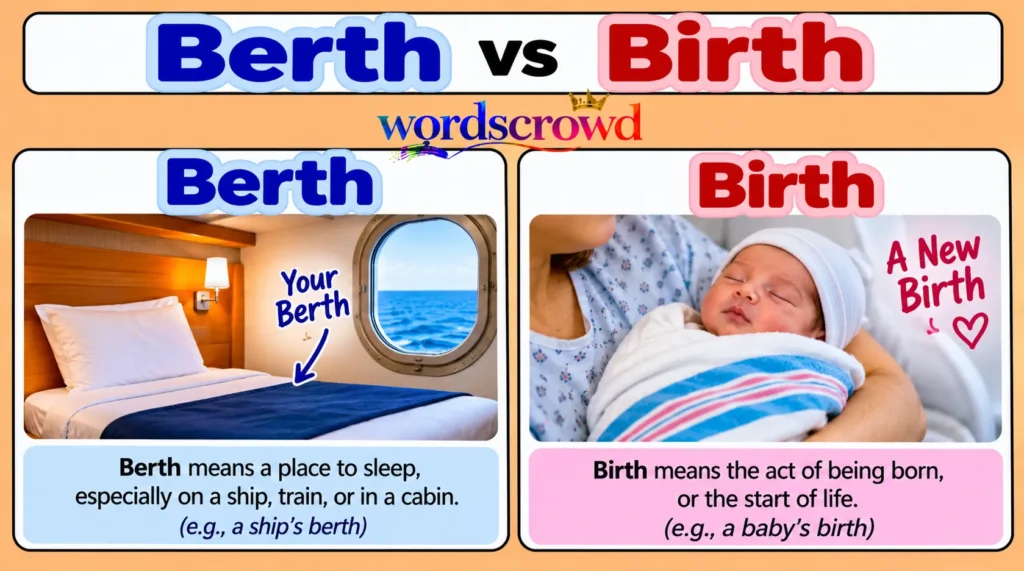
Have you ever heard someone say berth and birth and wondered which word they actually meant? You’re not alone. These two English words create confusion because they sound almost exactly the same, yet their meanings are completely different.
The difference between berth vs birth is not about American English versus British English, and it is not a choice between formal and informal writing. Both are correct English words. The real difference is their meaning and context.
Berth usually refers to a sleeping space on a ship or train, a place where a boat is docked, or a position in a competition. Birth refers to the process of being born, the beginning of life, or the origin of something.
For example, you might book a berth on an overnight train, but you celebrate the birth of a baby. Confusing these words can make an otherwise clear sentence sound incorrect.
In this guide, you’ll discover their meanings, pronunciation, grammar, spelling, origins, and differences. You’ll also learn how to use both words in everyday conversations, professional writing, academic work, and real-life situations.
Quick Answer
Berth means a sleeping place, a ship’s docking space, or an allocated position in a competition.
Birth means the process of being born or the beginning of someone’s life or something new.
Both words are correct and are generally pronounced the same way: /bɜːθ/ in British English and /bɝːθ/ in American English.
Remember: You book a berth on a train, but you celebrate a baby’s birth.
Berth vs Birth: Comparison Table
| Feature | Berth | Birth |
|---|---|---|
| Main meaning | Sleeping space or allocated position | The act of being born |
| Part of speech | Noun and verb | Noun and verb |
| Pronunciation (UK) | /bɜːθ/ | /bɜːθ/ |
| Pronunciation (US) | /bɝːθ/ | /bɝːθ/ |
| Main context | Ships, trains, accommodation, sports | Babies, life, beginnings, origins |
| Noun form | A berth | A birth |
| Verb form | To berth | To birth |
| Past tense | Berthed | Birthed |
| Present participle | Berthing | Birthing |
| Plural | Berths | Births |
| Formality | Neutral; sometimes technical | Neutral; everyday and formal |
| Common phrase | Wide berth | Give birth |
| Another expression | Sleeping berth | Birth certificate |
| Professional use | Transport and sports | Medicine, records, history |
| American English | Correct | Correct |
| British English | Correct | Correct |
| Common mistake | Writing birth for a sleeping place | Writing berth for childbirth |
The main distinction: Berth is associated with space or a position. Birth is associated with life, arrival, or beginnings.
What Does Berth Mean?
Berth is a noun and a verb. It is commonly used when discussing ships, boats, trains, sleeping arrangements, and positions in competitions.
As a noun, it describes a place where someone can sleep, a location where a ship can dock, or a position that someone has earned.
As a verb, it describes placing a ship in a particular docking space or bringing it into that space.
1. Berth as a Noun
The word berth has several meanings.
A. A sleeping place
A berth can refer to a bed or sleeping space on a ship, train, or another form of transport.
Examples:
- We booked a comfortable berth on the overnight train.
- My brother slept in the upper berth.
- The passenger requested a lower berth.
- Each cabin has two sleeping berths.
In this context, berth is similar to bunk or sleeping space.
B. A place for a ship
A berth can also describe a designated place in a harbor or port where a ship or boat stays.
Examples:
- The captain guided the vessel toward its berth.
- The harbor assigned the boat a new berth.
- Our ship arrived at its designated berth early.
- The marina has several available berths.
This meaning is particularly common in maritime and shipping language.
C. A position in a competition
In sports, a berth can mean a place or opportunity to participate in a competition.
Examples:
- The team earned a berth in the championship.
- Our school secured a berth in the national tournament.
- The players are fighting for a playoff berth.
- She won a berth on the Olympic team.
Here, berth means an earned place or qualification, not a physical bed.
D. A job or position
Berth can also refer to a position or appointment, although this meaning is less common in everyday modern English.
Example:
- He finally secured a good berth with a shipping company.
2. Berth as a Verb
Berth can also function as a verb.
It means to bring a ship into a designated docking space or to place it there.
Examples:
- The captain will berth the vessel near the harbor entrance.
- The ship berthed safely before sunset.
- The ferry is berthing at the eastern terminal.
- The harbor staff berthed the boat beside the pier.
The common verb forms are:
| Verb form | Example |
|---|---|
| Base form | Berth |
| Third-person singular | Berths |
| Past tense | Berthed |
| Past participle | Berthed |
| Present participle | Berthing |
Notice that the past tense is berthed, not birthed.
Origin and History of Berth
The word berth dates back to the early seventeenth century.
Its earliest nautical meaning involved sufficient space for a ship to maneuver or remain safely at sea. Over time, the meaning expanded to include a designated docking location and a sleeping place aboard a ship.
The exact origin is uncertain, but etymological sources commonly connect it with the verb bear and the suffix -th.
This historical development explains why the word is still strongly associated with ships, accommodation, and allocated space.
How to Use Berth in Everyday English
You are most likely to encounter berth in these situations:
- Travel: Booking a sleeping place on a train or ship.
- Shipping: Discussing a vessel’s docking location.
- Sports: Talking about qualifying for a championship.
- Safety: Describing a safe distance from something.
- Employment: Referring to an assigned position.
One particularly common expression is give someone or something a wide berth.
It means to keep a safe distance or deliberately avoid someone or something.
Examples:
- I give that aggressive dog a wide berth.
- Drivers should give cyclists a wide berth.
- She gave the unpleasant situation a wide berth.
This expression is useful in both everyday conversation and professional writing.
Professional and Academic Examples of Berth
Business:
The shipping company secured an additional berth to accommodate its growing fleet.
Transportation:
Passengers should confirm their berth numbers before boarding the overnight train.
Sports journalism:
The national team earned a berth in the final after an impressive performance.
Academic writing:
The study examines how port authorities allocate berths to commercial vessels.
What Does Birth Mean?
Birth is primarily a noun referring to the process of being born, the arrival of a baby, or the beginning of something.
It can also describe someone’s family background, origin, or the creation of an idea, movement, organization, or event.
Unlike berth, which is mainly associated with physical space and positions, birth is connected with life and beginnings.
1. Birth as a Noun
Birth has several important meanings.
A. The arrival of a baby
This is the most common meaning of birth.
It describes the process or event in which a baby comes into the world.
Examples:
- The birth of their daughter brought happiness to the family.
- The hospital recorded the baby’s birth.
- Her birth was celebrated by relatives and friends.
- The doctor helped during a difficult birth.
B. The beginning of something
Birth can also describe the creation or beginning of something that is not a living person.
Examples:
- The invention marked the birth of modern technology.
- The agreement led to the birth of a new organization.
- The birth of the internet changed communication forever.
- Her first novel marked the birth of a successful writing career.
In these examples, birth is used figuratively to describe the beginning of something.
C. Family background or origin
Birth can describe someone’s family background, ancestry, or the circumstances into which they were born.
Examples:
- She is British by birth.
- He comes from a family of artists by birth.
- The historical record includes his place of birth.
- Her country of birth is listed on the application.
2. Birth as a Verb
Although birth is mainly used as a noun, it can also function as a verb.
As a verb, it means to give birth to something or bring something into existence.
Examples:
- The movement birthed a new generation of artists.
- The project birthed several creative ideas.
- The crisis birthed a different approach to leadership.
- The organization birthed an educational initiative.
However, in everyday English, people generally prefer expressions such as:
- Give birth to a baby.
- Bring a new idea into existence.
- Create a new organization.
- Launch a new project.
The verb birth is correct, but it can sound more formal, literary, or figurative depending on the sentence.
Birth: Important Grammar Forms
| Verb form | Example |
|---|---|
| Base form | Birth |
| Third-person singular | Births |
| Past tense | Birthed |
| Past participle | Birthed |
| Present participle | Birthing |
The noun has the plural form births.
Examples:
- The hospital recorded 200 births last month.
- Several births were reported in the same region.
- The organization studies birth rates.
Origin and History of Birth
The word birth has a long history in English.
It appeared around the beginning of the thirteenth century and developed from a Scandinavian source, possibly Old Norse, replacing or existing alongside the related Old English word gebyrd.
The historical word was connected with being born, family descent, ancestry, and origin.
Its deeper Germanic roots are also associated with the idea of bearing or bringing forth.
Over the centuries, birth developed additional meanings. Today, it can describe the arrival of a child, someone’s family background, or the beginning of an important event or idea.
How to Use Birth in Everyday English
Birth appears in many everyday situations.
Family conversations:
- The baby’s birth is expected next month.
- We celebrated the birth of our first child.
Official documents:
- Date of birth.
- Place of birth.
- Birth certificate.
Medical language:
- Natural birth.
- Premature birth.
- Birth complications.
History and culture:
- The birth of a civilization.
- The birth of a tradition.
Business and technology:
- The birth of a startup.
- The birth of a new technology.
Professional and Academic Examples of Birth
Medical writing:
The researchers examined the relationship between maternal health and birth outcomes.
Business writing:
The partnership marked the birth of a new international business venture.
Academic writing:
The paper explores the birth of modern political institutions.
Historical writing:
The birth of the movement transformed the country’s cultural landscape.
Berth vs Birth: Key Differences Explained
Although the two words share the same pronunciation in standard British and American English, they serve different purposes.
Here are the most important differences.
1. Meaning
- Berth: A sleeping space, docking location, or allocated position.
- Birth: The arrival of a baby or the beginning of something.
Example:
- Correct: I reserved a berth on the train.
- Correct: I celebrated the birth of my nephew.
2. Context
Berth is commonly used in transportation, shipping, sports, and discussions about distance.
Birth is commonly used in family life, medicine, history, and discussions about beginnings.
3. Common Expressions
Berth:
- Sleeping berth.
- Upper berth.
- Lower berth.
- Wide berth.
- Playoff berth.
- Secure a berth.
Birth:
- Give birth.
- Date of birth.
- Place of birth.
- Birth certificate.
- Birth rate.
- At birth.
4. Word Forms
Both words can function as nouns and verbs, but their common grammatical uses differ.
Berth is frequently used as a noun and occasionally as a verb.
Birth is predominantly a noun, although its verb form is also established.
5. Pronunciation
In standard British and American English, both words are pronounced alike.
Their pronunciation does not provide a reliable way to distinguish them.
You must use the meaning and context of the sentence.
6. Spelling
The words differ by one letter:
- Berth
- Birth
That small spelling difference creates two completely different meanings.
7. Formality
Neither word is inherently more formal or informal than the other.
Both are acceptable in professional, academic, and everyday English when used correctly.
Are Berth and Birth Pronounced the Same?
Yes. In standard British and American English, berth and birth are homophones.
Homophones are words that have the same pronunciation but different meanings and spellings.
Their International Phonetic Alphabet (IPA) pronunciations are:
| Word | British English | American English |
|---|---|---|
| Berth | /bɜːθ/ | /bɝːθ/ |
| Birth | /bɜːθ/ | /bɝːθ/ |
Both contain three important sounds:
- /b/ – The initial sound, as in book.
- /ɜː/ or /ɝː/ – The central vowel sound, as in bird.
- /θ/ – The final unvoiced TH sound, as in think.
Why Do People Confuse Their Pronunciation?
The main reason is that the spelling difference does not produce a standard pronunciation difference.
When someone says either word, listeners usually depend on the sentence to understand the intended meaning.
For example:
- She booked a berth.
- She celebrated a birth.
The final sound is the same, but the context makes the meaning clear.
Pronunciation tip: Don’t try to pronounce the E in berth differently from the I in birth. Focus on spelling and meaning instead.
Grammar Explanation: Berth vs Birth
Understanding their grammar makes it easier to use these words correctly.
1. Are Berth and Birth Nouns?
Yes. Both can be used as countable nouns.
Examples:
- The ship has a private berth.
- The birth was recorded yesterday.
- Several berths are available.
- The hospital reported multiple births.
Both nouns can take articles such as a and the.
Examples:
- A berth is available on the train.
- The birth was registered.
2. Can Berth and Birth Be Verbs?
Yes.
Berth as a verb:
The ship will berth at the harbor.
Birth as a verb:
The movement birthed a new generation of writers.
Their verb forms are different:
- Berth → Berthed → Berthing.
- Birth → Birthed → Birthing.
3. What Are Their Plural Forms?
Both words form their plurals by adding -s.
- One berth → Two berths.
- One birth → Two births.
Examples:
- The train offers four sleeping berths.
- The hospital recorded 50 births.
4. Can They Be Used as Adjectives?
They are not ordinary adjectives in their basic forms, but they can appear in compound expressions that modify nouns.
Examples:
- Berth availability.
- Berth allocation.
- Birth certificate.
- Birth weight.
- Birth control.
5. What About Adverbs and Prepositions?
Neither word has a common standard adverb form.
However, both can appear with prepositions.
Common combinations include:
Berth:
- In a berth.
- At a berth.
- On a berth.
- Within a berth.
- Give something a wide berth.
Birth:
- At birth.
- By birth.
- From birth.
- Since birth.
- After birth.
- Before birth.
The preposition depends on the intended meaning.
6. Capitalization and Punctuation
Neither word requires capitalization unless it begins a sentence, appears in a title, or forms part of a proper name.
Correct:
- The baby celebrated its first birthday.
- The train has a comfortable berth.
Both words follow ordinary English punctuation rules.
25 Real-Life Examples of Berth vs Birth
The easiest way to understand the difference is to see how each word works in different situations.
Here are 25 original examples.
A. Everyday Conversation
- My parents booked a comfortable berth on the overnight train.
- The birth of my little sister changed our family forever.
- Please give that aggressive dog a wide berth.
- When is your nephew’s expected birth?
B. Travel and Transportation
- We requested a lower berth because climbing the ladder was difficult.
- The ship reached its assigned berth before midnight.
- Every passenger received a separate sleeping berth.
- The harbor has enough space to accommodate another vessel’s berth.
C. School and Education
- The teacher explained the difference between berth and birth.
- Students discussed the birth of modern democracy in history class.
- The athlete earned a berth in the national school championship.
- Our biology lesson covered the stages of human birth.
D. Business and Professional Writing
- The shipping company requested an additional berth at the port.
- The new partnership marked the birth of an international business.
- The manager confirmed the availability of sleeping berths for employees traveling overnight.
E. Email Writing
- Please confirm my berth reservation before Friday.
- Congratulations on the birth of your beautiful daughter!
- The vessel will arrive at its designated berth tomorrow morning.
F. Academic Writing
- The research examines the history of birth registration.
- The report analyzes the allocation of berths at major commercial ports.
- The birth of industrial society changed economic relationships.
G. Social Media and Text Messages
- Finally secured a berth in the championship!
- Welcome to the world, little one! Happy birth day!
- Keeping a wide berth from unnecessary drama today.
- Celebrating the birth of a brand-new idea!
Writing note: In example 23, birthday is the correct standard spelling for the annual celebration of someone’s birth. The expression happy birth day is not the normal way to write a birthday greeting.
Common Mistakes: Berth vs Birth
Even experienced English speakers sometimes confuse these words, particularly when writing from memory or typing quickly.
Let’s examine the most common errors.
Mistake 1: Using Birth for a Sleeping Place
Incorrect: I booked a birth on the train.
Correct: I booked a berth on the train.
Why?
A berth is a sleeping space on a train or ship. Birth refers to the arrival of a baby or the beginning of something.
Mistake 2: Using Berth for a Baby’s Arrival
Incorrect: Congratulations on the berth of your daughter!
Correct: Congratulations on the birth of your daughter!
Why?
Birth describes the arrival of a baby. Berth has no such meaning in standard modern English.
Mistake 3: Confusing a Playoff Berth with Birth
Incorrect: The team secured a playoff birth.
Correct: The team secured a playoff berth.
Why?
In sports, berth refers to a place or opportunity to participate in a competition.
Mistake 4: Incorrectly Using Berth Certificate
Incorrect: Please submit your berth certificate.
Correct: Please submit your birth certificate.
Why?
A birth certificate is an official document recording a person’s birth.
Mistake 5: Confusing Their Verb Forms
Incorrect: The ship was birthed at the harbor.
Correct: The ship was berthed at the harbor.
Why?
Berthed is the past-tense and past-participle form of the verb berth.
Mistake 6: Using Birth Instead of Wide Berth
Incorrect: Give that dangerous area a wide birth.
Correct: Give that dangerous area a wide berth.
Why?
The established expression is give someone or something a wide berth, meaning to keep a safe distance.
Mistake 7: Confusing Birth Rate with Berth Rate
Incorrect: The hospital reported an increase in berth rates.
Correct: The hospital reported an increase in birth rates.
Why?
Birth rate refers to the number of births in a population over a particular period.
Berth rate is not the intended expression in this context.
Memory Tricks: How to Remember Berth vs Birth
If you frequently confuse these words, a simple memory trick can help.
1. Remember BIRTH and BABY
The word birth contains the letter I.
Think:
I = Infant.
An infant is a baby, so birth is connected with babies and the beginning of life.
Examples:
- Birth certificate.
- Birth date.
- Birth rate.
- Birth announcement.
2. Remember BERTH and BED
Think:
BERTH = BED.
Both words are associated with sleeping arrangements.
A berth is a place where you can sleep on a ship or train.
Examples:
- Sleeping berth.
- Upper berth.
- Lower berth.
3. Think About Ships
Berth is a nautical and transportation-related word.
If your sentence discusses a ship, train, harbor, docking location, or playoff position, berth may be the word you need.
4. Think About Life and Beginnings
If your sentence discusses a baby, family origin, new idea, or beginning, birth is probably correct.
5. Use This Simple Formula
| If you mean… | Choose… |
|---|---|
| A sleeping place | Berth |
| A ship’s docking location | Berth |
| A sports qualification | Berth |
| Keeping a safe distance | Berth |
| A baby’s arrival | Birth |
| A birth certificate | Birth |
| A new beginning | Birth |
| Family origin | Birth |
The easiest trick: Berth has a bed connection. Birth has a baby connection.
Berth vs Birth in American and British English
Some English spelling differences depend on the country. For example, Americans generally write color, while British writers usually write colour.
However, berth and birth are not regional spelling alternatives.
Both words are correct in:
- American English.
- British English.
- Canadian English.
- Australian English.
- International English.
Their meanings also remain essentially the same across these varieties.
Is Berth More Common in British English?
Berth is used in both American and British English, particularly in transportation, maritime language, and sports.
The word may be more familiar to readers who regularly encounter railway and maritime terminology, but it is not exclusively British.
Is Birth More Common in American English?
No. Birth is a standard word in both varieties.
It is commonly used in medical documents, family conversations, government records, and everyday writing around the world.
Do Dictionaries Recognize Both Words?
Yes. Major dictionaries, including Merriam-Webster, Cambridge, Oxford, and Collins, recognize berth and birth as separate English words.
Cambridge provides the same standard UK and US IPA pronunciation for both words. Oxford also documents berth as a noun and verb, including its transportation meanings.
Common Expressions and Collocations
Learning common word combinations helps you recognize the correct spelling more quickly.
Common Expressions with Berth
| Expression | Meaning |
|---|---|
| Sleeping berth | A place to sleep |
| Upper berth | Higher sleeping space |
| Lower berth | Lower sleeping space |
| Wide berth | A safe distance |
| Playoff berth | A qualifying place in a playoff |
| Secure a berth | Obtain a designated place |
| Assigned berth | A designated sleeping or docking space |
| Berth allocation | Distribution of available spaces |
Common Expressions with Birth
| Expression | Meaning |
|---|---|
| Give birth | Deliver a baby |
| Date of birth | The day someone was born |
| Place of birth | The location where someone was born |
| Birth certificate | Official record of birth |
| Birth rate | Number of births in a population |
| Birth weight | A baby’s weight at birth |
| Premature birth | Birth before the expected time |
| At birth | At the time of being born |
| By birth | Because of one’s origin or background |
| Birth control | Methods used to prevent pregnancy |
These combinations are especially helpful for spelling and vocabulary practice.
Why Do People Confuse Berth and Birth?
There are several reasons these words are commonly mixed up.
1. They Sound the Same
The biggest reason is pronunciation.
In standard British and American English, both words share the same IPA pronunciation.
When someone hears the words without seeing them written, it can be difficult to know which spelling is intended.
2. Their Spellings Are Almost Identical
The only difference is one vowel:
- Berth.
- Birth.
Because the words look so similar, writers sometimes choose the wrong one.
3. Both Can Be Nouns and Verbs
Another source of confusion is that both words have noun and verb uses.
For example:
- The ship will berth at the harbor.
- The movement birthed a new generation of artists.
However, their meanings remain different.
4. Autocorrect Does Not Always Help
Both words are correctly spelled English words.
A spellchecker may accept either word even when the sentence requires the other one.
For example, a writing program may not flag:
We celebrated the berth of our daughter.
The spelling is valid, but the meaning is incorrect.
This is why proofreading should include checking word meaning, not just spelling.
How to Choose the Correct Word Every Time
Use this simple five-step method.
- Read the whole sentence. Do not choose a word based only on pronunciation.
- Identify the subject. Is the sentence about a ship, train, sleeping space, or competition?
- Check for life-related meaning. Is it about a baby, family origin, or a new beginning?
- Check common expressions. Phrases such as wide berth and give birth provide useful clues.
- Replace the word mentally. If the sentence discusses a sleeping place, try bed. If it discusses the arrival of a baby, try being born.
For example:
- I booked a ___ on the train.
The correct answer is berth, because the sentence refers to a sleeping place.
- They celebrated the ___ of their first child.
The correct answer is birth, because the sentence refers to a baby’s arrival.
This approach works in emails, essays, social media posts, and professional documents.
Frequently Asked Questions (FAQs)
1. What is the difference between berth and birth?
Berth refers to a sleeping space, a ship’s docking location, or a position in a competition. Birth refers to the process of being born or the beginning of something. Both are correct words but have different meanings.
2. Is berth or birth correct?
Both are correct English words. Use berth when discussing sleeping arrangements, ships, or competition positions. Use birth when discussing babies, life, ancestry, or beginnings. The correct choice depends on context.
3. Are berth and birth pronounced the same?
Yes. In standard British and American English, both are pronounced /bɜːθ/ and /bɝːθ/, respectively. They are homophones, meaning they sound alike but have different spellings and meanings.
4. Is berth a noun or a verb?
Berth can be both a noun and a verb. As a noun, it refers to a sleeping space, docking location, or allocated position. As a verb, it means to bring a ship into a designated docking space.
5. Is birth a noun or a verb?
Birth is primarily a noun describing the arrival of a baby or the beginning of something. It can also function as a verb, meaning to give birth to something or bring something into existence. Its verb forms include birthed and birthing.
6. What does give someone a wide berth mean?
To give someone or something a wide berth means to keep a safe distance or avoid getting too close. For example, drivers should give pedestrians a wide berth. The correct spelling is berth, not birth.
7. Is it playoff berth or playoff birth?
The correct expression is playoff berth. It means a place or qualification that allows a team or athlete to participate in a playoff competition. Playoff birth is incorrect in this context.
8. Is it birth certificate or berth certificate?
The correct expression is birth certificate. It is an official document that records information about someone’s birth, such as their name, date of birth, and place of birth.
9. How can I remember berth vs birth?
Remember that berth is connected with a bed, because it can mean a sleeping place on a ship or train. Birth is connected with a baby, because it describes the beginning of life. This simple association makes the difference easier to remember.
Final Verdict: Berth vs Birth
So, which word should you use: berth or birth?
The answer is simple: both words are correct, but they are not interchangeable.
Use berth when discussing:
- A sleeping place on a ship or train.
- A ship’s docking location.
- A position in a sports competition.
- Keeping a safe distance from something.
- An allocated position or space.
Use birth when discussing:
- The arrival of a baby.
- The beginning of life.
- A person’s family background or origin.
- The creation of an idea, movement, or organization.
- Birth certificates, birth dates, and birth rates.
Here is the easiest way to remember the difference:
BERTH = BED, BOAT, OR POSITION.
BIRTH = BABY, LIFE, OR BEGINNING.
Although these words sound alike, their meanings are entirely different. Pay attention to the context, choose the correct spelling, and your writing will be much clearer.
Next time you book a sleeping space on a train, remember that you’re booking a berth, not a birth!
If you found this explanation helpful, share it with someone who often confuses these commonly mixed-up English words. And keep exploring Wordscrowd for more simple, practical English grammar and vocabulary guides.