Have you ever typed “sweetie,” “sweety,” or “sweatie” and suddenly wondered whether you chose the right spelling? You are not alone.
These three forms look almost identical, and they sound nearly the same when spoken. That makes this a surprisingly common English spelling question.
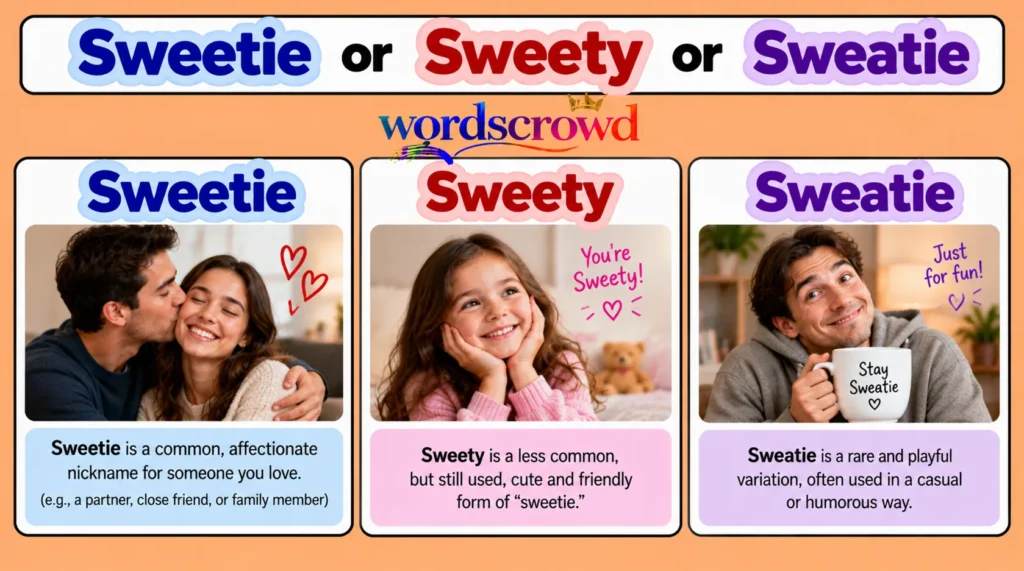
The good news is that the answer is fairly simple: sweetie is the standard and safest spelling, while sweety is also a legitimate alternative spelling.
Sweatie, however, is generally not the spelling you want when you mean a person you love, a kind person, or a friendly term of address.
Major dictionaries support this distinction. Merriam-Webster lists sweetie as a noun meaning “sweetheart” and records sweety as a British spelling of that sense. Cambridge also lists sweety as an alternative form of sweetie.
So which should you actually use?
If you are writing a text, email, social-media caption, story, school assignment, or professional message, choose “sweetie.” It is widely recognizable and works naturally in both American and British English.
In this guide, we will compare sweetie vs. sweety vs. sweatie, explain the meaning, pronunciation, grammar, history, regional usage, common mistakes, and real-life examples, and give you a simple memory trick so you never have to second-guess the spelling again.
Quick Answer
Sweetie is the standard spelling and the best choice in most situations.
Sweety is also a real word and an accepted alternative spelling of sweetie, particularly associated with British English.
Sweatie is generally not the correct spelling when you mean “sweetheart,” “darling,” or “a lovely person.” If that is your intended meaning, write sweetie.
Best choice: sweetie
Acceptable alternative: sweety
Usually avoid: sweatie
Sweetie vs. Sweety vs. Sweatie: Comparison Table
| Feature | Sweetie | Sweety | Sweatie |
|---|---|---|---|
| Standard spelling | Yes | Yes, as an alternative | Generally no for this meaning |
| Meaning | Darling, sweetheart, kind/pleasant person | Same basic meaning as sweetie | Usually a misspelling when intended to mean sweetie |
| Part of speech | Noun | Noun | Not normally used as the noun sweetie |
| Pronunciation | /ˈswiːti/ | /ˈswiːti/ | Often intended to sound like sweetie |
| Formality | Informal | Informal | Not recommended for standard writing |
| American English | Common | Less common | Avoid |
| British English | Common | Recognized alternative | Avoid for the term of endearment |
| Term of endearment | Yes | Yes | No |
| Can describe a kind person? | Yes | Yes | No, not in standard usage |
| Can address someone directly? | Yes | Yes | Not normally |
| Best for professional writing | Usually no | Usually no | No |
| Best everyday choice | Yes | Sometimes | No |
| Example | “Thanks, sweetie.” | “Thanks, sweety.” | “Thanks, sweatie.” ❌ |
| Memory tip | Sweet + ie = sweetie | Alternative spelling | Think sweat, not sweet |
Bottom line: If you are unsure, use sweetie. It is the clearest, most familiar, and safest spelling.
What Does “Sweetie” Mean?
Sweetie is an informal noun used for someone who is loved, liked, or regarded affectionately. It can refer to a romantic partner, child, friend, or simply a kind and pleasant person.
For example:
- “My sweetie is coming over tonight.”
- “Thanks, sweetie.”
- “She is such a sweetie.”
- “Are you okay, sweetie?”
The word can therefore do more than one job in conversation.
Sweetie as a term of endearment
The most familiar use is as a term of affection.
You might say:
“Good morning, sweetie.”
Here, sweetie functions as a form of address. It can express affection, warmth, care, or familiarity.
The person being addressed does not necessarily have to be a romantic partner. Parents may call children sweetie, friends may use it with one another, and someone may use it toward a stranger in a warm or reassuring way.
Cambridge classifies this use as informal and notes that it can be used when speaking to someone you love, including a child, partner, or good friend.
Sweetie as “a kind person”
You can also use sweetie to describe someone rather than directly address them.
For example:
“Your sister is a real sweetie.”
In this sentence, sweetie means that the person is pleasant, kind, or easy to like.
Oxford gives the same general sense, describing a sweetie as a person who is kind and easy to like.
Sweetie as a romantic partner
In American English especially, sweetie can refer to someone’s romantic partner.
“I’m going to the concert with my sweetie.”
Here, sweetie is similar to:
- sweetheart
- darling
- honey
- love
- beloved
- partner
Merriam-Webster defines sweetie in one of its principal senses as “sweetheart.”
Sweetie as a British word for a sweet
There is another interesting use.
In British English, sweetie can also be a child’s word for a sweet, meaning a small piece of confectionery or candy.
For example:
“Can I have a sweetie?”
This sense is particularly associated with British English. Both Cambridge and Oxford identify this meaning.
So context matters.
Compare:
“She’s such a sweetie.”
Here, sweetie refers to a person.
But:
“Would you like a sweetie?”
In British usage, sweetie may refer to candy.
The Origin and History of “Sweetie”
The spelling sweetie is not a modern internet invention. It has a long history in English.
Merriam-Webster records the first known use of sweetie in 1705.
The word is naturally connected with sweet, a word that has long been used not only for taste but also for qualities such as kindness, pleasantness, affection, and attractiveness.
The ending -ie helps create an affectionate or diminutive form in English. Similar patterns appear in words such as:
- doggie
- auntie
- granny
- lassie
- birdie
Thus, sweetie developed as an affectionate form related to sweet.
The history also helps explain why sweetie feels natural as a pet name. It combines the positive meaning of sweet with an affectionate word ending.
What Does “Sweety” Mean?
Sweety is not simply a random misspelling. It is a recognized spelling of sweetie.
Merriam-Webster explicitly identifies sweety as a British spelling of the relevant sense of sweetie.
Cambridge likewise lists sweety as an alternative spelling of sweetie.
That means this sentence is understandable and legitimate:
“Thanks, sweety.”
However, if your goal is to use the spelling that will be recognized most broadly by modern English readers, sweetie is usually the better choice.
Is “sweety” grammatically correct?
Yes—when it is being used as the recognized noun sweety, meaning sweetie.
For example:
“She’s my sweety.”
The word is functioning as a noun.
However, spelling preference matters. Some readers, particularly American readers, may find sweetie more familiar.
Therefore:
Correct: “Goodnight, sweetie.”
Also acceptable: “Goodnight, sweety.”
Best general choice: “Goodnight, sweetie.”
Is “sweety” more British?
It can be associated with British usage, and Merriam-Webster specifically labels it a British spelling of sweetie.
That does not mean Americans cannot understand or use it. It simply means that sweetie is the safer international spelling.
What Does “Sweatie” Mean?
This is where the three spellings separate sharply.
If you want to call someone sweetie, then sweatie is generally not the correct spelling.
For example:
“Thanks, sweatie.”
Most readers will assume you made a spelling mistake.
Why?
Because sweatie visually connects with sweat, not sweet.
Compare:
- sweet → sweetie
- sweat → sweaty
- sweat → sweatier
This distinction is extremely useful.
“Sweatie” is not the normal comparative form of “sweaty”
A common source of confusion is the relationship between sweaty and sweatier.
The adjective is:
sweaty
Its comparative form is:
sweatier
Not:
sweatie
For example:
“After the workout, I was sweatier than I expected.”
Not:
“After the workout, I was sweatie than I expected.”
So if you see sweatie, do not automatically assume it is another spelling of sweetie.
Could “sweatie” appear creatively?
Yes. English speakers sometimes deliberately create unusual spellings online, in jokes, usernames, memes, or playful messages.
Someone might intentionally write:
“Hey, sweatie!”
as a joke based on sweetie and sweat.
But creative internet spelling does not make sweatie the standard spelling of the affectionate noun.
Warning: If you are writing an essay, email, article, school assignment, or professional message, do not use sweatie when you mean sweetie.
Sweetie or Sweety: Are Both Correct?
Yes, but they are not equally preferred.
This is one of the most important points in the entire comparison.
Sweetie
Sweetie is the standard and safest spelling.
Use it when you want the most widely recognizable form.
Sweety
Sweety is a legitimate alternative spelling.
It is especially associated with British English according to Merriam-Webster, while Cambridge lists it simply as an alternative form.
Sweatie
Sweatie is generally not an accepted standard spelling of sweetie.
So the practical ranking is:
- Sweetie — best general choice
- Sweety — correct alternative
- Sweatie — avoid when you mean sweetie
Sweetie vs. Sweety: Key Differences
Although sweetie and sweety can mean the same thing, there are useful differences in preference.
- Sweetie is the more familiar spelling for many English speakers.
- Sweety is an accepted alternative spelling.
- Sweetie is the safer choice for international English.
- Sweety may feel more British to some readers.
- Both can function as nouns.
- Both can be terms of endearment.
- Both can describe a kind or pleasant person.
- Neither is normally appropriate for formal academic writing.
- Neither should be confused with sweaty.
- Sweatie should not replace either standard spelling.
Grammar: How Is “Sweetie” Used?
Understanding the grammar is easier than it might first appear.
Sweetie is a noun
The most basic grammatical category of sweetie is noun.
For example:
“My sweetie is waiting outside.”
Here, sweetie is a noun referring to a person.
Sweetie can be a form of address
It can also appear when directly speaking to someone:
“Come here, sweetie.”
In this use, it behaves like other terms of address such as:
- darling
- honey
- sweetheart
- dear
- love
Sweetie can follow a possessive
You can say:
- my sweetie
- your sweetie
- her sweetie
- his sweetie
- their sweetie
Examples:
“My sweetie loves hiking.”
“Have you met her sweetie?”
Plural form
The plural of sweetie is:
sweeties
For example:
“The children were all little sweeties.”
You can also use the plural for several loved ones or romantic partners in contexts where the meaning is clear.
Capitalization
Sweetie is normally lowercase unless it begins a sentence or appears in a proper name.
Correct:
“Good night, sweetie.”
Correct:
“Sweetie, can you help me?”
Usually unnecessary:
“Good night, Sweetie.”
Capitalizing it can be a stylistic choice in personal messages, but standard English does not require it simply because it is a term of affection.
Punctuation
When sweetie is used as direct address, commas can help clarify the sentence.
“Sweetie, please listen.”
“Please listen, sweetie.”
“Please, sweetie, listen.”
The commas separate the term of address from the main sentence.
Pronunciation: Sweetie and Sweety
The two standard spellings are pronounced essentially the same.
Sweetie: /ˈswiːti/
Sweety: /ˈswiːti/
Cambridge provides the corresponding British and American pronunciations for sweetie and sweety.
The first syllable sounds like sweet, and the second sounds like the ending in words such as city or pretty.
A simple approximation is:
SWEET-ee
That pronunciation is one reason spelling confusion is so common. When people hear the word, they cannot tell whether the writer intends sweetie or sweety.
Sweetie vs. Sweety in American and British English
Regional English adds another layer to the question.
American English
Sweetie is a very natural spelling in American English.
For example:
“Thanks, sweetie.”
“I’m meeting my sweetie for dinner.”
“You’re a sweetie.”
Sweety can be understood, but sweetie is usually the safer spelling if you want broad American recognition.
British English
British English recognizes sweetie and sweety.
Cambridge lists sweety as another form of sweetie, while Merriam-Webster identifies sweety specifically as a British spelling.
British English also has the additional noun meaning a sweet/candy, particularly in child-oriented usage.
International English
For websites, blogs, social media, business communication, and content intended for a global audience, sweetie is the clearest option.
It avoids unnecessary regional uncertainty.
Formal vs. Informal Usage
All three spellings need to be considered in terms of register.
Informal situations
Sweetie works naturally in:
- texts
- family conversations
- romantic conversations
- friendly chats
- personal social media
- casual dialogue
- fiction
- informal notes
Example:
“See you tomorrow, sweetie!”
Professional situations
Be careful with sweetie in professional communication.
Although the word is grammatically fine, addressing a colleague, customer, manager, or client as sweetie can sound overly familiar or even patronizing.
Instead of:
“Thanks for your help, sweetie.”
A professional email would normally say:
“Thank you for your help.”
Or:
“I appreciate your assistance.”
Academic writing
Avoid sweetie in formal academic prose unless you are discussing the word itself or quoting dialogue.
For example, this is perfectly acceptable:
“The character repeatedly addresses her daughter as ‘sweetie,’ emphasizing their close relationship.”
Here, the word is being analyzed rather than casually used.
20+ Real-Life Examples
The easiest way to understand sweetie, sweety, and sweatie is to see them in context.
Everyday Conversation
- “Are you feeling better, sweetie?”
- “Thanks for helping me, sweetie.”
- “She’s such a sweetie.”
- “Come sit beside me, sweetie.”
- “My sweetie surprised me with flowers.”
Text Messages
- “Goodnight, sweetie ❤️”
- “Are you home yet, sweetie?”
- “Don’t worry, sweetie. Everything will be okay.”
- “Morning, sweety! Hope you slept well.”
- “Miss you, sweetie.”
Notice that sweety is possible in casual writing, but sweetie remains the safer general spelling.
Family Conversations
- “Grandma called me sweetie when I was little.”
- “Come here, sweetie. Let me fix your jacket.”
- “That little boy is such a sweetie.”
- “Would you like another cookie, sweetie?”
Romantic Context
- “I’m going out with my sweetie tonight.”
- “My sweetie knows exactly how to make me laugh.”
- “Happy anniversary to my sweetie.”
- “I bought this gift for my sweetie.”
Social Media
- “Weekend getaway with my sweetie!”
- “Celebrating another year with my sweetie.”
- “Look who brought me flowers—my sweetie!”
- “She’s an absolute sweetie.”
Professional Context
- Instead of writing “Thanks, sweetie” to a client, write “Thank you for your help.”
- In a formal article, you might write: “The author uses ‘sweetie’ as an affectionate form of address.”
British English and Food
- “The child asked for another sweetie.”
Here, depending on context, sweetie can mean a piece of candy in British English. Cambridge and Oxford both recognize this use.
Common Mistakes With Sweetie, Sweety, and Sweatie
Mistake 1: Writing “sweatie” for a loved one
Incorrect for the intended meaning:
“I love you, sweatie.”
Better:
“I love you, sweetie.”
Why? Because sweatie is not the normal standard spelling of the term of endearment.
Mistake 2: Assuming “sweety” is always wrong
Not necessarily.
“Thanks, sweety.”
This spelling is recognized as an alternative form of sweetie.
However, if you want the safest spelling for general English, choose sweetie.
Mistake 3: Confusing “sweety” with “sweaty”
These are completely different.
Sweety = an alternative spelling of sweetie.
Sweaty = covered in or producing sweat.
Compare:
“She’s my sweetie.”
“After running, I was sweaty.”
Mistake 4: Using “sweatie” instead of “sweatier”
If you are comparing levels of sweatiness, use sweatier.
Correct:
“This workout made me sweatier than yesterday’s workout.”
Incorrect:
“This workout made me sweatie than yesterday’s workout.”
The spelling sweatie should not be treated as the comparative form of sweaty.
Mistake 5: Using “sweetie” in a formal email
The word itself is not grammatically wrong, but the tone can be inappropriate.
Instead of:
“Hi sweetie, I need those documents.”
Use:
“Hello, I need those documents when you have a moment.”
The problem here is not spelling. It is register and professionalism.
Sweetie, Sweety, Sweaty, and Sweatie: Don’t Mix Them Up
These words can look deceptively similar.
| Word | Meaning |
|---|---|
| sweetie | sweetheart; darling; kind person |
| sweety | alternative spelling of sweetie |
| sweaty | covered in or producing sweat |
| sweatie | generally not the standard spelling for sweetie |
A useful visual comparison is:
sweet → sweetie
but:
sweat → sweaty → sweatier
That one distinction solves most spelling problems.
Memory Tricks for Remembering the Correct Spelling
Trick 1: Start with “sweet”
Think:
SWEET + IE = SWEETIE
If you mean a darling or sweetheart, begin with sweet.
Trick 2: Remember the “sweet” relationship
A sweetie is someone you consider sweet.
So:
sweet → sweetie
The spelling keeps the entire word sweet intact.
Trick 3: Save “sweat” for sweaty
If the word is about perspiration, think:
sweat → sweaty
That gives you:
sweaty, sweatier
not sweatie.
Trick 4: When in doubt, choose “sweetie”
If you are writing for an international audience and cannot decide between sweetie and sweety, use:
sweetie
It is clear, familiar, and widely recognized.
When Should You Use “Sweetie”?
Use sweetie when you want to:
- Address someone affectionately
- Refer to a romantic partner
- Describe someone kind or pleasant
- Write casual dialogue
- Create a warm personal message
- Reproduce natural informal speech
- Discuss the word itself
- Use the British food sense when context makes it clear
Examples:
“Thank you, sweetie.”
“He’s a real sweetie.”
“My sweetie is picking me up.”
When Should You Use “Sweety”?
Use sweety when you intentionally want the alternative spelling of sweetie.
It is especially relevant in British English, where dictionaries recognize it as an alternative spelling.
For general international writing, however, there is little reason to choose sweety over the more familiar sweetie unless you have a specific stylistic or regional reason.
When Should You Avoid “Sweatie”?
Avoid sweatie when:
- You mean sweetheart.
- You mean darling.
- You are addressing someone affectionately.
- You are writing a formal article.
- You are writing a school assignment.
- You are writing professional correspondence.
- You want standard English spelling.
- You mean the comparative of sweaty.
The only time you might see sweatie is in a deliberately creative, humorous, nonstandard, or user-generated context. That does not make it the recommended standard spelling.
Is “Sweetie” Rude?
Not inherently.
The tone depends heavily on who says it, to whom, and in what situation.
Between close friends:
“Thanks, sweetie!”
can sound warm and friendly.
Between romantic partners:
“Goodnight, sweetie.”
sounds affectionate.
From a parent to a child:
“Come here, sweetie.”
sounds caring.
But from a stranger to an adult in a professional setting, the same word may sound overly familiar or patronizing.
Therefore, sweetie is not automatically polite or impolite. Context controls the tone.
Is “Sweetie” a Term of Endearment?
Yes.
It belongs to the broad group of English terms of endearment, including:
- sweetheart
- darling
- honey
- dear
- love
- babe
- beloved
Oxford and Cambridge both describe affectionate uses of sweetie, including addressing someone in a kind or loving way.
Can You Call a Friend “Sweetie”?
Yes.
The word does not have to be romantic.
For example:
“You’re a sweetie for helping me move.”
Here, the speaker is simply expressing appreciation.
However, cultural expectations differ. Some speakers use terms like sweetie, dear, and love very freely, while others reserve them for family or romantic relationships.
Can “Sweetie” Be Used for Men?
Absolutely.
Sweetie is not grammatically restricted to women.
You can say:
“He’s such a sweetie.”
or:
“Goodnight, sweetie.”
The meaning depends on the relationship and context, not the person’s gender.
Can “Sweetie” Refer to a Child?
Yes.
This is a very common use.
“Are you okay, sweetie?”
“Come here, sweetie.”
The word can express affection, reassurance, or tenderness.
Is “Sweetie” Appropriate in a Business Email?
Usually, no—unless you know the recipient well and the relationship is genuinely informal.
For professional communication, safer alternatives include:
- Dear [Name]
- Hello [Name]
- Thank you
- I appreciate your help
- Best regards
Compare:
Too personal for most business contexts:
“Thanks, sweetie!”
Professional:
“Thank you for your assistance.”
The issue is not that sweetie is grammatically incorrect. It is that the word carries a strongly personal and informal tone.
Frequently Asked Questions
Is “sweetie” or “sweety” correct?
Both are recognized spellings, but sweetie is the safest and most widely familiar choice. Merriam-Webster identifies sweety as a British spelling, while Cambridge lists it as an alternative form.
Is “sweatie” a correct spelling of sweetie?
Generally, no. If you mean “darling,” “sweetheart,” or “a kind person,” use sweetie or, where appropriate, sweety.
Is “sweety” a real word?
Yes. Sweety is a recognized alternative spelling of sweetie. It is not simply an accidental misspelling.
Is sweetie more American or British?
Sweetie is used in both American and British English. Sweety is particularly associated with British spelling in Merriam-Webster’s entry.
What does sweetie mean when someone calls you that?
It usually expresses affection, friendliness, kindness, or familiarity. Depending on the situation, it can mean darling, sweetheart, or simply a kind person.
Is “sweetie” a noun or an adjective?
Sweetie is primarily a noun. It can refer to a loved person, a kind person, or—in British English—a sweet or piece of candy.
What is the plural of sweetie?
The plural is sweeties.
Example:
“The children were such sweeties.”
Is “sweatie” the comparative of “sweaty”?
No. The comparative form of sweaty is sweatier.
Correct:
“I was sweatier after the second workout.”
Not:
“I was sweatie after the second workout.”
Can I use “sweetie” in formal writing?
Usually, no. It is an informal word. Use it in dialogue or when discussing the word itself, but choose more neutral language for formal academic or professional writing.
Sweetie vs. Sweety vs. Sweatie: Final Verdict
The answer is straightforward once you separate standard spelling, alternative spelling, and mistake.
Use sweetie when:
- You mean sweetheart or darling.
- You are addressing someone affectionately.
- You mean a kind or pleasant person.
- You want the safest spelling.
- You are writing for a broad international audience.
Use sweety when:
- You mean the same thing as sweetie.
- You are comfortable with the alternative spelling.
- A British-English context or personal style makes it appropriate.
Avoid sweatie when:
- You mean sweetie.
- You are writing standard English.
- You are preparing professional, academic, or published content.
The easiest rule to remember is: sweet → sweetie.
If you’re writing “Good morning, sweetie,” you have the spelling most readers will recognize immediately.
If you write “Good morning, sweety,” the meaning is still clear and the spelling is recognized, especially in British usage.
But “Good morning, sweatie” will normally look like a spelling error unless you are deliberately making a joke or using creative slang.
So, when you’re stuck between sweetie or sweety or sweatie, choose sweetie. It is the clearest, most practical, and most universally useful form.
In short: Sweetie = preferred. Sweety = acceptable alternative. Sweatie = generally avoid.

Elon Parker is a dedicated writer at Wordscrowd, creating clear, informative, and engaging content for readers.
With a focus on useful information, Elon aims to make every article simple, reliable, and easy to understand.