If you have ever paused while typing “reevaluation,” “re-evaluation,” or “re evaluation,”
you are not alone. This is one of those small English spelling questions that can make even experienced writers stop and think.
The confusion comes from the prefix re-, the possibility of a double vowel, and differences between dictionaries and style preferences.
The good news is that the rule is much simpler than it first appears.
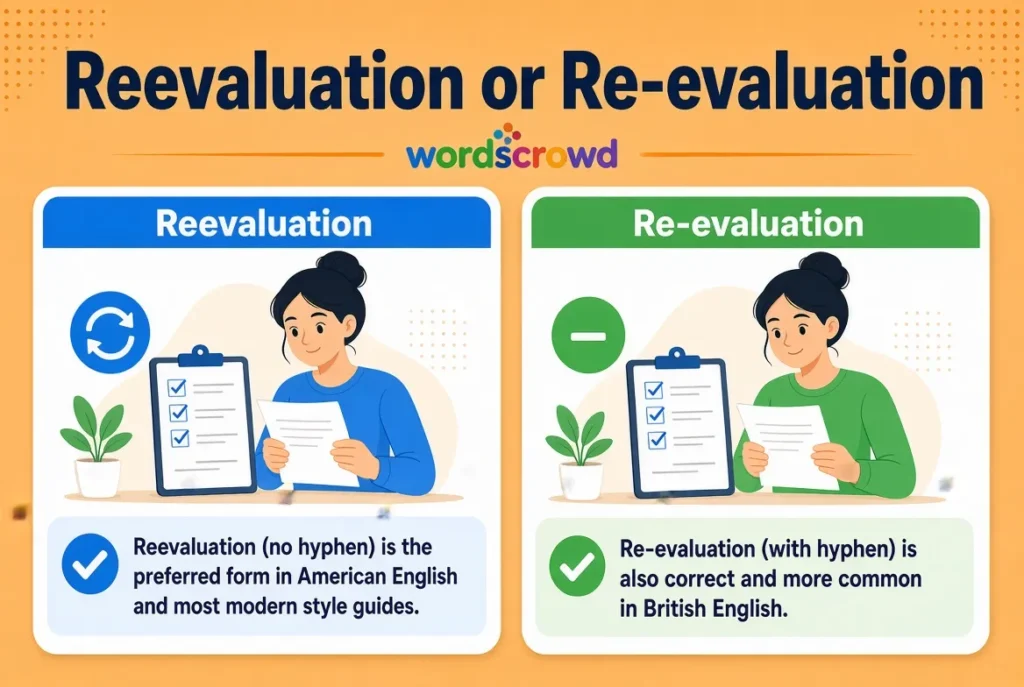
In modern English, reevaluation is generally the preferred closed form when you mean the act of evaluating something again.
Re-evaluation is also used, especially when a writer wants to make the word easier to read or avoid confusion. Re evaluation, written as two separate words, is generally not the preferred form when re- functions as a prefix.
This guide explains the reevaluation or re evaluation hyphen rule in plain English.
You will learn when to write reevaluation, when re-evaluation can be useful, why re evaluation is usually avoided, how the prefix re- works, and what to consider in American and British English.
Quick Answer
Reevaluation is usually the best modern spelling when you mean evaluation again.
Re-evaluation is also acceptable in some contexts, particularly when the hyphen improves readability or prevents confusion.
Re evaluation as two separate words is generally not the standard spelling when re- is being used as a prefix.
Best general choice: reevaluation
Reevaluation vs. Re-Evaluation vs. Re Evaluation
| Form | Status | Typical use | Recommendation |
|---|---|---|---|
| reevaluation | Standard closed compound | Modern general writing | Preferred |
| re-evaluation | Hyphenated variant | Clarity, style preference, some publications | Acceptable |
| re evaluation | Usually nonstandard | Treating re as a separate word | Avoid |
| re-evaluate | Standard verb form | To evaluate again | Preferred |
| reevaluate | Standard verb form | To evaluate again | Preferred |
| re evaluation | Usually incorrect in this sense | Two separate words | Avoid |
Quick rule: When re- means “again” and forms a new word with evaluation, write reevaluation in most modern contexts. Use re-evaluation if a house style or readability concern calls for the hyphen.
What Does “Reevaluation” Mean?
Reevaluation means evaluating something again, usually because circumstances have changed, new information has appeared, or the original assessment needs to be reconsidered.
For example:
- The committee ordered a reevaluation of the proposal.
- The patient’s treatment required reevaluation after several weeks.
- The company conducted a reevaluation of its pricing strategy.
- The teacher recommended a reevaluation of the student’s work.
The word is built from:
re- + evaluation = reevaluation
Here, re- means again.
The base word is evaluation, which means the process of judging, assessing, measuring, or considering something.
So:
reevaluation = evaluation again
That simple meaning is the key to understanding the spelling.
Is “Reevaluation” One Word?
Yes.
Reevaluation is normally written as one word when re- functions as a prefix meaning “again.”
The same pattern appears in many familiar English words:
- reevaluate
- reconsider
- review
- reassess
- rethink
- rewrite
- reread
- rebuild
- reorganize
- reexamine
However, English does not apply the re- prefix mechanically in every possible situation. Some words retain a hyphen because the combination could be confusing, awkward, or difficult to read.
That is why re-evaluation can still appear in edited English.
Is “Re-Evaluation” Correct?
Yes, re-evaluation can be correct.
The hyphenated form is not automatically a spelling error. In some dictionaries, publications, organizations, or style systems, writers may use the hyphen to make the structure clearer.
The hyphen can be especially useful because reevaluation contains three consecutive vowels:
r-e-e-v-a-l-u-a-t-i-o-n
Some readers find the sequence visually awkward. A hyphen gives the reader an immediate visual boundary:
re-evaluation
This makes the prefix and base word easier to recognize.
Example
Both of these can be understood:
The board requested a reevaluation of the policy.
The board requested a re-evaluation of the policy.
The first is usually the cleaner modern form. The second can be justified by a publication’s style or a writer’s concern about readability.
Why Is “Re Evaluation” Usually Wrong?
The form re evaluation, with a space, is generally not the preferred spelling when you mean evaluation again.
The reason is grammatical.
In this word, re- is a prefix, not an independent word.
A prefix attaches to a base word.
For example:
- re + write → rewrite
- re + assess → reassess
- re + examine → reexamine
- re + evaluate → reevaluate
- re + evaluation → reevaluation
You would not normally write:
- re write
- re assess
- re examine
- re evaluate
- re evaluation
The same principle applies to reevaluation.
Important: “Re evaluation” is different from a genuine phrase in which re has another grammatical function. But when re- means “again,” it normally behaves as a prefix.
Reevaluation or Re-Evaluation: Which Should You Use?
For most general writing, use:
reevaluation
That is the safest choice if you want a modern, clean, standard form.
Use:
re-evaluation
when your organization’s style guide, publisher, dictionary preference, or readability needs support the hyphenated form.
Avoid:
re evaluation
when you mean “evaluation again.”
The practical rule
If you are writing a:
- blog post
- website
- school assignment
- report
- business document
- general article
reevaluation is usually the best choice.
If you are writing for a specific publication, university, company, or professional organization, check its style guide first.
The Prefix “Re-”: The Rule Behind the Spelling
To understand reevaluation, it helps to understand re-.
The prefix re- commonly means:
- again
- back
- anew
Examples include:
- rewrite = write again
- rebuild = build again
- reconsider = consider again
- reassess = assess again
- recalculate = calculate again
- reorganize = organize again
- reevaluate = evaluate again
The same logic gives us:
re- + evaluation → reevaluation
The spelling looks slightly unusual because the prefix ends in e and the base word begins with e.
That produces:
re + evaluation → reevaluation
The two e letters are retained.
Why Does “Reevaluation” Have Two E’s?
This is one of the most common questions about the word.
The answer is simple: the word contains the prefix re- followed by the base word evaluation.
The spelling does not normally remove one of the e letters.
So:
re + evaluation = reevaluation
not:
re + valuation
and not:
re + valuation = revaluation
These are actually different words.
Reevaluation vs. Revaluation
This distinction matters.
Reevaluation
Reevaluation means evaluating something again.
The teacher requested a reevaluation of the assignment.
Revaluation
Revaluation usually refers to changing the assessed or monetary value of something.
The currency underwent a revaluation.
Notice the difference:
reevaluation → evaluation again
revaluation → a change in valuation/value
Removing the second e does not merely change the spelling. It can change the word itself.
Reevaluation: Meaning, Grammar, and Word Form
Definition
Reevaluation is a noun meaning the act or process of evaluating something again.
Part of speech
Noun
Related verb
Reevaluate
Related forms
- reevaluate — verb
- reevaluated — past tense/past participle
- reevaluating — present participle
- reevaluation — noun
- reevaluations — plural noun
Pronunciation
The pronunciation generally follows the pronunciation of reevaluation, with the prefix re- attached to evaluation.
The exact pronunciation can vary slightly by speaker and dialect, but the spelling is the same in standard American and British English.
Common Collocations
Reevaluation frequently appears with words such as:
- complete reevaluation
- careful reevaluation
- thorough reevaluation
- major reevaluation
- regular reevaluation
- independent reevaluation
- strategic reevaluation
- financial reevaluation
- medical reevaluation
- policy reevaluation
- performance reevaluation
- risk reevaluation
- annual reevaluation
These combinations are useful because they show how the noun naturally appears in real writing.
Reevaluation in Professional Writing
Reevaluation is especially common in professional contexts.
For example:
The management team began a reevaluation of its long-term strategy.
The consultant recommended a reevaluation of the company’s risk-management procedures.
The project requires a reevaluation of the original budget.
In business writing, the closed form reevaluation often looks cleaner and more consistent with other words beginning with re-.
Business example
Instead of:
We need to do a re evaluation of our pricing structure.
Write:
We need to conduct a reevaluation of our pricing structure.
An even more concise version is:
We need to reevaluate our pricing structure.
That last version is often stronger because the verb is direct and economical.
Reevaluation in Academic Writing
Academic writers often use reevaluation when discussing theories, evidence, interpretations, or previous research.
Examples:
The new evidence led to a reevaluation of the original hypothesis.
The study supports a reevaluation of earlier assumptions.
These findings may require a reevaluation of existing models.
Academic writing should generally favor consistency. If your institution or journal has a preferred spelling, follow that standard throughout the paper.
A useful academic-writing tip
If you can replace the noun phrase with a direct verb, the sentence may become clearer.
Instead of:
The discovery resulted in a reevaluation of the theory.
You could write:
The discovery led researchers to reevaluate the theory.
Both are grammatical. The second is often more direct.
Reevaluation in Everyday English
The word is more formal than some everyday alternatives.
People may say:
I need to rethink this.
instead of:
I need to conduct a reevaluation.
They may say:
We should look at it again.
instead of:
We should perform a reevaluation.
So while reevaluation is completely natural, its tone depends on context.
Formal
The committee will conduct a reevaluation of the proposal.
Neutral
We need to reevaluate the plan.
Casual
Maybe we should rethink the plan.
All three communicate a similar basic idea, but they fit different situations.
Reevaluation vs. Re-Evaluation in American English
In American English, reevaluation is a common modern spelling.
The closed form fits a broader tendency to close prefixes and compounds when the resulting word remains readable.
You will also encounter:
- reevaluate
- reelect
- reenter
- reestablish
- reexamine
- reengineer
However, American style is not completely uniform. Some writers and publications still use hyphens in certain re- compounds.
Therefore, the practical rule is not:
“Every word beginning with re- must never have a hyphen.”
Instead:
Use the established spelling of the word and follow the applicable style guide.
Reevaluation vs. Re-Evaluation in British English
British English also uses reevaluation, while re-evaluation can appear in edited British writing.
The important point is that the difference is not a simple American = one word / British = hyphen rule.
Both varieties of English can use either form depending on the dictionary, publisher, house style, or context.
If you are writing for a British publication, follow its editorial standard.
If you are writing for a general international audience, reevaluation is a practical choice.
What Do Style Guides Say About Hyphens?
Hyphenation is one area where English style can vary.
Major style references such as The Chicago Manual of Style, AP Style, and major dictionaries provide guidance, but individual publications may also maintain house rules.
The most important principle is consistency.
If a publication uses:
reevaluation
do not randomly switch to:
re-evaluation
later in the same document.
Likewise, if a house style requires the hyphenated version, use it consistently.
Dictionary vs. Style Guide
A dictionary generally tells you how a word is spelled and used.
A style guide tells you how to make editorial decisions across a larger body of writing.
That distinction matters.
A dictionary may list a preferred spelling while a publication may choose a different house style for readability or consistency.
So when editing professional content, check both:
- An authoritative dictionary.
- The relevant publication or organizational style guide.
Does the Hyphen Change the Meaning?
Usually, no.
In this case, reevaluation and re-evaluation generally refer to the same concept: evaluating something again.
The difference is primarily orthographic and stylistic, not semantic.
Compare:
The committee requested a reevaluation.
with:
The committee requested a re-evaluation.
The meaning is essentially the same.
However, re evaluation is not normally the preferred way to express the same concept.
20+ Real-Life Examples
Here are original examples showing how reevaluation, re-evaluation, and related forms work in different settings.
Everyday Conversation
- “After hearing both sides, I think the situation deserves a reevaluation.”
- “The new information made me reevaluate my decision.”
- “Maybe we should reevaluate our plans for the weekend.”
- “I had a complete reevaluation of what I wanted after that experience.”
School and Education
- “The teacher requested a reevaluation of the student’s final project.”
- “The new evidence may lead to a reevaluation of the original conclusion.”
- “Students can request a reevaluation of their grades under the university’s policy.”
- “The professor decided to reevaluate the assignment criteria.”
Business
- “The company is conducting a reevaluation of its pricing strategy.”
- “Recent market changes forced us to reevaluate our sales targets.”
- “The board approved a complete reevaluation of the investment plan.”
- “Our team should reevaluate the project’s timeline before making a final commitment.”
Professional Email
- “Following our meeting, I recommend a reevaluation of the proposed schedule.”
- “Could you please reevaluate the figures before we send the report?”
- “The updated data may require a reevaluation of our previous recommendation.”
Academic Writing
- “The findings support a reevaluation of the traditional interpretation.”
- “Further research may encourage scholars to reevaluate the existing model.”
- “The evidence provides a strong reason for reevaluating the original assumption.”
Social Media
- “One unexpected plot twist and suddenly I’m reevaluating every theory I had.”
- “After checking my bank account, it’s time for a serious reevaluation of my shopping habits.”
- “That workout has me reevaluating my definition of ‘easy.’”
Text Messages
- “I just saw the forecast. Reevaluating our outdoor plans 😂”
- “After that conversation, I’m definitely reevaluating things.”
- “Maybe a reevaluation of our strategy is needed lol.”
Common Mistakes With Reevaluation
Mistake 1: Writing “Re Evaluation”
❌ The committee ordered a re evaluation of the policy.
Why?
Because re- is functioning as a prefix meaning “again.”
Better:
✅ The committee ordered a reevaluation of the policy.
Or, where stylistically appropriate:
✅ The committee ordered a re-evaluation of the policy.
Mistake 2: Removing an “E”
❌ The committee requested a revaluation of the decision.
If your intended meaning is “evaluation again,” this changes the word.
Better:
✅ The committee requested a reevaluation of the decision.
Remember that revaluation is a different word.
Mistake 3: Assuming the Hyphenated Form Is Always Wrong
❌ “Re-evaluation is always incorrect.”
That is too absolute.
Better:
Re-evaluation can be a legitimate variant, depending on editorial style and context.
Mistake 4: Assuming Every “Re-” Word Needs a Hyphen
❌ re-write
❌ re-think
❌ re-consider
❌ re-evaluate
Modern standard spelling normally gives:
✅ rewrite
✅ rethink
✅ reconsider
✅ reevaluate
The spelling of each individual word should be checked rather than applying a blanket hyphen rule.
Mistake 5: Using “Reevaluation” When a Verb Is Better
This is not a spelling error, but it can make writing heavier.
Wordy:
The manager conducted a reevaluation of the proposal.
More direct:
The manager reevaluated the proposal.
The noun is useful when the process itself is the focus. The verb is often better when you want a direct, active sentence.
When Should You Use “Re-Evaluation”?
There are several situations where the hyphenated version may be useful.
1. Your House Style Requires It
Some publishers, organizations, and institutions prefer certain hyphenation patterns.
Follow their rules.
2. Readability Matters
A writer may choose re-evaluation because the closed form looks visually dense.
Compare:
reevaluation
re-evaluation
The second form makes the structure immediately visible.
3. You Need to Make the Prefix Clear
The hyphen can show that re- means “again.”
This can be useful in technical or highly edited prose.
But remember: readability alone does not mean every writer should insert a hyphen wherever a word looks unusual.
When Should You Avoid “Re-Evaluation”?
Avoid the hyphen when:
- your style guide specifically prefers closed compounds;
- you are aiming for consistency with reevaluate and similar words;
- the dictionary or publication you are following uses reevaluation;
- there is no genuine readability problem.
For general web content, reevaluation is usually the cleaner choice.
Is “Re-Evaluate” or “Reevaluate” Correct?
Both forms can be encountered, but reevaluate is generally the preferred modern closed form.
Examples:
We need to reevaluate the proposal.
The team will reevaluate its priorities.
She decided to reevaluate her original position.
The same word family follows the same basic pattern:
reevaluate → reevaluation
This gives your writing a useful consistency rule.
Tip: If you choose reevaluate, using reevaluation keeps the word family visually consistent.
Reevaluation Word Family
Understanding the whole family makes spelling easier.
| Word | Part of Speech | Meaning |
|---|---|---|
| reevaluate | Verb | Evaluate again |
| reevaluated | Verb | Evaluated again |
| reevaluating | Verb | Evaluating again |
| reevaluation | Noun | The act of evaluating again |
| reevaluations | Plural noun | Multiple acts of evaluating again |
Examples
We need to reevaluate the proposal.
The proposal was reevaluated last month.
The committee is reevaluating the evidence.
The reevaluation produced a different conclusion.
Several reevaluations were conducted during the project.
Hyphenation Rules for Words Beginning With “Re-”
There is no single rule that says every re- word must be closed or hyphenated.
Instead, consider the established spelling and the meaning.
Usually Closed
Common examples include:
- rewrite
- reread
- rethink
- reconsider
- rebuild
- reorganize
- reassess
- reassignment
- reconsideration
- reevaluate
- reevaluation
Sometimes Hyphenated
Some re- combinations may be hyphenated in certain styles, particularly where a hyphen helps distinguish the meaning or avoid confusion.
For example, the distinction can become important when removing the hyphen could make the reader misinterpret the word.
The key lesson is:
Do not create a hyphen simply because a word contains the prefix re-. Check the established form and the relevant style.
How to Decide Between Reevaluation and Re-Evaluation
Use this simple decision process.
Step 1: Ask what you mean
If you mean evaluation again, you are dealing with the prefix re-.
Step 2: Check the standard closed form
The usual modern spelling is:
reevaluation
Step 3: Check your style guide
If your publisher, school, employer, or journal prefers re-evaluation, follow that standard.
Step 4: Stay consistent
Do not alternate between:
- reevaluation
- re-evaluation
- re evaluation
throughout the same document.
Step 5: Never use the space casually
If re- is a prefix, re evaluation is generally not the standard choice.
Memory Tricks
Trick 1: “Again” Test
Ask:
Does re- mean “again”?
If yes, think:
re + evaluation = reevaluation
Trick 2: Keep the Base Word
Start with:
evaluation
Add:
re-
You get:
reevaluation
Do not delete the first letter of evaluation.
Trick 3: No Space for a Prefix
Remember:
Prefixes attach.
So:
❌ re evaluation
✅ reevaluation
Trick 4: Verb and Noun Match
Remember the pair:
reevaluate → reevaluation
If you know one, the other becomes easier to spell.
Trick 5: Think “Two E’s, One Word”
re + evaluation = reevaluation
Two e’s meet, but they remain in the spelling.
Reevaluation vs. Revaluation: A Crucial Difference
Because the two words look similar, this deserves special attention.
Reevaluation
Means evaluating again.
The researcher called for a reevaluation of the evidence.
Revaluation
Means changing or reassessing value, especially in economic or financial contexts.
The government announced a revaluation of the currency.
Easy distinction
reevaluation = evaluate again
revaluation = change the valuation/value
Do not use them interchangeably.
Is Reevaluation Formal or Informal?
Reevaluation is neutral-to-formal.
It works well in:
- academic writing
- business writing
- reports
- professional emails
- research
- government documents
- technical writing
For casual conversation, speakers may prefer simpler verbs:
Let’s rethink it.
Let’s look at it again.
Maybe we should reconsider.
That does not make reevaluation too formal. It simply means the word has a more analytical tone.
Better Alternatives to “Reevaluation”
Depending on your context, you might use:
- reconsideration
- reassessment
- review
- reexamination
- reconsidering
- reassessing
- reviewing
- rethinking
But these words are not always perfect synonyms.
For example:
reevaluation emphasizes evaluating again.
reconsideration emphasizes thinking about a decision again.
reassessment emphasizes assessing something again.
review is broader and can mean examining something again without necessarily changing the evaluation.
Choose the word that matches your intended meaning.
Frequently Asked Questions
Is “reevaluation” one word?
Yes. Reevaluation is normally written as one word when re- means “again” and modifies evaluation.
Is “re-evaluation” grammatically correct?
Yes. Re-evaluation can be an acceptable hyphenated spelling. Its use may depend on dictionary preference, editorial policy, or house style.
Is “re evaluation” correct?
Generally, no, when you mean “evaluation again.” In that meaning, re- functions as a prefix and is normally attached to the base word.
Which is better: reevaluation or re-evaluation?
For most general modern writing, reevaluation is the safest choice. Use re-evaluation when a specific style guide prefers it or when the hyphen is deliberately used for clarity.
Is reevaluate one word or two?
Reevaluate is one word.
We need to reevaluate the plan.
The form re evaluate is not normally used when re- means “again.”
Is revaluation the same as reevaluation?
No. Revaluation and reevaluation are different words. Reevaluation means evaluating again, while revaluation commonly refers to changing or reassessing value.
Should I use reevaluation in academic writing?
Yes. Reevaluation is suitable for academic writing. However, always follow your university, journal, or publisher’s preferred style if it specifies a different hyphenation.
Does American English use reevaluation?
Yes. Reevaluation is used in American English. Re-evaluation can also appear depending on editorial style.
Does British English use re-evaluation?
Yes, re-evaluation can be found in British English, but reevaluation is also used. The distinction is not simply an American-versus-British rule.
Final Verdict: Reevaluation or Re Evaluation?
The answer is straightforward once you understand how re- works.
Best general spelling
Reevaluation ✅
Acceptable variant
Re-evaluation ✅
Form to avoid in this meaning
Re evaluation ❌
The main reason is that re- is functioning as a prefix meaning “again.” Prefixes are normally attached to the words they modify, so reevaluation is the natural closed form.
The hyphenated re-evaluation is not necessarily wrong. It can be appropriate under a particular style guide or when a writer wants to make the word’s structure easier to read.
The safest professional approach is therefore:
- Use reevaluation as your default.
- Use re-evaluation when your style guide or editorial context calls for it.
- Avoid re evaluation when you mean “evaluation again.”
- Do not confuse reevaluation with revaluation.
- Keep the spelling consistent throughout the same document.
Bottom line: If you’re simply wondering what to type in ordinary modern English, choose reevaluation.
Recommended sentence:
The committee decided to conduct a reevaluation of the proposal after receiving new information.
That spelling is clear, concise, professional, and easy for modern readers to understand.