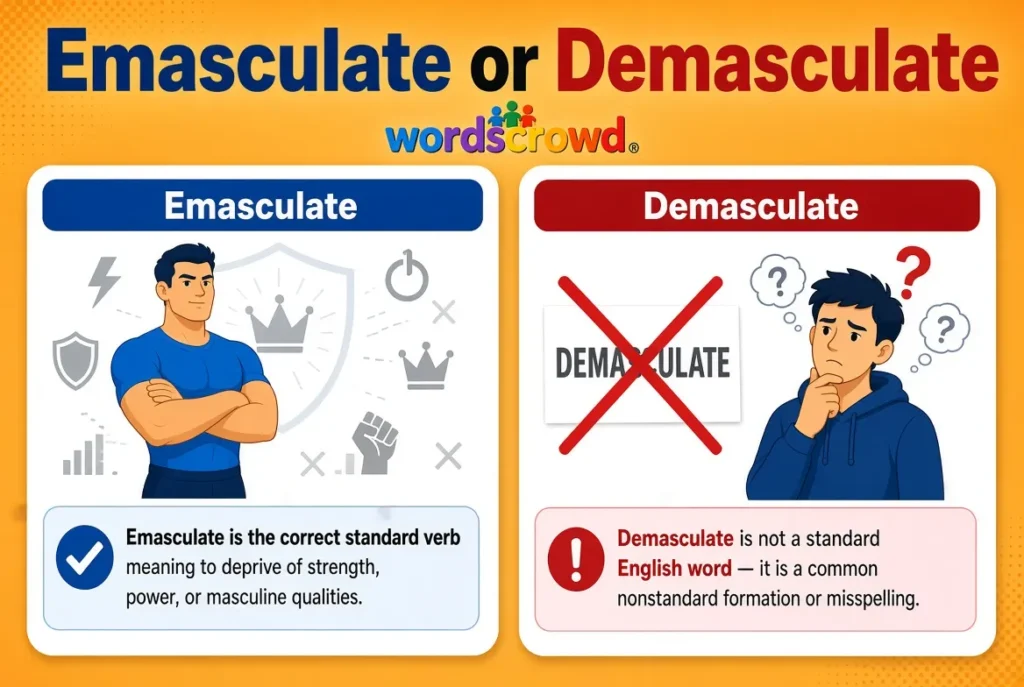
Emasculate or demasculate? If you have seen both forms and wondered whether they mean the same thing, you are not alone.
The confusion usually comes from the prefix de-, which often appears in English words to suggest removal, reversal, or reduction.
Because of that familiar pattern, demasculate can look like a perfectly reasonable alternative to emasculate.
But there is an important distinction: emasculate is the established standard English word, while demasculate is not the normal standard form you should choose in careful English.
The verb emasculate can mean to remove or reduce a man’s masculine qualities, strength, authority, or confidence.
In a literal or historical sense, it can also mean to castrate.
Because the word can carry a sensitive or insulting meaning when applied to a person, context matters.
This guide explains emasculate or demasculate clearly, including pronunciation, meaning, grammar, etymology, modern usage, formal writing, common mistakes, examples, and the situations in which you should avoid the word altogether.
Quick Answer
Emasculate is the correct and established English word.
Demasculate is generally not the standard word and should normally be avoided in edited or formal English.
Use emasculate when you mean to deprive someone of masculine power, confidence, authority, or traditionally masculine qualities. In a literal historical sense, it can also mean to castrate.
Emasculate or Demasculate: The Key Difference
| Feature | Emasculate | Demasculate |
|---|---|---|
| Standard English | Yes | Generally no |
| Part of speech | Verb; also adjective-related forms exist | Nonstandard/uncommon formation |
| Basic meaning | To deprive of masculine qualities, power, or confidence; historically, to castrate | Intended to express a similar idea, but not the established standard form |
| Pronunciation | /ɪˈmæskjəleɪt/ | Not recommended as a standard form |
| Formal writing | Appropriate when the meaning is suitable | Avoid |
| Academic writing | Possible, but use carefully because of its loaded meaning | Avoid |
| Everyday conversation | Used occasionally | Rare/nonstandard |
| Tone | Formal, literary, or potentially sensitive | Unusual and likely to sound incorrect |
| Common mistake | Using it when “weaken,” “humiliate,” or “undermine” would be clearer | Treating it as the normal opposite/form of masculate |
| Preferred choice | Emasculate | Not normally used |
| US English | Emasculate | Avoid |
| UK English | Emasculate | Avoid |
| Best advice | Use when its precise meaning is intended | Choose another established word |
Quick rule: If you are deciding between emasculate and demasculate, choose emasculate.
What Does Emasculate Mean?
Emasculate is an established English verb with two related senses.
First, it can have a literal biological or historical meaning: to castrate or deprive a male of the reproductive organs or their function.
Second, and often more relevant in modern writing, it can mean to deprive a man or male-associated figure of strength, confidence, authority, power, or traditionally masculine qualities.
For example:
- “The criticism made him feel emasculated.”
- “The policy was described as an attempt to emasculate the committee.”
- “He worried that losing his position would emasculate his authority.”
The second sense is often figurative. It does not necessarily mean anything physical happened.
A Simple Definition
Emasculate means to deprive someone or something of masculine power, strength, authority, or effectiveness; historically, it can also mean to castrate.
The word can therefore describe a person, an institution, an organization, or even an abstract source of authority.
Emasculate as a Verb
The most common grammatical use is as a verb:
- “The experience emasculated him.”
- “He felt emasculated by the public criticism.”
- “The amendment would emasculate the agency.”
Its basic forms include:
| Form | Example |
|---|---|
| Base form | emasculate |
| Third-person singular | emasculates |
| Past tense | emasculated |
| Past participle | emasculated |
| Present participle | emasculating |
Emasculated
Emasculated is especially common when describing a person’s emotional reaction.
For example:
“He felt emasculated after being publicly dismissed.”
Here, the word describes a feeling of reduced masculine confidence, dignity, status, or authority.
However, it is important not to assume that every man who feels embarrassed is “emasculated.” The word has a more specific association with masculinity and perceived power.
Emasculating
Emasculating describes something that causes a person to feel deprived of masculine confidence, status, strength, or authority.
Examples:
- “He found the experience deeply emasculating.”
- “The public criticism was emasculating.”
- “Being constantly overruled made him feel emasculated.”
Again, context matters because the word can sound judgmental if it is used carelessly.
The Origin of Emasculate
The history of emasculate helps explain why it looks different from what many readers might expect.
The word ultimately comes from Latin emasculare, meaning to make or render male-like in relation to the root connected with masculus, meaning “male.”
English adopted the word through historical Latin influence, and it developed both literal and figurative senses.
The literal sense is older and relates to castration. Over time, English speakers extended the word metaphorically to ideas such as weakening, depriving of strength, or removing power associated with masculinity.
That historical development is important because it explains why emasculate can sometimes appear in political, institutional, literary, or figurative writing.
How Do You Pronounce Emasculate?
Emasculate is commonly pronounced approximately:
ih-MASS-kyuh-layt
The stress falls on the second syllable:
e-MAS-cu-late
The final part sounds like “-late” in many standard pronunciations.
Related forms include:
- emasculated — ih-MASS-kyuh-lay-tid
- emasculating — ih-MASS-kyuh-lay-ting
- emasculation — ih-MASS-kyuh-LAY-shun
Because pronunciation can vary slightly between speakers and dictionaries, the important point is to stress the “mas” portion of emasculate.
What About Demasculate?
This is where the comparison becomes straightforward.
Demasculate is not the normal established English verb corresponding to emasculate. A reader may construct it by analogy with many English words beginning with de-, but that does not automatically make it standard English.
English is full of productive-looking patterns that do not always produce accepted words.
For example, speakers can sometimes create a word that seems logically constructed but is not recognized as standard vocabulary. Demasculate falls into this problem for ordinary edited English.
Why Does Demasculate Look Plausible?
The confusion is understandable.
The prefix de- appears in many established English words:
- deactivate
- deconstruct
- decrease
- defrost
- deregulate
- devalue
- decentralize
So someone might reason:
masculate → demasculate
The problem is that English vocabulary is not formed by applying prefixes mechanically to every possible root.
A word can look grammatically logical and still not be an established standard word.
Is Demasculate a Misspelling?
In most ordinary contexts, if someone writes demasculate when they mean the established verb, the safest correction is emasculate.
It is better not to treat demasculate as a normal alternative spelling.
If your goal is clear, standard English—especially in professional, academic, editorial, or published writing—emasculate is the safer and established choice.
Why People Confuse Emasculate and Demasculate
There are several reasons this pair causes confusion.
1. The Prefix Pattern Looks Familiar
English uses de- frequently to express reversal, removal, or reduction.
That encourages people to assume that demasculate must be the opposite of masculate.
2. The Root Is Not Common
Most speakers do not regularly encounter words related to masculate. As a result, they may build a new form based on what seems logical.
3. Emasculate Has a Less Obvious Structure
Modern speakers may not immediately recognize the historical structure of emasculate. It can therefore look like an unusual word that needs a familiar prefix.
4. Similar Words Encourage False Patterns
English contains pairs such as:
- empower / disempower
- activate / deactivate
- centralize / decentralize
- value / devalue
But not every semantic relationship works the same way.
Language tip: A word that looks morphologically possible is not necessarily an accepted English word.
Is Emasculate a Negative Word?
Often, yes.
The word can be emotionally loaded because its figurative meaning is tied to masculinity, weakness, humiliation, and loss of power.
Consider:
“He was criticized.”
This is neutral.
Compare:
“He was emasculated.”
This suggests something more specific: he experienced a loss of masculine confidence, status, authority, or perceived strength.
That makes emasculate much stronger than simple synonyms such as criticize or embarrass.
When Emasculate Can Sound Insensitive
Be careful when describing another person’s feelings.
For example:
“The manager emasculated the employee.”
This may imply that the employee’s masculinity was damaged or humiliated. If that is not the intended meaning, a clearer alternative may be:
- humiliated
- embarrassed
- undermined
- belittled
- disrespected
- weakened
- intimidated
- stripped of authority
The best word depends on what actually happened.
Emasculate vs Weaken
These words overlap, but they are not interchangeable.
Weaken is broad.
Emasculate is more specific and often connected with masculinity or perceived masculine authority.
Compare:
“The reforms weakened the agency.”
This simply means the agency became less powerful.
“The reforms emasculated the agency.”
This suggests that the agency was stripped of much of its strength, authority, or effectiveness, often with a strong figurative tone.
For professional writing, weaken is often preferable when gender or masculinity is not relevant.
Emasculate vs Humiliate
These words describe different ideas.
Humiliate means to cause someone to feel deeply embarrassed or ashamed.
Emasculate emphasizes a perceived loss of masculine confidence, status, power, or identity.
Someone can be humiliated without feeling emasculated.
For example:
“The comedian humiliated him in front of the audience.”
This focuses on embarrassment.
“The public rejection left him feeling emasculated.”
This focuses on the effect on his sense of masculinity or masculine confidence.
Emasculate vs Castrate
The relationship is closer, but the words are still not identical in modern usage.
Castrate has a direct biological meaning involving removal or destruction of the male reproductive organs or their function.
Emasculate can have a similar literal historical meaning, but it is also widely used figuratively.
For example:
“The animal was castrated.”
is a precise biological statement.
By contrast:
“The decision emasculated the organization.”
is figurative.
Emasculate vs Disempower
Disempower is often the better modern alternative when you are talking about authority rather than masculinity.
Compare:
“The new rules disempowered local officials.”
This clearly means the officials lost power or control.
“The new rules emasculated local officials.”
This is much more figurative and may suggest that the loss of authority was experienced specifically as a loss of masculine status or strength.
For neutral professional writing, disempower is often clearer.
Emasculate in Professional Writing
The word can appear in serious writing, but writers should use it deliberately.
Business Writing
Suppose a company loses decision-making authority:
“The restructuring could emasculate the regional office.”
This is grammatically possible, but weaken or strip the office of authority may be clearer for a business audience.
Better:
“The restructuring could significantly weaken the regional office.”
Academic Writing
In academic writing, the word may be useful when discussing:
- gender
- masculinity
- social identity
- cultural expectations
- power structures
- gender studies
- literature
- psychology
- historical attitudes toward masculinity
Example:
“The novel portrays public failure as an experience that emasculates its male protagonist.”
Here, the word is precise because masculinity is part of the analysis.
Professional Reports
If the intended meaning is simply “make less effective,” consider:
- weaken
- undermine
- limit
- reduce
- diminish
- constrain
- strip of authority
These are often more precise and less emotionally loaded.
Emasculate in Everyday Conversation
You may hear emasculated more often than the base verb emasculate.
For example:
“He felt emasculated after being mocked by his teammates.”
The adjective-like participle emasculated works naturally here.
However, the word remains relatively strong. It is not simply another way to say sad or embarrassed.
20 Real-Life Examples of Emasculate
Here are original examples across different contexts.
Everyday Conversation
- “He felt emasculated when everyone laughed at his mistake.”
- “She didn’t mean to emasculate him; she was simply correcting the error.”
- “Being unable to help his family made him feel emasculated.”
- “The teasing was funny at first, but eventually it became emasculating.”
Workplace
- “The repeated public criticism left the manager feeling emasculated.”
- “The restructuring could emasculate the department by removing most of its decision-making authority.”
- “The director rejected the proposal because it would effectively emasculate the team.”
- “A good manager should challenge employees without humiliating or emasculating them.”
Academic Writing
- “The novel explores how social expectations can emasculate men who fail to meet traditional ideals.”
- “The study examines whether workplace stereotypes can contribute to feelings of emasculation.”
- “The character interprets dependence on others as emasculating because of his cultural expectations.”
Business and Professional Writing
- “The proposed amendment would emasculate the committee by removing its independent authority.”
- “Rather than emasculating the department, the new structure is intended to clarify its responsibilities.”
- “The board argued that the change would weaken the organization rather than emasculate it.”
- “I want to make sure my comments are constructive and do not leave anyone feeling emasculated.”
- “The revised process should reduce unnecessary criticism without emasculating team leaders.”
Social Media
- “A bad day can make you feel defeated, but it doesn’t have to leave you emasculated.”
- “Public disagreement isn’t automatically emasculating; sometimes it’s simply part of a healthy debate.”
Literature and Commentary
- “The author uses the character’s public failure to create an emasculating turning point.”
- “The scene shows how the loss of social status can become psychologically emasculating.”
Common Mistakes With Emasculate and Demasculate
Mistake 1: Using Demasculate as the Standard Verb
Wrong or nonstandard:
“The criticism demasculated him.”
Better:
“The criticism emasculated him.”
However, if the intended meaning is simply that the criticism made him feel bad, an even better sentence may be:
“The criticism embarrassed him.”
Mistake 2: Assuming Emasculate Means Any Kind of Weakening
Less precise:
“The storm emasculated the bridge.”
This sounds unusual because there is no natural connection to masculinity.
Better:
“The storm weakened the bridge.”
Or:
“The storm severely damaged the bridge.”
Mistake 3: Using Emasculate When You Mean Humiliate
Possible but potentially misleading:
“The teacher emasculated the student.”
If masculinity is not part of the intended meaning, choose:
“The teacher humiliated the student.”
Mistake 4: Using the Word Without Considering Its Tone
“The policy emasculated the workers.”
This may sound rhetorically charged.
If the intended meaning is simply reduced authority:
“The policy reduced the workers’ decision-making power.”
Mistake 5: Treating Emasculate and Demasculate as Normal Opposites
It is tempting to think:
masculine → emasculate
feminine → demasculate
But English vocabulary does not work that neatly.
Demasculate is not the standard counterpart you should create simply by adding de- to masculate.
Is Emasculate Formal or Informal?
Emasculate is generally more formal or literary than casual.
You may encounter it in:
- journalism
- academic writing
- literature
- essays
- social commentary
- discussions of masculinity
- political analysis
- psychology-related discussions
- formal criticism
In casual conversation, people may prefer simpler expressions:
- make him feel weak
- embarrass him
- undermine him
- make him feel powerless
- take away his authority
The best choice depends on your audience.
Is Emasculate Used in American and British English?
Yes.
Emasculate is an established word in both American English and British English.
There is no major US-versus-UK spelling distinction here.
You do not need to write one version for American readers and another for British readers.
The main issue is meaning and context, not regional spelling.
Does Emasculate Have a Noun Form?
Yes.
The noun is emasculation.
It describes the act, process, or experience of being emasculated.
Examples:
- “The character’s emasculation becomes a central theme.”
- “The policy resulted in the emasculation of the committee’s authority.”
- “The novel explores emotional emasculation.”
The noun is particularly common in formal, literary, academic, or analytical contexts.
Related Word Family
| Word | Part of Speech | Example |
|---|---|---|
| emasculate | verb | “The policy could emasculate the agency.” |
| emasculated | past participle/adjectival use | “He felt emasculated.” |
| emasculating | present participle/adjective | “The experience was emasculating.” |
| emasculation | noun | “The novel explores his emasculation.” |
What Are Better Alternatives to Emasculate?
Sometimes the most accurate answer is not emasculate at all.
Choose an alternative based on your intended meaning.
If you mean “make weaker”
Use:
- weaken
- diminish
- reduce
- impair
If you mean “take away authority”
Use:
- disempower
- undermine
- strip of authority
- limit
- constrain
If you mean “embarrass”
Use:
- embarrass
- humiliate
- shame
- ridicule
If you mean “make someone feel powerless”
Use:
- undermine
- intimidate
- disempower
- make powerless
If masculinity is genuinely central
Emasculate may be exactly the right word.
Tip: Strong vocabulary is not always better vocabulary. The best word is the one that communicates the intended meaning most precisely.
Grammar: How to Use Emasculate Correctly
Emasculate is a transitive verb, meaning it can take a direct object.
For example:
“The experience emasculated him.”
Here:
- The experience = subject
- emasculated = verb
- him = direct object
Another structure is:
“He felt emasculated.”
Here, emasculated functions as a participial adjective describing his state.
You can also use:
“The reforms emasculated the committee.”
This is a figurative use in which an institution is treated as losing power or effectiveness.
Common Sentence Patterns
Subject + emasculate + object
“The criticism emasculated him.”
Subject + feel + emasculated
“He felt emasculated.”
Something + be + emasculating
“The experience was emasculating.”
The emasculation of + noun
“The emasculation of the committee became controversial.”
Can Emasculate Be Used for Women?
The word is historically connected to male anatomy and masculinity, so its most direct personal use traditionally concerns men or masculine identity.
However, figurative language can extend beyond literal biological categories. A writer may use emasculate in a broader metaphorical discussion of authority or traditionally masculine power.
Still, if your intended meaning is simply weaken, humiliate, or disempower, those words are usually clearer.
Do not use emasculate simply because you want a sophisticated synonym for “weaken.”
Can Emasculate Describe an Organization?
Yes.
This is a well-established figurative use.
For example:
“The legislation would emasculate the regulatory body.”
The organization obviously has no biological sex. The word is being used metaphorically to mean that the organization would lose power, authority, force, or effectiveness.
This usage is common in formal commentary and political writing.
However, because the metaphor is strong, weaken, curtail, or strip of authority may sometimes be clearer.
Is Demasculate Ever Appropriate?
For standard modern English, avoid demasculate unless you are discussing a specific historical, technical, or unusual source in which the word itself appears and you need to quote or analyze that usage.
For ordinary writing, there is no practical advantage to choosing it.
If you mean:
- remove masculine qualities → emasculate
- weaken → weaken
- take away power → disempower
- embarrass → humiliate
- reduce effectiveness → undermine or weaken
This approach gives readers a familiar, precise word.
Memory Tricks
Trick 1: Remember the Established Word
Think:
EMAsculate = the English word you want.
If you are choosing between emasculate and demasculate, remember the established form starts with E.
Trick 2: Don’t Build Words Automatically
The fact that de- works in deactivate does not mean it works in every word.
English patterns are useful clues, not mathematical formulas.
Trick 3: Think “Masculinity Removed”
The mascul- part relates to male or masculine qualities.
So:
emasculate → deprive of masculine strength or qualities
Trick 4: Use a Simpler Synonym When Appropriate
If you find yourself using emasculate only because you want a stronger word for “weaken,” stop and ask:
“Am I actually talking about masculinity or masculine power?”
If the answer is no, weaken may be better.
Frequently Asked Questions
Is emasculate or demasculate correct?
Emasculate is the established standard English word. Demasculate is generally not the standard form and should normally be avoided in edited English.
What does emasculate mean?
Emasculate means to deprive someone of masculine qualities, confidence, power, authority, or strength. Historically and literally, it can also mean to castrate.
Is demasculate a real English word?
You may encounter demasculate as an uncommon or nonstandard formation, but it is not the normal standard English choice. In ordinary writing, use emasculate or a more precise synonym.
Is emasculate a negative word?
It can be. When applied to a person, emasculate may imply humiliation, loss of masculine confidence, or damage to a person’s sense of masculine identity. It can therefore carry a strong or sensitive tone.
What is the noun form of emasculate?
The noun is emasculation. For example: “The story focuses on his emotional emasculation.”
What is the adjective form of emasculate?
Emasculated is commonly used adjectivally, as in “He felt emasculated.” Emasculating can also describe something that causes that feeling.
Is emasculate used in American English?
Yes. Emasculate is used in both American and British English. There is no major regional spelling difference between the two.
Is emasculate the same as humiliate?
No. Humiliate focuses on causing embarrassment or shame. Emasculate specifically suggests a loss of masculine confidence, status, power, or qualities, although the two ideas can overlap.
What is a better word than emasculate?
It depends on your intended meaning. Weaken, undermine, disempower, humiliate, and embarrass can all be better choices in specific contexts because they are more precise and less loaded.
Emasculate or Demasculate: Final Verdict
The answer is clear:
Use “emasculate.”
Emasculate is the established English verb. It can mean to castrate in its literal or historical sense, but in modern figurative usage it often means to deprive someone or something of masculine strength, confidence, authority, power, or effectiveness.
Demasculate is not the normal standard English alternative. Although its formation may look logical because English frequently uses the prefix de-, that does not make it the preferred word.
The most important lesson is not simply to memorize one spelling. It is to choose vocabulary based on meaning and context.
Use emasculate when the idea of masculinity or masculine power is genuinely important. If you simply mean “make weaker,” use weaken. If you mean “take away authority,” use disempower or undermine. If you mean “cause embarrassment,” use humiliate or embarrass.
Final Quick Summary
- Correct standard word: emasculate
- Normally avoid: demasculate
- Part of speech: Verb
- Noun: emasculation
- Common participle: emasculated
- Another participle: emasculating
- Literal historical meaning: to castrate
- Modern figurative meaning: to deprive of masculine confidence, power, authority, or qualities
- US vs UK: used in both varieties
- Best alternative when meaning is simply “weaken”: weaken
- Best alternative when meaning is “take away power”: disempower
- Best alternative when meaning is “embarrass”: humiliate
Bottom line: When faced with emasculate or demasculate, choose emasculate—unless you are deliberately discussing an unusual historical or source-specific use of demasculate. In normal professional, academic, and everyday English, emasculate is the reliable choice.

Elon Parker is a dedicated writer at Wordscrowd, creating clear, informative, and engaging content for readers.
With a focus on useful information, Elon aims to make every article simple, reliable, and easy to understand.