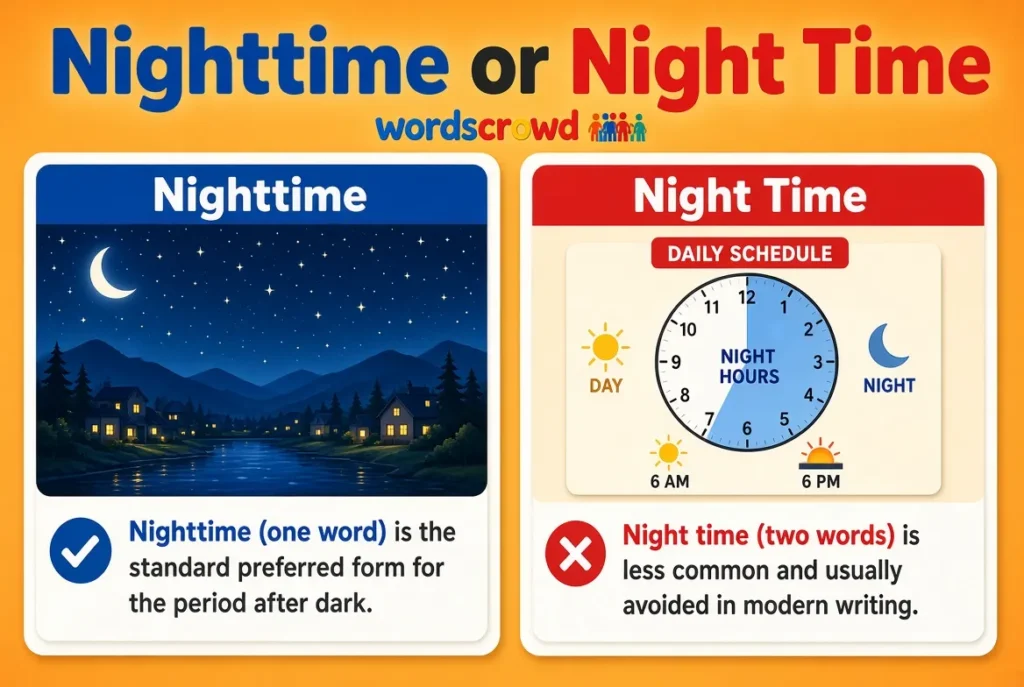
Have you ever typed “nighttime” and wondered whether it should actually be written as “night time”?
You are not alone. Both forms appear in English, and the difference can seem surprisingly confusing because the phrase combines two ordinary words: night and time.
The good news is that this is not a case of one spelling being completely right and the other being completely wrong.
“Nighttime” is a standard compound word, while “night time” can also appear when the writer is treating the two words as separate words.
In modern everyday English, however, nighttime is usually the most natural choice when you mean “the period of the night.”
This small spelling choice matters because compound words often develop gradually in English.
A combination may begin as two separate words, become hyphenated, and eventually settle into a closed compound. The same pattern can be seen in words such as daytime, weekend, and lifetime.
In this guide, you will learn exactly when to use nighttime and when night time may be appropriate, how the forms differ grammatically, how American and British English handle them, whether night-time is correct, how to use the word in professional and academic writing, and how to avoid common mistakes.
Quick Answer
Nighttime is the standard one-word spelling when you mean the period of the night or the time when it is dark.
- Nighttime = the usual modern spelling.
- Night time = possible when night and time are functioning separately, but it is much less common for the general meaning “the period of night.”
- Night-time = a hyphenated form that can be found, especially in some British or editorial contexts, but it is not usually necessary in ordinary modern writing.
Best choice: Use nighttime in most everyday, professional, and general-purpose writing.
Nighttime or Night Time: At a Glance
| Feature | Nighttime | Night time |
|---|---|---|
| Spelling | One word | Two words |
| Basic meaning | The period of night | Night + time treated separately |
| Part of speech | Usually noun or adjective | Usually a phrase rather than a fixed compound |
| Commonness | Very common | Less common for the general meaning |
| Natural in everyday English | Yes | Usually less natural |
| Formal writing | Recommended | Use only when context calls for separate words |
| Academic writing | Usually preferred | Limited use |
| Business writing | Usually preferred | Rare |
| American English | Common | Less common in the compound sense |
| British English | Common | Also possible in limited contexts |
| Hyphenated form | Not normally needed | Night-time may occur in some styles |
| Example | “I work at nighttime.” | “The night time was unusually short.” |
| Best general choice | Nighttime | Usually avoid as the default spelling |
Quick rule: If you can replace the expression with “during the night” or “the period of night,” nighttime is normally the better choice.
What Does “Nighttime” Mean?
Nighttime is a noun that refers to the part of a day when it is night, especially the period after sunset and before sunrise.
It can also function as an adjective when it describes something associated with the night.
Nighttime as a Noun
As a noun, nighttime refers to the general period of darkness.
Examples:
- Nighttime is quieter than daytime.
- I prefer working during nighttime.
- The temperature drops sharply at nighttime.
- Some animals are more active at nighttime.
In these sentences, nighttime names a period.
You can often substitute “the night” or “during the night”, depending on the sentence.
Nighttime as an Adjective
Nighttime can also describe something that happens or is intended for the night.
Examples:
- nighttime activities
- nighttime temperatures
- nighttime driving
- nighttime entertainment
- nighttime routine
- nighttime traffic
- nighttime photography
Here, nighttime modifies another noun.
For example:
The city has strict nighttime traffic rules.
In this sentence, nighttime tells us what kind of traffic rules are being discussed.
The Origin and Development of “Nighttime”
English has a long history of turning frequently paired words into compounds.
The word night is extremely old. It traces back through Middle English and Old English forms to the Germanic language family. It is related to words such as German Nacht and Dutch nacht.
Time is also an ancient English word, coming through Old English tīma and related Germanic forms.
When words such as night and time are frequently used together, English speakers naturally begin treating them as a single concept. That process is known as compounding.
English contains many compounds that have developed in similar ways:
- day + time → daytime
- life + time → lifetime
- bed + room → bedroom
- class + room → classroom
- news + paper → newspaper
- week + end → weekend
Not every compound develops at exactly the same speed or follows the same spelling history. That is why English still contains many compounds that may appear as one word, two words, or a hyphenated form depending on usage and editorial style.
For modern general writing, nighttime is the established closed compound.
How to Pronounce “Nighttime”
Nighttime is pronounced essentially like the two words night and time spoken together:
NIGHT-time
A simple phonetic representation is approximately:
/ˈnaɪt.taɪm/
The first syllable receives the main stress.
Because the spelling is closed, it does not mean that the pronunciation changes dramatically from night time. The main difference is grammatical and stylistic rather than phonetic.
Is “Nighttime” One Word?
Yes.
When written as nighttime, it is a single compound word.
For example:
I enjoy nighttime photography.
You should not insert a space simply because the word contains two recognizable concepts.
What Does “Night Time” Mean?
Night time consists of the separate nouns night and time. Although the two-word form can occur, it is not normally the preferred spelling when you simply mean the period of night.
This distinction is important.
Compare:
Nighttime is peaceful.
with:
The night time was shorter than expected.
The first sentence uses nighttime as an established compound meaning the period of night.
The second sentence can be understood as treating night and time as separate elements. However, in ordinary modern English, many editors would rewrite it because nighttime is more natural.
Why Do People Write “Night Time”?
There are several reasons.
1. They are following the literal structure
A writer may think:
night + time = night time
That logic is understandable, but English compounds do not always follow simple mathematical rules.
2. They have seen the form elsewhere
Older publications, websites, signs, and regional writing can contain the two-word version.
3. They are influenced by other expressions
English commonly uses expressions such as:
- night shift
- night school
- night sky
- night train
- night bus
- night market
Because night often modifies another noun as a separate word, writers may naturally assume night time should also remain open.
4. They are trying to emphasize “time”
In unusual contexts, a writer may deliberately treat time as an independent noun.
For most general writing, however, nighttime is cleaner.
Nighttime vs Night Time: The Key Difference
The biggest difference is not meaning. It is word formation and usage.
Use “nighttime” when:
- You mean the general period of night.
- You are using the expression as a fixed concept.
- You want the standard modern spelling.
- You are writing an article, report, email, or website copy.
- You are using it as an adjective before another noun.
Examples:
- nighttime hours
- nighttime driving
- nighttime temperatures
- nighttime routine
- nighttime activities
Consider “night time” only when:
- The words genuinely function independently.
- You are discussing a specific kind of time associated with a night.
- The surrounding sentence makes the separate structure meaningful.
- A particular publication or style system requires that spelling.
Even then, nighttime will often be the more natural revision.
Editor’s tip: If you are unsure, choose nighttime unless your sentence clearly requires night and time to remain separate.
Nighttime as a Noun vs. Adjective
Understanding this distinction makes the spelling much easier.
“Nighttime” as a noun
When it names the period of night:
Nighttime can be beautiful in the countryside.
I usually read at nighttime.
The roads are quieter at nighttime.
“Nighttime” as an adjective
When it describes another noun:
We went on a nighttime walk.
The park has special nighttime lighting.
The researchers recorded nighttime temperatures.
The hotel offers nighttime security.
In these examples, nighttime works like a compound modifier.
Is “Nighttime” Formal or Informal?
Nighttime is neither slang nor unusually informal. It is a standard English word.
You can use it in:
- everyday conversation
- blogs
- journalism
- business writing
- educational materials
- professional reports
- general nonfiction
- websites
- academic prose when appropriate
That said, academic writers sometimes choose more precise expressions such as during the night, overnight, nocturnal, or during nighttime hours, depending on the subject.
For example:
Participants were monitored during the night.
may sound more precise in a research report than:
Participants were monitored at nighttime.
The best choice depends on the meaning you want.
Is “Nighttime” American or British English?
Nighttime is used in both American and British English.
It is not a spelling that belongs exclusively to the United States.
You may encounter several forms in English-language sources:
- nighttime
- night-time
- night time
But these forms are not equally common in every context.
American English
American English strongly favors nighttime as the closed compound.
Examples:
nighttime temperatures
nighttime activities
nighttime driving
nighttime entertainment
British English
British English also uses nighttime, although night-time can appear in some British publications and dictionaries or under particular editorial conventions.
This does not mean that British writers must use night-time.
There is no universal US rule saying:
Americans use nighttime, British speakers use night-time.
That would be too simple.
The actual situation is more flexible.
Best international choice: If you want a spelling that works naturally for a broad English-speaking audience, nighttime is an excellent choice.
Is “Night-Time” Correct?
Yes, night-time can be found in English.
The hyphenated form is not automatically a spelling error. However, it is generally less necessary in modern general-purpose writing than nighttime.
Hyphens are often used in English compounds when they improve clarity or reflect a particular editorial convention. But once a compound becomes well established as a single word, the closed form often becomes preferred.
Compare:
- nighttime
- daytime
- lifetime
These are all familiar closed compounds.
Should You Write “Night-time”?
If you are following a specific house style, dictionary preference, publication standard, or historical source, night-time may be appropriate.
Otherwise:
nighttime
is usually the simplest choice.
Grammar: Is “Nighttime” a Noun or Adjective?
It can be both, depending on the sentence.
As a noun
Nighttime is my favorite part of the day.
Here, nighttime names a period.
As an adjective
I enjoy nighttime photography.
Here, nighttime modifies photography.
English has many compound words that can work in more than one grammatical role. Context determines the function.
What Prepositions Work With “Nighttime”?
This is where natural English becomes more useful than memorizing a single rule.
“At nighttime”
This is grammatically possible and understandable.
The streets become quiet at nighttime.
However, many native speakers simply say:
The streets become quiet at night.
The shorter expression is extremely natural.
“During nighttime”
This is also possible.
The animals are active during nighttime.
But:
The animals are active during the night.
may sound smoother in many formal contexts.
“During the nighttime”
This is grammatically fine but can feel more deliberate or formal.
The temperature falls significantly during the nighttime.
“At night”
Do not forget the simplest option.
I work at night.
You do not need nighttime in every sentence.
Nighttime vs “At Night”
These expressions overlap, but they are not always interchangeable.
At night is usually an adverbial phrase describing when something happens.
I exercise at night.
Nighttime is a noun or adjective referring to the period or things associated with it.
Nighttime is peaceful here.
I enjoy nighttime walks.
A useful distinction is:
At night = when something happens.
Nighttime = the period or a quality associated with night.
20+ Real-Life Examples
The best way to understand compound-word usage is to see it in different settings.
Everyday Conversation
- I usually feel more creative at nighttime.
- The neighborhood is much quieter at night.
- Do you like nighttime walks?
- I don’t drive much at nighttime.
- The stars are especially bright at nighttime.
Text Messages
- Are you free tonight? I prefer nighttime plans.
- Let’s go for a nighttime walk.
- I love nighttime because everything feels calmer.
School and Education
- The class discussed how animals adapt to nighttime conditions.
- Our science project measures nighttime temperatures.
- The students observed nighttime animal behavior.
Business Writing
- The store will introduce new nighttime security procedures.
- Nighttime deliveries require advance approval.
- The company is reviewing nighttime staffing levels.
Professional Writing
- The report compares daytime and nighttime traffic patterns.
- Researchers recorded nighttime noise levels throughout the study.
- The equipment is designed for nighttime operation.
Academic Writing
- The study examined changes in nighttime activity among participants.
- Nighttime temperatures were consistently lower during the second observation period.
- The researchers identified a significant difference between daytime and nighttime behavior.
Social Media
- City lights hit differently during a nighttime adventure.
- Nighttime skies make every trip feel magical.
- Coffee tastes better during a quiet nighttime study session.
Travel Writing
- The city becomes especially lively during nighttime hours.
- Visitors can explore several nighttime markets in the area.
Common Mistakes With “Nighttime” and “Night Time”
Mistake 1: Assuming “night time” is always the standard spelling
Less preferred:
I love walking around during night time.
Better:
I love walking around during nighttime.
Or even more naturally:
I love walking around at night.
Mistake 2: Using “night-time” without a reason
Possible but unnecessary:
We offer night-time tours.
Simpler modern form:
We offer nighttime tours.
The hyphen is not needed in most ordinary contexts.
Mistake 3: Thinking “nighttime” is only an adjective
Incorrect assumption:
Nighttime can never stand alone.
Correct:
Nighttime is peaceful in the mountains.
Here, nighttime is a noun.
Mistake 4: Using “at nighttime” when “at night” is much more natural
Awkward:
I usually sleep at nighttime.
More natural:
I usually sleep at night.
The first sentence is understandable, but the second is simpler.
Mistake 5: Treating British and American spelling as completely different
Misconception:
“Nighttime” is American, while “night-time” is British.
Reality: Both varieties use different forms depending on context and editorial preference. Nighttime is widely understood and used across English varieties.
Mistake 6: Overusing the compound
You do not need to replace every occurrence of night with nighttime.
Compare:
I went out at night.
This is more natural than:
I went out at nighttime.
But:
I enjoy nighttime photography.
Here, nighttime is useful because it describes the type of photography.
Nighttime in Professional Writing
In professional writing, consistency matters more than choosing an exotic spelling.
If your document uses nighttime, continue using nighttime throughout.
This is particularly useful in:
- policies
- schedules
- safety instructions
- business reports
- technical documentation
- operating procedures
- marketing copy
- healthcare communication
- transportation documents
For example:
Nighttime security staff must complete the inspection before 11 p.m.
The closed compound is concise and easy to scan.
Nighttime in Academic Writing
Academic writing often values precision over conversational style.
You can use nighttime when it is the clearest term:
The experiment measured nighttime activity.
However, researchers may sometimes prefer more specific expressions:
- during the night
- overnight
- nocturnal activity
- nighttime hours
- after sunset
- before sunrise
The choice should reflect the actual research meaning.
For example, nocturnal can be more technical because it specifically relates to activity occurring at night.
The study examined nocturnal behavior.
But nocturnal should not be used merely to make writing sound academic. If nighttime behavior is clearer for your audience, use it.
Nighttime Collocations You Should Know
A collocation is a combination of words that commonly occur together.
Common expressions with nighttime include:
- nighttime activities
- nighttime hours
- nighttime driving
- nighttime temperatures
- nighttime traffic
- nighttime routine
- nighttime photography
- nighttime entertainment
- nighttime security
- nighttime operations
- nighttime events
- nighttime behavior
- nighttime environment
- nighttime lighting
- nighttime conditions
- nighttime visibility
- nighttime workers
- nighttime economy
- nighttime noise
- nighttime travel
Learning these combinations can help you write more naturally.
Nighttime vs Overnight
These words are related but not identical.
Nighttime refers broadly to the period of night.
The city looks beautiful at nighttime.
Overnight usually describes something that happens, remains, travels, or lasts through the night.
We stayed overnight.
The package arrived overnight.
So:
nighttime = the period of night
overnight = occurring or continuing through the night
Nighttime vs Nocturnal
These terms also overlap but have different tones.
Nighttime is ordinary, accessible English.
nighttime activities
Nocturnal is more formal or scientific and often describes organisms or behavior associated with night.
nocturnal animals
For a general audience, nighttime is usually easier to understand.
For scientific writing, nocturnal may be more precise when discussing biological behavior.
Is “Nighttime” One Word in Dictionaries?
Yes. Major English dictionaries recognize nighttime as a word.
This is important because dictionary treatment provides strong evidence that the closed compound is established in modern English.
Dictionaries such as Merriam-Webster, Cambridge Dictionary, Oxford English Dictionary, and Collins document English vocabulary and usage, although individual dictionaries may differ in how they present variants, labels, examples, or historical forms.
A dictionary is useful evidence, but it is not the only factor in deciding which form to use. Modern frequency, editorial style, grammar, audience, and context also matter.
Style Guides and Editorial Consistency
Different style systems may make slightly different decisions about compounds and hyphenation.
Professional editors commonly consider:
- Is the compound established?
- Could the spelling create ambiguity?
- Does the publication have a house style?
- Is the audience international?
- Is the compound being used as a noun or modifier?
- Does the chosen dictionary or style guide support the form?
For a general website, blog, business document, or educational article, nighttime is a strong default.
If your organization follows a specific style guide, however, follow that guide consistently.
Memory Tricks for “Nighttime” vs “Night Time”
Trick 1: Think of “daytime”
You probably already write:
daytime
not:
day time
Because daytime is a familiar compound.
The matching word is:
nighttime
Trick 2: One concept, one word
If you mean one clear concept—the period of night—think:
nighttime = one period = one word
Trick 3: The “daytime partner”
Remember this pair:
daytime ↔ nighttime
Both are standard closed compounds.
Trick 4: Use “at night” when you need simplicity
If you are unsure whether nighttime fits naturally, ask whether at night works.
I study at night.
No compound is needed.
When Should You Use “Nighttime”?
Choose nighttime when you mean:
- the period of night
- something associated with night
- an activity occurring during the night
- a condition occurring at night
- a category or type related to night
Examples:
nighttime temperatures
nighttime travel
nighttime exercise
nighttime photography
nighttime security
nighttime noise
When Should You Use “Night Time”?
In ordinary modern writing, there are relatively few situations in which you need the two-word form.
If you find yourself writing night time, pause and ask:
Am I simply talking about the period of night?
If the answer is yes, nighttime will usually be the better choice.
If the two words are being used independently for a special contrast or rhetorical reason, keeping them separate may be defensible.
The key is not to treat every appearance of two words as a spelling mistake. English allows combinations of words to remain separate when grammar or meaning requires it.
Frequently Asked Questions
Is nighttime one word or two words?
Nighttime is normally written as one word when it means the period of night. It is the standard modern compound spelling for most general writing.
Is night time grammatically correct?
Night time can occur in English, but it is not usually the preferred spelling when you mean the general period of night. In most cases, nighttime is the cleaner choice.
Is nighttime or night-time correct?
Both forms can be found, but nighttime is generally the simplest modern spelling. Night-time may appear in some British or editorial styles.
Is nighttime American or British English?
Nighttime is used in both American and British English. It is not exclusive to either variety. British publications may also use the hyphenated night-time in some contexts.
Should I write “at nighttime” or “at night”?
Both can be grammatical, but at night is usually more natural and concise in everyday English.
I study at night.
is generally preferable to:
I study at nighttime.
Is “nighttime” formal English?
Yes. Nighttime is a standard English word and is suitable for formal writing. However, expressions such as during the night, overnight, or nocturnal may be more appropriate in specific professional or academic contexts.
Should “nighttime” be capitalized?
Normally, no. It is a common noun or adjective and does not require capitalization.
Correct:
We enjoy nighttime walks.
It is capitalized only when it begins a sentence or appears in a title according to the title’s capitalization style.
Is “nighttime” hyphenated?
Usually, no. The common modern form is nighttime. The variant night-time can appear in some sources and style systems.
What is the difference between nighttime and overnight?
Nighttime refers to the period of night. Overnight usually describes something that occurs, continues, remains, or travels through the night.
Final Verdict: Nighttime or Night Time?
If you came here looking for a simple answer, here it is:
Use “nighttime” as your default spelling.
It is a standard compound word, it is widely used in both American and British English, and it works naturally in everyday, professional, educational, and general-purpose writing.
Use nighttime for:
- the period of night
- nighttime activities
- nighttime temperatures
- nighttime driving
- nighttime photography
- nighttime security
- nighttime events
- nighttime behavior
Use at night when that sounds more natural:
I work at night.
The children sleep at night.
We went outside at night.
Use night-time only when:
- a particular publication or style guide prefers it,
- you are following an established house style,
- or you are preserving a source’s original spelling.
Use night time cautiously
The two-word form is not automatically impossible, but it is generally not the best default choice when you simply mean “the period of night.”
Best general rule: nighttime is one word.
English compounds can be confusing because spelling does not always follow a simple formula. But once you recognize nighttime as an established compound—just like daytime and lifetime—the choice becomes much easier.
For most readers, writers, editors, students, bloggers, and professionals, nighttime is the safe, natural, modern choice.