If you have ever written a sentence such as “Our website has dozens of how tos,” you may have stopped and wondered:
Should it be “how tos,” “how-tos,” or “how-to’s”? English has a talent for making simple expressions surprisingly complicated.
The confusion happens because how to is normally written as two words when it introduces an instruction: how to cook rice, how to fix a bike, or how to write an essay.
But English also uses how-to as a noun and as a compound adjective. Once it becomes a noun meaning an instructional guide, the spelling and plural form change.
So, what should you write?
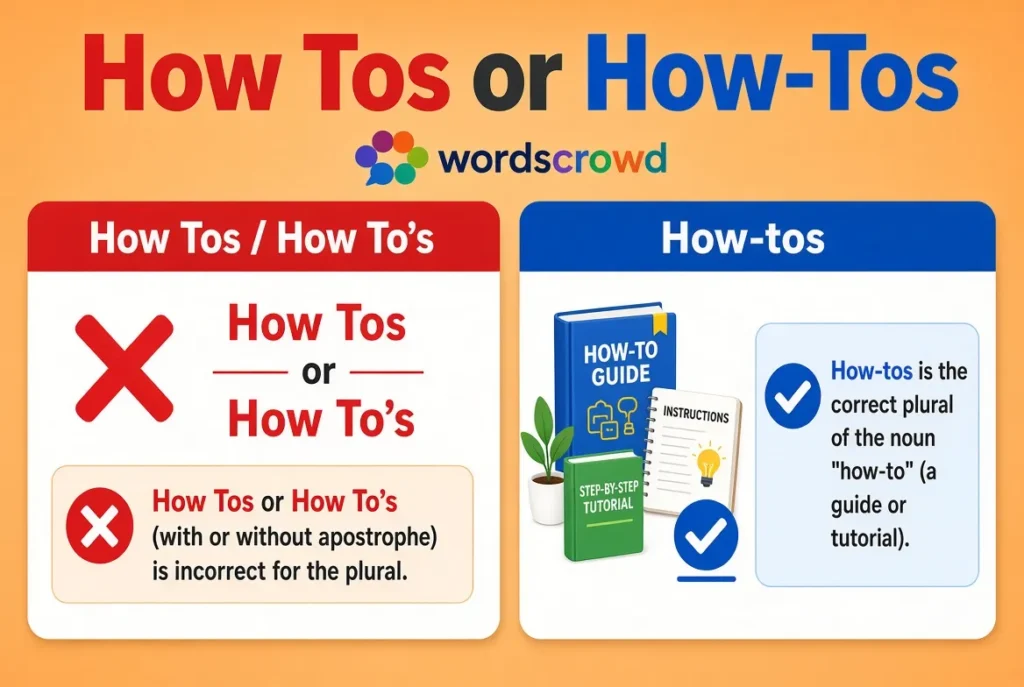
The standard modern plural form is how-tos.
Major dictionaries such as Merriam-Webster and Cambridge list how-to as a noun and give how-tos as its plural.
This guide explains the difference between how tos and how-tos, when the hyphen belongs, why the apostrophe is usually unnecessary, how how to works in ordinary sentences, and which form is best for blogs, websites, academic writing, business communication, and everyday English.
Whether you are an ESL learner, blogger, student, editor, teacher, or professional writer, you will have a clear answer by the end.
Quick Answer
How-tos is the preferred modern plural form when you mean multiple instructional guides, tutorials, or pieces of practical advice.
- Singular: a how-to
- Plural: how-tos
- Adjective: a how-to guide
- Verb phrase: learn how to write
- Usually avoid: how to’s
- Usually avoid in polished writing: how to’s / how-to’s as a plural
For example:
The website publishes several how-tos every month.
Merriam-Webster lists how-to as both an adjective and noun, while Cambridge specifically gives the plural as how-tos.
How Tos or How-Tos: At a Glance
| Feature | How tos | How-tos |
|---|---|---|
| Standard modern plural | Not preferred | Preferred |
| Singular form | how-to | how-to |
| Meaning | Multiple instructional pieces | Multiple instructional pieces |
| Hyphen | Missing | Used |
| Apostrophe | None | None |
| Part of speech | Informal/open construction | Compound noun |
| Example | I read several how tos. | I read several how-tos. |
| Professional writing | Less desirable | Recommended |
| Blog writing | Understandable | Best choice |
| Academic writing | Better reworded | Acceptable |
| Meaning | Intended to mean tutorials | Tutorials/guides |
| Possessive form | — | the how-to’s structure |
| Recommended plural | No | how-tos |
Quick rule: When how-to is being used as a noun meaning “an instructional guide,” make it plural by adding -s: how-tos.
What Does “How-To” Mean?
A how-to is an instructional guide that explains how to perform a task or accomplish something.
It can refer to a written article, video, manual, tutorial, guide, or another form of practical instruction.
For example:
- a how-to on baking bread
- a how-to guide for beginners
- a how-to video about photography
- several how-tos about home repairs
Merriam-Webster defines how-to as a noun referring to a practical method or instruction, and also uses it as an adjective for something that provides practical instruction.
Cambridge likewise treats how-to as both an adjective and a countable noun and gives how-tos as the plural.
The Basic Meaning
Think of how-to as a shortened form of:
something that explains how to do something
For example:
I found a how-to for repairing my laptop.
Here, how-to is a noun.
You could expand the sentence:
I found a guide explaining how to repair my laptop.
The shorter noun how-to is simply more convenient.
Why Do People Write “How Tos”?
The form how tos appears because writers naturally remember the original expression how to as two words.
Consider these ordinary sentences:
- I know how to swim.
- She learned how to drive.
- He explained how to install the software.
- We discussed how to improve the website.
In each sentence, how to is a grammatical phrase—not a noun.
When writers want to turn that expression into the name of an instructional guide, however, English treats it as a compound noun:
how-to
That is why the plural becomes:
how-tos
rather than simply:
how tos
The distinction is small visually but important grammatically.
How-Tos: The Preferred Plural Form
How-tos is the clearest standard choice when you mean more than one instructional guide.
Examples:
The website contains hundreds of how-tos.
I bookmarked three how-tos about photography.
Our editors are preparing new how-tos for beginners.
The magazine publishes practical how-tos every weekend.
The plural is formed by adding -s to the compound noun:
how-to → how-tos
This follows a familiar pattern in English compound nouns:
- follow-up → follow-ups
- check-in → check-ins
- write-up → write-ups
- know-how → know-hows
- how-to → how-tos
Merriam-Webster’s current dictionary and thesaurus entries explicitly recognize how-tos as the plural of how-to.
Why Is There No Apostrophe in “How-Tos”?
The most important grammar point is simple:
Apostrophes do not normally make ordinary nouns plural.
An apostrophe usually indicates:
- possession
- a contraction
- certain special cases involving individual letters, symbols, or unusual forms
For example:
- one guide → two guides
- one book → two books
- one tutorial → two tutorials
- one how-to → two how-tos
The s is simply a plural marker.
There is no possession involved.
Compare These Forms
Plural:
The site has many how-tos.
Possessive:
The how-to’s introduction is easy to follow.
In the second sentence, how-to’s can be interpreted as a possessive form: the introduction belongs to the how-to.
That is a completely different grammatical job.
how-tos = more than one how-to
how-to’s = something belonging to a how-to
This distinction is one reason the apostrophe should not be added merely to make the word plural.
“How To” Without a Hyphen: When Is It Correct?
This is where things get especially interesting.
How to is absolutely correct when it forms part of a normal grammatical construction.
For example:
I don’t know how to start.
She showed me how to use the camera.
They explained how to solve the problem.
Do you know how to contact the manager?
Here, how to is not a noun. It introduces an infinitive construction.
The hyphen would be wrong.
You would not write:
I don’t know how-to start.
That changes the grammatical structure.
How to + Verb
The common structure is:
how to + base verb
Examples:
- how to cook
- how to write
- how to learn
- how to drive
- how to study
- how to calculate
- how to communicate
- how to improve
In these expressions, how to should remain two separate words.
Correct: She taught me how to swim.
Incorrect: She taught me how-to swim.
When Should “How-To” Be Hyphenated?
The hyphen is appropriate when how-to functions as a compound adjective before a noun or as a noun referring to an instructional guide.
Before a Noun
Examples:
- how-to guide
- how-to article
- how-to video
- how-to book
- how-to manual
- how-to course
- how-to website
- how-to tutorial
For example:
I watched a how-to video about gardening.
She published a how-to article for new writers.
We created a how-to guide for customers.
The hyphen helps readers recognize that how-to works together as one modifier.
Cambridge specifically gives examples such as how-to book, how-to guide, and how-to article.
As a Noun
When the term itself means an instructional guide, use:
a how-to
and, for more than one:
several how-tos
For example:
This magazine contains a useful how-to on gardening.
The website has hundreds of how-tos.
How-Tos vs. How-To’s
This is the comparison many writers actually want.
How-Tos
How-tos is the preferred modern plural form.
Example:
Our blog publishes new how-tos every Friday.
Here, the s simply makes the noun plural.
How-To’s
How-to’s is sometimes encountered as a plural, particularly in older or informal writing, but it is not the best choice for modern professional copy.
Some dictionaries and usage discussions have historically allowed apostrophe forms for unusual expressions, which helps explain why you may see how-to’s in published material. Older English conventions sometimes used apostrophes in certain plural forms.
However, current dictionary evidence gives how-tos as the straightforward plural.
Best Practice
If you are writing for:
- a professional website
- a blog
- a business
- a newspaper
- an academic audience
- a marketing campaign
- a technical publication
use:
how-tos
rather than:
how-to’s
How-Tos vs. How Tos: The Real Difference
The difference is primarily about compound-word treatment.
“How to”
Two words when it is part of a grammatical phrase:
Learn how to code.
“How-to”
Hyphenated when it functions as a compound modifier or noun:
Read this how-to guide.
“How-tos”
Hyphenated plural noun:
We published five how-tos.
This gives you a useful three-part rule:
how to = grammatical phrase
how-to = compound noun/adjective
how-tos = plural compound noun
How-To as an Adjective
A how-to can describe something that provides instructions.
Examples:
I bought a how-to book.
She watched a how-to video.
We need a simple how-to guide.
The company created a how-to manual.
In these examples, how-to describes the noun that follows it.
Why the Hyphen Helps
Without the hyphen, the reader may initially interpret how and to as separate grammatical elements.
Compare:
how to guide the team
This means something different from:
a how-to guide
The first is a normal phrase involving the verb guide.
The second means a guide that teaches someone how to do something.
That tiny hyphen can therefore improve readability.
How-To as a Noun
When how-to stands alone as a noun, it means an instructional piece.
Examples:
I found a useful how-to online.
This is the best how-to I’ve seen on the subject.
The course includes a beginner-friendly how-to.
She wrote a detailed how-to about home gardening.
Its plural is:
how-tos
For example:
The website contains dozens of practical how-tos.
How-Tos in Professional Writing
Professional writers should generally choose how-tos when referring to multiple instructional resources.
For example:
The customer portal contains product manuals, FAQs, and how-tos.
This sounds natural and concise.
However, sometimes guides, tutorials, or instructions may be even better.
Choose “How-Tos” When:
- the audience is familiar with online content
- the tone is friendly
- the material is practical
- you are discussing a collection of instructional resources
- you want concise web copy
Choose “Guides” When:
- the audience is formal
- you are writing a report
- clarity is more important than conversational style
- the material is comprehensive
Choose “Tutorials” When:
- the content teaches a process
- the audience expects technical terminology
- the content is interactive or instructional
For example:
Our website offers how-tos for beginners.
sounds more conversational than:
Our website offers instructional manuals for beginners.
Neither is inherently wrong. The choice depends on tone and context.
How-Tos in Academic Writing
In academic writing, how-tos is grammatically acceptable, but it may not always be the strongest stylistic choice.
Academic writing often favors precise terms such as:
- instructional guides
- procedural guides
- tutorials
- instructional materials
- practical guides
- step-by-step instructions
Instead of:
The study analyzed popular online how-tos.
you might write:
The study analyzed popular online instructional guides.
However, if how-tos is the actual term used by the source, community, or research topic, there is no grammatical reason to avoid it.
The key is register.
Conversational: The website has dozens of how-tos.
Formal: The website provides dozens of instructional guides.
How-Tos in Blogs and SEO Content
For blogs, how-tos is particularly useful because readers immediately understand the meaning.
Examples:
- beginner how-tos
- DIY how-tos
- cooking how-tos
- writing how-tos
- photography how-tos
- gardening how-tos
- SEO how-tos
- technology how-tos
Search engines can understand all of these expressions, but writers should prioritize natural language rather than repeating the same phrase excessively.
Instead of:
Read our how-tos. Our how-tos cover SEO. These how-tos explain SEO.
write:
Explore our practical how-tos, tutorials, and step-by-step guides for improving your SEO skills.
That gives readers more useful vocabulary and avoids repetitive copy.
20 Real-Life Examples
Here are original examples showing how each form works.
Everyday Conversation
- “I found a great how-to on fixing my bicycle.”
- “Do you know how to change the tire?”
- “She saved several how-tos for her weekend project.”
- “Can you show me how to install this app?”
School and Education
- “Our teacher shared a how-to guide for writing research papers.”
- “The students watched several how-to videos before starting the experiment.”
- “I need to learn how to format my references correctly.”
Business
- “The company created a how-to manual for new employees.”
- “Our support team publishes helpful how-tos for customers.”
- “Please explain how to submit the expense report.”
- “I’ve attached a short how-to guide for setting up your account.”
- “Could you send me the instructions on how to access the portal?”
Professional Writing
- “The publication regularly features practical how-tos for small-business owners.”
- “This article explains how to create an effective content calendar.”
Social Media
- “Just posted three new how-tos for beginner photographers!”
- “Does anyone know how to make this recipe?”
Technology
- “The site offers detailed how-tos for configuring popular software.”
- “I watched a tutorial explaining how to reset the device.”
Daily Life
- “We need a simple how-to for assembling the new bookshelf.”
- “He searched online to learn how to repair the leaking tap.”
Notice the pattern: how-tos works when the expression acts as a plural noun, while how to remains two words when it introduces an action.
Common Mistakes With “How Tos”
Mistake 1: Writing “How To’s” as a Simple Plural
Wrong for standard modern usage:
The website has several how to’s.
Better:
The website has several how-tos.
The apostrophe is not needed to make the noun plural.
Mistake 2: Dropping the Hyphen in the Compound Noun
Less preferred:
We published several how tos.
Better:
We published several how-tos.
The hyphen signals that the expression is being treated as a compound noun.
Mistake 3: Hyphenating “How To” in a Normal Sentence
Incorrect:
She taught me how-to cook.
Correct:
She taught me how to cook.
Here, how to is part of an infinitive construction.
Mistake 4: Confusing “How-To” With “How to”
Compare:
This is a how-to guide.
and:
This guide explains how to bake bread.
The first uses how-to as a compound modifier.
The second uses how to as part of the sentence’s grammar.
Mistake 5: Using “How-To’s” When You Mean Possession
If you write:
The how-to’s introduction is confusing.
you may be expressing possession: the introduction of the how-to.
For the plural, however:
The how-tos are easy to follow.
That distinction matters.
How to Use the Apostrophe Correctly
Apostrophes are often misunderstood because they appear in many different grammatical situations.
Possession
The how-to’s author included helpful illustrations.
This means the author of the how-to.
Plural
The website contains ten how-tos.
No apostrophe.
Contraction
The apostrophe can also show missing letters:
do not → don’t
cannot → can’t
it is → it’s
But how-to’s is not a contraction.
Therefore, if you simply want to say “more than one how-to,” write:
how-tos
How-To, How-Tos, and “How To”: Grammar Explained
The easiest way to understand the forms is to identify the grammatical role.
| Form | Grammatical role | Example |
|---|---|---|
| how to | grammatical phrase | I know how to swim. |
| how-to | compound adjective | a how-to article |
| how-to | compound noun | I read a how-to. |
| how-tos | plural compound noun | I read several how-tos. |
| how-to’s | possessive in appropriate context | The how-to’s author |
This distinction solves most usage problems.
Is “How-To” a Noun or Adjective?
It can be either, depending on context.
Noun
I found a useful how-to.
Adjective
I found a useful how-to guide.
In the second example, how-to modifies guide.
That flexibility is one reason the term is so common in modern English.
US vs UK English
There is no major US-versus-UK disagreement over the basic plural form.
Both American and British English dictionaries recognize how-to and how-tos.
Cambridge’s English Dictionary gives how-to as a noun and lists how-tos as the plural.
Merriam-Webster, a major American dictionary, likewise lists how-to as a noun and recognizes how-tos as its plural.
So you do not need to switch to how tos simply because your audience is British or American.
US: how-tos
UK: how-tos
The main difference is not regional. It is grammatical and stylistic.
Is “How-To” Capitalized?
Usually, how-to is lowercase unless it appears at the beginning of a sentence or in a title where your chosen title style requires capitalization.
Examples:
I wrote a how-to guide.
The website publishes how-tos.
In a title, capitalization depends on the style you follow:
How-Tos for Beginners
or
How-tos for Beginners
Both can appear depending on house style and title-case rules.
The important thing is consistency.
Is “How-To” Hyphenated Before a Noun?
Yes, when it functions as a compound modifier, how-to is normally hyphenated.
Examples:
- how-to guide
- how-to article
- how-to video
- how-to book
- how-to course
- how-to manual
This makes the relationship between the words easier to read.
how-to guide
is immediately understood as a type of guide.
What About “How-To Guide”?
You may wonder whether how-to guide contains a redundant meaning because a how-to already means a guide.
Not necessarily.
How-to guide is an established and natural compound phrase.
For example:
We created a beginner-friendly how-to guide.
Here, how-to describes the type of guide.
It is similar to expressions such as:
- user guide
- study guide
- reference guide
- training guide
The phrase is clear and widely understood.
Better Alternatives to “How-Tos”
Sometimes the best edit is not choosing between how tos and how-tos, but replacing the expression entirely.
Depending on your audience, consider:
- guides
- tutorials
- instructions
- walkthroughs
- manuals
- step-by-step guides
- instructional articles
- practical guides
- learning resources
- explainers
Example
Instead of:
Our site has 50 how-tos about gardening.
You could write:
Our site has 50 gardening guides and tutorials.
That may be more descriptive and more natural for a formal audience.
Memory Tricks for “How-Tos”
Here are several easy ways to remember the correct form.
Trick 1: Treat “How-To” Like “Follow-Up”
Think:
follow-up → follow-ups
how-to → how-tos
No apostrophe is needed.
Trick 2: Apostrophe Means Ownership
Ask:
“Am I showing possession?”
If the answer is no, you probably do not need an apostrophe.
several how-tos = plural
the how-to’s title = possession
Trick 3: Think “Tutorials”
If you can replace how-tos with tutorials, use the plural:
The website has many tutorials.
Therefore:
The website has many how-tos.
Trick 4: Remember the Three Forms
Memorize this:
how to = action
how-to = guide
how-tos = guides
That one line covers most situations.
A Simple Decision Guide
When you’re unsure which form to use, follow these steps.
- Are you describing an action?
Use how to.She learned how to drive. - Are you describing an instructional guide?
Use how-to.She bought a how-to book. - Are you talking about multiple instructional guides?
Use how-tos.She downloaded several how-tos. - Are you showing possession?
A possessive how-to’s may be appropriate.The how-to’s author explained the process. - Are you writing formal content?
Consider replacing how-tos with guides, tutorials, or instructions if that better suits the tone.
FAQ: How Tos or How-Tos?
Is “how-tos” grammatically correct?
Yes. How-tos is the standard modern plural of the noun how-to. Merriam-Webster and Cambridge both recognize the form.
Is “how tos” correct?
You may encounter how tos, but how-tos is the clearer and preferred form when you mean the plural noun for instructional guides. The hyphen identifies the expression as a compound term.
Is “how-to’s” correct?
As a simple plural, how-to’s is not the preferred modern form. Use how-tos instead. An apostrophe can be appropriate when how-to is being made possessive.
Is “how to” always written as two words?
No. It depends on its grammatical function. In a sentence such as “I know how to cook,” it is two words. When it functions as the noun or compound modifier how-to, it is hyphenated.
What is the plural of “how-to”?
The preferred plural is how-tos.
one how-to → two how-tos
Cambridge explicitly lists how-tos as the plural.
Should I write “how-to guide” or “how to guide”?
Use how-to guide when you mean a guide that teaches someone how to do something.
This is a how-to guide for beginners.
But use how to guide when guide is functioning as a verb:
She will how to guide the team.
That second construction is unusual and would normally be rewritten, such as:
She will explain how to guide the team.
Is “how-tos” suitable for professional writing?
Yes, especially in websites, customer support, marketing, technical communication, and other practical contexts. For highly formal academic writing, guides, tutorials, or instructional materials may sometimes sound more polished.
Should “how-to” be capitalized?
Normally, no. Use lowercase in ordinary prose:
We published several how-tos.
Capitalization depends on sentence position and the title style used by your publication.
Is “how-tos” American or British English?
It is used in both. The basic plural form is not a significant US-versus-UK distinction. Cambridge and Merriam-Webster both recognize how-tos.
Final Verdict: How Tos or How-Tos?
If your question is “How tos or how-tos?”, the best answer is straightforward:
Use “how-tos” when you mean multiple instructional guides.
The core forms are:
| What you mean | Best form | Example |
|---|---|---|
| An action | how to | Learn how to cook. |
| One instructional guide | how-to | I found a useful how-to. |
| An instructional modifier | how-to | a how-to guide |
| Several instructional guides | how-tos | We published five how-tos. |
| Possession | how-to’s when genuinely possessive | The how-to’s author revised it. |
The biggest mistake is treating how to and how-to as though they always perform the same grammatical job. They do not.
When how to introduces an action, keep it open:
I learned how to swim.
When how-to describes or names an instructional resource, use the compound form:
I watched a how-to video.
And when you have more than one instructional resource, add the plural -s:
I watched several how-tos.
The easiest rule to remember
Action = how to.
Guide = how-to.
Guides = how-tos.
For modern professional English, that is the safest and clearest choice.
If your goal is polished web content, editorial writing, business communication, or educational material, how-tos is generally the form to choose rather than how tos or how-to’s. Current dictionary evidence strongly supports the hyphenated plural.
In short: write “how-tos.”

Elon Parker is a dedicated writer at Wordscrowd, creating clear, informative, and engaging content for readers.
With a focus on useful information, Elon aims to make every article simple, reliable, and easy to understand.