Afterward or afterwards—which one should you use?
If you have ever paused while writing a sentence such as “We went home afterward” or “We went home afterwards,” you are not alone.
Both forms look natural, both are found in dictionaries, and both mean essentially the same thing: at a later time or after something has happened.
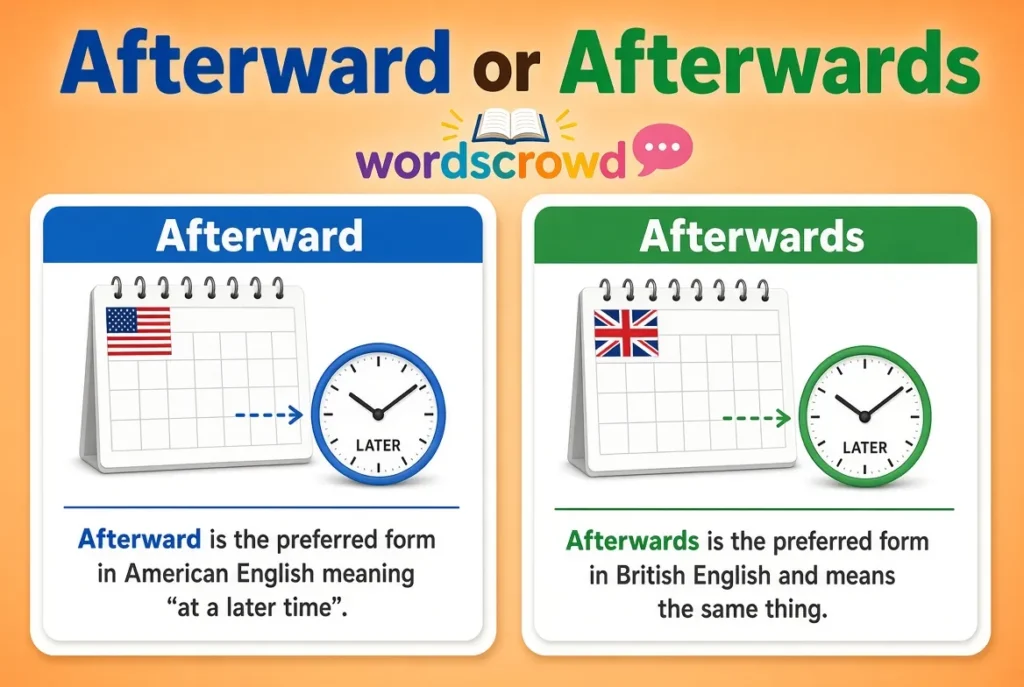
The real difference is not grammar or meaning. It is mainly regional preference. Afterward is the usual form in American English, while afterwards is especially common in British English.
Both are standard English, and neither is simply a “wrong” version of the other.
Cambridge identifies afterwards as mainly UK and afterward as the usual US form, while Oxford likewise labels afterwards as especially British and says North American English usually uses afterward.
That makes this a useful word-choice question rather than a simple right-versus-wrong grammar test. If you are writing for an American audience, afterward will usually feel more natural.
If you are writing for a British audience, afterwards is often the more familiar choice.
In this guide, you will learn exactly how afterward and afterwards differ, how they are pronounced, where each form is preferred, whether they are interchangeable, how to use them in academic and professional writing, and how to avoid common mistakes.
You will also get plenty of real-life examples so you can choose confidently every time.
Quick Answer
Afterward and afterwards are both correct. They have the same basic meaning: “at a later time” or “after something else has happened.”
- Afterward → preferred in American English
- Afterwards → especially common in British English
- Neither form is grammatically incorrect.
- For a consistent US style, choose afterward.
- For a consistent UK style, choose afterwards.
Afterward vs Afterwards: Quick Comparison
| Feature | Afterward | Afterwards |
|---|---|---|
| Meaning | At a later time | At a later time |
| Part of speech | Adverb | Adverb |
| Basic function | Shows a later event | Shows a later event |
| Grammar | Standard | Standard |
| US English | Usually preferred | Also possible |
| UK English | Possible | Especially common |
| Pronunciation | /ˈæftərwərd/ | /ˈɑːftəwədz/ in UK English |
| Formality | Neutral | Neutral |
| Meaning difference | None | None |
| Spelling difference | No final s | Has final s |
| Common use | “We talked afterward.” | “We talked afterwards.” |
| Academic writing | Correct | Correct |
| Business writing | Correct | Correct |
| Everyday speech | Very common in US English | Very common in UK English |
| Is it incorrect? | No | No |
| Best US choice | Afterward | — |
| Best UK choice | — | Afterwards |
| Easy memory | US often drops the s | UK often keeps the s |
Bottom line: The choice between afterward and afterwards usually tells your reader more about regional English than about grammar.
What Does “Afterward” Mean?
Afterward is an adverb meaning at a later time or after the event just mentioned.
For example:
We had dinner and went for a walk afterward.
The word afterward refers to the time following dinner. The sentence could be expanded to:
We had dinner and went for a walk after dinner.
But because dinner has already been mentioned, afterward provides a convenient way to refer back to the event.
Cambridge defines afterward as an adverb meaning “after the time mentioned” and identifies it as the usual American form, while Oxford’s American dictionary gives the same general meaning: at a later time, after an event that has already been mentioned.
Is “Afterward” a Word?
Yes. Afterward is a standard English word.
It is not a shortened, informal, or incorrect version of afterwards. It is a fully established adverb and is particularly common in American English.
Examples include:
- I called her afterward.
- We can discuss it afterward.
- He apologized afterward.
- What happened afterward?
- She felt better afterward.
How Do You Pronounce “Afterward”?
In American English, afterward is commonly pronounced approximately:
AF-ter-werd
Cambridge gives the US pronunciation as /ˈæf.tɚ.wɚd/.
The pronunciation can vary slightly by accent, so you do not need to imitate one exact sound to use the word naturally.
What Does “Afterward” Do in a Sentence?
Afterward normally works as an adverb of time.
It tells the reader or listener when something happened in relation to an earlier event.
Compare:
We went to the restaurant.
with:
We went to the restaurant afterward.
The second sentence tells us that the restaurant visit happened after an event already understood from context.
Common Uses of “Afterward”
You will often see afterward after verbs:
- talk afterward
- leave afterward
- return afterward
- apologize afterward
- meet afterward
- discuss it afterward
- think about it afterward
- regret it afterward
It can also appear at the beginning of a sentence:
Afterward, we went home.
Or in the middle:
We afterward discovered that the information was incorrect.
The final position is usually more natural in ordinary conversation:
We went home afterward.
“Soon Afterward” and “Shortly Afterward”
Two very common combinations are:
soon afterward
and
shortly afterward
Both mean that something happened not long after another event.
Examples:
She graduated and soon afterward found a job.
The company launched the product and shortly afterward announced a second version.
These combinations are useful in narratives, journalism, essays, reports, and general writing.
What Does “Afterwards” Mean?
Afterwards is also an adverb meaning at a later time or after something else has happened.
In other words, there is no basic meaning difference between afterward and afterwards.
Cambridge labels afterwards as mainly UK, while Oxford describes it as especially British English and notes that North American English usually uses afterward.
Examples:
We went out for coffee afterwards.
She called me afterwards.
What are you doing afterwards?
They discussed the decision afterwards.
Is “Afterwards” Grammatically Correct?
Yes.
Afterwards is completely standard English.
It is not a mistake, and the final -s does not make the word plural.
This is important because some learners assume that afterwards must be wrong because afterward looks simpler. That is not the case.
English has many adverbs ending in -ward or -wards, including:
- toward / towards
- backward / backwards
- forward / forwards
- upward / upwards
- downward / downwards
- afterward / afterwards
Regional and stylistic preferences vary from word to word, but the presence of -s does not automatically make an adverb incorrect.
How Do You Pronounce “Afterwards”?
In British English, Cambridge gives the pronunciation approximately as:
AHF-tuh-wudz
with the dictionary transcription /ˈɑːf.tə.wədz/.
In American English, afterwards can also be pronounced naturally, but afterward is generally the more usual form.
Common Uses of “Afterwards”
You can use afterwards in many of the same contexts as afterward:
We had lunch and went shopping afterwards.
She apologized afterwards.
I’ll call you afterwards.
They realized their mistake afterwards.
Afterwards, everyone went home.
The word is especially natural in British English conversation and writing.
Afterward or Afterwards: What Is the Actual Difference?
The most important point is simple:
There is generally no difference in meaning.
The distinction is primarily regional.
American English
American English generally favors:
afterward
For example:
We talked about it afterward.
This is the form you will commonly encounter in US-focused writing.
British English
British English commonly favors:
afterwards
For example:
We talked about it afterwards.
This sounds completely natural in British English.
Are Both Forms Interchangeable?
In terms of meaning, yes.
You can usually replace one with the other without changing the meaning of the sentence.
For example:
We went home afterward.
and:
We went home afterwards.
Both mean that the people went home at a later time, following an event already mentioned or understood.
The main thing that changes is the regional flavor of the sentence.
Tip: If you change from afterward to afterwards, you normally do not need to change anything else in the sentence.
Why Do Americans Say “Afterward” and British Speakers Often Say “Afterwards”?
This difference is part of a larger pattern in English involving -ward and -wards forms.
English has historically developed both versions of several directional or temporal adverbs. The exact distribution is not always identical across words, but regional preferences have developed over time.
Oxford traces afterwards to Old English æftewearde, associated with the idea of direction or position, and notes that its modern form was influenced by after.
So the -s in afterwards is not a random modern addition. The form has a long history in English.
Modern English simply settled into different preferences in different regions.
This is why it is better to think:
American preference: afterward
British preference: afterwards
rather than:
Correct: afterward
Incorrect: afterwards
That second interpretation is wrong.
Afterward vs Afterwards in US and UK English
Regional English is one of the biggest reasons people become confused about this pair.
In American English
Afterward is usually the safest choice.
Examples:
- I’ll call you afterward.
- We can talk about it afterward.
- She regretted the decision afterward.
- They went out for dinner afterward.
Afterwards is not necessarily incomprehensible or impossible in American English, but it is less typical.
In British English
Afterwards is especially common.
Examples:
- I’ll call you afterwards.
- We can talk about it afterwards.
- She regretted the decision afterwards.
- They went out for dinner afterwards.
Again, afterward is understandable and can occur in British writing, but afterwards is the more familiar regional choice.
Cambridge explicitly distinguishes the two forms this way: afterward is marked US, while afterwards is marked mainly UK.
Which Should International Writers Use?
There is no universal requirement.
Choose based on your audience:
- Writing for the United States? Use afterward.
- Writing for the United Kingdom? Use afterwards.
- Writing for an international audience? Either is clear.
- Following a house style? Follow the publication’s established preference.
- Writing a formal document? Consistency matters more than choosing one “correct” form.
Grammar: Are “Afterward” and “Afterwards” Adverbs?
Yes.
Both are adverbs, specifically adverbs that can indicate time.
They describe when something happens.
Consider:
We went shopping afterward.
The word afterward tells us when we went shopping.
Likewise:
We went shopping afterwards.
The word afterwards performs the same grammatical job.
What Is the Difference Between “After” and “Afterward”?
This is where grammar becomes more interesting.
After has several grammatical functions. It can work as a preposition, conjunction, and adverb.
For example:
We left after lunch.
Here, after is a preposition because it comes before the noun phrase lunch.
We left after the meeting ended.
Here, after introduces a clause.
But:
We had lunch and left afterwards.
Here, afterwards is an adverb referring back to the earlier event.
Cambridge’s grammar guidance explains that after can be used before a noun phrase or clause, while afterwards is used as an adverb and is more common than after when the adverb is used alone.
Compare These Sentences
After + noun:
We went home after dinner.
After + clause:
We went home after we finished dinner.
Afterward/afterwards + previous event:
We finished dinner and went home afterward.
or:
We finished dinner and went home afterwards.
All three structures are grammatical, but they are built differently.
“After” vs “Afterward” vs “Afterwards”
These three words are related, but they are not always interchangeable.
| Expression | Typical function | Example |
|---|---|---|
| after | Preposition/conjunction/adverb | We left after dinner. |
| afterward | Adverb | We left afterward. |
| afterwards | Adverb | We left afterwards. |
The easiest way to understand the distinction is this:
After often connects the later event directly to the earlier event.
Afterward/afterwards usually refers back to an event already established in the conversation or sentence.
Example
We had an important meeting. Afterward, we went for coffee.
The word afterward points back to the meeting.
You could instead say:
We went for coffee after the meeting.
Here, after directly introduces the meeting.
“Later” vs “Afterward” vs “Afterwards”
These words are close in meaning, but there can be a subtle difference in focus.
Afterward / Afterwards
Usually means after the event just mentioned.
We finished the exam and went for lunch afterward.
Later
Usually means at a later time, but it does not always directly emphasize the immediately preceding event.
I’ll call you later.
Cambridge notes that later or later on generally refers to a later time and may not imply the same close sequence as afterwards.
Compare:
She finished work and went home afterwards.
This clearly connects going home with finishing work.
She’ll call me later.
This simply says the call will happen at a later time.
“Afterward” and “Afterwards” in Formal Writing
Both forms are acceptable in formal writing.
You can use either in:
- reports
- essays
- business correspondence
- academic assignments
- articles
- professional documentation
- presentations
- formal narratives
However, regional consistency is a good editing practice.
If the rest of your document follows American English conventions, afterward will usually fit better.
If your document follows British English conventions, afterwards will usually fit better.
Academic Writing
Both are grammatically acceptable:
The researchers conducted a second experiment afterward.
The researchers conducted a second experiment afterwards.
The choice does not change the academic meaning.
In academic prose, you may sometimes choose subsequently when the context calls for a more formal tone.
For example:
The researchers subsequently conducted a second experiment.
Oxford labels subsequently as formal and defines it as meaning afterward or later, after something else has happened.
However, do not replace every instance of afterward with subsequently. The words are not always stylistically equivalent.
Afterward is plain, natural English.
Subsequently sounds more formal and is common in analytical or institutional writing.
Professional and Business Writing
In business writing, either afterward or afterwards can work.
For example:
I’ll send the revised document afterward.
Or:
I’ll send the revised document afterwards.
If you work with an American company, afterward may be the more natural choice.
If your organization follows British English, afterwards may fit better.
A More Formal Alternative
Sometimes subsequently or later may be preferable depending on meaning.
For example:
The contract was reviewed and subsequently approved.
This sounds more formal than:
The contract was reviewed and approved afterward.
But the more formal word is not automatically better. Good professional writing favors clarity and naturalness, not complicated vocabulary.
20+ Real-Life Examples of Afterward and Afterwards
The easiest way to master this distinction is to see the words in different situations.
Everyday Conversation
- I have to finish my homework first, but I’ll call you afterward.
- We grabbed some coffee afterwards.
- What are you doing afterward?
- She felt much better afterward.
- Let’s discuss the details afterwards.
Family and Friends
- We watched a movie and ordered pizza afterward.
- They went for a walk afterwards.
- I’ll tell you the whole story afterward.
- He apologized afterward, so we moved on.
- We laughed about it afterwards.
School and Education
- The students discussed the exam afterward.
- We went to the library afterwards to study.
- The teacher answered questions afterward.
- She realized her mistake only afterward.
Business
- I’ll send the report afterward.
- We can schedule a follow-up meeting afterwards.
- The manager spoke with the client afterward.
- The team reviewed the proposal afterwards.
Academic Writing
- The researchers examined the results afterward.
- The participants completed a questionnaire afterwards.
- The study was repeated shortly afterward.
- The researchers subsequently identified an additional pattern.
Social Media
- Coffee first, productivity afterward. ☕
- We survived the hike and celebrated afterwards!
- Best concert ever. Still smiling afterward.
Text Messages
- I’ll explain afterward.
- Let’s eat first and decide afterwards.
- Call me afterward.
Professional Email
- I’ll review the document and send my comments afterward.
- We can discuss the remaining questions afterwards.
Notice that the meaning remains the same when you switch the regional form:
I’ll review the document and send my comments afterward.
I’ll review the document and send my comments afterwards.
The difference is primarily regional preference, not grammar.
Common Mistakes With Afterward and Afterwards
Mistake 1: Thinking “Afterwards” Is Incorrect
Wrong idea:
“Afterwards” is grammatically wrong because the correct word is “afterward.”
Why this is wrong:
Afterwards is a standard English adverb. It is especially common in British English.
Correct:
We went home afterward.
Also correct:
We went home afterwards.
Mistake 2: Thinking “Afterward” Is Only American and Therefore Wrong in Britain
This is also too strong.
Afterward is particularly associated with American English, but it is not an unintelligible or inherently ungrammatical form in British English.
Regional preference does not mean exclusive ownership.
A British reader will understand:
We talked afterward.
Just as an American reader will understand:
We talked afterwards.
Mistake 3: Using “After” When “Afterward” Is Needed
Consider:
We finished the meeting and went for coffee after.
This may occur in informal English, but learners often find afterward/afterwards clearer and more natural when the word stands alone.
Better:
We finished the meeting and went for coffee afterward.
Or:
We finished the meeting and went for coffee afterwards.
Cambridge notes that after can function as an adverb, but afterwards is more common when this kind of standalone adverbial meaning is intended.
Mistake 4: Confusing “Afterward” With “Afterwards” as Different Meanings
There is no standard meaning distinction like:
afterward = immediately
afterwards = much later
That is not the rule.
Both can refer to a later time following an event.
For example:
We spoke afterward.
does not necessarily mean “immediately.”
Likewise:
We spoke afterwards.
does not necessarily mean “hours later.”
The exact timing comes from context.
Mistake 5: Assuming the “S” Makes It Plural
Afterwards is an adverb, not a plural noun.
The -s is part of the word’s established form.
So do not analyze it as:
afterward + plural s
English word formation is not always that simple.
What About “Soon Afterward” and “Soon Afterwards”?
Both are correct.
American style
The company launched the service and soon afterward expanded it.
British style
The company launched the service and soon afterwards expanded it.
Likewise:
Shortly afterward, the results were published.
and:
Shortly afterwards, the results were published.
Both versions are grammatical.
The same regional preference applies.
What About “Immediately Afterward” and “Immediately Afterwards”?
Again, both are correct.
American English:
She called me immediately afterward.
British English:
She called me immediately afterwards.
The adverb immediately provides the timing information. Afterward/afterwards identifies the sequence.
What About “Right Afterward” and “Right Afterwards”?
Both can be found, especially in conversational English.
I’ll call you right afterward.
I’ll call you right afterwards.
However, regional preferences still apply.
If you are writing in American English, right afterward will usually feel more natural.
If you are writing in British English, right afterwards is a natural choice.
What About “Afterward” at the Beginning of a Sentence?
Yes, you can place it at the beginning.
American English
Afterward, we went back to the hotel.
British English
Afterwards, we went back to the hotel.
This placement can be useful when you want to emphasize the sequence of events.
You can also put the adverb at the end:
We went back to the hotel afterward.
We went back to the hotel afterwards.
The final position is often especially natural in everyday English.
What About “Afterward” in the Middle of a Sentence?
It can occur in the middle, although sentence rhythm matters.
For example:
She afterward admitted that she had been nervous.
This is grammatical, but many speakers would naturally prefer:
She admitted afterward that she had been nervous.
Or:
Afterward, she admitted that she had been nervous.
Good writing is not only about grammatical possibility. It is also about what sounds natural in context.
Is “Afterwards” More Informal Than “Afterward”?
No.
This is a common misconception.
The difference between them is not primarily formal versus informal.
Instead:
- afterward → commonly associated with US English
- afterwards → especially associated with UK English
Both can appear in formal and informal contexts.
For example, a formal report might use:
The committee subsequently reviewed the evidence.
But it could also use:
The committee reviewed the evidence afterward.
And a casual conversation might use:
We went out afterwards.
The context determines formality more than the final s.
Which Is Better for SEO and Online Writing?
There is no grammatical SEO advantage to choosing one over the other.
If your website primarily targets:
United States
Use afterward naturally.
United Kingdom
Use afterwards naturally.
Global audience
You can use either. Readers will understand both.
More importantly, do not repeatedly force the exact phrase afterward or afterwards into unrelated sentences. Search engines do not need unnatural repetition to understand a simple vocabulary comparison.
A strong language article should cover related concepts naturally, including:
- afterward meaning
- afterwards meaning
- afterward vs afterwards
- American English
- British English
- adverb of time
- after vs afterward
- afterward pronunciation
- afterwards pronunciation
- correct usage
- regional spelling
- English grammar
- US vs UK English
- formal writing
- everyday English
Style Guides and Editorial Consistency
Professional editors usually care less about declaring one version “correct” and more about following the appropriate style consistently.
If your publication has a house style, follow it.
For example, a US publication may consistently use American spellings and vocabulary choices. A British publication may follow British conventions.
The same principle applies to many language pairs:
- color / colour
- center / centre
- toward / towards
- traveled / travelled
- afterward / afterwards
This does not mean every pair has exactly the same regional history or usage pattern. It simply illustrates why editorial consistency matters.
A Practical Editorial Rule
If you are editing a document and find both forms mixed together:
We discussed the problem afterward. We reviewed the solution afterwards.
There is no major grammar problem.
But if the document is clearly written for an American audience, you may want:
We discussed the problem afterward. We reviewed the solution afterward.
For a British audience:
We discussed the problem afterwards. We reviewed the solution afterwards.
The goal is consistency, not artificial correction.
Memory Tricks: How to Remember Afterward vs Afterwards
Here are some simple ways to remember the difference.
Memory Trick 1: Think “US Drops the S”
For a quick writing shortcut:
US → afterward
UK → afterwards
It is not an absolute rule about every speaker, but it is a useful practical guide.
Memory Trick 2: “British English Likes the Extra S”
When writing British English, remember:
after → afterwards
The extra s can help you remember the British preference.
Memory Trick 3: Meaning Stays the Same
Do not waste energy trying to memorize two definitions.
Instead remember:
Afterward = afterwards = later
Then memorize only the regional preference.
Memory Trick 4: Ask Where Your Reader Is
If you are unsure, ask:
“Who am I writing for?”
- Americans → afterward
- British readers → afterwards
- International readers → either
That question solves most real-world usage problems.
When Should You Use “Afterward”?
Choose afterward when:
- You are writing American English.
- Your audience is primarily in the United States.
- Your publication follows US English.
- You want consistency with other American vocabulary and spelling.
- You are writing an email, article, report, essay, or social post for a US audience.
Examples:
I’ll call you afterward.
We discussed the problem afterward.
She regretted it afterward.
When Should You Use “Afterwards”?
Choose afterwards when:
- You are writing British English.
- Your audience is primarily in the UK.
- Your publication follows British English.
- You want your word choice to sound naturally British.
- The surrounding text follows British conventions.
Examples:
I’ll call you afterwards.
We discussed the problem afterwards.
She regretted it afterwards.
When Should You Avoid Both?
Sometimes neither word is the best option.
If you need to identify the exact event, use after + noun:
We spoke after the meeting.
If you need to identify a specific later time:
We spoke two hours later.
If you are writing highly formal analytical prose and the sequence matters:
The company subsequently revised its policy.
The best word is the one that expresses the intended relationship clearly.
“Afterward” vs “Afterwards” vs “Subsequently”
These words overlap, but they are not identical in style.
| Word | Main idea | Style |
|---|---|---|
| afterward | later, after an event | Neutral |
| afterwards | later, after an event | Neutral |
| subsequently | later as a consequence or sequence | More formal |
| later | at a later time | Neutral |
| next | immediately following in sequence | Neutral |
| thereafter | after that point/event | Formal |
Oxford specifically labels subsequently as formal.
Example
She graduated and afterward moved to London.
Natural and neutral.
She graduated and afterwards moved to London.
Also natural, especially in British English.
She graduated and subsequently moved to London.
More formal and somewhat more detached.
She graduated and later moved to London.
Neutral, but less tightly tied to the immediately preceding event.
“Afterward” vs “Thereafter”
These are sometimes confused because both refer to time following something.
Afterward is everyday English:
We talked afterward.
Thereafter is more formal and often means from that time onward:
The agreement remained in effect thereafter.
So they are not perfect substitutes.
If you are chatting with a friend, afterward is usually more natural.
If you are drafting a legal, historical, or formal institutional document, thereafter may fit the context better.
Frequently Asked Questions
Is “afterward” or “afterwards” correct?
Both are correct. Afterward is usually preferred in American English, while afterwards is especially common in British English. Neither is a grammatical error.
Is “afterwards” British or American?
Afterwards is especially British, although it is also understood and used elsewhere. Cambridge describes it as mainly UK and notes that US English usually prefers afterward.
Is “afterward” American English?
Yes. Afterward is the usual American English form. It is also recognized outside the United States, so it should not be treated as an exclusively American word.
Do “afterward” and “afterwards” mean the same thing?
Yes. In ordinary usage, both mean at a later time or after something else has happened. The main difference is regional preference rather than meaning.
Is “afterwards” more formal than “afterward”?
No. Neither is inherently more formal. Both are neutral adverbs. The main distinction is US versus UK usage.
Can I use “afterwards” in American English?
Yes. Americans can use and understand afterwards, but afterward is generally the more typical American choice.
Can I use “afterward” in British English?
Yes. British readers understand afterward, although afterwards is especially common in British English.
Is “afterward” an adverb?
Yes. Afterward is an adverb of time. It tells us that something happens at a later time following an event already mentioned or understood.
Which is better for academic writing: “afterward” or “afterwards”?
Both are grammatically acceptable. Choose according to the English variety used by your institution, publisher, or target audience. For US academic writing, afterward is usually the natural choice; for UK academic writing, afterwards is often preferred.
Final Verdict: Afterward or Afterwards?
The answer is refreshingly simple:
Afterward and afterwards are both correct.
They have essentially the same meaning, and both function as adverbs meaning “at a later time” or “after something else has happened.”
The main difference is regional English:
- 🇺🇸 American English: afterward is usually preferred.
- 🇬🇧 British English: afterwards is especially common.
- 🌍 International English: either form is generally clear.
- ✍️ Professional writing: follow your audience, publisher, or house style.
- 🎓 Academic writing: both are grammatically valid; maintain regional consistency.
So, if you are writing for an American audience, write:
We discussed the issue afterward.
If you are writing for a British audience, write:
We discussed the issue afterwards.
And if you accidentally use the “other” form, do not panic. You have not made a serious grammar mistake.
The One-Line Rule to Remember
Afterward = US preference. Afterwards = UK preference. Both are correct.
Once you understand that, the afterward or afterwards question becomes much easier. The important thing is not to hunt for a winner where English has given us two legitimate forms. Instead, choose the version that fits your audience and keep your writing consistent.

Elon Parker is a dedicated writer at Wordscrowd, creating clear, informative, and engaging content for readers.
With a focus on useful information, Elon aims to make every article simple, reliable, and easy to understand.