Have you ever typed “envolved” and wondered whether it is actually a word? You are not alone. The confusion usually happens because involved is pronounced in a way that can make the spelling feel less obvious, especially for English learners and people writing quickly.
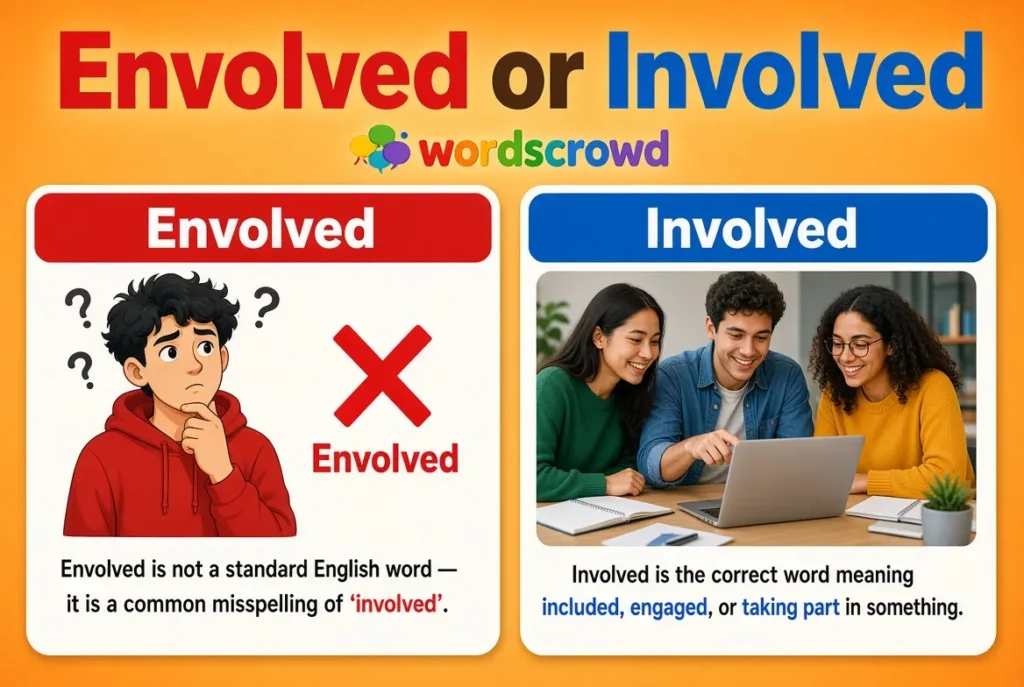
The good news is simple: involved is the standard English word you want in modern English. Envolved is not the standard spelling of the word meaning “taking part,” “included,” “connected,” or “complicated.” Major English dictionaries list involved as the past tense and past participle of involve, and also as an adjective.
So if you are writing an email, school assignment, business report, social media post, application, or everyday message, choose involved.
But there is more to this spelling question than simply saying “one is right and one is wrong.” Involved has several meanings and grammatical uses, and understanding them will help you use the word naturally rather than merely memorize its spelling.
This guide explains envolved or involved, why the mistake happens, how to pronounce involved, how to use it with different prepositions, and more than 20 real-life examples.
Quick Answer
Involved is the correct standard English spelling.
Envolved is generally an incorrect spelling when you mean the past tense or past participle of involve.
- ✅ She was involved in the project.
- ❌ She was envolved in the project.
Use involved when you mean taking part, included, connected, affected, or complicated, depending on context. Cambridge and Merriam-Webster both recognize involved as a standard English word.
Envolved vs Involved at a Glance
| Feature | Envolved | Involved |
|---|---|---|
| Standard English spelling | ❌ No | ✅ Yes |
| Dictionary-listed form of involve | ❌ No | ✅ Yes |
| Part of speech | Not standard in this use | Verb form / adjective |
| Base word | — | involve |
| Past tense of involve | ❌ | ✅ |
| Past participle | ❌ | ✅ |
| Meaning “taking part” | ❌ | ✅ |
| Meaning “included” | ❌ | ✅ |
| Meaning “complicated” | ❌ | ✅ |
| Common in professional writing | ❌ | ✅ |
| Common in academic writing | ❌ | ✅ |
| Common in everyday English | ❌ | ✅ |
| US English | ❌ | ✅ |
| UK English | ❌ | ✅ |
| Recommended spelling | No | Involved |
Bottom line: If you are deciding between envolved or involved, write involved.
What Does “Involved” Mean?
Involved has several related meanings, so the exact meaning depends on the sentence.
It can describe someone who takes part in something, something that is included or affected, or something that is complicated or difficult to understand. It can also describe a romantic relationship. Cambridge lists these major adjective uses, while Merriam-Webster likewise identifies meanings involving participation, inclusion, relationships, and complexity.
1. Involved = Taking Part
When someone is involved in something, they participate in it or have a role in it.
David is involved in the school debate club.
This means David participates in the club.
More examples:
- I am involved in the community project.
- Several teachers were involved in the event.
- She became involved in the campaign.
- Everyone involved helped solve the problem.
This is one of the most common meanings of involved.
2. Involved = Included or Affected
The word can also mean that someone or something is part of a situation.
Three companies were involved in the deal.
Here, involved means the companies were connected with or included in the deal.
Similarly:
Several students were involved in the incident.
The students were connected to or affected by the incident.
3. Involved = Complicated
Involved can describe something that has many parts and is difficult to understand or deal with.
The legal process is extremely involved.
Here, involved does not mean that someone participated. It means complicated.
Merriam-Webster describes this sense as extreme or excessive complexity, while Cambridge uses it for something that is not simple and is therefore difficult to understand.
4. Involved = Emotionally or Romantically Connected
You may also hear:
They became romantically involved.
This means they entered a romantic relationship.
Similarly:
She became emotionally involved in the case.
Here, the person developed a strong emotional connection.
Cambridge specifically recognizes involved with for close or romantic relationships.
Why Is “Envolved” Incorrect?
The main reason people write envolved is likely the relationship between pronunciation and spelling.
English spelling does not always give learners a perfect guide to pronunciation. When people hear a word rather than see it written, they may create a spelling that seems logical to them.
The correct word is:
involve → involved
The spelling does not change from in- to en-.
Compare:
- involve → involved
- involve → involving
- involve → involvement
Not:
- envolve → envolved
- envolving
- envolvement
The standard English word is built around involve.
Merriam-Webster gives involved as the past-tense and past-participle form of involve.
Tip: If you know the base verb is involve, the correct past form is easy: involved.
Is “Involved” a Verb or an Adjective?
This is an important question because involved can function in more than one grammatical role.
“Involved” as a Verb Form
Involved is the simple past and past participle of the verb involve.
The basic forms are:
| Form | Example |
|---|---|
| Base form | involve |
| Third-person singular | involves |
| Present participle | involving |
| Past tense | involved |
| Past participle | involved |
Examples:
- The project involves five departments.
- The project involved five departments.
- The project has involved five departments.
- The project is involving several experts.
Merriam-Webster explicitly lists involved and involving as forms of the verb involve.
“Involved” as an Adjective
Involved can also describe a person, situation, process, explanation, or relationship.
Examples:
- She is an involved parent.
- It was an involved explanation.
- He became involved in the project.
- The process is too involved for beginners.
In these sentences, the word functions differently depending on the structure.
How to Pronounce “Involved”
The correct pronunciation is based on involve, with the ending changing according to normal English pronunciation patterns.
Cambridge gives these pronunciations:
- UK: /ɪnˈvɒlvd/
- US: /ɪnˈvɑːlvd/
A simple learner-friendly approximation is:
in-VOLVD
The stress falls on the second syllable.
Why Pronunciation Causes Confusion
When spoken quickly, involved can sound less clearly separated into its written parts. This can make learners unsure whether the first syllable is spelled in- or en-.
But pronunciation should not be used to invent a new spelling.
The spelling remains:
I-N-V-O-L-V-E-D
The Origin of “Involved”
The history of involved helps explain why the spelling begins with in-.
Merriam-Webster traces involve through Middle English forms such as envolven and involven to Latin involvere, meaning roughly to roll, enclose, or wrap up.
Over time, the word developed several figurative meanings.
The basic historical idea of something being wrapped up or enclosed is related to later meanings such as:
- included
- connected
- entangled
- complicated
- engaged
This is why involved can describe both participation and complexity. The meanings developed around the idea of being connected or entangled with something.
The spelling involved is therefore not an arbitrary modern spelling. It belongs to the established history of the word involve.
Involved vs Envolved: The Key Difference
The central difference is very straightforward:
- Involved is the standard English word.
- Envolved is not the standard spelling for the meanings discussed in this article.
The easiest comparison
I was involved in the meeting. ✅
I was envolved in the meeting. ❌
The first sentence is correct.
Another example
She was deeply involved in the research. ✅
Not:
She was deeply envolved in the research. ❌
In formal writing
Always choose involved.
That includes:
- university assignments
- job applications
- business reports
- professional emails
- essays
- research papers
- websites
- official documents
- presentations
There is no reason to use envolved as an alternative spelling.
How to Use “Involved” Correctly
The most important grammar patterns are worth learning because involved frequently appears with particular structures.
Involved in + Noun
Use involved in when someone participates in or is connected to an activity, situation, or field.
Examples:
- She is involved in education.
- He was involved in the project.
- They are involved in community work.
- I became involved in the discussion.
This is one of the most useful patterns to memorize.
Involved in + -ing Verb
You can also use involved in before a gerund.
Examples:
- She is involved in organizing the event.
- He was involved in planning the conference.
- They are involved in developing the software.
- We became involved in helping local students.
Notice the structure:
involved in + verb-ing
Not:
involved in + to + verb
For example:
She is involved in organizing the meeting. ✅
Not:
She is involved in to organize the meeting. ❌
Involved With vs Involved In
These two expressions are closely related but are not always interchangeable.
“Involved in”
Involved in commonly emphasizes participation in an activity, event, process, subject, or situation.
Examples:
- She is involved in research.
- He was involved in the project.
- They were involved in the negotiations.
- I am involved in organizing the conference.
“Involved with”
Involved with often emphasizes a relationship or connection with a person, organization, group, or cause.
Examples:
- She is involved with a local charity.
- He became involved with the organization.
- They are involved with several community groups.
It can also have a romantic meaning when referring to people.
She became involved with someone she met at university.
Cambridge specifically distinguishes be involved with someone as a relationship expression.
Tip: When you mean participation in an activity, involved in is often the natural choice. When you mean a relationship or connection with a person or organization, involved with may be more appropriate.
Involve, Involved, Involving, and Involvement
A common source of spelling mistakes is confusion among the different forms of the word family.
Involve
Involve is the base verb.
The job will involve travel.
Involved
Involved is the past form and past participle.
She involved her colleagues in the decision.
She was involved in the decision.
Involving
Involving is the present participle.
The project is involving several departments.
It can also work as a participial adjective or in a reduced clause:
We need a plan involving local businesses.
Involvement
Involvement is the noun.
Her involvement in the project was valuable.
This gives you a useful word family:
involve → involved → involving → involvement
There is no standard form:
envolve → envolved → envolving → envolvement
when you mean the ordinary modern English word family described here.
20+ Real-Life Examples of “Involved”
Understanding a spelling rule is helpful, but seeing the word in realistic sentences is even better.
Everyday Conversation
- Are you involved in the school event this weekend?
- I don’t want to get involved in their argument.
- She has been involved in the club for years.
- How did you get involved with that organization?
School and Education
- Our teacher encouraged every student to become involved in the discussion.
- Several students were involved in organizing the science fair.
- He became more involved in academic activities during his final year.
- The assignment was more involved than I expected.
Business
- Five departments were involved in the project.
- Please keep everyone involved informed about the schedule.
- The new position involves working with international clients.
- Our legal team was involved in reviewing the agreement.
Professional Emails
- Thank you to everyone involved in preparing the presentation.
- Could you please include the people involved in the next meeting?
- I appreciate your involvement in this project.
- We will contact the departments involved before making a final decision.
Academic Writing
- The study examines the factors involved in language development.
- Several variables are involved in the process.
- The researchers investigated the mechanisms involved in memory formation.
- The procedure is relatively involved and requires careful preparation.
Social Media
- Proud to be involved in such a meaningful project!
- We had an amazing day with everyone involved.
- Getting involved in your community can make a real difference.
Text Messages
- Are you involved in the event tomorrow?
- Don’t get involved 😂
- I’m already involved, so I can’t back out now!
Common Mistakes With “Involved”
The most common problem is spelling, but there are several other mistakes worth knowing.
Mistake 1: Writing “Envolved”
❌ She was envolved in the project.
Why it is wrong:
The standard form is involved, from the verb involve.
Correct:
✅ She was involved in the project.
Mistake 2: Using “Involved to”
❌ He is involved to organize the event.
This is not the normal grammatical pattern.
Better:
✅ He is involved in organizing the event.
The usual structure is:
involved in + noun
or
involved in + -ing form
Mistake 3: Confusing “Involved In” With “Involved With”
These expressions overlap, but context matters.
❌ She is involved in her boyfriend.
If you mean a romantic relationship, a more natural sentence would be:
✅ She is involved with her boyfriend.
For activities:
✅ She is involved in the project.
Mistake 4: Confusing “Involved” With “Involvement”
These are different parts of speech.
❌ Her involved in the project was important.
Correct:
✅ Her involvement in the project was important.
Here, involvement is the noun.
Mistake 5: Using “Involved” When You Mean “Complicated”
Sometimes involved means complicated, but context must make that clear.
The instructions are involved.
This can mean the instructions are complicated.
If your audience may misunderstand the sentence, complicated or complex may be clearer.
For example:
The application process is complicated.
This is often more direct than:
The application process is involved.
Involved vs Complicated
These words can be synonyms in some contexts, but they are not identical.
Complicated directly tells the reader that something is difficult because it has many parts or problems.
Involved can suggest something highly detailed, complex, or difficult to follow.
Compare:
The instructions are complicated.
This simply means they are difficult.
The instructions are long and involved.
This suggests that the instructions have many details or interconnected parts.
Merriam-Webster places involved among words such as complex, complicated, and intricate, while noting that involved can suggest extreme complication or disorder.
Involved vs Included
These words sometimes overlap, but they are not always interchangeable.
Included usually focuses on something being part of a larger group, list, package, or whole.
Involved can emphasize participation, connection, responsibility, or effect.
Compare:
Breakfast is included in the price.
This means breakfast is part of what you receive.
But:
Several employees were involved in the project.
This means they participated or had a role.
So:
included = part of something
involved = connected to, participating in, or affected by something
Involved vs Engaged
These can also overlap.
She is involved in the project.
means she participates in or has a role in it.
She is engaged in the project.
can suggest active participation, attention, or commitment.
In some professional contexts, engaged may sound more positive because it highlights active interest.
For example:
The students were actively engaged in the lesson.
This emphasizes their attention and participation.
The students were involved in the lesson.
This emphasizes participation or inclusion.
Is “Envolved” Ever Correct?
For ordinary modern English writing, no—not as the spelling of the standard word “involved.”
If you intend to say that someone participated in something, was connected to something, or was affected by something, use:
involved
If you intend to describe something complicated, use:
involved
If you intend to describe a romantic relationship, use:
involved, often with with.
The safest rule is simple:
If the base word is “involve,” the past form is “involved.”
US vs UK English: Is “Involved” Different?
No major spelling difference exists here.
Both American English and British English use:
involved
Examples:
- US: She was involved in the project.
- UK: She was involved in the project.
The pronunciation can differ somewhat between British and American English. Cambridge lists /ɪnˈvɒlvd/ for UK English and /ɪnˈvɑːlvd/ for US English.
But the spelling remains involved in both varieties.
So envolved is not a British alternative to involved.
Formal vs Informal Use
Involved is completely acceptable in formal and informal English.
Formal
The researchers involved in the study completed the analysis.
Business
All departments involved will receive an updated schedule.
Academic
The variables involved in the experiment require further analysis.
Everyday
I don’t want to get involved.
Social media
So happy to be involved in this amazing project!
The word itself is not slang or overly casual.
“Get Involved” and “Be Involved”
Two very common expressions are:
get involved
and
be involved
They are related but slightly different.
Get Involved
Get involved often suggests beginning to participate.
I decided to get involved in the community project.
The person was not previously participating and chose to take part.
Be Involved
Be involved describes an existing state of participation.
I am involved in the community project.
The person is already participating.
Simple memory rule
Get involved = start participating
Be involved = already participating
“Become Involved”
Become involved is another useful expression.
It often sounds slightly more formal than get involved.
Compare:
I got involved in the project last year.
Natural and conversational.
I became involved in the project last year.
Natural and somewhat more formal.
She became increasingly involved in community work.
This works especially well in professional, academic, and biographical writing.
“Involved in” With Different Tenses
Because involved is the past participle of involve, it can appear in many tense structures.
Present
She is involved in the project.
Past
She was involved in the project.
Present perfect
She has been involved in the project for three years.
Past perfect
She had been involved in the project before moving abroad.
Future
She will be involved in the next stage.
Modal
She may be involved in the decision.
The spelling stays involved.
How “Involve” Changes in a Sentence
Understanding the base verb can make the spelling easier to remember.
Active verb
The manager involved the team in the decision.
Here, involved is a past-tense verb.
Passive construction
The team was involved in the decision.
Here, involved is the past participle in a passive construction.
Adjective-like use
The process was extremely involved.
Here, involved describes the process.
The same spelling appears in all three cases, but the grammatical function changes.
Memory Tricks for “Envolved or Involved”
If spelling is your main problem, use one of these memory tricks.
Memory Trick 1: Remember the Base Word
Think:
INVOLVE → INVOLVED
Do not invent a new beginning.
involve + d = involved
Memory Trick 2: “In” Means Inside
Imagine someone being in a project.
I am IN the project → I am INVOLVED in the project.
This is not a complete explanation of the word’s etymology, but it is a useful memory aid.
Memory Trick 3: Learn the Word Family
Memorize the family together:
involve
involved
involving
involvement
Once the family is familiar, envolved will look unusual.
Memory Trick 4: Use the “V” Chain
Notice the spelling:
in-VOLV-ed
The middle of the word contains volv.
Think:
in + volv + ed = involved
A Quick Test: Which Sentence Is Correct?
Try these before looking at the answers.
Question 1
A. She was envolved in the project.
B. She was involved in the project.
Answer: B
Question 2
A. He became involved in the campaign.
B. He became envolved in the campaign.
Answer: A
Question 3
A. Don’t get envolved in the argument.
B. Don’t get involved in the argument.
Answer: B
Question 4
A. The process is very envolved.
B. The process is very involved.
Answer: B
Question 5
A. They are involved with the organization.
B. They are envolved with the organization.
Answer: A
Frequently Asked Questions
Is “envolved” a word?
Envolved is not the standard spelling to use when you mean the past tense, past participle, or adjective involved. For standard modern English, write involved.
Is “involved” the correct spelling?
Yes. Involved is the correct standard spelling of the past tense and past participle of involve, and it is also used as an adjective.
Why do people spell involved as envolved?
The mistake can result from pronunciation. English spelling is not always predictable from sound, and the first syllable of involved may lead some writers to hear or remember an en- beginning.
What is the past tense of involve?
The past tense is involved.
She involved her colleagues in the discussion.
The past participle is also involved.
She has involved her colleagues in the discussion.
Is involved a verb or adjective?
It can be both, depending on the sentence. It is a verb form of involve, and it can also function as an adjective meaning, for example, participating, connected, or complicated.
What is the difference between involved in and involved with?
Involved in commonly refers to participation in an activity, project, process, or situation. Involved with can describe a connection with a person, organization, or group and can also refer to a romantic relationship.
Is involved used in American and British English?
Yes. Involved is standard in both American and British English. The pronunciation may differ, but the spelling does not.
Is involved a formal word?
Yes. Involved works naturally in everyday conversation as well as formal business, academic, and professional writing.
Can involved mean complicated?
Yes. For example:
The instructions are too involved for beginners.
In this context, involved means complicated or difficult to follow.
Final Verdict: Envolved or Involved?
If you are choosing between envolved or involved, the answer is clear:
Use “involved.”
Involved is the standard English spelling and has several common meanings:
- taking part — She is involved in the project.
- included or connected — Several people were involved.
- affected — The entire department was involved.
- complicated — The process is quite involved.
- romantically connected — They became romantically involved.
Envolved should not be used as an alternative spelling of involved in standard English.
The easiest rule to remember is:
INvolve → INvolved
Once you remember the base verb involve, the spelling becomes much easier.
For professional, academic, educational, and everyday writing, choose involved every time you mean the standard English word. Dictionaries such as Cambridge and Merriam-Webster recognize involved and document its uses across participation, inclusion, relationships, and complexity.
Final answer:
✅ Involved = correct
❌ Envolved = incorrect spelling for this meaning
If you are ever unsure, go back to the base form: involve → involved.

Elon Parker is a dedicated writer at Wordscrowd, creating clear, informative, and engaging content for readers.
With a focus on useful information, Elon aims to make every article simple, reliable, and easy to understand.