Have you ever received help from someone and wondered whether you should say “I appreciate it” or “I appreciated it”?
Both expressions are grammatically correct, but they do not mean exactly the same thing.
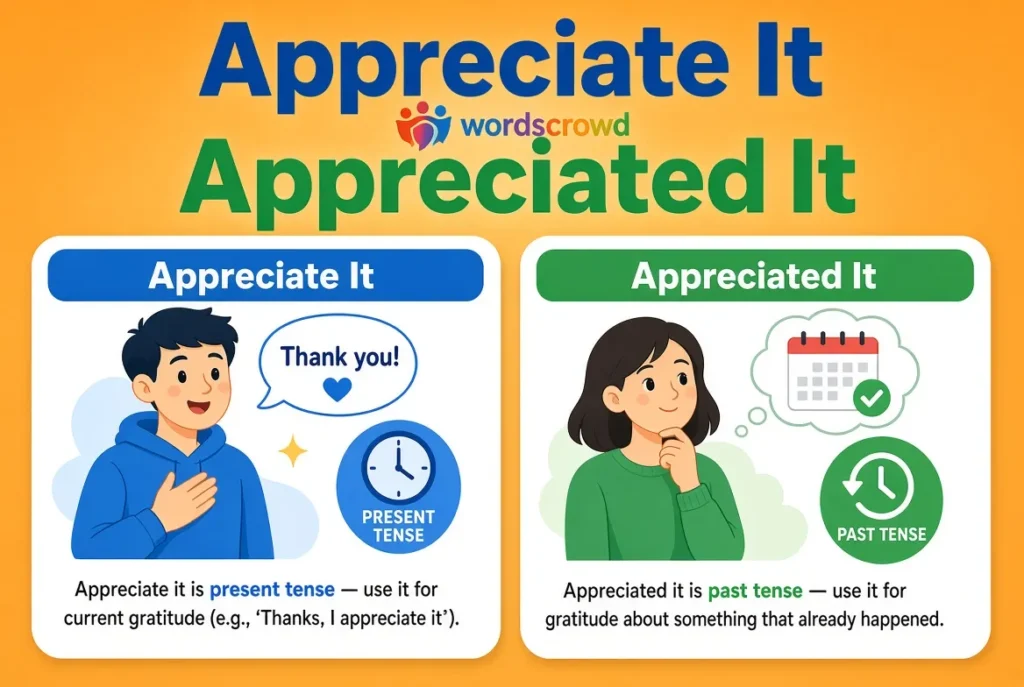
The difference comes down mainly to tense and timing. “I appreciate it” uses the present tense and usually expresses gratitude that you feel now.
“I appreciated it” uses the past tense and usually describes gratitude you felt at a particular time in the past.
That small change can affect how natural your sentence sounds. For example, if a coworker helps you with a problem five minutes ago, you would normally say, “I appreciate it.”
If you are talking about help someone gave you last year, you might say, “I really appreciated it.”
There is another important point: “I appreciate it” is extremely common in everyday English, especially when thanking someone.
It can sound warm, polite, professional, or casual depending on the situation. “I appreciated it” is also useful, but it usually requires a clear past context.
In this guide, you will learn exactly when to use appreciate it or appreciated it, how their grammar differs, what native English speakers normally say, which expression works in emails and professional situations, and how to avoid common mistakes.
Quick Answer
“I appreciate it” is generally used when you are expressing gratitude now, especially for something someone has just done or is doing.
“I appreciated it” is used when you are talking about gratitude you felt in the past, often for a completed situation.
- Present: “Thanks for your help. I appreciate it.”
- Past: “You helped me when I was struggling, and I really appreciated it.”
Both are correct. The correct choice depends on when the appreciation applies.
Appreciate It or Appreciated It: Quick Comparison
| Feature | I appreciate it | I appreciated it |
|---|---|---|
| Tense | Present simple | Past simple |
| Main meaning | I am grateful for it now | I was grateful for it then |
| Time | Present/current situation | Completed past situation |
| Common use | Thanking someone | Reflecting on past help |
| Tone | Natural, warm, polite | Reflective, sometimes formal |
| Everyday conversation | Very common | Common when discussing the past |
| Professional email | Very common | Appropriate when referring to past assistance |
| Example | “I appreciate your help.” | “I appreciated your help.” |
| Current gratitude | Yes | Usually no |
| Past gratitude | Possible only with context | Yes |
| Best for immediate thanks | Yes | Usually no |
| Best for a completed past event | Sometimes | Yes |
Quick rule: If you are grateful right now, use “I appreciate it.” If you are describing gratitude you felt at a past time, use “I appreciated it.”
What Does “I Appreciate It” Mean?
“I appreciate it” means “I am grateful for what you have done” or “I value the help, kindness, effort, or consideration you have shown.”
The verb appreciate is in the simple present tense.
Grammar
The structure is:
I + appreciate + it
Here:
- I = subject
- appreciate = present-tense verb
- it = object pronoun
For example:
“Thanks for staying late. I appreciate it.”
The speaker is expressing gratitude at the time of speaking.
Why “It” Is Used
In “I appreciate it,” the word it normally refers to something already understood from the conversation.
For example:
“Thanks for helping me move this desk. I appreciate it.”
Here, it refers to the person’s help.
You can also replace it with a noun:
- “I appreciate your help.”
- “I appreciate your kindness.”
- “I appreciate your patience.”
- “I appreciate the opportunity.”
- “I appreciate your time.”
When Is “I Appreciate It” Natural?
It is especially natural when someone has:
- helped you
- given you something
- offered assistance
- spent time helping you
- shown kindness
- been patient
- given useful advice
- done you a favor
- considered your situation
- supported you
Examples:
“Thanks for explaining that. I appreciate it.”
“I appreciate it. That really helped.”
“Thanks for covering my shift. I appreciate it.”
“I really appreciate your patience.”
The Meaning of “I Appreciate It” Can Be Broader Than “Thank You”
Although “I appreciate it” often functions like “thank you,” the two expressions are not always identical.
Thank you directly expresses thanks.
I appreciate it can also communicate that you value the effort or kindness involved.
Compare:
“Thanks for helping me.”
and:
“I appreciate you taking the time to help me.”
The second version places more emphasis on the value of the person’s effort.
This is one reason appreciate is especially useful in professional English.
Is “I Appreciate It” Formal or Informal?
It can work in both formal and informal English.
Casual conversation
“Thanks for the ride. I appreciate it!”
Workplace conversation
“Thanks for sending that over. I appreciate it.”
Professional email
“Thank you for reviewing the document. I appreciate it.”
Customer service
“Thanks for your patience. We really appreciate it.”
So you do not need to avoid “I appreciate it” simply because it sounds conversational. It is widely accepted in professional communication.
However, in very formal writing, you may sometimes choose a more specific expression:
“I greatly appreciate your assistance.”
or:
“Your assistance is greatly appreciated.”
What Does “I Appreciated It” Mean?
“I appreciated it” uses the simple past tense.
It normally means:
“I was grateful for it at a particular point in the past.”
For example:
“When you helped me during my first week, I really appreciated it.”
The speaker is describing a past experience.
The appreciation belongs to that past situation.
Grammar
The structure is:
I + appreciated + it
Here:
- I = subject
- appreciated = past-tense verb
- it = object pronoun
The verb changes from:
appreciate → appreciated
This signals that the appreciation is being viewed as something that happened in the past.
When Should You Use “I Appreciated It”?
Use “I appreciated it” when the context is clearly or naturally connected to a completed past event.
For example:
“You gave me excellent advice before my interview. I appreciated it.”
Here, the advice was given in the past, and the speaker is looking back on that experience.
Another example:
“I appreciated it when you checked on me after the accident.”
The sentence refers to a completed past situation.
Common situations for “I Appreciated It”
You might use it when:
- telling a story
- discussing an earlier event
- writing a thank-you note after a completed situation
- reflecting on someone’s past kindness
- describing a previous workplace experience
- talking about an old favor
- explaining how you felt about something that happened before
For example:
“I appreciated everything you did for me during college.”
This does not necessarily mean the speaker is no longer grateful. It simply places the appreciation in a past context.
That distinction is important.
Does “I Appreciated It” Mean I Am No Longer Grateful?
Not necessarily.
This is one of the biggest misunderstandings about the phrase.
If someone says:
“I appreciated your help.”
they are describing their appreciation in relation to a past event.
The sentence does not automatically mean:
“I don’t appreciate your help anymore.”
Context determines the broader meaning.
For example:
“I appreciated your help when I was starting the company, and I still appreciate everything you do.”
Here, both forms appear naturally:
- appreciated = past situation
- appreciate = continuing gratitude
Appreciate It vs Appreciated It: The Key Difference
The simplest distinction is time perspective.
“I appreciate it”
Think:
I feel grateful now.
Example:
“Thanks for helping me today. I appreciate it.”
“I appreciated it”
Think:
I felt grateful at that past time.
Example:
“You helped me last month, and I really appreciated it.”
The important thing is not simply whether the action happened in the past.
Someone can perform an action in the past, but you can still use the present tense to express your current gratitude.
For example:
“Thanks for helping me yesterday. I really appreciate it.”
The help happened yesterday, but the speaker’s appreciation exists now.
That is perfectly natural.
Why People Confuse “Appreciate It” and “Appreciated It”
The confusion is understandable because the underlying idea is the same: gratitude or recognition of value.
The only major grammatical difference is the tense:
- appreciate = present
- appreciated = past
But English speakers often discuss past actions while expressing present feelings.
That creates sentences such as:
“Thanks for what you did yesterday. I appreciate it.”
The action is past, but the appreciation is current.
This is why simply thinking “past action = past tense” can lead you to the wrong choice.
The Real Question: When Is the Appreciation Happening?
Instead of asking:
“When did the person help me?”
ask:
“When am I expressing the appreciation?”
This is a much better way to choose the tense.
Example
Someone helped you yesterday.
You could say:
“I appreciate it.”
if you are expressing gratitude now.
You could also say:
“I appreciated it.”
if you are describing how you felt about that event in the past.
Both can be grammatically correct, but they create different perspectives.
20+ Real-Life Examples
1. Everyday Conversation
“Thanks for carrying that box. I appreciate it.”
The speaker is grateful now.
2. Asking for Help
“If you could send me the file today, I’d appreciate it.”
This is a special construction. “I’d appreciate it” means “I would be grateful if you did this.”
3. After a Favor
“Thanks for picking me up from the station. I appreciate it.”
The favor has just happened, and the speaker is expressing current gratitude.
4. Talking About Yesterday
“You helped me with the presentation yesterday, and I appreciated it.”
The speaker is looking back at a past event.
5. Workplace Conversation
“Thanks for covering my shift. I appreciate it.”
This sounds natural and professional.
6. Professional Email
“Thank you for taking the time to review my application. I appreciate it.”
The writer is expressing current gratitude.
7. Reflecting on Past Support
“When I was new to the team, I really appreciated your guidance.”
The phrase refers to a past period.
8. Text Message
“Thanks! I appreciate it!”
This is extremely natural in casual messaging.
9. Social Media
“Thanks everyone for the birthday wishes. I really appreciate it!”
The gratitude is current.
10. Academic Situation
“Thank you for explaining the assignment. I appreciate it.”
The student is thanking the teacher or classmate now.
11. Past Academic Situation
“I appreciated the feedback my professor gave me during my final year.”
The writer is discussing a completed period.
12. Business Communication
“I appreciate your quick response.”
This expresses current appreciation.
13. Past Business Experience
“I appreciated how professionally your team handled the issue.”
The speaker is reflecting on a previous experience.
14. Friend Helping You
“You always know how to make things easier. I appreciate it.”
The appreciation is ongoing.
15. Talking About an Old Friendship
“I always appreciated the way you supported me when we worked together.”
The sentence describes past support.
16. Customer Service
“Thank you for waiting. We appreciate your patience.”
This is a standard professional expression.
17. Discussing a Previous Customer
“The customer appreciated our quick response.”
This is past tense because the sentence describes a previous reaction.
18. Email Follow-Up
“I appreciate you getting back to me so quickly.”
The response has already arrived, but the writer’s gratitude is current.
19. Looking Back
“At the time, I appreciated everything my parents did for me.”
The phrase places the appreciation firmly in a past period.
20. Continuing Gratitude
“I appreciated your help then, and I still appreciate it today.”
This sentence clearly separates past and present appreciation.
21. A Polite Request
“I’d appreciate it if you could keep me updated.”
Here, “I’d appreciate it” refers to a desired future action.
22. Formal Writing
“We greatly appreciate your continued support.”
The company expresses present gratitude.
“I Appreciate It” vs “I Appreciated It” in Emails
Both forms can appear in emails, but they serve different purposes.
Use “I appreciate it” for current gratitude
“Thank you for sending the revised contract. I appreciate it.”
This is a natural professional response.
You can also write:
“I appreciate your prompt response.”
“I appreciate your assistance with this matter.”
“I really appreciate you taking the time to meet with me.”
Use “I appreciated it” when describing past help
“I appreciated your assistance during the project last year.”
This sounds like a reflection on a completed situation.
For a direct thank-you email sent immediately after receiving help, “I appreciate it” will usually sound more natural.
“I Appreciate It” vs “I Appreciated It” in Professional English
In business communication, the present form is often especially useful because it expresses current goodwill.
For example:
“I appreciate your flexibility.”
“I appreciate your patience.”
“I appreciate your understanding.”
“I appreciate your quick response.”
These phrases are common because they acknowledge another person’s effort while maintaining a polite, professional tone.
The past form works when the writer is specifically discussing something completed:
“I appreciated your support during the transition.”
The sentence sounds reflective rather than like an immediate thank-you.
What About “I’d Appreciate It”?
This phrase deserves special attention because it is often confused with both forms.
“I’d appreciate it” usually means:
“I would be grateful if you did something.”
It is commonly used for polite requests.
For example:
“I’d appreciate it if you could send the report by Friday.”
“I’d appreciate it if you didn’t share this information.”
“I’d appreciate it if you could let me know your decision.”
Here, the speaker is not thanking someone for something already done.
Instead, the speaker is politely asking for an action.
Compare the Three Forms
I appreciate it.
= I am grateful for it now.
I appreciated it.
= I was grateful for it in the past.
I’d appreciate it.
= I would be grateful if something happened.
This three-way distinction solves many common usage problems.
Grammar: Why the Tense Matters
The verb appreciate is a regular verb.
Its basic forms include:
| Verb Form | Example |
|---|---|
| Base form | appreciate |
| Third-person singular | appreciates |
| Past tense | appreciated |
| Past participle | appreciated |
| Present participle | appreciating |
Examples:
- “I appreciate your help.”
- “She appreciates your support.”
- “I appreciated your advice.”
- “They have appreciated your work.”
- “We are appreciating the opportunity.”
Present Simple
“I appreciate your help.”
This expresses present appreciation.
Simple Past
“I appreciated your help.”
This presents the appreciation as belonging to a past situation.
Present Perfect
You may also see:
“I have appreciated your support throughout this project.”
This connects past appreciation with a period continuing up to the present or with a present perspective on a past period.
Is “Appreciate It” Always About Gratitude?
No.
The verb appreciate has several meanings.
It can mean:
- To be grateful for something.
- To recognize the value or importance of something.
- To understand something fully.
- To increase in value, especially in economic contexts.
For example:
“I appreciate your honesty.”
This means I value or recognize the importance of your honesty.
But:
“The property appreciated in value.”
Here, appreciated means that the property’s value increased.
So the meaning of appreciate depends strongly on context.
“Appreciate It” and Common Collocations
English speakers frequently use appreciate with words such as:
- appreciate it
- appreciate your help
- appreciate your support
- appreciate your patience
- appreciate your understanding
- appreciate your time
- appreciate the effort
- appreciate the opportunity
- appreciate your kindness
- appreciate the gesture
- really appreciate
- greatly appreciate
- sincerely appreciate
- deeply appreciate
Examples:
“I really appreciate your help.”
“We greatly appreciate your patience.”
“I sincerely appreciate the opportunity.”
These collocations are useful in both everyday and professional English.
Common Mistakes
Mistake 1: Using “appreciated” for an immediate thank-you
Less natural:
“Thanks for helping me. I appreciated it.”
This can be grammatically possible, but without a past context it may sound as though you are describing a completed past feeling rather than simply thanking the person.
More natural:
“Thanks for helping me. I appreciate it.”
Mistake 2: Thinking past action always requires past tense
Incorrect reasoning:
“She helped me yesterday, so I must say, ‘I appreciated it.’”
Not necessarily.
You can say:
“She helped me yesterday, and I appreciate it.”
The help occurred yesterday, but the gratitude is being expressed now.
Mistake 3: Using “I appreciate it” for a past story
If you are telling a story about how someone helped you years ago, the past form may fit better:
“When I started my first job, my manager helped me a lot. I really appreciated it.”
The sentence is about a past experience.
Mistake 4: Confusing “appreciate” with “thank”
Appreciate and thank are related, but they are not interchangeable in every grammatical structure.
You can say:
“I appreciate your help.”
You can say:
“I thank you for your help.”
But “I appreciate it” and “I thank it” are not equivalent expressions.
Mistake 5: Forgetting the object after “appreciate”
When using the gratitude meaning, appreciate generally needs an object.
Natural:
“I appreciate it.”
“I appreciate your help.”
“I appreciate your kindness.”
But simply saying:
“I appreciate.”
is usually incomplete in ordinary English.
Better Alternatives to “I Appreciate It”
Depending on the situation, you can vary your language.
Casual
- “Thanks!”
- “Thanks a lot!”
- “I really appreciate it.”
- “You’re a lifesaver.”
- “Thanks, I owe you one.”
Professional
- “I appreciate your assistance.”
- “Thank you for your help.”
- “I greatly appreciate your support.”
- “Thank you for taking the time.”
- “Your assistance is greatly appreciated.”
Formal
- “I sincerely appreciate your assistance.”
- “I am very grateful for your support.”
- “Your consideration is greatly appreciated.”
The best choice depends on your relationship with the reader and the situation.
US English vs UK English
There is no major American-versus-British English difference between “I appreciate it” and “I appreciated it.”
Both forms are standard in:
- American English
- British English
- Canadian English
- Australian English
- other major varieties of English
The difference is primarily tense and context, not geography.
An American speaker and a British speaker can both naturally say:
“I appreciate it.”
Likewise, both can say:
“I appreciated it.”
Pronunciation and surrounding expressions can vary somewhat across English varieties, but the grammatical distinction remains essentially the same.
Pronunciation
The verb appreciate is commonly pronounced approximately:
uh-PREE-shee-ayt
The final sound is similar to “ate.”
Appreciated is approximately:
uh-PREE-shee-ay-tid
The ending is pronounced as an extra syllable because -ed follows a word ending in a /t/ sound.
Examples:
appreciate → “uh-PREE-shee-ayt”
appreciated → “uh-PREE-shee-ay-tid”
The pronunciation difference is small but useful when speaking clearly.
Memory Tricks
Trick 1: Think “Now” vs “Then”
Appreciate = now.
Appreciated = then.
This is the easiest rule.
Trick 2: Watch the “-ed”
The -ed in appreciated signals past tense.
appreciate → present
appreciated → past
Trick 3: Ask One Question
Before choosing the phrase, ask:
“Am I talking about my gratitude now or my gratitude then?”
If the answer is now:
“I appreciate it.”
If the answer is then:
“I appreciated it.”
Trick 4: Remember the Three Forms
Keep these together:
I appreciate it = I am grateful now.
I appreciated it = I was grateful then.
I’d appreciate it = I would be grateful if you did it.
That three-part pattern is particularly useful for English learners.
When “I Appreciate It” Is Better
Choose “I appreciate it” when:
- someone has just helped you
- you are currently thanking someone
- you want to show current gratitude
- you are writing a thank-you email
- you are responding to a favor
- you want a polite professional phrase
- you are acknowledging someone’s effort
Example:
“Thanks for fixing the issue so quickly. I appreciate it.”
When “I Appreciated It” Is Better
Choose “I appreciated it” when:
- you are telling a past story
- you are describing a previous experience
- you are reflecting on past support
- the appreciation belongs to a completed period
- you are discussing how you felt at a particular time
Example:
“During my first month at the company, I appreciated all the guidance I received.”
A Simple Decision Guide
Use this five-step method:
- Identify the action or kindness.
- Decide whether you are expressing gratitude now or describing past gratitude.
- If the gratitude is current, use appreciate.
- If the gratitude belongs to a past situation, use appreciated.
- Check whether “I’d appreciate it” is actually intended if you are making a polite request.
Example
Someone sends you a document.
You reply:
“Thanks for sending this. I appreciate it.”
Someone asks about a document you received last week:
“I appreciated how quickly she sent it.”
Someone has not sent the document yet:
“I’d appreciate it if you could send it today.”
Three situations. Three natural forms.
FAQ
Is “I appreciate it” grammatically correct?
Yes. “I appreciate it” is completely grammatical and very common. It usually expresses present gratitude for someone’s help, kindness, effort, or consideration.
Is “I appreciated it” grammatically correct?
Yes. “I appreciated it” is also grammatically correct. It uses the simple past tense and normally refers to gratitude connected with a past situation.
Which is better: “I appreciate it” or “I appreciated it”?
Neither is universally better. “I appreciate it” is normally better for expressing gratitude now, while “I appreciated it” is better when describing gratitude associated with a past event.
Can I say “I appreciate it” for something that happened yesterday?
Yes. The action can have happened yesterday while your appreciation is still being expressed now.
For example:
“Thanks for helping me yesterday. I really appreciate it.”
This is completely natural.
Does “I appreciated it” mean I am no longer grateful?
No. The past tense does not automatically mean that your gratitude has ended. It simply places the appreciation in a past context.
Is “I’d appreciate it” the same as “I appreciate it”?
No. “I’d appreciate it” usually introduces a polite request.
“I’d appreciate it if you could call me tomorrow.”
It means you would be grateful if the requested action happened.
Is “I appreciate it” professional?
Yes. It is widely used in professional emails, workplace conversations, customer service, and business communication. For more formal situations, you can also use “I greatly appreciate your assistance.”
Is “I appreciate it” American or British English?
Both. The phrase is standard in both American and British English. The difference between appreciate and appreciated is grammatical rather than regional.
Can “appreciate” mean something other than “be grateful”?
Yes. Appreciate can also mean to recognize the value or importance of something or to understand something. In financial or economic contexts, appreciate can mean to increase in value.
Final Verdict
So, appreciate it or appreciated it—which one should you use?
The answer is simple once you focus on the time of the appreciation.
Use “I appreciate it” when you are expressing gratitude now.
“Thanks for your help. I appreciate it.”
Use “I appreciated it” when you are describing gratitude connected to a past situation.
“When I was struggling last year, I really appreciated your support.”
And remember the third expression:
“I’d appreciate it” is normally used for a polite request.
“I’d appreciate it if you could send the information by Friday.”
The Best Rule to Remember
Appreciate = gratitude now.
Appreciated = gratitude in the past.
I’d appreciate it = a polite request.
There is no universal winner between “I appreciate it” and “I appreciated it.” Both are correct English. The real difference is tense, perspective, and context.
For an immediate thank-you, “I appreciate it” will usually be the natural choice. When you are looking back on something that happened before, “I appreciated it” often fits better.
Once you learn to focus on when the appreciation is being expressed—not merely when the helpful action happened—the choice becomes much easier.

Elon Parker is a dedicated writer at Wordscrowd, creating clear, informative, and engaging content for readers.
With a focus on useful information, Elon aims to make every article simple, reliable, and easy to understand.