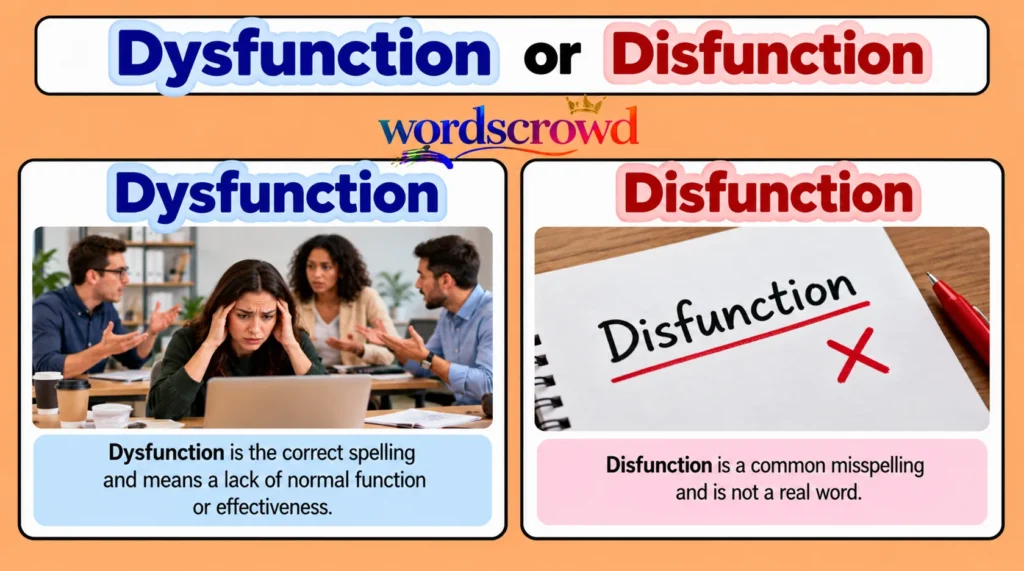
Have you ever written “disfunction” and wondered whether something looked slightly off? You are not alone.
The spelling disfunction is easy to produce because the prefix dis- is common in English, and many familiar words begin with it.
However, when you mean a problem with the normal working of a system, body part, organization, or process, the standard modern spelling is dysfunction.
That small difference—dis- versus dys-—can cause a surprisingly large amount of confusion.
Both forms look plausible, and their pronunciation is close enough that hearing the word does not always help you choose the correct spelling.
So, is it disfunction or dysfunction? In standard contemporary English, dysfunction is the form you should normally use.
Disfunction is generally treated as a nonstandard, obsolete, or very uncommon variant rather than the preferred spelling for ordinary modern writing.
This guide explains the difference clearly. You will learn what dysfunction means, where the word comes from, how to pronounce it, how it behaves grammatically, when to use it in medical, professional, academic, and everyday contexts, and why disfunction can appear even though it is not the spelling most writers should choose.
Quick Answer
Dysfunction is the standard spelling in modern English when you mean impaired, abnormal, or ineffective functioning.
- ✅ dysfunction — standard and preferred
- ⚠️ disfunction — uncommon/nonstandard in modern general usage
- Dysfunction can be a noun and also appears in related forms such as dysfunctional and dysfunctionally.
- Example: “The team suffered from serious communication dysfunction.”
Quick rule: If you are describing something that is not functioning normally, write dysfunction, not disfunction.
Dysfunction vs. Disfunction: Comparison Table
| Feature | Dysfunction | Disfunction |
|---|---|---|
| Standard modern spelling | Yes | Generally no |
| Meaning | Impaired or abnormal functioning | Historically/rarely used variant |
| Part of speech | Noun | Rare/variant noun |
| Pronunciation | /dɪsˈfʌŋkʃən/ | Usually intended to sound like dysfunction |
| Common in modern English | Very common | Very uncommon |
| Medical writing | Preferred | Avoid |
| Academic writing | Preferred | Avoid |
| Business writing | Preferred | Avoid |
| Everyday English | Preferred | Avoid |
| Related adjective | dysfunctional | disfunctional is generally not preferred |
| Meaning difference | Refers to abnormal/impaired functioning | Usually intended to express the same idea |
| Recommended for formal writing | Yes | No |
| US English | Dysfunction | Avoid |
| UK English | Dysfunction | Avoid |
| Best choice | Dysfunction | Not normally recommended |
What Does Dysfunction Mean?
Dysfunction is a noun meaning a failure, impairment, or abnormality in the way something normally functions.
The word can describe many different things:
- a body organ that is not working normally
- a biological or physiological process
- a relationship
- a family system
- a workplace
- a government or organization
- a machine or technical system
- a social system
- a psychological or behavioral pattern
The central idea is simple:
Dysfunction = functioning that is impaired, abnormal, ineffective, or disrupted.
Examples of Dysfunction
Consider these sentences:
- “The doctor diagnosed kidney dysfunction.”
- “The company has a serious communication dysfunction.”
- “Years of conflict created family dysfunction.”
- “The machine stopped because of a mechanical dysfunction.”
- “Political dysfunction delayed the decision.”
In each sentence, something is not working as it should.
Is Dysfunction a Noun?
Yes. Dysfunction is primarily a noun.
For example:
“The organization is experiencing dysfunction.”
The plural is:
dysfunctions
Example:
“Several dysfunctions contributed to the project’s failure.”
The adjective is:
dysfunctional
Example:
“The department has become dysfunctional.”
Pronunciation of Dysfunction
Dysfunction is commonly pronounced approximately as:
dis-FUNK-shun
Its phonetic transcription is:
/dɪsˈfʌŋkʃən/
The stress falls on the second syllable:
dys-FUNC-tion
This pronunciation is one reason people can become uncertain about the spelling. The spoken form does not clearly reveal whether the word should begin with dis- or dys-.
Common Collocations With Dysfunction
English speakers commonly use dysfunction with words such as:
- organizational dysfunction
- family dysfunction
- political dysfunction
- social dysfunction
- sexual dysfunction
- cognitive dysfunction
- neurological dysfunction
- renal dysfunction
- kidney dysfunction
- liver dysfunction
- immune dysfunction
- communication dysfunction
- systemic dysfunction
- institutional dysfunction
- workplace dysfunction
These combinations are useful because they show how broadly the word can be applied.
The Origin of Dysfunction
The spelling makes more sense when you look at the word’s history.
Dysfunction is formed from dys- + function.
The prefix dys- comes from Greek and is associated with ideas such as bad, difficult, abnormal, impaired, or faulty.
The word function, meanwhile, ultimately comes through Latin functio, related to the idea of performing or carrying out something.
So, conceptually:
dys- + function → abnormal or impaired functioning
This is important because English contains many words beginning with dys-, particularly in scientific and medical vocabulary.
Examples include:
- dyslexia
- dysgraphia
- dysphagia
- dysplasia
- dysregulation
- dystrophy
- dysmenorrhea
Not every dys- word means exactly the same thing, but the prefix often signals some form of difficulty, abnormality, impairment, or problematic functioning.
Why Does “Disfunction” Look So Natural?
The confusion is understandable because dis- is also an extremely productive English prefix.
You probably already know words such as:
- disagree
- disconnect
- disappear
- dishonest
- disapprove
- dislike
- disorganize
- discontinue
Because dis- frequently communicates ideas such as separation, reversal, negation, or opposition, it is tempting to build disfunction from dis- + function.
But English does not always form words by simply attaching whichever prefix seems logical.
Some words have established historical spellings that must be learned as vocabulary.
That is exactly what happens with dysfunction.
What Does Disfunction Mean?
The spelling disfunction is the source of much of the confusion in this comparison.
In modern standard English, disfunction is not the form you should normally choose when you mean impaired or abnormal functioning.
You may occasionally encounter it in older texts, historical material, dictionaries that record variants, or writing produced by people who have confused the spelling with the more familiar prefix dis-.
The important point for modern writers is practical:
If you are writing ordinary contemporary English, use “dysfunction.”
Is Disfunction a Word?
This question requires a little care.
Rather than saying that disfunction has never existed in English, it is more accurate to say that dysfunction is the established standard form for the meaning most people intend today.
English contains many historical spellings and rare variants that can appear in dictionaries or older publications without being good choices for modern writing.
Therefore, seeing disfunction somewhere does not mean that it is the preferred spelling today.
Should You Use Disfunction?
Generally, no.
If you are writing:
- an essay
- a report
- a medical document
- a business email
- a blog post
- a research paper
- a résumé
- a presentation
- website copy
- social media content
choose dysfunction when you mean impaired or abnormal functioning.
Dysfunction vs. Disfunction: The Key Difference
The most important difference is not meaning. In most modern contexts, someone who writes disfunction is attempting to express the same basic concept as dysfunction.
The real difference is standardness and spelling.
The Main Points
- Dysfunction is the standard modern spelling.
- Disfunction is uncommon and generally not recommended.
- The two forms can appear similar in meaning because they are often used to represent the same concept.
- The standard adjective is dysfunctional.
- In formal, academic, medical, and professional writing, dysfunction is the safe choice.
- The difference is mainly about word formation and established usage, not pronunciation.
- The spelling dys- reflects the word’s Greek-derived formation.
Editor’s tip: When a word looks as though it could take a familiar prefix but an established technical spelling exists, follow the established spelling rather than reconstructing the word from scratch.
Dysfunction in Grammar
Understanding the grammar of dysfunction is straightforward.
Dysfunction as a Noun
The most common grammatical role is a noun.
Examples:
- “The study identified a serious dysfunction.”
- “The system developed several dysfunctions.”
- “Communication dysfunction affected the entire team.”
Dysfunction as a Countable Noun
Dysfunction can be countable when referring to a particular type or instance of impaired functioning.
Singular:
“The researchers identified one major dysfunction.”
Plural:
“The researchers identified several dysfunctions.”
It can also be used more broadly as an uncountable concept:
“The organization is experiencing dysfunction.”
The choice depends on whether you are discussing a general condition or separate problems.
Dysfunctional as an Adjective
The adjective dysfunctional describes something that is not working properly.
Examples:
- a dysfunctional family
- a dysfunctional workplace
- a dysfunctional system
- a dysfunctional relationship
- a dysfunctional organization
Notice the spelling:
dysfunction → dysfunctional
Not:
disfunction → disfunctional
Dysfunctionally as an Adverb
The adverb dysfunctionally is possible, although it is much less common than the noun and adjective.
Example:
“The departments were operating dysfunctionally.”
In many cases, a writer would choose a clearer construction instead:
“The departments were operating poorly.”
or:
“The departments were functioning ineffectively.”
Does Dysfunction Have a Verb Form?
There is no everyday standard verb to dysfunction that should replace normal verbs such as:
- malfunction
- fail
- break down
- operate poorly
- function improperly
Instead, use dysfunctional as an adjective:
“The system is dysfunctional.”
For a noun:
“The system has a dysfunction.”
For a process:
“The system is functioning improperly.”
Dysfunction in Medical English
Dysfunction is especially common in medicine and health-related writing.
Medical professionals use it when an organ, physiological system, or biological process is functioning abnormally.
Examples include:
- renal dysfunction
- cardiac dysfunction
- liver dysfunction
- immune dysfunction
- neurological dysfunction
- respiratory dysfunction
- sexual dysfunction
- cognitive dysfunction
The word does not necessarily mean that something has stopped working completely.
That distinction matters.
Dysfunction Does Not Always Mean Complete Failure
Suppose an organ is still working but not at a normal level.
A clinician might describe this as dysfunction rather than complete failure.
This gives the word a useful middle ground:
normal function → impaired function → complete failure
Dysfunction generally belongs in the middle category.
For example:
“The patient showed mild renal dysfunction.”
This does not automatically mean the kidneys have completely failed. It indicates that their function is impaired or abnormal.
Dysfunction in Business and Professional Writing
The word is also common outside medicine.
In business English, dysfunction often describes organizations, teams, processes, or communication systems that fail to work effectively.
Examples
“The project suffered from organizational dysfunction.”
“Poor communication created dysfunction within the team.”
“The company is trying to address departmental dysfunction.”
“The new manager inherited a dysfunctional workflow.”
In these contexts, the word can sound more precise than simply saying problem.
Compare:
“The company has a problem.”
with:
“The company has serious organizational dysfunction.”
The second sentence suggests that the problem is not just one isolated mistake. Instead, the way the organization operates is impaired.
Dysfunction in Academic Writing
Dysfunction works well in academic writing, especially in fields such as:
- medicine
- psychology
- sociology
- biology
- political science
- organizational studies
- neuroscience
- education
However, academic writers should avoid using it simply to sound sophisticated.
If you mean failure, say failure.
If you mean inefficiency, say inefficiency.
If you mean abnormal functioning, dysfunction may be exactly right.
Compare the Meanings
Failure
“The experiment failed.”
Inefficiency
“The process was inefficient.”
Dysfunction
“The system demonstrated significant dysfunction.”
These words overlap, but they are not interchangeable in every context.
Dysfunction vs. Malfunction
A useful comparison is dysfunction vs. malfunction.
Both describe something that is not working correctly, but they are often used in different settings.
Malfunction is especially common for:
- machines
- equipment
- devices
- mechanical systems
- technical systems
Example:
“The printer malfunctioned.”
Dysfunction is broader and often appears in:
- biological systems
- medical contexts
- social systems
- organizations
- relationships
- institutions
Example:
“The organization suffered from dysfunction.”
You can sometimes use either word, but context determines which sounds natural.
20+ Real-Life Examples
Here are original examples showing how dysfunction works in different settings.
Everyday Conversation
- “There is some serious dysfunction in this household.”
- “The team’s constant arguments are a sign of dysfunction.”
- “We need to fix the communication dysfunction before it gets worse.”
Medical Context
- “The test results suggested mild kidney dysfunction.”
- “The doctor explained that the medication could affect liver function.”
- “The researchers studied neurological dysfunction in older adults.”
Workplace
- “The manager called a meeting to address team dysfunction.”
- “Poor communication was creating dysfunction between the two departments.”
- “The new workflow reduced some of the dysfunction in the office.”
Business Email
- “We should address the communication dysfunction before the next project begins.”
- “Several process-related dysfunctions have delayed the rollout.”
- “The report identifies organizational dysfunction as a major concern.”
Academic Writing
- “The study examines how social dysfunction can affect educational outcomes.”
- “Researchers observed evidence of cognitive dysfunction among the participants.”
- “The paper explores institutional dysfunction in public organizations.”
Social Media
- “Every family has a little dysfunction sometimes.”
- “Office dysfunction: when five people attend a meeting and nobody knows why.”
- “Our group chat has officially reached maximum dysfunction.”
Text Messages
- “This team has so much dysfunction 😂.”
- “Can we please fix this communication dysfunction?”
- “The printer is having another meltdown. Total dysfunction.”
Professional Writing
- “Leadership changes alone may not resolve the underlying organizational dysfunction.”
- “The review identified several sources of systemic dysfunction.”
- “The department developed a plan to reduce operational dysfunction.”
Daily Speaking
- “I think our schedule has some serious dysfunction.”
- “The meeting was a perfect example of workplace dysfunction.”
Common Mistakes With Disfunction and Dysfunction
Mistake 1: Using Disfunction in Formal Writing
❌ “The company has serious disfunction.”
✅ “The company has serious dysfunction.”
Why?
Dysfunction is the established modern spelling.
Mistake 2: Writing Disfunctional
❌ “The department has become disfunctional.”
✅ “The department has become dysfunctional.”
The adjective follows the standard spelling of the noun:
dysfunction → dysfunctional
Mistake 3: Assuming Dis- Must Be the Correct Prefix
❌ “Function means working, so disfunction must mean not working.”
✅ “The established word is dysfunction.”
English prefixes are not always predictable enough to determine spelling from meaning alone.
Mistake 4: Confusing Dysfunction With Complete Failure
❌ “Dysfunction always means the system has completely stopped.”
✅ “Dysfunction generally refers to impaired, abnormal, or ineffective functioning.”
The degree of impairment can vary.
Mistake 5: Using Dysfunction When a Simpler Word Is Better
❌ “The printer experienced dysfunction.”
Better:
✅ “The printer malfunctioned.”
The original sentence may be understandable, but malfunction is more natural for a machine.
Mistake 6: Using Dysfunction as a Verb
Awkward:
❌ “The organization dysfunctioned after the merger.”
Better:
✅ “The organization became dysfunctional after the merger.”
Or:
✅ “The organization stopped functioning effectively after the merger.”
Dysfunction and Dysfunctional: Don’t Mix Them Up
These two related words are easy to distinguish once you know their grammatical roles.
| Word | Part of Speech | Example |
|---|---|---|
| dysfunction | Noun | “The team has dysfunction.” |
| dysfunctions | Plural noun | “Several dysfunctions were identified.” |
| dysfunctional | Adjective | “The team is dysfunctional.” |
| dysfunctionally | Adverb | “The system operated dysfunctionally.” |
A simple test is to ask:
Am I naming the problem, or describing something?
If you are naming it, use dysfunction.
If you are describing something as impaired, use dysfunctional.
US vs. UK English
There is no major American-versus-British spelling difference here.
Both American English and British English use:
dysfunction
So you should not treat disfunction as the British alternative to the American dysfunction.
The same standard spelling works across major varieties of English.
This is different from pairs such as:
- color / colour
- center / centre
- realize / realise
There is no comparable standard US/UK split for dysfunction.
Formal vs. Informal Usage
Dysfunction can appear in both formal and informal English.
Formal
“The study identified significant institutional dysfunction.”
Professional
“We need to address the dysfunction in our current reporting process.”
Informal
“Our family has a little dysfunction.”
The word itself is not inherently formal. What changes is the surrounding vocabulary and context.
For casual conversation, however, simpler alternatives may sometimes sound more natural:
- problem
- issue
- trouble
- conflict
- breakdown
- poor communication
When Should You Use Dysfunction?
Use dysfunction when you are describing a condition in which something is not operating normally or effectively.
It is especially appropriate when the problem involves an underlying system or pattern.
Use It For:
- medical functioning
- biological systems
- organizations
- institutions
- relationships
- families
- communication
- social systems
- cognitive processes
- workplace structures
Avoid It When:
- you simply mean a single mistake
- you mean a machine broke down and malfunction is clearer
- a simpler word would communicate the idea better
- you are using it only to make your writing sound technical
Writing tip: Precision is better than complexity. Use dysfunction when its specific meaning adds something useful.
Memory Tricks for Dysfunction
The spelling can be remembered with a few simple tricks.
Memory Trick 1: Think “Dys = Difficult”
Connect dys- with difficult or abnormal.
Dysfunction = difficult/abnormal functioning
Memory Trick 2: Remember the Family
If you know words such as:
- dyslexia
- dysregulation
- dysplasia
- dysfunction
you can remember that dysfunction belongs to the same spelling family.
Memory Trick 3: Don’t Rebuild the Word
Do not think:
dis + function = disfunction
Instead, memorize the established word:
dys + function = dysfunction
Memory Trick 4: Dysfunctional Gives It Away
Most English speakers recognize:
dysfunctional
Once you remember the adjective, the noun becomes easier:
dysfunctional → dysfunction
Is Dysfunction a Negative Word?
Usually, yes.
Dysfunction generally describes something that is not working properly, so it carries a negative or critical meaning.
For example:
“The organization has dysfunction.”
suggests a problem.
However, the strength of the criticism depends on context.
Compare:
“There is some dysfunction in the team.”
with:
“The organization is completely dysfunctional.”
The second is much stronger.
Is Dysfunction the Same as Dysfunctional?
No.
They are closely related, but they have different grammatical jobs.
Dysfunction is a noun:
“The organization has dysfunction.”
Dysfunctional is an adjective:
“The organization is dysfunctional.”
A useful pattern is:
has dysfunction
versus
is dysfunctional
This distinction is especially useful in formal writing.
Is Disfunction Ever Acceptable?
In modern general-purpose writing, it is best to avoid disfunction.
There can be historical, lexical, or specialized circumstances in which rare variants appear in recorded English. But that does not make them the preferred choice for today’s standard writing.
If your goal is to communicate clearly to a broad English-speaking audience, dysfunction is overwhelmingly the better choice.
This is particularly important for:
- school assignments
- university papers
- websites
- professional reports
- medical writing
- business documents
- journalism
- applications
- published content
What Dictionaries Tell Us
Major English dictionaries are useful when resolving spelling questions because they distinguish established headwords from variants and historical forms.
When checking a word such as dysfunction, reputable references such as Merriam-Webster, Cambridge Dictionary, Oxford English Dictionary, and Collins Dictionary can help confirm spelling, pronunciation, grammatical category, meaning, and usage.
For professional writing, however, dictionary consultation should be combined with context. A dictionary can tell you that a form exists; it does not always mean that form is the best choice for your particular sentence.
That distinction is especially important with rare or historical variants.
Frequently Asked Questions
Is it disfunction or dysfunction?
Dysfunction is the standard modern spelling. Use it when referring to impaired, abnormal, or ineffective functioning.
Is disfunction a misspelling?
In most modern contexts, disfunction should be treated as a nonstandard or incorrect spelling of dysfunction. Historical or rare uses may exist, but they do not make it the preferred modern form.
What is the difference between dysfunction and dysfunctional?
Dysfunction is a noun, while dysfunctional is an adjective.
- “The organization has dysfunction.”
- “The organization is dysfunctional.”
How do you pronounce dysfunction?
It is commonly pronounced dis-FUNK-shun, with the main stress on FUNK: /dɪsˈfʌŋkʃən/.
Is dysfunction used in American English?
Yes. Dysfunction is standard in American English.
Is dysfunction used in British English?
Yes. Dysfunction is also standard in British English. There is no normal UK spelling of disfunction that replaces it.
What is an example of dysfunction?
“Poor communication caused dysfunction within the team.”
Here, dysfunction means that the team’s normal operation has become impaired.
Is dysfunction the same as malfunction?
Not always. Malfunction is especially common for machines and technical equipment, while dysfunction is widely used for biological, medical, social, organizational, and relational problems.
What is the opposite of dysfunction?
Depending on the context, possible opposites include normal functioning, proper functioning, healthy functioning, effective operation, or functionality.
Final Verdict: Dysfunction or Disfunction?
If you are deciding between disfunction or dysfunction, the answer is straightforward:
Use “dysfunction.”
Dysfunction is the standard modern spelling for impaired, abnormal, or ineffective functioning. It works naturally in medical, academic, professional, organizational, social, and everyday contexts.
Disfunction may appear occasionally in historical or nonstandard writing, but it is not the spelling you should normally choose.
The Best Rule to Remember
- ✅ dysfunction — standard and recommended
- ❌ disfunction — generally avoid in modern standard English
- ✅ dysfunctional — correct adjective
- ❌ disfunctional — generally avoid
If you are writing an essay, report, email, website, research paper, or professional document, there is no real reason to risk the less familiar spelling.
Choose dysfunction.
When in doubt, remember:
Dysfunction = abnormal or impaired function.
That one spelling choice will keep your writing accurate, natural, and professional.

Elon Parker is a dedicated writer at Wordscrowd, creating clear, informative, and engaging content for readers.
With a focus on useful information, Elon aims to make every article simple, reliable, and easy to understand.