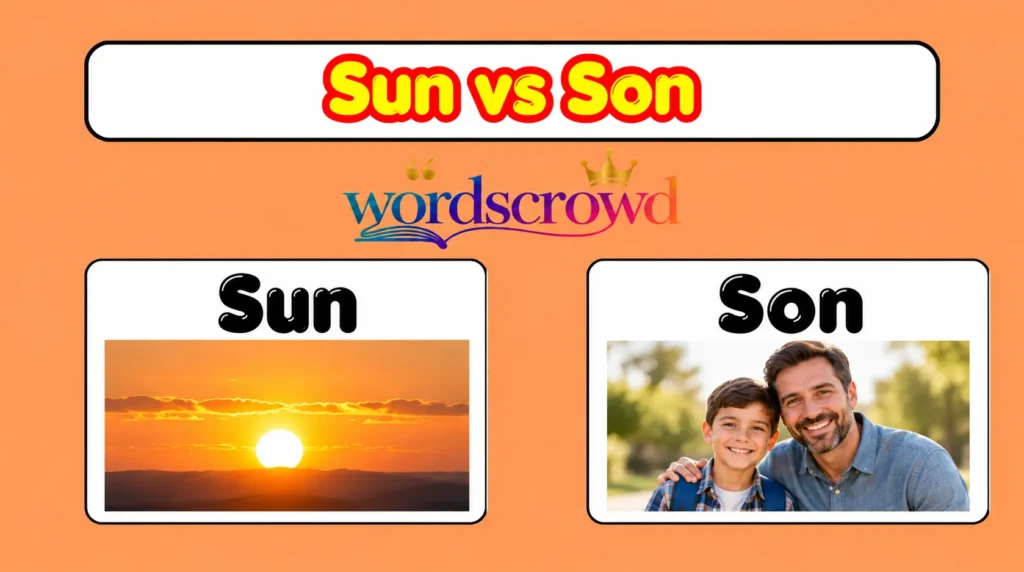
Sun and son are two completely different English words that sound exactly the same. That makes sun vs son a common vocabulary and spelling problem, especially for English learners and anyone writing quickly.
The good news is that the difference is simple once you connect each word with its meaning.
Sun refers to the star at the center of our solar system, or sometimes to its light or warmth. Son refers to a male child in relation to his parent or parents.
So, although sun and son have the same pronunciation, you cannot normally use one in place of the other. The correct spelling depends entirely on what you mean.
In this guide, you’ll learn the difference between sun vs son, how to pronounce them, when to use each word, why they are confusing, common mistakes, examples from everyday and professional English, and easy ways to remember which spelling you need.
Quick Answer
Sun and son are homophones: they sound alike but have different meanings and spellings.
- Sun = the star that gives Earth light and heat.
The sun is shining brightly. - Son = a male child.
Their son is studying at university.
Use “sun” for the star, sunlight, or sunshine. Use “son” for a male child.
Quick rule: Sun = sky. Son = family.
Sun vs Son: Comparison Table
| Feature | Sun | Son |
|---|---|---|
| Meaning | The star at the center of our solar system | A male child |
| Part of speech | Noun | Noun |
| Pronunciation | /sʌn/ | /sʌn/ |
| Sound | Same | Same |
| Spelling | S-U-N | S-O-N |
| Main context | Nature, weather, astronomy, light, heat | Family and relationships |
| Refers to | A celestial body or its light/warmth | A male child |
| Plural | Suns | Sons |
| Possessive | Sun’s | Son’s |
| Common phrase | in the sun | my son |
| Professional use | Weather, science, travel, health, environment | Family, biography, personal information |
| Academic use | Astronomy, climate, science | Family studies, literature, social sciences |
| Everyday use | Very common | Very common |
| Formal/informal | Neither is inherently formal or informal | Neither is inherently formal or informal |
| Common mistake | Using son when referring to sunlight | Using sun when referring to a male child |
| Memory trick | Sun = sky | Son = someone in your family |
The most important difference
The easiest distinction is:
Sun → something in the sky
Son → someone in a family
They are not interchangeable.
What Does “Sun” Mean?
Sun is a noun used primarily for the star at the center of our solar system.
It is also commonly used when talking about the light, warmth, or rays produced by that star.
Examples
- The sun rises in the east.
- The sun is very bright today.
- We sat outside in the sun.
- The plants need sun to grow.
- The afternoon sun made the room warm.
In each sentence, sun is connected with light, heat, daylight, or the celestial object itself.
The sun in science
In astronomy, the Sun is a star. When referring specifically to our solar system’s star, scientific writing often capitalizes it as the Sun.
For example:
Earth orbits the Sun.
In ordinary writing, especially when discussing sunshine or daylight rather than the astronomical object, lowercase sun is also common:
We spent the afternoon in the sun.
Capitalization therefore depends partly on context and style.
“Sun” as a source of light or warmth
English speakers frequently use sun in expressions where the meaning is not simply the astronomical object.
For example:
- in the sun
- under the sun
- sunlight
- sunshine
- sunny
- sunburn
- sunrise
- sunset
- sun-warmed
Consider:
The children played in the sun.
The sentence is really about exposure to sunlight, not about physically being inside the star.
Another example:
I opened the curtains to let the sun in.
Here, sun refers naturally to sunlight or daylight entering the room.
“Sun” in Professional and Academic English
The word sun appears in many areas of formal writing.
Science
The Earth receives energy from the Sun.
Weather
Temperatures are expected to rise when the sun comes out.
Environmental writing
Solar energy converts sunlight from the Sun into usable power.
Travel writing
The resort is popular for its beaches and warm sun.
Health and lifestyle writing
Long periods in strong sun can damage unprotected skin.
The word itself is neither formal nor informal. Its suitability depends on the sentence and subject.
What Does “Son” Mean?
Son is a noun that means a male child in relation to a parent or parents.
For example:
- They have one son.
- Her son is ten years old.
- My son starts school next month.
- Their youngest son lives abroad.
The word describes a family relationship.
Son is about family
Whenever you’re talking about a male child and his relationship to a parent, son is usually the word you need.
Compare:
Sarah has a son.
This tells us Sarah has a male child.
But:
Sarah sat in the sun.
This tells us Sarah sat in sunlight.
The pronunciation is identical, but the meaning is completely different.
“Son” in Different Contexts
Everyday conversation
My son loves football.
School
Her son is in the sixth grade.
Business
The company was later managed by the founder’s son.
Biography
His son followed him into the family business.
Formal writing
The deceased was survived by his wife and two sons.
Historical writing
The king’s eldest son eventually inherited the throne.
The word son can therefore appear in casual conversation, professional documents, historical texts, legal writing, and academic work.
Why Are Sun and Son So Confusing?
The main reason is pronunciation.
Sun and son are homophones.
A homophone is a word that has the same pronunciation as another word but a different spelling and meaning.
Other common English homophones include:
- two / too / to
- there / their / they’re
- right / write
- see / sea
- flower / flour
- pair / pear
- one / won
Likewise:
sun / son
are pronounced the same in standard varieties of English.
Why does this matter?
When you hear someone say:
“My son is outside.”
You cannot determine the spelling from the sound alone.
You need to understand the context.
If the speaker says:
“The sun is outside.”
the intended meaning is completely different.
That’s why spelling matters when writing.
Sun vs Son Pronunciation
Both words are generally pronounced:
/sʌn/
They have the same basic vowel sound as the word run.
Sun
sun → /sʌn/
Son
son → /sʌn/
The difference is spelling, not pronunciation.
Important: Don’t try to create a different pronunciation for son just because it is spelled with an o.
In standard English, sun and son normally sound the same.
Are Sun and Son Interchangeable?
No.
Although they are homophones, they have different meanings.
You cannot normally substitute one for the other.
Correct
My son is at home.
Incorrect
My sun is at home.
Why is the second sentence wrong?
Because sun refers to the star or its light, not a male child.
Now reverse the situation:
Correct
The sun is very hot today.
Incorrect
The son is very hot today.
The second sentence would mean that a male child is very hot, which could technically be meaningful in a completely different situation, but it does not mean the star.
Key Differences Between Sun and Son
Here is the difference in the simplest possible form:
- Sun is connected with astronomy, daylight, light, and warmth.
- Son is connected with family and parent-child relationships.
- Both words are normally pronounced /sʌn/.
- Sun is spelled S-U-N.
- Son is spelled S-O-N.
- They are homophones, not synonyms.
- Context tells you which meaning is intended when you hear the words.
- Spelling tells the reader which meaning you intend when you write them.
Remember: You hear the same sound, but you write the meaning.
Grammar: How Sun and Son Work in a Sentence
Both sun and son are primarily countable nouns, although sun can also be used in an uncountable way when referring to sunlight or sunshine.
Sun as a noun
The sun is bright.
Here, sun is a noun referring to the celestial object.
We sat in the sun.
Here, sun refers to sunlight or exposure to sunlight.
Son as a noun
Their son is a doctor.
Here, son is a singular countable noun.
Its plural form is:
son → sons
Example:
They have three sons.
Possessive forms
The possessive form of son is:
son’s
Example:
My son’s bicycle is outside.
The plural possessive is:
sons’
Example:
The two sons’ rooms were upstairs.
For sun, the possessive is usually:
sun’s
Example:
The sun’s energy reaches Earth.
Capitalization: Sun or sun?
This is a slightly more advanced question.
When referring specifically to Earth’s star as an astronomical object, Sun is often capitalized in scientific or astronomy-focused writing.
Example:
The Sun is approximately 150 million kilometers from Earth.
When using sun in ordinary expressions about sunlight, lowercase is standard:
We spent the afternoon in the sun.
The morning sun was warm.
Different style guides and publications can make somewhat different capitalization choices, so consistency with the style guide you are following matters.
The key point is that capitalization does not turn sun into son.
20 Real-Life Examples of Sun vs Son
The fastest way to understand the difference is to see the words in natural contexts.
Everyday conversation
- The sun is shining today.
- My son is playing outside.
- We sat in the sun after lunch.
- Her son called her this morning.
Family conversation
- My son starts school next week.
- Their son is learning to drive.
- His son lives in another city.
- She brought her son to the park.
School and education
- The students learned how the Earth moves around the Sun.
- Her son is studying mathematics at school.
Business
- The company was founded by his son.
- Solar panels convert energy from the Sun into electricity.
- I’ll be taking the afternoon off to attend my son’s school event.
- The office receives direct sun through the windows in the morning.
Academic writing
- The Earth receives energy from the Sun.
- The researcher interviewed each participant and one participant’s son.
Social media
- Beautiful sunset after a long day in the sun!
- Proud of my son for finishing his first race.
Daily life
- Close the curtains because the afternoon sun is too bright.
- My son left his backpack in the car.
Notice how the surrounding words make the intended meaning obvious.
Common Mistakes With Sun and Son
Mistake 1: Using “sun” for a male child
Wrong:
My sun is five years old.
Correct:
My son is five years old.
Why?
A five-year-old male child is your son, not your sun.
Mistake 2: Using “son” for sunlight
Wrong:
I love sitting in the son.
Correct:
I love sitting in the sun.
Why?
You sit in sunlight, so the correct spelling is sun.
Mistake 3: Confusing “sons” and “suns”
These are also different words.
Sons
Plural of son:
They have two sons.
Suns
Plural of sun:
Astronomers have discovered planets orbiting other suns.
This distinction is particularly useful in science writing.
Mistake 4: Assuming spelling follows pronunciation
English spelling is not always predictable from pronunciation.
Because sun and son sound alike, listening alone does not tell you which spelling to choose.
Instead, ask:
What does the word mean?
- Sky/light/heat → sun
- Male child → son
Sun vs Son in Compound Words
Knowing related words can make the distinction easier.
Words related to sun
- sunlight
- sunshine
- sunny
- sunrise
- sunset
- sunburn
- sunbeam
- sunscreen
- sunlit
These all connect to sun.
Words related to son
- son-in-law
- stepson
- grandson
- sonship
- sons
- son’s
These all connect to son and family relationships.
A useful clue
If the word is about weather, daylight, astronomy, heat, or light, think sun.
If it is about family, children, parents, or relationships, think son.
Memory Tricks for Sun vs Son
Here are several ways to make the distinction stick.
Memory Trick 1: Sky vs Family
SUN = SKY
SON = FAMILY
This is probably the easiest trick.
Memory Trick 2: “O” for offspring
The o in son can remind you of offspring.
S-O-N → offspring
A son is someone’s male offspring.
Memory Trick 3: “U” for up
The u in sun can remind you of something up in the sky.
S-U-N → up
The Sun is up in the sky.
Memory Trick 4: Think of “sunny”
If you can replace the idea with sunny, choose sun.
It is a sunny day.
Therefore:
The sun is shining.
If you can replace the idea with child, choose son.
He has a male child.
Therefore:
He has a son.
How to Choose the Correct Word
When writing sun vs son, don’t rely on pronunciation. Use this three-step test.
Step 1: Identify the meaning
Ask:
Am I talking about light, heat, daylight, or the star?
If yes → sun
Step 2: Check for family meaning
Ask:
Am I talking about a male child or family relationship?
If yes → son
Step 3: Read the sentence again
Make sure the meaning makes sense.
For example:
Her ___ is ten years old.
A person can be ten years old, so:
Her son is ten years old.
But:
The ___ is shining.
Something that shines in the sky is the:
sun
Sun vs Son in British and American English
There is essentially no US-versus-UK spelling difference here.
Both American English and British English use:
- sun for the star or sunlight
- son for a male child
Both are also generally pronounced the same.
So this is not a case like:
- color / colour
- center / centre
- traveled / travelled
The difference between sun and son is meaning, not regional English.
Is “Son” Ever Used Outside Family Relationships?
Yes, but the central idea remains a male child or a person addressed as a son.
For example, son can appear in religious, literary, historical, or figurative expressions.
A famous example is:
the Son
In Christian theology, the Son is a title referring to Jesus Christ in the doctrine of the Trinity.
This is a specialized meaning and should not be confused with the ordinary family meaning.
The spelling remains son, not sun.
Is “Sun” Ever Used Figuratively?
Yes.
English sometimes uses sun metaphorically to represent warmth, happiness, brightness, hope, or a central source of something.
For example:
She was the sun of the family.
That is figurative language, not a reference to the physical star.
Likewise, literary writing may describe a person as someone’s “sun” to suggest that the person brings light or happiness.
Again, context matters.
Why Context Matters So Much
When two words sound identical, listeners depend on context.
Imagine hearing:
“My son is at school.”
The words around son—“my” and “is at school”—make the family meaning clear.
Now hear:
“The sun is setting.”
The word “setting” makes the astronomical meaning clear.
This is why native speakers rarely struggle to understand these words in conversation.
The problem usually appears in writing, where the spelling must communicate the intended meaning.
Common Phrases With Sun
Some natural expressions include:
- in the sun
- under the sun
- sunny day
- sunlight
- sunshine
- sunrise
- sunset
- morning sun
- afternoon sun
- direct sun
- sun exposure
Examples:
We spent the morning in the sun.
The sunrise was beautiful.
The room gets a lot of sunlight.
Common Phrases With Son
Common expressions include:
- my son
- her son
- their son
- eldest son
- youngest son
- only son
- son-in-law
- stepson
- grandson
- son’s birthday
- father and son
- mother and son
Examples:
Her eldest son works abroad.
He went fishing with his father and son.
We’re celebrating our son’s birthday this weekend.
A Note About “Son” and “Daughter”
A useful vocabulary comparison is:
- son = male child
- daughter = female child
For example:
They have one son and two daughters.
By contrast, sun has nothing to do with family relationships.
A Note About “Sun” and “Moon”
Another useful vocabulary comparison is:
- sun = our solar system’s star
- moon = Earth’s natural satellite
For example:
The Sun provides light and energy, while the Moon reflects sunlight.
This can help learners place sun firmly in the astronomy vocabulary group.
Can “Sun” and “Son” Be Used as Verbs?
In ordinary modern English, both are primarily nouns.
Sun can also occur in verb constructions, especially to sun oneself, meaning to expose oneself to sunlight.
Example:
The seal was sunning itself on the rocks.
Son does not normally function as a standard everyday verb.
So if you’re choosing between the two in ordinary writing, the noun meaning is usually what matters.
Are Sun and Son Synonyms?
No.
Synonyms are words with the same or closely related meanings.
Sun and son have completely different meanings.
They are homophones, not synonyms.
Compare:
Homophones:
sun / son
Synonyms:
big / large
Antonyms:
hot / cold
Understanding this terminology can help explain why the two words sound alike without meaning the same thing.
What Happens If You Use the Wrong One?
Usually, the reader can still understand what you intended from context, but the spelling error can make your writing look careless.
For example:
I took my son to the beach.
is clear and correct.
But:
I took my sun to the beach.
creates a strange image because sun does not mean a child.
In professional emails, school assignments, applications, articles, and other published content, choosing the correct homophone is especially important.
Frequently Asked Questions
1. What is the difference between sun and son?
Sun refers to the star that provides Earth with light and heat, or to its sunlight. Son means a male child in relation to a parent or parents. They sound the same but have different spellings and meanings.
2. Are sun and son pronounced the same?
Yes. In standard English, sun and son are generally pronounced /sʌn/. They are homophones.
3. Which is correct: “my sun” or “my son”?
My son is correct when you mean a male child.
My son is six years old.
“My sun” would refer literally to a person’s sun, which is not the normal meaning in everyday English.
4. Is it “the sun” or “the son”?
Use the sun when talking about the star or sunlight.
The sun is bright today.
Use the son when a particular male child is being discussed.
The son of the president attended the event.
5. Why do sun and son sound the same?
They developed with different spellings and meanings but have the same pronunciation in modern standard English. Their identical pronunciation makes them homophones.
6. Is “son” related to “sun”?
Although the modern words look and sound similar, son and sun are different words with different meanings and historical development. Their modern similarity is primarily a spelling-and-sound coincidence.
7. Are sun and son the same in British and American English?
Yes. Both British and American English use sun for the star or sunlight and son for a male child. The basic pronunciation is also the same.
8. What is the plural of sun?
The plural is suns when referring to multiple stars like our Sun.
Astronomers study distant suns and the planets that orbit them.
The plural of son is sons.
They have three sons.
9. How can I remember sun vs son?
Use the simple rule:
Sun = sky.
Son = family.
You can also remember the o in son as standing for offspring.
Quick Reference: Sun vs Son
SUN ☀️
Think: sky, sunlight, sunshine, star, warmthSON 👨👩👦
Think: family, child, parent, male offspring
If you mean:
- A star → sun
- Sunshine → sun
- Daylight → sun
- Heat from the star → sun
- A male child → son
- A parent’s male child → son
- Family relationship → son
Final Verdict: Sun vs Son
The answer to sun vs son is simple once you focus on meaning rather than sound.
Sun is the correct word when you’re talking about the star at the center of our solar system, its light, its warmth, or sunlight.
Son is the correct word when you’re talking about a male child or a family relationship.
Both words are pronounced the same, so pronunciation cannot tell you which spelling to use. Context and meaning are the deciding factors.
The best rule to remember
☀️ Sun = sky
👦 Son = family
So write:
The sun is shining.
But:
My son is smiling.
They sound alike, but they mean entirely different things. When you’re writing, choose the spelling that matches the meaning you want to communicate.

Elon Parker is a dedicated writer at Wordscrowd, creating clear, informative, and engaging content for readers.
With a focus on useful information, Elon aims to make every article simple, reliable, and easy to understand.