English can be surprisingly tricky when two forms come from the same verb. Agreed or agree is a perfect example.
Both words are correct, both are extremely common, and both come from the same verb—but they do not always work in the same sentence.
The confusion usually appears when someone wants to say that they share an opinion, accept a suggestion, or have reached a decision. Should you write “I agree” or “I agreed”? Is “agreed” simply a more formal version of “agree”?
Can you say “Agreed!” by itself? And why does changing one word sometimes change the entire time reference of a sentence?
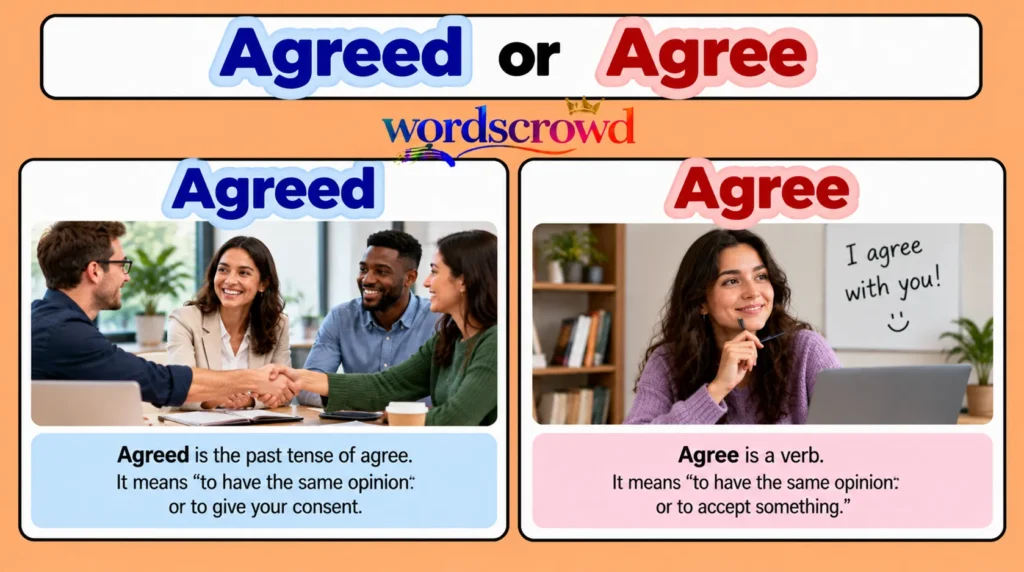
The key is simple: agree is the base form of the verb, while agreed is mainly its simple past and past participle form.
In addition, agreed can function as an adjective and can also be used as a short response meaning “yes” or “I accept.”
This guide explains the difference clearly, including tense, sentence structure, pronunciation, formal and informal usage, common collocations, British and American English, professional writing, everyday conversation, and dozens of natural examples.
Quick Answer
Agree is the present/base form of the verb: “I agree with you.”
Agreed is usually the past tense or past participle: “We agreed yesterday.” It can also be an adjective or a standalone response: “The agreed price is $500.” / “Agreed!”
So, both are correct. The right choice depends mainly on tense, sentence structure, and context.
Agreed or Agree: At a Glance
| Feature | Agree | Agreed |
|---|---|---|
| Basic form | Base/present form | Past form / past participle |
| Part of speech | Verb | Verb; sometimes adjective |
| Pronunciation | /əˈɡriː/ | /əˈɡriːd/ |
| Main meaning | Have the same opinion or accept something | Had the same opinion, accepted something, or was previously decided |
| Present example | “I agree with you.” | — |
| Past example | — | “I agreed with you yesterday.” |
| Perfect tense | “I have agreed.” | Used as past participle |
| Future | “I will agree.” | — |
| Standalone response | Usually no | “Agreed!” |
| Adjective use | No | “the agreed price” |
| Everyday conversation | Very common | Very common |
| Business writing | Very common | Very common |
| Academic writing | Very common | Common when describing previous agreement |
| Formality | Neutral | Neutral; “Agreed!” can sound concise or formal |
| US English | Common | Common |
| UK English | Common | Common; some structures such as “agree a deal” are especially associated with UK usage |
| Main question answered | “Do I agree now?” | “Did I agree?” / “Has something been agreed?” |
| Easy memory | Agree = now/base form | Agreed = past/completed/agreed-upon |
Cambridge identifies agree as a verb used for having the same opinion, accepting suggestions, or reaching decisions. It also identifies agreed as an adjective meaning accepted or approved and as a standalone response meaning “yes.”
What Does “Agree” Mean?
Agree is the base form of the verb agree. It generally means to have the same opinion, accept an idea or suggestion, or reach a decision with another person.
Examples:
- I agree with you.
- We agree on the main issue.
- They agree that the plan is practical.
- She agreed to help us.
- The two sides need to agree on a price.
The word can describe several related ideas, not just “having the same opinion.”
Agree Can Mean “Have the Same Opinion”
This is perhaps the most common use.
I agree with your opinion.
Here, the speaker is saying that their opinion is the same or substantially similar.
Other examples:
- I agree with Sarah.
- We agree about the problem.
- They agree on the basic facts.
- Do you agree with me?
- Most researchers agree that the evidence is important.
Cambridge lists structures such as agree with, agree about, agree on, and agree that among the common grammatical patterns of the verb.
Agree Can Mean “Accept”
Agree can also mean to accept a proposal, request, or suggestion.
She agreed to help us.
This does not necessarily mean that she shared someone’s opinion. It means she accepted the proposed action.
More examples:
- He agreed to the terms.
- They agreed to meet tomorrow.
- I agreed to join the project.
- The company agreed to the request.
- She agreed that we should leave early.
Agree Can Mean “Reach a Decision Together”
Another important meaning is to arrive at an arrangement or decision.
We need to agree on a date.
The people involved may not have started with the same opinion. They may have discussed several possibilities and eventually reached a common decision.
For example:
We discussed three possible meeting dates and finally agreed on Friday.
Agree Can Mean “Correspond” or “Match”
The verb is not limited to people.
Two pieces of information can agree when they match or are consistent.
Examples:
- The figures agree with the original report.
- His account does not agree with the evidence.
- The two reports agree on several important points.
- The results agree with our expectations.
Oxford also records this meaning of agree: information, accounts, or figures can agree when they correspond or match.
Agree in Grammar
There is another technical use that language learners often encounter.
A word can agree grammatically with another word.
For example:
Tom likes jazz.
The singular subject Tom requires the singular verb likes. The verb agrees with its subject in number and person.
This grammatical sense is recognized by both Cambridge and Oxford.
What Does “Agreed” Mean?
Agreed is the simple past and past participle form of agree.
It can also function as an adjective, and it can appear as a short standalone response.
That gives agreed several important uses.
Agreed as the Past Tense of Agree
Use agreed when the agreement happened in the past.
I agreed with him yesterday.
Compare:
I agree with him.
The agreement is being expressed now.
I agreed with him yesterday.
The agreement happened in the past.
More examples:
- We agreed on a price last night.
- She agreed to the proposal.
- They agreed that the plan was too expensive.
- I agreed with your suggestion at the meeting.
- The two companies agreed to work together.
Merriam-Webster lists agreed as the past form of agree and gives “agreed; agreeing” as the verb’s principal forms.
Agreed as a Past Participle
Agreed is also used after auxiliary verbs such as have, has, and had.
Examples:
- I have agreed to the terms.
- She has agreed to participate.
- They had agreed on a price before the meeting.
- We have agreed that changes are necessary.
In these sentences, agreed is not simply functioning as an ordinary past-tense verb. It is the past participle form used in a perfect construction.
Agreed as an Adjective
This is one of the biggest reasons people search for agreed or agree.
Consider:
The agreed price is $800.
Here, agreed describes price. It means the price that the people involved have accepted or decided upon.
Other examples include:
- the agreed date
- the agreed price
- the agreed terms
- the agreed deadline
- the agreed plan
- the agreed amount
- the agreed schedule
- the agreed procedure
Cambridge specifically defines agreed as an adjective meaning accepted or approved, with common business combinations such as agreed price, agreed time, and agreed date.
Agreed as a Standalone Response
You can also simply say:
“Agreed!”
This means something like:
- Yes.
- I agree.
- I accept.
- That is acceptable.
- We have reached the same conclusion.
For example:
“Let’s meet at 6 p.m.”
“Agreed.”
This use is perfectly natural, especially when the speaker wants to give a short, decisive response.
Cambridge explicitly records “Agreed!” as a response meaning “yes.”
Agreed or Agree: The Main Difference
The easiest way to understand the difference is to focus on time and grammatical function.
1. Use “agree” for the present or base form
I agree with you.
The speaker is expressing agreement now.
2. Use “agreed” for a completed past action
I agreed with you yesterday.
The agreement happened in the past.
3. Use “agreed” after have, has, or had
We have agreed on the price.
They had agreed before the meeting.
4. Use “agreed” before a noun when it means “accepted” or “decided”
We followed the agreed plan.
5. Use “Agreed!” as a short response
“Let’s use the second option.”
“Agreed!”
Grammar: Agree vs Agreed
Understanding the verb forms makes the choice much easier.
The Main Verb Forms
| Form | Example |
|---|---|
| Base form | agree |
| Third-person singular present | agrees |
| Present participle | agreeing |
| Simple past | agreed |
| Past participle | agreed |
Examples:
- I agree.
- She agrees.
- They are agreeing.
- We agreed.
- They have agreed.
Notice that agree and agreed are not interchangeable simply because they share the same meaning.
Present Simple
Use agree for present-time statements.
I agree with your point.
We agree on the main issue.
They agree that the proposal is useful.
For third-person singular subjects, use agrees:
She agrees with me.
He agrees that the plan is realistic.
Simple Past
Use agreed when the agreement occurred in the past.
We agreed on the price yesterday.
She agreed to help us last week.
They agreed that the meeting should be postponed.
Present Perfect
Use have/has + agreed.
We have agreed on the final details.
She has agreed to the new schedule.
This often emphasizes a completed decision that remains relevant now.
Past Perfect
Use had + agreed when one past agreement happened before another past event.
They had agreed on the terms before the lawyers arrived.
Future
Use will agree, not will agreed.
Correct:
We will agree on the final version tomorrow.
Incorrect:
We will agreed on the final version tomorrow.
Agree With, Agree To, and Agree On
One of the most useful parts of mastering agree is learning which preposition belongs with it.
Agree With Someone
Use agree with when you share someone’s opinion.
I agree with you.
She agrees with her manager.
They agreed with the professor.
You can also use agree with something when you accept or support an idea, statement, or viewpoint.
I agree with that argument.
Agree To Something
Use agree to when you accept a proposal, arrangement, request, condition, or course of action.
She agreed to the contract.
They agreed to the new rules.
He agreed to help.
A useful pattern is:
agree to + noun
We agreed to the proposal.
Or:
agree to + verb
We agreed to meet at noon.
Cambridge gives agree to something and agree to do something as established grammatical patterns.
Agree On Something
Use agree on when people reach the same decision about a particular subject.
We agreed on the price.
They agreed on a meeting date.
The committee agreed on the final wording.
Agree That + Clause
Use agree that before a complete idea.
I agree that this is the best option.
They agreed that the deadline was unrealistic.
Agree About Something
Use agree about when talking about whether people have the same opinion concerning a subject.
We agree about most things.
They don’t agree about politics.
Is “Agreed” More Formal Than “Agree”?
Not exactly.
The difference is primarily grammatical, not simply formal.
Compare:
I agree.
I agreed.
The second sentence is past tense. It does not automatically become more formal.
However, “Agreed.” as a standalone response can sound concise, decisive, or somewhat formal depending on the situation.
For example:
Casual:
“Want to grab coffee?”
“Sure!”
Concise/professional:
“Let’s move the meeting to Thursday.”
“Agreed.”
Formal business context:
“We will proceed according to the revised schedule.”
“Agreed.”
So, agreed is not inherently more formal than agree. Context creates much of the difference in tone.
Is “Agreed” Correct in American English?
Yes.
Agreed is standard English in both American and British English.
The past tense:
I agreed.
The past participle:
I have agreed.
The adjective:
the agreed terms
The standalone response:
Agreed.
All are standard.
There can, however, be differences in certain constructions involving the verb.
For example, Cambridge notes the British business usage “agree a deal”, meaning to reach agreement on a deal.
In many American contexts, speakers are more likely to say:
agree to a deal
or
agree on a deal
depending on the intended meaning.
This is a good reminder that regional variation sometimes affects the construction around a word rather than the word itself.
20+ Real-Life Examples of Agree and Agreed
The best way to understand the difference is to see it in natural contexts.
Everyday Conversation
- I agree with you.
- I agreed with her yesterday.
- Do you agree with this idea?
- We agreed to meet after lunch.
- They agree on almost everything.
Text Messages
- “Pizza tonight?” — “Agreed!”
- I agree 😂 That movie was terrible.
- We agreed to leave at eight, remember?
School and Academic English
- Many scholars agree that language changes over time.
- The researchers agreed on the main conclusion.
- I agree with the author’s argument.
- The two studies agree with each other on several points.
Business English
- The clients agreed to the revised proposal.
- We have agreed on the final deadline.
- Please follow the agreed procedure.
- The teams agreed that further discussion was necessary.
Email Writing
- I agree with your recommendation.
- As agreed, I have attached the revised document.
- We agreed on the meeting time during our call.
- Please let me know if you agree to these changes.
Professional Writing
- The parties have agreed to the terms of the settlement.
- The agreed deadline remains unchanged.
- Both departments agreed on a practical solution.
- The final figures agree with the original estimates.
Social Media
- Agreed. This is exactly what I was thinking.
- I completely agree!
- We may not agree on everything, but this one is obvious.
Common Mistakes With Agree and Agreed
Mistake 1: Using “agreed” for a present opinion
Incorrect in a present-time context:
I agreed with you.
If you mean that you share the person’s opinion now, use:
I agree with you.
Use agreed only when the past meaning is intended.
I agreed with you during yesterday’s meeting.
Mistake 2: Using “agree” after “have”
Incorrect:
We have agree on the price.
Correct:
We have agreed on the price.
After have/has/had, you need the past participle.
Mistake 3: Using “agreed” after “will”
Incorrect:
We will agreed tomorrow.
Correct:
We will agree tomorrow.
After will, use the base form.
Mistake 4: Confusing “agree with” and “agree to”
Consider:
I agree with you.
This means I share your opinion.
But:
I agree to your proposal.
This means I accept your proposal.
The preposition changes the relationship between the speaker and the idea.
Mistake 5: Forgetting the -s with he/she/it
Incorrect:
She agree with me.
Correct:
She agrees with me.
The present-tense third-person singular form is agrees.
Mistake 6: Treating “agreed” as only a past-tense verb
This sentence is perfectly correct:
We followed the agreed schedule.
Here, agreed describes schedule. It functions adjectivally.
Mistake 7: Assuming “Agreed!” always means past tense
In:
Agreed!
the word is being used as a standalone response. It means something like “I agree” or “Yes, that is acceptable.”
It does not necessarily refer to an event that happened yesterday.
Agreed vs Agree in Email Writing
Professional emails often contain both forms, but they serve different purposes.
Use “agree” to express your current position
I agree with your recommendation.
I agree that we should postpone the launch.
Use “agreed” to refer to a previous decision
As agreed, I have attached the report.
We agreed during yesterday’s meeting that the deadline would move.
Use “agreed” as an adjective
Please review the agreed terms before signing.
The agreed deadline is Friday.
A Useful Business Phrase: “As Agreed”
As agreed is extremely common in professional communication.
Examples:
As agreed, I have attached the final document.
As agreed during our meeting, the project will begin next Monday.
As agreed, we will send the revised proposal by Friday.
It means “as we previously discussed or decided.”
Agree vs Agreed in Academic Writing
Both forms are useful in academic English.
Use agree when discussing a current position:
Many researchers agree that early intervention is important.
Use agreed when describing a historical or completed agreement:
The committee agreed that further research was necessary.
Use agree with when evaluating an argument:
The findings agree with previous research.
Use agreed in a passive or participial structure:
The agreed methodology was applied throughout the study.
In academic writing, always choose the form based on meaning and grammatical structure, rather than trying to make your writing sound more formal.
Word Origin and History
The verb agree has a long history in English.
Merriam-Webster traces it through Middle English agreen, from Anglo-French agreer, ultimately connected with Latin gratus, meaning something like pleasing, welcome, or acceptable. Merriam-Webster records the first known English use of agree in the 15th century.
Oxford similarly traces the word through Old French to Latin roots associated with being pleasing or acceptable.
The modern English family developed around the central idea of being in harmony, accepting something, or reaching compatibility.
That explains why today’s word can cover several related meanings:
- sharing an opinion
- accepting a proposal
- reaching a decision
- matching information
- being compatible
- grammatical agreement
Common Collocations With Agree
Learning common word combinations is often more useful than memorizing a definition.
Common “Agree With” Collocations
- agree with someone
- agree with an opinion
- agree with a statement
- agree with an argument
- agree with a decision
- agree with the conclusion
Examples:
I agree with your conclusion.
She doesn’t agree with the decision.
Common “Agree On” Collocations
- agree on a price
- agree on a date
- agree on a plan
- agree on a solution
- agree on a deadline
- agree on terms
- agree on a strategy
Example:
The teams agreed on a final deadline.
Common “Agree To” Collocations
- agree to a proposal
- agree to the terms
- agree to a request
- agree to the conditions
- agree to help
- agree to participate
- agree to meet
Example:
The company agreed to the revised conditions.
Common “Agreed” Collocations
- agreed price
- agreed date
- agreed deadline
- agreed terms
- agreed plan
- agreed amount
- agreed schedule
- agreed procedure
- agreed solution
- agreed conditions
These are especially common in business and professional English. Cambridge’s Business English entry specifically highlights combinations such as agreed deal, agreed price, and agreed time/date.
Memory Tricks for Agree or Agreed
Trick 1: “Agree” = Now
Think:
I agree = I think so now.
Example:
I agree with you.
Trick 2: “Agreed” = Already Decided
Think:
Agreed = the decision has been made.
Example:
We agreed on the price yesterday.
Trick 3: “Agreed + Noun” = Accepted
If agreed comes directly before a noun, it often means accepted or decided.
agreed price
agreed deadline
agreed terms
Think:
agreed + noun = accepted/decided noun
Trick 4: “Agreed!” = “Yes!”
If someone says:
Agreed!
mentally replace it with:
I agree!
That makes the standalone use easy to remember.
Quick Decision Guide
When you are unsure, ask yourself these questions:
- Am I talking about my opinion right now?
→ Use agree. - Did the agreement happen in the past?
→ Use agreed. - Do I have have/has/had before the verb?
→ Use agreed. - Is the word describing a noun such as price, date, or plan?
→ Use agreed. - Am I giving a short response meaning “yes”?
→ Agreed! works. - Does the sentence contain will?
→ Use agree, not agreed.
Frequently Asked Questions
Is “agreed or agree” a grammar question?
Yes. The choice between agree and agreed is mainly a question of verb form and grammatical function. Context determines whether you need the present/base form, past form, past participle, or adjective-like use.
Is “I agree” correct?
Yes. I agree is the standard present-tense way to express that you share someone’s opinion or accept an idea.
I agree with your point.
Is “I agreed” correct?
Yes. I agreed is correct when referring to an agreement that happened in the past.
I agreed with her during yesterday’s meeting.
Can I say “Agreed!” by itself?
Yes. Agreed! is a standard standalone response meaning “I agree,” “Yes,” or “I accept.” It is especially useful when responding briefly to a suggestion or proposal.
Is “agreed” a past tense or an adjective?
It can be both, depending on the sentence.
As a past-tense verb:
We agreed yesterday.
As a past participle:
We have agreed.
As an adjective:
the agreed terms
Which is more formal: “agree” or “agreed”?
Neither is automatically more formal. They normally represent different grammatical functions or time references. However, standalone “Agreed.” can sound concise and businesslike.
What is the difference between “agree with” and “agree to”?
Agree with usually means sharing someone’s opinion:
I agree with you.
Agree to usually means accepting a proposal, request, condition, or action:
I agreed to the proposal.
What is the difference between “agree on” and “agree to”?
Agree on commonly refers to reaching a shared decision about a subject:
We agreed on a price.
Agree to commonly refers to accepting a proposal or condition:
We agreed to the price.
Is “as agreed” correct English?
Yes. As agreed is a standard phrase meaning “as previously discussed, decided, or accepted.”
As agreed, I have attached the document.
It is particularly common in professional emails and business communication.
Final Verdict: Agreed or Agree?
The answer is both are correct, but they are used differently.
Use agree when you are talking about a present opinion, a general state, or the base form of the verb:
I agree with you.
Use agreed when you are describing a past agreement:
We agreed yesterday.
Use agreed after have, has, or had:
They have agreed to the proposal.
Use agreed before a noun when it means accepted or previously decided:
the agreed price
And use “Agreed!” as a short response meaning:
“I agree.”
The most important point is that agreed is not simply a more formal version of agree. The two forms have different grammatical jobs. Once you identify the time, sentence structure, and intended meaning, the choice becomes straightforward.
The simplest rule to remember
Agree = present/base form.
Agreed = past, past participle, accepted/decided, or “yes” as a standalone response.
So if someone asks, “Which is correct: agreed or agree?”, the best answer is:
Both are correct—the sentence determines which one you need.
That small distinction can make your everyday conversation, emails, academic writing, and professional English much more precise.

Elon Parker is a dedicated writer at Wordscrowd, creating clear, informative, and engaging content for readers.
With a focus on useful information, Elon aims to make every article simple, reliable, and easy to understand.