Lunch is simple. The spelling of the time when you eat it is where things get surprisingly tricky. If you have ever stopped while writing an email and wondered, “Should I write lunchtime or lunch time?”, you are not alone.
Both forms can be found in English, which makes the choice even more confusing. Major dictionaries treat lunchtime as an established noun, while lunch time also appears as an alternative form in some dictionaries.
Collins, for example, lists lunch time alongside lunchtime, while Oxford and Cambridge use lunchtime as their main headword.
The good news is that you do not need to memorize a complicated grammar rule. In modern standard English, lunchtime is the safest and most widely recognized one-word form.
Lunch time is also understandable and can be acceptable, especially when the writer is treating lunch and time as separate words.
This guide explains the difference clearly. You will learn which form to choose in everyday conversation, school assignments, business emails, professional writing, American English, and British English.
We will also look at pronunciation, grammar, capitalization, prepositions, common mistakes, examples, and easy memory tricks.
Quick Answer
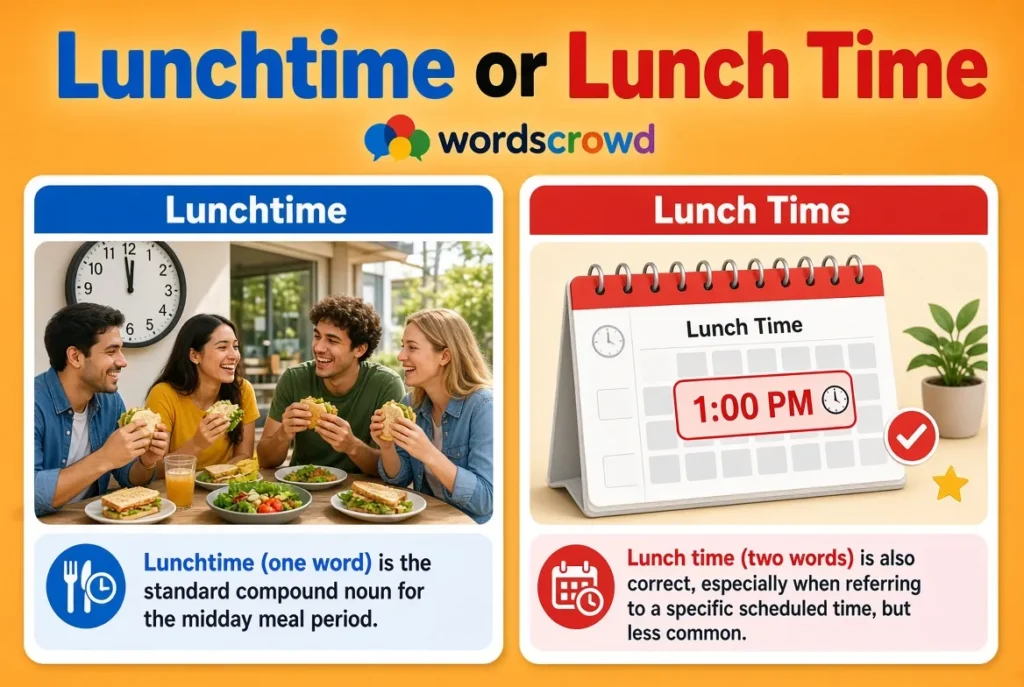
Lunchtime is the standard one-word spelling and the best choice in most modern English writing.
Lunch time can also occur and is recognized by some dictionaries, but it is less useful as the default spelling when you simply mean “the time when lunch is eaten.” Collins explicitly lists it as an alternative form.
Best practice: When in doubt, write lunchtime.
Quick rule:
lunchtime = the general period when lunch is eaten
lunch = the meal itself
Lunchtime or Lunch Time: Comparison at a Glance
| Feature | lunchtime | lunch time |
|---|---|---|
| Standard spelling | Yes | Acceptable alternative in some usage |
| Meaning | Time when lunch is normally eaten | Same basic meaning |
| Part of speech | Noun | Noun phrase / alternative form |
| Pronunciation | /ˈlʌntʃtaɪm/ | Usually the same |
| Main function | Names a general time period | Treats lunch + time more separately |
| Formal writing | Preferred default | Acceptable in some contexts, but less conventional |
| Everyday English | Very common | Understandable |
| American English | Common | Also encountered |
| British English | Common | Also encountered |
| Dictionary status | Main headword in Oxford and Cambridge | Listed as an alternative by Collins |
| Compound adjective | lunchtime meeting | lunch-time/lunch time meeting is less standard |
| Plural | lunchtimes | Usually avoid forcing a plural phrase |
| Safest choice | lunchtime | Use only when context supports it |
| Example | We met at lunchtime. | We met at lunch time. |
| Recommended for learners | Yes | Usually choose lunchtime instead |
Oxford defines lunchtime as the time around the middle of the day when people usually eat lunch and lists it as a noun. Cambridge likewise gives lunchtime as a noun meaning the time in the middle of the day when people usually eat a meal.
What Does “Lunchtime” Mean?
Lunchtime is a noun meaning the period around the middle of the day when people normally eat lunch.
For example:
- We usually eat at lunchtime.
- I’ll call you around lunchtime.
- The restaurant gets busy at lunchtime.
- She takes a walk during lunchtime.
The important point is that lunchtime refers to a period of the day, not the food itself.
Cambridge defines lunch as the meal eaten in the middle of the day, while its separate lunchtime entry refers to the time when people eat that meal.
Lunchtime Is a Noun
In normal usage, lunchtime functions as a noun.
Consider:
Lunchtime is approaching.
Here, lunchtime is the subject.
Or:
We arrived at lunchtime.
Here, lunchtime follows the preposition at.
You can also modify it:
We had a long lunchtime discussion.
In that sentence, lunchtime acts as a modifier before discussion.
Oxford specifically gives examples such as lunchtime concert, and its collocation information includes combinations such as lunchtime meeting and lunchtime drink.
What Time Is Lunchtime?
There is no universal clock time called “lunchtime.”
For many people, it falls somewhere around noon to early afternoon, but schedules vary by country, workplace, school, culture, and personal routine.
That is why:
- noon means 12:00 p.m.
- lunchtime means the period when lunch is normally eaten.
These are not exact synonyms.
For example:
I usually eat lunch at 1:30 p.m., so my lunchtime is later than noon.
That sentence makes perfect sense.
Lunchtime Does Not Have to Last Exactly One Hour
Another common misunderstanding is that lunchtime must mean a 60-minute break.
It does not.
The word can refer broadly to the period when lunch is normally eaten. Oxford describes it as the time around the middle of the day when people usually eat lunch.
If you specifically mean a work break of one hour, lunch hour may be clearer.
I finished the report during my lunch hour.
Cambridge defines lunch hour as the period in the middle of the day when people stop work to have lunch.
What Does “Lunch Time” Mean?
Lunch time uses the same two basic words—lunch and time—and can communicate essentially the same idea as lunchtime.
For example:
Is it lunch time yet?
A reader will understand that you mean the time for lunch.
However, there is an important usage point: lunchtime is the more established one-word form in modern standard English. Oxford and Cambridge use lunchtime as their dictionary headword, while Collins lists lunch time as an alternative.
So the choice is not simply:
One is correct. One is wrong.
That would be too simplistic.
A better explanation is:
Both forms can be found, but “lunchtime” is the safer default.
Why Does “Lunch Time” Exist?
English has a long history of turning combinations of words into compounds.
Consider:
- breakfast time
- bedtime
- dinnertime
- nighttime
- daytime
- lunchtime
Some compounds become strongly established as single words. Others remain open phrases, and some fluctuate between forms.
Lunchtime has become a conventional compound noun. Collins traces the word to lunch + time and dates its recorded origin to the mid-19th century.
That history helps explain why the one-word form feels natural today.
Is “Lunch Time” Wrong?
No, not automatically.
Some dictionaries recognize lunch time as an alternative. Collins explicitly gives “also lunch time” in its entry for lunchtime.
The practical question is therefore not:
“Is lunch time grammatically possible?”
It is:
“Which form should I choose if I want the clearest, most conventional modern English?”
The answer is lunchtime.
Lunchtime vs Lunch Time: The Key Difference
The biggest difference is spelling and conventionality, not meaning.
1. “Lunchtime” is the established compound
When you mean the general period when people eat lunch, lunchtime is the cleanest choice.
I’ll see you at lunchtime.
2. “Lunch time” separates the two words
In contexts where a writer wants to treat lunch and time as separate elements, the open form can appear.
We need to decide what lunch time works best for everyone.
However, even here, many editors would naturally rewrite the sentence for clarity:
We need to decide what time to have lunch.
This is an important writing lesson: sometimes the best solution is not choosing between two spellings. It is rewriting the sentence.
3. The one-word form is better as a modifier
Modern English commonly uses:
- lunchtime meeting
- lunchtime concert
- lunchtime appointment
- lunchtime show
- lunchtime break
- lunchtime discussion
- lunchtime news
Oxford specifically records lunchtime before nouns such as concert, drink, and meeting.
So if you are writing:
We attended a ______ meeting.
lunchtime meeting is the natural choice.
Pronunciation of Lunchtime
Both lunchtime and lunch time are normally pronounced as /ˈlʌntʃtaɪm/.
Cambridge gives lunchtime as /ˈlʌntʃ.taɪm/ in both UK and US English.
Break it into two parts:
lunch + time
The pronunciation is roughly:
LUNCH-time
The word lunch itself is pronounced /lʌntʃ/ in both British and American English according to Cambridge.
Does the Spelling Change the Pronunciation?
Usually, no.
Compare:
I’ll call you at lunchtime.
and:
I’ll call you at lunch time.
The intended pronunciation is essentially the same.
That means this is primarily a spelling and usage question, not a pronunciation question.
Is Lunchtime One Word or Two?
When you mean the general period for eating lunch, one word is the best default: lunchtime.
This is supported by the dictionary treatment of the term.
Oxford gives:
lunchtime — noun
Cambridge also gives:
lunchtime — noun
Collins goes a step further and notes that lunch time is also found as an alternative.
So if you are a student, professional writer, English learner, blogger, editor, or business communicator, the simplest rule is:
Use “lunchtime” unless you have a specific reason to write “lunch time.”
Is Lunchtime American or British English?
Lunchtime is used in both American and British English.
There is no simple US-versus-UK rule that says Americans must write lunch time and British speakers must write lunchtime. That claim would be misleading.
Oxford provides both British and American dictionary treatment of lunchtime, and Cambridge also records the term in both varieties.
Collins likewise provides British and American English information for lunchtime.
British English
Natural examples include:
I’ll phone you at lunchtime.
There’s a lunchtime concert at the theatre.
American English
Natural examples include:
I’ll call you around lunchtime.
The café is crowded at lunchtime.
So if you are writing for an international audience, lunchtime is an excellent choice.
Lunchtime vs Lunch: Do Not Confuse Them
This is a more important distinction than lunchtime vs lunch time.
Lunch is the meal.
Lunchtime is the period when the meal is normally eaten.
Compare:
I had a sandwich for lunch.
I called her at lunchtime.
You eat lunch.
You do not normally eat lunchtime.
Correct
- I had lunch at noon.
- I’ll see you at lunchtime.
- We talked during lunchtime.
- Lunch was delicious.
- The office is quiet after lunch.
Incorrect or unnatural
- I ate a delicious lunchtime.
- I had a sandwich for lunchtime.
- I cooked lunchtime for my family.
Instead, use lunch when you mean the meal.
Grammar: How to Use Lunchtime Correctly
Use “at lunchtime”
This is one of the most common patterns.
I’ll call you at lunchtime.
What are you doing at lunchtime?
The shop is busiest at lunchtime.
The preposition at works naturally with a particular point or customary time.
Use “during lunchtime”
Use during when you want to emphasize an activity taking place within the period.
We discussed the proposal during lunchtime.
She studies vocabulary during lunchtime.
However, depending on the context, during lunch or during the lunch break may sound even more natural.
Use “before lunchtime”
Please finish the report before lunchtime.
Use “after lunchtime”
I’ll send the documents after lunchtime.
Use “around lunchtime”
This means approximately during that period.
He arrived around lunchtime.
This is especially useful when you do not know the exact time.
Use “by lunchtime”
This means no later than the lunchtime period.
We should have the results by lunchtime.
Oxford gives the natural example by lunchtime, showing how the compound works with common time expressions.
Lunchtime, Lunch Break, and Lunch Hour
These expressions are related, but they are not identical.
Lunchtime
Focuses on when lunch is normally eaten.
I’ll call you at lunchtime.
Lunch break
Focuses on a break from work, school, or another activity.
I went for a walk during my lunch break.
Lunch hour
Usually refers to a period of about an hour set aside for lunch, particularly in a work context.
I have a doctor’s appointment during my lunch hour.
Cambridge treats lunch hour as a period when people stop work to have lunch and also gives lunch break as a related expression.
Quick Comparison
| Expression | Main idea | Example |
|---|---|---|
| lunch | The meal | I had lunch at 1. |
| lunchtime | Time when lunch is eaten | I’ll call at lunchtime. |
| lunch break | Break from work/school | I went out during my lunch break. |
| lunch hour | Usually about an hour for lunch | I have an appointment during my lunch hour. |
| noon | Exactly 12:00 p.m. | The meeting starts at noon. |
20+ Real-Life Examples of Lunchtime
The following examples show how native speakers might naturally use lunchtime in different situations.
Everyday Conversation
- Are you free at lunchtime?
- I’ll call you around lunchtime.
- What do you usually eat at lunchtime?
- The café gets really busy at lunchtime.
- Let’s meet before lunchtime.
Workplace and Business
- The client called just before lunchtime.
- We scheduled the meeting for lunchtime.
- I’ll send the revised proposal by lunchtime.
- The office is usually quieter after lunchtime.
- She arranged a lunchtime meeting with the sales team.
Email Writing
- Could we discuss this briefly at lunchtime?
- I’ll have the figures ready by lunchtime tomorrow.
- Please let me know if you’re available around lunchtime.
- The delivery is expected to arrive before lunchtime.
School and Education
- The students returned to class after lunchtime.
- We have a science club meeting during lunchtime.
- The library is especially busy at lunchtime.
- She finished her homework before lunchtime.
Social Media
- Nothing beats a good sandwich at lunchtime.
- Lunchtime views are better with good company.
- A quick coffee run before lunchtime ☕
- Powered by sandwiches and surviving until lunchtime!
Professional Writing
- Attendance increased during the lunchtime session.
- The facility operates a shuttle service around lunchtime.
- Researchers collected additional observations during the lunchtime period.
Casual Texting
- Free at lunchtime?
- See you at lunchtime!
- Want to grab lunch around lunchtime?
The last sentence is grammatically possible but repetitive. A better version is:
Want to grab lunch around noon?
This illustrates an important editing principle: correct English is not always the same thing as the most natural English.
Common Mistakes With Lunchtime
Mistake 1: Treating “lunch” and “lunchtime” as interchangeable
Wrong:
I had a great lunchtime.
If you mean the meal was enjoyable, say:
I had a great lunch.
If you mean the period was enjoyable, you can say:
I had a great time at lunchtime.
Mistake 2: Writing “lunch time” when a compound noun is expected
Less conventional:
We have a lunch time meeting.
Better:
We have a lunchtime meeting.
The one-word form is particularly natural when it modifies another noun.
Mistake 3: Using the wrong preposition
Incorrect for standard general usage:
I’ll see you in lunchtime.
Better:
I’ll see you at lunchtime.
Or:
I’ll see you during lunchtime.
Mistake 4: Confusing lunchtime with noon
Not always accurate:
Lunchtime means exactly 12:00.
Better:
Lunchtime usually refers to the period around the middle of the day when people eat lunch.
Cambridge and Oxford both define lunchtime as a broader period associated with eating lunch, rather than a precise clock time.
Mistake 5: Assuming “lunch time” is always wrong
Too strict:
“Lunch time” is never correct.
That is not a reliable rule. Collins explicitly records lunch time as an alternative form.
A better editorial rule is:
Prefer “lunchtime,” but do not treat every occurrence of “lunch time” as an automatic grammatical error.
Mistake 6: Overusing “the”
Consider:
I’ll call you at lunchtime.
This is the normal general expression.
Compare:
The lunchtime we chose for the ceremony was inconvenient.
The second sentence refers to a specific lunch period, so the definite article is possible because lunchtime is being identified more specifically.
When Should You Use “Lunchtime”?
Use lunchtime when you mean:
- the general time for lunch
- the period around midday when lunch is eaten
- the customary lunch period
- an approximate time associated with lunch
- a compound modifier before another noun
Examples:
See you at lunchtime.
The lunchtime crowd was enormous.
We should finish by lunchtime.
There is a lunchtime concert today.
I’ll arrive around lunchtime.
When Can “Lunch Time” Be Used?
Lunch time can be used when the writer wants the phrase to remain visibly separate, and it is recognized as an alternative spelling by some dictionaries.
Collins explicitly lists lunch time as an alternative to lunchtime.
However, if you are unsure, there is little reason to choose it over the established one-word form.
For most learners and most professional writing:
lunchtime is the better default.
Lunchtime in Formal and Professional Writing
Professional writing rewards consistency and clarity.
Imagine these sentences in a company email:
I’ll call you at lunchtime.
I’ll send the report by lunchtime.
We have a lunchtime meeting scheduled for Thursday.
All three are clean, concise, and natural.
You could potentially encounter lunch time in published writing, but there is usually no advantage in choosing the open form when the established compound works perfectly.
Business Email Example
Subject: Thursday Meeting
Hi Sarah,
Could we meet at lunchtime on Thursday to discuss the revised schedule? I’ll bring the updated figures with me.
Best,
Daniel
The one-word form works naturally in business communication without sounding too formal or too casual.
Lunchtime in Academic Writing
Academic writing usually requires greater precision than casual conversation.
Instead of:
Students completed the survey at lunch time.
a polished version would generally be:
Students completed the survey at lunchtime.
But if the exact clock time matters, be more precise:
Students completed the survey between 12:00 and 1:00 p.m.
This is an important distinction. Lunchtime is a general time expression. It should not be used when your research requires an exact time.
Lunchtime as a Modifier
One of the strongest reasons to prefer lunchtime is its ability to work smoothly as a compound modifier.
Examples include:
- lunchtime meeting
- lunchtime concert
- lunchtime lecture
- lunchtime show
- lunchtime news
- lunchtime menu
- lunchtime crowd
- lunchtime appointment
- lunchtime session
- lunchtime event
Oxford explicitly identifies lunchtime as something used before nouns, including concert and meeting.
Why This Matters
Compare:
We attended a lunchtime concert.
with:
We attended a lunch time concert.
The first version is much cleaner and more conventional.
Capitalization: Lunchtime or Lunchtime?
In ordinary sentences, lunchtime is lowercase.
Correct:
I’ll see you at lunchtime.
Incorrect unless it is a title or heading:
I’ll see you at Lunchtime.
The word does not normally need a capital letter simply because it refers to a time of day.
In Titles
Title capitalization depends on the style system you are following.
For example:
Lunchtime or Lunch Time: Which Is Correct?
Here, Lunchtime is capitalized because it appears in a title, not because lunchtime is normally a proper noun.
Plural Form: Lunchtimes
Because lunchtime is a noun, it can be pluralized when the context requires it.
We spent several lunchtimes discussing the project.
The restaurant is crowded during lunchtimes.
Oxford marks lunchtime as both countable and uncountable, and its examples include the plural lunchtimes.
In everyday English, however, singular expressions such as at lunchtime are often more natural.
Is “Lunchtime” a Compound Word?
Yes. From a modern vocabulary perspective, lunchtime functions as a compound noun formed from lunch + time.
English contains many compounds involving time:
- bedtime
- daytime
- nighttime
- dinnertime
- playtime
- teatime
- lunchtime
Not every word + time combination becomes a single word. That is why English spelling can feel unpredictable.
The historical development of lunchtime also supports its treatment as an established compound. Dictionary.com and Collins trace it to lunch + time and date its recorded use to the mid-19th century.
A Simple Rule for English Learners
If you are learning English and do not want to worry about edge cases, remember this:
- Lunch = the meal.
- Lunchtime = the time when you normally eat the meal.
- Lunch break = a break from work or school for lunch.
- Lunch hour = usually an approximately one-hour lunch period.
- Noon = exactly 12:00 p.m.
- Lunchtime is the safest spelling when you mean the general lunch period.
This rule will handle almost every ordinary situation.
Memory Tricks for Lunchtime vs Lunch Time
Memory Trick 1: Lunch + Time Becomes Lunchtime
Think of other familiar compounds:
bed + time = bedtime
night + time = nighttime
lunch + time = lunchtime
The pattern makes the spelling easier to remember.
Memory Trick 2: Eat Lunch, Not Lunchtime
Remember:
You eat lunch. You arrive at lunchtime.
That one sentence solves many grammar problems.
Memory Trick 3: One Word for One Established Period
When you are naming the general period associated with lunch, choose:
lunchtime
When you need to describe the meal itself, choose:
lunch
Memory Trick 4: Think “When,” Not “What”
Ask yourself:
What am I talking about?
If the answer is food/meal, use lunch.
What did you eat?
Lunch.
If the answer is time, use lunchtime.
When did you arrive?
At lunchtime.
Lunchtime vs Lunch Time vs Lunch Break vs Noon
These four expressions are easy to confuse, so here is the clearest distinction:
Lunch = the meal.
Lunchtime = the general period when lunch is eaten.
Lunch break = time away from work or school for lunch.
Noon = exactly 12:00 p.m.
For example:
I ate lunch at noon during my lunch break.
All four concepts can appear in the same sentence, but they mean different things.
Frequently Asked Questions
Is “lunchtime” one word or two?
Lunchtime is the standard one-word form and the best choice in most modern English writing. Some dictionaries also recognize lunch time as an alternative.
Is “lunch time” grammatically correct?
It can be acceptable. Collins lists lunch time as an alternative form of lunchtime. However, lunchtime is the safer and more conventional default for general writing.
Which is more common: lunchtime or lunch time?
Lunchtime is the more established dictionary headword and the form most learners should use by default. Oxford and Cambridge both list lunchtime as the main form.
Is lunchtime American or British?
It is used in both American and British English. There is no simple regional rule requiring one spelling in one variety and the other spelling in the other.
Should I write “at lunchtime” or “at lunch time”?
For the standard general expression, at lunchtime is the best choice.
I’ll see you at lunchtime.
This is concise and natural.
Is “lunchtime” the same as noon?
No. Noon means exactly 12:00 p.m., while lunchtime refers more broadly to the period when people normally eat lunch.
What is the difference between lunchtime and lunch break?
Lunchtime focuses on the time of day when lunch is eaten. Lunch break focuses on the break from work, school, or another activity. Cambridge also treats lunch hour and lunch break as related expressions.
Is “lunchtime meeting” correct?
Yes. Lunchtime meeting is a natural compound phrase. Oxford specifically lists lunchtime as a modifier before nouns such as meeting and concert.
Can I use “lunchtimes” in the plural?
Yes. Lunchtimes is a valid plural form when you are talking about multiple lunch periods.
We discussed the issue over several lunchtimes.
Oxford lists lunchtime as both countable and uncountable and gives the plural lunchtimes.
Final Verdict: Lunchtime or Lunch Time?
The answer is straightforward once you separate dictionary possibility from best editorial choice.
Lunchtime is the recommended spelling in most situations.
It is an established noun, appears as the main headword in major learner dictionaries such as Oxford and Cambridge, and works naturally in everyday, academic, professional, and business English.
Lunch time is not simply an invented or meaningless spelling. Some authoritative dictionary resources recognize it as an alternative form. Collins explicitly lists “also lunch time.”
So there is no need to panic when you see the two-word version.
The Best-Practice Rule
Use “lunchtime” when you mean the general time or period when lunch is eaten.
Examples:
- I’ll call you at lunchtime.
- We have a lunchtime meeting.
- The restaurant is busy at lunchtime.
- Please finish this before lunchtime.
- She usually walks during lunchtime.
Use lunch when you mean the meal:
- I had lunch at one.
- What did you have for lunch?
- Let’s have lunch together.
Use lunch break when you mean time away from work or school:
- I’ll finish it during my lunch break.
Use lunch hour when the duration of roughly an hour matters:
- I made the appointment during my lunch hour.
And use noon when you mean exactly 12:00 p.m.:
- The meeting begins at noon.
Bottom Line
If you are writing an email, school assignment, article, report, website, social media post, or professional document and you are wondering whether to choose lunchtime or lunch time, choose lunchtime.
It is short, conventional, widely understood, and supported as the standard dictionary form in major English reference works. Lunch time can be encountered as an alternative, but it does not give you a practical advantage in most ordinary sentences.
When in doubt: lunchtime.

Elon Parker is a dedicated writer at Wordscrowd, creating clear, informative, and engaging content for readers.
With a focus on useful information, Elon aims to make every article simple, reliable, and easy to understand.