Have you ever typed “what happen?” and wondered whether it should actually be “what happened?”? You are not alone.
These two phrases look almost identical, but the missing -ed changes the grammar completely.
The confusion usually comes from the verb happen.
English questions often change verb forms when we talk about different times, and auxiliary verbs such as do, does, and did can make the rules even more confusing.
As a result, learners may write “what happen” when they mean “what happened,” or they may accidentally use “what happened” when they are asking about something happening now.
The good news is that the difference is simple once you understand the tense and sentence structure.
In most ordinary questions about something that already occurred, “What happened?” is correct.
If you are asking about something that is happening now, you normally need “What is happening?” or “What happens?”, depending on the meaning.
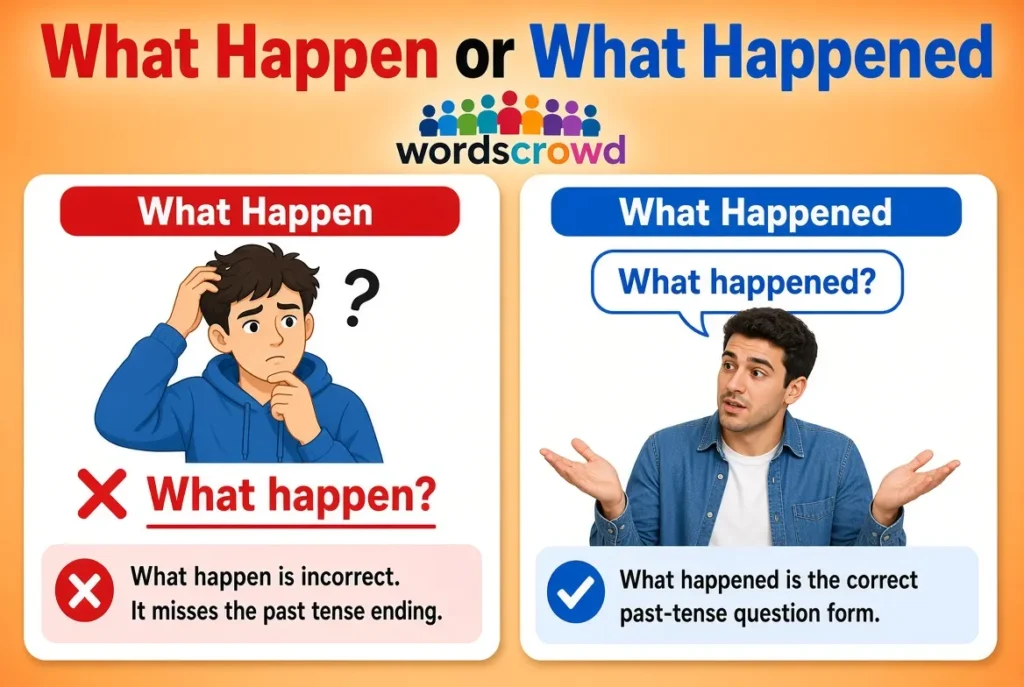
The phrase “what happen” by itself is generally not the correct standard-English question.
This guide explains what happen or what happened in clear, practical English.
You will learn when each form works, why “what happen?” is usually incorrect, how happen changes with tense, and how native speakers naturally use these expressions in conversations, emails, school writing, business communication, and everyday speech.
Quick Answer
“What happened?” is the correct phrase when you are asking about something that occurred in the past.
- What happened? → asks about a past event.
- What happens? → asks about something that normally or generally occurs.
- What is happening? → asks about something occurring now.
- What happen? → usually incorrect as a standalone standard-English question.
Quick rule: If you mean “What occurred?” or “What went wrong?”, use “What happened?”
What Is the Difference Between “What Happen” and “What Happened”?
The main difference is verb form and tense.
| Feature | What happen? | What happened? |
|---|---|---|
| Main verb | happen | happened |
| Tense/form | Bare/base form | Simple past |
| Standalone question | Usually incorrect | Correct |
| Refers to a past event | No | Yes |
| Refers to something generally occurring | Not by itself | No |
| Natural in conversation | Usually no | Yes |
| Meaning | Incomplete/incorrect in most cases | “What occurred?” |
| Example | ❌ What happen? | ✅ What happened? |
| Correct present alternative | What happens? | — |
| Correct ongoing alternative | What is happening? | — |
| Correct emphatic structure | What did happen? | — |
The important point is that “what happen” is not normally a complete standard-English question.
If you want to ask about a past event, use:
What happened?
If you want to ask about something occurring right now, use:
What is happening?
If you want to ask about a regular or expected event, use:
What happens?
The Three Forms to Remember
A simple comparison makes the difference much easier:
- What happened? — past
- What happens? — general or habitual present
- What is happening? — happening now
What Does “What Happened?” Mean?
“What happened?” is a question asking someone to explain an event that has already occurred.
The verb happened is the simple past form of happen.
Examples
- What happened at the meeting?
- What happened yesterday?
- What happened to your phone?
- What happened after the accident?
- What happened between you and Sarah?
In each sentence, the speaker is asking about an event or situation that occurred before the moment of speaking.
“What Happened?” in Everyday Conversation
This phrase is extremely common in spoken English.
Imagine your friend suddenly looks upset.
You might ask:
“What happened?”
You are not necessarily asking for a specific time. You are asking about the event that caused the person’s current situation.
For example:
“You look worried. What happened?”
The event may have happened only a few minutes ago, earlier today, or even yesterday.
“What Happened?” Does Not Always Mean Something Bad
A common misconception is that “What happened?” always means something went wrong.
It does not.
It can be neutral:
“You were at the concert last night. What happened?”
It can show curiosity:
“What happened after the movie ended?”
It can express concern:
“You look tired. What happened?”
It can even introduce a surprising story:
“So, what happened next?”
The exact emotion depends on the context and tone.
Grammar of “What Happened?”
The Verb “Happen”
Happen is a verb. It means to take place or occur.
Its common forms include:
| Form | Example |
|---|---|
| Base form | happen |
| Third-person singular | happens |
| Past tense | happened |
| Present participle | happening |
| Past participle | happened |
The simple past form is happened.
Therefore:
What happened? ✅
is a complete question.
Why Does “Happened” Work Here?
In “What happened?”, the question word what is functioning as the subject of the verb.
Compare:
Something happened.
Turn something into a question:
What happened?
The structure is straightforward:
What + happened?
There is no need for did because the question word itself is the subject.
This is an important English grammar pattern.
Compare It With “What Did You Do?”
Look at these two questions:
What happened?
What did you do?
They look similar, but their structures are different.
In “What happened?”, what is the subject.
In “What did you do?”, you is the subject and what is the object.
That is why did appears in the second sentence.
Why Is “What Happen?” Usually Incorrect?
The phrase “what happen?” uses the base form happen without an auxiliary verb or another grammatical structure that licenses the base form.
In a normal standalone question, this does not work:
❌ What happen?
Standard English requires a suitable verb form.
Depending on your intended meaning, you could say:
✅ What happened?
or
✅ What happens?
or
✅ What is happening?
The correct choice depends on time and meaning.
The Problem Is Not the Word “What”
The word what is perfectly fine.
The issue is the form of happen.
Compare:
❌ What happen?
with:
✅ What happened?
The addition of -ed makes the verb the correct simple past form.
When Should You Use “What Happened?”
Use “What happened?” when asking about an event that occurred in the past.
1. Asking About Something That Just Occurred
“You suddenly stopped talking. What happened?”
The event happened very recently.
2. Asking About an Earlier Event
“I heard there was a problem at work. What happened?”
The problem occurred before the conversation.
3. Asking for an Explanation
“Why did the project fail? What happened?”
Here, the speaker wants an explanation of a past situation.
4. Asking About a Story
“You said the trip was exciting. What happened next?”
The speaker wants information about the next event.
5. Asking About a Person or Object
“What happened to your old laptop?”
This asks what became of the laptop or what occurred to it.
What Does “What Happens?” Mean?
“What happens?” is different because happens is the third-person singular present form of happen.
You use it when asking about something that normally, regularly, or generally occurs.
Examples
What happens if I miss the deadline?
What happens when water reaches 100°C at standard atmospheric pressure?
What happens next in the story?
What happens during the final exam?
These questions are not necessarily about one completed event in the past.
They ask about a process, rule, routine, consequence, or expected event.
Compare
What happened when you missed the deadline?
This asks about a specific past situation.
What happens if you miss the deadline?
This asks about the general consequence of missing a deadline.
That single change—from happened to happens—can completely change the meaning.
What Does “What Is Happening?” Mean?
If you want to ask about something occurring right now, the natural expression is often:
What is happening?
This uses the present continuous tense.
Examples
- What is happening outside?
- What is happening in the office?
- What is happening here?
- What is happening with the computer?
- What is happening right now?
Compare All Three
Consider this useful set:
What happened?
Something occurred in the past.
What happens?
Something generally occurs.
What is happening?
Something is occurring now.
This is one of the easiest ways to understand the difference.
Can “What Happen” Ever Be Correct?
This is where the grammar gets more interesting.
Although “what happen?” is generally incorrect as a standalone question, the word happen can correctly appear after what in certain sentence structures.
The problem is not that the sequence what + happen can never occur. The problem is using “What happen?” as a normal question.
Example 1: “What Did Happen?”
Consider:
What did happen?
This is grammatically correct.
Here, did is the auxiliary verb, so the main verb returns to its base form:
did + happen
The question is often emphatic.
For example:
“Everyone says there was a problem, but what did happen?”
The speaker may be emphasizing the question.
Example 2: “What Happens If…”
Here, happen is not correct, but happens is:
✅ What happens if we leave now?
Not:
❌ What happen if we leave now?
Example 3: “What Will Happen?”
After the modal auxiliary will, the base form happen is correct:
What will happen next?
Here, will + happen is the grammatical structure.
So the base form happen is completely normal after certain auxiliary or modal verbs.
Example 4: “What Can Happen?”
What can happen if we ignore the warning?
Again, can + happen is correct.
Example 5: “What Might Happen?”
What might happen tomorrow?
The modal might is followed by the base verb happen.
The Rule
The base form happen can be correct after words such as:
- did
- will
- can
- could
- may
- might
- should
- would
- must
Examples:
- What did happen?
- What will happen?
- What can happen?
- What could happen?
- What might happen?
- What should happen?
- What would happen?
- What must happen?
So the issue is not simply happen vs happened. The surrounding grammar matters.
What Is the Grammar Rule Behind “What Happened?”
The key rule is the difference between a subject question and an object question.
Subject Question
When what is the subject:
What happened?
Structure:
What + past-tense verb
No did is needed.
Object Question
When another person or thing is the subject:
What did John do?
Structure:
What + did + subject + base verb
Here, John is the subject, so did carries the past tense.
Compare These Carefully
What happened?
versus
What did happen?
Both can be grammatical, but they do not have exactly the same conversational effect.
The first is the ordinary question.
The second is often emphatic or contrastive.
Now compare:
What did you do?
This is a standard object question.
A Simple Test
Ask yourself:
Who or what performed the action?
If the answer is what, you often do not need did.
Something happened.
→ What happened?
If another subject performs the action:
John broke the window.
→ What did John break?
This distinction is extremely useful for English learners.
Key Differences Between “What Happen” and “What Happened”
Here are the most important differences in plain English:
- “What happened?” is the standard question about a past event.
- “What happen?” is normally incorrect as a standalone question.
- “What happens?” asks about a general, repeated, or expected event.
- “What is happening?” asks about something occurring now.
- “What did happen?” is grammatically correct but often adds emphasis.
- “What will happen?” asks about the future.
- “What can happen?” asks about a possibility.
- “What might happen?” asks about a possible future or hypothetical event.
- The correct form depends on tense and sentence structure, not simply on the word what.
Tip: Never choose between happen and happened without first asking yourself: When does the event occur?
Happen, Happens, Happened, and Happening
Understanding the whole verb family makes the original question much easier.
Happen
Happen is the base form.
Use it after modal verbs and auxiliaries where the grammar requires the base form.
Examples:
- What will happen?
- What did happen?
- What could happen?
- What might happen?
Happens
Happens is the third-person singular present form.
Examples:
- What happens next?
- What happens if we wait?
- What usually happens here?
Happened
Happened is the simple past form.
Examples:
- What happened yesterday?
- What happened after the meeting?
- What happened to the package?
Happening
Happening is the present participle.
It commonly appears with forms of be:
- What is happening?
- What was happening?
- What has been happening?
Real-Life Examples: “What Happen” vs “What Happened”
The following examples show how native English speakers naturally choose the correct form in different situations.
Everyday Conversation
- “You look upset. What happened?”
Use the past because something caused the person’s current state. - “What happens after this level?”
This asks about the next stage in a process. - “What is happening outside?”
This asks about something occurring now. - “I missed the beginning. What happened?”
The speaker wants information about an earlier event.
Text Messages
- “You left so suddenly. What happened?”
- “What happens if I click this button?”
- “What is happening lol?”
In casual texting, people may omit words or use nonstandard grammar, but that does not make “what happen?” standard English.
School
- “What happened in the final chapter?”
- “What happens to the character at the end of the novel?”
- “What will happen if the experiment is repeated?”
These questions demonstrate past, general/present, and future meanings.
Business
- “What happened during yesterday’s client meeting?”
- “What happens if the payment is delayed?”
- “What will happen if the deadline is missed?”
- “What did happen to the original proposal?”
The last example may be used for emphasis.
Professional Email
- “Could you please explain what happened during the system update?”
This is a polite and professional way to ask about a past event.
- “Could you clarify what happens after the application is submitted?”
This asks about a process.
Academic Writing
- “The report examines what happened during the first phase of the study.”
- “The researchers investigated what happens when the variables are changed.”
Notice that both happened and happens can appear naturally in formal writing.
Social Media
- “Okay, what happened here? 😂”
- “Wait… what is happening?”
- “What happens next? 👀”
These are natural informal examples.
Daily Life
- “What happened to the keys?”
- “What happens when the store closes?”
- “What will happen if it rains?”
- “What could happen if we ignore the warning?”
Common Mistakes With “What Happen”
Mistake 1: Using “What Happen?” for a Past Event
❌ What happen yesterday?
Why it is wrong:
The word yesterday clearly places the event in the past, so the verb should be happened.
Correct:
✅ What happened yesterday?
Mistake 2: Writing “What Happen?” When You Mean “What Happened?”
❌ You look worried. What happen?
Correct:
✅ You look worried. What happened?
The speaker is asking about an event that has already occurred.
Mistake 3: Forgetting the -s in a General Question
❌ What happen if I press this button?
Correct:
✅ What happens if I press this button?
Why?
The question asks about a general consequence or result.
Mistake 4: Using “What Happened?” for Something Happening Right Now
Suppose you hear a strange noise at this exact moment.
You might say:
✅ What is happening?
If the event is already over, you can say:
✅ What happened?
The distinction depends on whether the event is ongoing or completed.
Mistake 5: Adding “Did” Incorrectly
❌ What did happened?
This is a very common grammar error.
Correct:
✅ What did happen?
Why?
After did, the main verb must normally be in the base form.
Therefore:
- did + happen ✅
- did + happened ❌
Compare:
What happened?
and:
What did happen?
Both can be correct, but they have different structures.
Mistake 6: Confusing “What Happened?” With “What Did You Happen?”
These sentences are not interchangeable.
What happened?
asks about an event.
What did you do?
asks about someone’s action.
The verb happen normally does not work like an ordinary action verb with a direct object.
You can say:
What happened to John?
But you would not normally say:
❌ What did John happen?
When to Use “What Happened?” in Formal Writing
“What happened?” is grammatically correct in formal writing, but direct questions may not always fit the style of academic prose.
For example, in conversation:
“What happened during the experiment?”
In an academic paper, you might instead write:
“The study examines what happened during the experiment.”
Or:
“The researchers investigated the events that occurred during the experiment.”
The second versions can sound more formal, but “what happened” itself is not grammatically informal.
Professional Writing
The phrase works naturally in:
- incident reports
- customer-service communication
- workplace emails
- news writing
- interviews
- meeting discussions
- explanatory writing
Example:
“Please provide a brief account of what happened.”
This is professional and completely standard.
Is “What Happened?” American or British English?
“What happened?” is standard in both American English and British English.
There is no major US-versus-UK grammar difference here.
Likewise:
- What happens? — standard in both
- What is happening? — standard in both
- What will happen? — standard in both
The basic tense rules remain the same.
Differences between American and British English may appear in vocabulary, pronunciation, spelling, or some usage preferences, but the distinction between “happen” and “happened” in these questions is not a major regional difference.
Pronunciation: “Happen” vs “Happened”
Pronunciation can also help you recognize the difference when listening.
Happen
Happen is commonly pronounced approximately:
HAP-ən
The final -en is usually unstressed.
Happened
Happened is commonly pronounced approximately:
HAP-ənd
The ending is usually short and unstressed rather than strongly pronounced as a separate syllable.
In natural speech, the difference can be subtle, especially for English learners.
Listening Tip
When someone says:
“What happened?”
the -ed ending may not sound like a strong “ed” sound.
That does not mean the ending is absent. English past-tense endings have different pronunciations depending on the final sound of the verb.
Why Do People Confuse “Happen” and “Happened”?
There are several reasons.
1. English Uses Auxiliary Verbs
English questions can change the main verb after an auxiliary.
For example:
You went home.
becomes:
Did you go home?
Not:
❌ Did you went home?
Learners may notice this rule and then become unsure about what happened.
2. “What” Can Be the Subject
The question:
What happened?
is unusual for some learners because there is no did.
But that is perfectly normal because what is the subject.
3. Spoken English Is Fast
In natural speech, happened can sound like a short form, making it harder to hear.
4. Other Languages May Use Different Question Structures
Learners often transfer grammar patterns from their first language into English.
That can produce forms such as:
❌ What happen?
even when the intended meaning is:
✅ What happened?
Memory Tricks for Remembering the Difference
Memory Trick 1: Past = -ED
When you are asking about something that already occurred, remember:
Past event → happened
Examples:
- yesterday → happened
- last night → happened
- earlier → happened
- before → happened
So:
What happened yesterday?
Memory Trick 2: “Right Now?” Think “Happening”
If the event is happening at this moment:
What is happening?
Think:
Now → happening
Memory Trick 3: General Rule = Happens
If you mean “What normally occurs?” use:
What happens?
Think:
Usually/general → happens
Memory Trick 4: After “Did,” Use “Happen”
Remember:
Did + base verb
Therefore:
What did happen?
Not:
❌ What did happened?
The Three-Question Shortcut
Memorize these:
Past: What happened?
General: What happens?
Now: What is happening?
If you remember these three, you will avoid most mistakes involving this phrase.
“What Happen” vs “What Happened” in Different Situations
| Situation | Correct Question |
|---|---|
| Something occurred yesterday | What happened? |
| Something went wrong | What happened? |
| You want a story about a past event | What happened? |
| You ask about a regular result | What happens? |
| You ask about a process | What happens? |
| Something is occurring now | What is happening? |
| You ask about the future | What will happen? |
| You ask about a possibility | What could happen? |
| You ask about a hypothetical situation | What would happen? |
| You ask emphatically about a past event | What did happen? |
This table is often more useful than trying to memorize one isolated grammar rule.
What About “What Happen to Me?”
You may see or hear variations such as:
What happened to me?
This is grammatically correct when asking about something that occurred to you in the past.
For example:
“I don’t remember what happened to me after midnight.”
But:
❌ “What happen to me?”
is generally incorrect if you mean a past event.
For a general or future meaning, the form changes:
What happens to me if I fail?
What will happen to me if I fail?
Again, tense controls the verb form.
“What Happened?” vs “What Was Happening?”
These expressions are also worth comparing.
What Happened?
This asks about a completed event.
What happened when the teacher arrived?
What Was Happening?
This asks about an activity or situation that was already in progress at a particular past time.
What was happening when the teacher arrived?
The first focuses more on the event.
The second focuses more on the ongoing situation.
This is an example of how English aspect can add a layer of meaning beyond simple past versus present.
“What Happened?” vs “What Has Happened?”
These two forms are closely related but not identical.
What Happened?
Simple past:
What happened at the meeting?
This focuses on a completed past event.
What Has Happened?
Present perfect:
What has happened to the schedule?
This often connects a past event to the present situation.
For example:
“The office is closed. What has happened?”
The speaker is interested in the current result.
In everyday conversation, the distinction can sometimes be flexible depending on the variety of English and context, but the underlying tense difference remains useful.
Does “What Happen” Mean Anything?
As a standalone standard-English question, “What happen?” is generally not considered grammatically correct.
However, happen can appear correctly in longer structures:
- What did happen?
- What will happen?
- What can happen?
- What could happen?
- What might happen?
- What should happen?
- What would happen?
So it is important not to memorize:
“Happen is wrong after what.”
That would be too broad.
The real rule is:
The correct form of “happen” depends on the grammatical structure around it.
Frequently Asked Questions
Is “what happen” grammatically correct?
Usually, no when it is used as a standalone question. If you are asking about a past event, use “What happened?” For a general situation, use “What happens?”
Is “what happened” correct grammar?
Yes. “What happened?” is a standard English question asking about an event that occurred in the past.
Should I say “what happen” or “what happened”?
If you mean “What occurred?”, use “What happened?” The word happened is the simple past form of happen.
What is the difference between “what happens” and “what happened”?
“What happens?” usually asks about something general, habitual, expected, or procedural. “What happened?” asks about a particular past event.
Is “What did happen?” correct?
Yes. “What did happen?” is grammatically correct because did is followed by the base verb happen. It often adds emphasis.
Can I say “What is happening?”
Yes. “What is happening?” is the natural question when you want to know what is occurring right now.
Why is “What did happened?” wrong?
After the auxiliary did, English normally uses the base form of the verb. Therefore, use “What did happen?”, not “What did happened?”
Is “What happened?” formal or informal?
It can be both. “What happened?” is grammatically neutral and works in everyday conversation as well as many professional contexts. More formal writing may use longer structures depending on the situation.
Is “What happened?” the same in American and British English?
Yes. “What happened?” is standard in both American and British English. There is no important regional grammar difference in this particular construction.
A Quick Decision Guide
When you are unsure which form to use, follow these steps.
Step 1: Is the event finished and in the past?
Use:
What happened?
Example:
What happened during the meeting?
Step 2: Are you asking about something that normally occurs?
Use:
What happens?
Example:
What happens when the battery runs out?
Step 3: Is it happening right now?
Use:
What is happening?
Example:
What is happening outside?
Step 4: Are you talking about the future?
Use:
What will happen?
Example:
What will happen if we cancel the order?
Step 5: Are you using a modal?
Use the base form:
What could happen?
What might happen?
What would happen?
Step 6: Are you using “did”?
Use:
What did happen?
Never:
❌ What did happened?
Final Verdict: “What Happen” or “What Happened”?
If your question is simply “what happen or what happened?”, the answer is clear:
“What happened?” is correct when you are asking about a past event.
The phrase “what happen?” is generally incorrect as a standalone standard-English question.
However, do not assume that happen itself is wrong. The base form is correct when grammar requires it:
- What did happen?
- What will happen?
- What can happen?
- What could happen?
- What might happen?
- What would happen?
And if your meaning is different, choose the appropriate form:
- Past: What happened?
- General: What happens?
- Right now: What is happening?
- Future: What will happen?
- Possibility: What could happen?
The Best Rule to Remember
Use “happened” for a completed past event, “happens” for something general or habitual, and “is happening” for something occurring now.
So if someone suddenly looks worried and you want to know why, the natural question is:
“What happened?”
If you are asking about a process, say:
“What happens next?”
And if something strange is taking place right in front of you, ask:
“What is happening?”
Once you connect the verb form to time and sentence structure, the confusion between “what happen” and “what happened” becomes much easier to avoid.

Elon Parker is a dedicated writer at Wordscrowd, creating clear, informative, and engaging content for readers.
With a focus on useful information, Elon aims to make every article simple, reliable, and easy to understand.