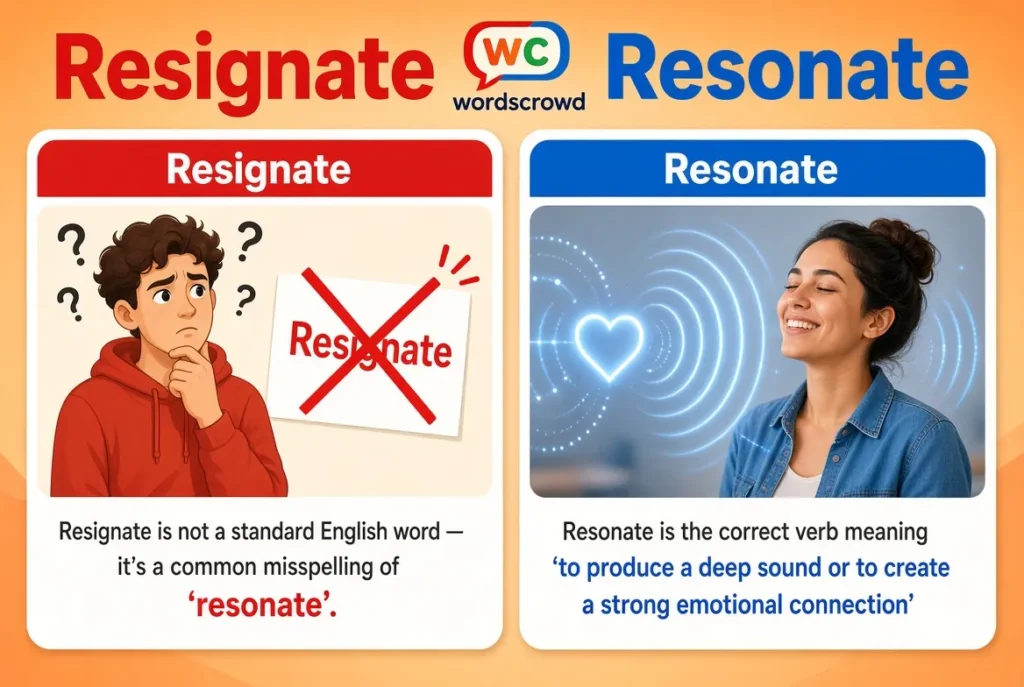
Have you ever written “resignate” and then stopped to wonder, “Wait—is that actually the right word?” You are not alone.
The confusion between resignate or resonate is surprisingly common because the two words look and sound similar, especially when spoken quickly.
But there is an important difference: resonate is the standard English word used when something creates a strong emotional, personal, intellectual, or auditory effect. For example, you can say, “Her story resonated with me” or “The music resonated throughout the hall.”
Major dictionary sources recognize resonate as an established English verb.
Resignate, on the other hand, is not the standard modern word for this meaning.
There is an interesting historical and modern story behind it: an obsolete form has existed in historical English, and newer nonstandard uses have appeared, including a proposed modern use meaning to cause someone’s resignation.
However, that does not make resignate an appropriate replacement for resonate in ordinary modern English.
That distinction matters if you are writing an essay, email, business document, social media post, article, or academic paper. Choosing resonate will normally give you the clear, established form your reader expects.
In this guide, you will learn exactly resignate or resonate: which is correct, what each form means, why people confuse them, how to pronounce and use resonate, common mistakes to avoid, and more than 20 natural examples from everyday and professional English.
Quick Answer
Resonate is the correct standard English word when you mean to produce a deep or continuing sound, or to create a strong emotional or personal connection.
- ✅ Correct: “Her message resonated with me.”
- ❌ Usually incorrect: “Her message resignated with me.”
- ✅ Correct: “The song resonated with the audience.”
- ❌ Usually incorrect: “The song resignated with the audience.”
The word resignate has appeared in other, limited uses, including historical English and a modern proposed use related to forcing someone to resign, but it is not the normal word for emotional connection or resonance.
Resignate or Resonate: Comparison Table
| Feature | Resignate | Resonate |
|---|---|---|
| Standard modern English? | Generally no | Yes |
| Common dictionary word? | Not as the normal modern sense people intend | Yes |
| Part of speech | Rare/nonstandard verb in some uses | Verb |
| Main modern meaning | Not normally used for emotional connection | To produce resonance or create a strong response |
| Emotional meaning | ❌ Not standard | ✅ Yes |
| Sound-related meaning | ❌ Not the normal choice | ✅ Yes |
| Common phrase | “resignate with me” ❌ | “resonate with me” ✅ |
| Professional writing | Avoid | Recommended |
| Academic writing | Avoid unless discussing the word itself | Appropriate |
| Everyday conversation | Avoid for the meaning “connect” | Natural |
| Past tense | resignated in rare/nonstandard uses | resonated |
| Present participle | resignating in rare/nonstandard uses | resonating |
| Typical collocation | — | resonate with someone |
| US English | Not standard for this meaning | Standard |
| UK English | Not standard for this meaning | Standard |
| Best choice | Usually avoid | Use this |
Bottom line: If you are trying to say that an idea, story, song, speech, experience, or message connected with someone, write resonate, not resignate.
What Does “Resignate” Mean?
The answer needs a little more care than simply saying “resignate is not a word.”
In ordinary modern English, resignate is not the standard verb people should use when they mean resonate. If you write:
❌ “The message resignated with the audience.”
your reader will normally expect:
✅ “The message resonated with the audience.”
However, English has a more complicated history than a simple correct/incorrect list suggests.
Historical Use of “Resignate”
A linguistic discussion from the University of Pennsylvania’s Language Log notes that the Oxford English Dictionary has an obsolete entry for resignate. The historical sense was essentially related to resign, with an example dating from the seventeenth century. The modern use that appeared much later is a different development.
So saying that resignate has never existed in any form whatsoever would be too absolute.
The more accurate statement is:
“Resignate” is not the standard modern English alternative to “resonate.”
That is the distinction an editor, teacher, or professional writer needs to know.
A Modern Proposed Meaning
There has also been a newer use of resignate meaning something like to cause or engineer someone’s resignation.
Collins has a “New Word Suggestion” for this sense, submitted in 2020, and labels it as a word being monitored for evidence of usage.
The University of Pennsylvania’s Language Log also discussed this modern coinage after the word appeared in connection with a workplace controversy.
It describes the modern formation as a new creation rather than a straightforward continuation of the old historical word.
That is interesting from a language-history perspective, but it does not change the practical answer for most writers.
Should You Use “Resignate”?
If you mean:
- connect emotionally
- appeal to someone
- create a strong response
- echo
- produce resonance
- affect someone deeply
then do not use resignate.
Use resonate.
If you are specifically discussing the rare modern coinage resignate or analyzing historical language, you may encounter it. In that special context, the word itself can be the subject of discussion.
Editor’s Tip: A word can exist somewhere in the history or margins of English without being the right word for normal modern writing.
What Does “Resonate” Mean?
Resonate is an established English verb with both literal and figurative meanings.
Merriam-Webster defines it in connection with producing or exhibiting resonance and also with affecting or appealing to someone personally or emotionally. Its recorded first known use dates to 1648.
Collins likewise gives meanings involving resonance and receiving a sympathetic response, particularly in the familiar construction resonate with.
1. Resonate Can Describe Sound
In its literal sense, resonate is associated with sound, vibration, and resonance.
For example:
“The singer’s voice resonated throughout the theater.”
Here, the word describes sound carrying or being enriched through resonance.
Other examples include:
- The drum resonated through the room.
- The church bell resonated across the valley.
- Her voice resonated in the empty hall.
- The guitar strings resonated beautifully.
- The low note resonated through the building.
2. Resonate Can Describe Emotional Connection
This is the meaning responsible for most resignate or resonate confusion.
When something resonates with you, it means it connects with you in a meaningful way.
For example:
“Her story resonated with me.”
This can mean that her story reminded you of your own experiences, emotions, beliefs, or struggles.
You might also say:
- “That message really resonated with me.”
- “The book resonated with young readers.”
- “His advice resonated with the team.”
- “The campaign resonated with local families.”
Merriam-Webster specifically recognizes this sense of resonate as affecting or appealing to someone personally or emotionally.
3. Resonate Can Describe Ideas
The subject does not have to be a person.
An idea, argument, message, theme, policy, story, or experience can resonate.
For example:
“The idea of flexible working resonated with employees.”
The sentence means that employees found the idea meaningful, appealing, or relevant.
4. Resonate Can Describe Cultural Impact
The word is also common when discussing culture, media, politics, advertising, and public communication.
For example:
“The campaign resonated with younger audiences.”
This does not mean the campaign literally produced an echo.
Instead, it means the campaign connected with that audience.
This figurative meaning is one reason resonate has become such a useful word in modern English.
Resonate: Grammar and Word Forms
One reason resonate is easy to use once you learn its pattern is that it behaves like a regular English verb.
Base Form
resonate
“The message can resonate with readers.”
Present Tense
resonate / resonates
“These ideas resonate with students.”
“This idea resonates with students.”
Past Tense
resonated
“Her speech resonated with the audience.”
Present Participle
resonating
“The message is resonating with customers.”
Third-Person Singular
resonates
“His story resonates with me.”
Perfect Forms
“The book has resonated with readers for years.”
“Her message had resonated with the community.”
Infinitive
“The goal is to resonate with a wider audience.”
Modal Construction
“Your message should resonate with young readers.”
How to Pronounce “Resonate”
The standard pronunciation is approximately:
REZ-uh-nayt
Merriam-Webster gives the pronunciation as /ˈre-zə-ˌnāt/.
The final part sounds like “nate.”
That pronunciation can be useful because it helps distinguish the word from other forms you may be tempted to invent.
Pronunciation Tip
Think:
REZ + uh + NATE
Not:
REZ + ignate
The spelling is:
r-e-s-o-n-a-t-e
The middle son can also give you a useful memory clue because resonate is historically connected with ideas of sound and sounding.
Why Do People Confuse “Resignate” and “Resonate”?
The mistake is understandable.
English has thousands of words that share similar endings, roots, and sound patterns. Our brains often construct words that feel correct before we consciously check whether they are established vocabulary.
1. The Words Look Similar
Compare them:
resignate
resonate
Both begin with:
reso-
Both end with:
-ate
Only a small part of the spelling separates them.
That visual similarity makes the mistake easy.
2. “Resign” Creates a False Association
The word resign is very common.
You also have:
- resignation
- resigned
- resigning
- resigns
A writer may unconsciously connect:
resign → resignation → resignate
But that does not produce the standard word needed for emotional connection.
The established word is:
resonate
3. English Has Many “-ate” Verbs
Consider:
- communicate
- demonstrate
- designate
- generate
- originate
- negotiate
- participate
- appreciate
Because English has many verbs ending in -ate, resignate may look perfectly plausible.
But English vocabulary cannot always be predicted by simply attaching a familiar ending to another word.
4. Fast Speech Can Blur Sounds
In rapid conversation, unstressed vowels can become less distinct.
That means a learner may hear a word incorrectly and later reproduce the spelling they think they heard.
This is especially common when someone has learned English primarily through listening.
5. People Repeat What They Hear
A nonstandard word can spread if enough people use it.
That does not automatically make it the best choice for formal English.
Language changes through real usage, but standard writing still relies heavily on established forms, dictionaries, editorial practice, and shared conventions.
Resignate or Resonate: The Key Difference
The easiest way to understand the difference is to focus on meaning and standard usage.
Use “Resonate” When Something:
- produces a deep or continuing sound
- vibrates or exhibits resonance
- affects someone emotionally
- connects with someone’s experience
- appeals to an audience
- feels meaningful or relevant
- creates a strong intellectual response
- remains influential or meaningful
Avoid “Resignate” When You Mean:
- resonate with me
- connect with me
- affect me
- appeal to me
- create an emotional response
- echo emotionally
- strike a chord
For example:
❌ “The poem resignated with me.”
✅ “The poem resonated with me.”
And:
❌ “Her speech resignated with the audience.”
✅ “Her speech resonated with the audience.”
The second version is the natural standard-English choice.
The Most Important Grammar Pattern: “Resonate With”
One of the most useful things to learn is the common structure:
something + resonates/resonated + with + someone
Examples:
“The story resonated with me.”
“The message resonated with the audience.”
“The campaign resonated with younger voters.”
“That experience still resonates with her.”
Why “With” Matters
The preposition with identifies the person or group that experiences the connection.
Compare:
“The message resonated.”
This is grammatically complete, but the audience is not specified.
Now:
“The message resonated with the students.”
The sentence clearly tells us who connected with it.
Common Structure
Subject + resonate + with + person/group
Examples:
- The story resonated with readers.
- The speech resonated with voters.
- The idea resonated with employees.
- The song resonated with teenagers.
- Her experience resonated with parents.
Is “Resonate With Me” Correct?
Yes.
“Resonate with me” is completely natural English.
It means that something creates a meaningful personal, emotional, or intellectual connection with you.
Examples
“That quote really resonates with me.”
“Her experience resonated with me because I went through something similar.”
“The author’s message still resonates with me.”
“That song resonates with me on a personal level.”
What Does “That Resonates With Me” Mean?
It usually means:
“That feels meaningful or relatable to me.”
Depending on context, it can mean:
- I strongly relate to that.
- I understand that feeling.
- That reminds me of my own experience.
- I agree with that idea.
- That has emotional significance for me.
- That message feels personally relevant.
It does not always mean agreement. Something can resonate with you because it describes your experience even if you do not completely agree with it.
Resonate in Professional English
Resonate is perfectly acceptable in professional communication.
It appears naturally in discussions about:
- marketing
- customer experience
- leadership
- communication
- education
- public relations
- branding
- workplace culture
- presentations
- audience engagement
Business Example
“We need a campaign that resonates with our target audience.”
This means the campaign should create a meaningful connection with the intended customers.
Professional Email Example
“Your comments about improving customer communication really resonated with our team.”
That sounds natural and professional.
Marketing Example
“The new slogan appears to resonate strongly with younger customers.”
Again, resonate is the standard choice.
Resonate in Academic Writing
You can use resonate in academic writing, but context matters.
It is most natural when discussing:
- cultural impact
- literature
- public response
- personal relevance
- audience reception
- themes
- social ideas
For example:
“The novel’s themes continue to resonate with contemporary readers.”
That is appropriate academic English.
However, academic writing often benefits from precision. If you simply mean agree, use agree. If you mean support, use support. If you mean relate to, use relate to.
Better Academic Word Choice
Instead of:
“The theory resonates with the data.”
you may sometimes need:
“The theory is consistent with the data.”
Why?
Because resonate expresses a broader sense of meaningful connection, while consistent with makes a more precise analytical claim.
Writing Tip: Use resonate when the idea of meaningful impact or connection is genuinely important. Do not use it merely because it sounds sophisticated.
Resonate in Everyday Conversation
The word is common in normal conversation.
You might hear:
“That really resonates with me.”
“I think that will resonate with people.”
“Her story resonated with me.”
“That part of the movie really resonated.”
It is not excessively formal.
It works in both casual and professional contexts.
20+ Real-Life Examples of “Resonate”
Here are original examples showing how native English speakers might use the word in different situations.
Everyday Conversation
- “That story really resonated with me.”
- “I think your advice will resonate with her.”
- “The ending resonated more with me than the rest of the movie.”
Text Messages
- “That quote totally resonates with me.”
- “Your message resonated with me today.”
Social Media
- “This reminder really resonates with anyone who has struggled with self-doubt.”
- “Her words resonated with thousands of followers.”
School
- “The teacher’s example resonated with the students because it related to their daily lives.”
- “The poem’s theme resonated with me after our class discussion.”
Academic Writing
- “The novel’s central themes continue to resonate with modern readers.”
- “The argument resonated strongly with audiences concerned about social inequality.”
Business
- “The new brand message resonated with customers.”
- “Our research suggests that the campaign resonates with first-time buyers.”
Professional Email
- “Your comments about workplace communication resonated with our management team.”
- “The presentation resonated particularly well with the client.”
Public Speaking
- “Her personal story resonated with everyone in the room.”
- “The speaker’s message resonated far beyond the original audience.”
Music
- “The singer’s voice resonated throughout the theater.”
- “The bass notes resonated through the wooden floor.”
Literature
- “The character’s loneliness resonated with readers of different generations.”
- “That final scene continues to resonate long after the book ends.”
Advertising
- “The campaign resonated with families looking for affordable options.”
Workplace
- “His approach to leadership really resonated with the new employees.”
News and Public Discussion
- “The message resonated with communities facing similar challenges.”
Common Mistakes With Resonate
Mistake 1: “Resignate With Me”
❌ Wrong for standard modern English:
“That story resignated with me.”
✅ Correct:
“That story resonated with me.”
Mistake 2: “The Message Resignates”
❌
“The message resignates with young people.”
✅
“The message resonates with young people.”
The third-person singular form is resonates.
Mistake 3: “It Resignated”
❌
“Her speech resignated with everyone.”
✅
“Her speech resonated with everyone.”
The past tense of resonate is resonated.
Mistake 4: “I Am Resignating With It”
❌
“I am resignating with this idea.”
✅
“I am resonating with this idea.”
However, even the correct grammatical form resonating is not always the most natural choice.
Often, you would simply say:
“I really relate to this idea.”
or:
“This idea really resonates with me.”
Mistake 5: Treating Resonate as a Synonym for “Agree”
These words overlap in some contexts, but they are not identical.
“I agree with your argument.”
means you accept or share the argument.
“Your argument resonates with me.”
means the argument creates a meaningful personal or intellectual response.
You can resonate with an idea without fully agreeing with it.
Mistake 6: Using “Resonate” Everywhere
Even a correct word can become weak if overused.
Instead of writing:
“The evidence resonates with the conclusion.”
you may need:
- supports
- reinforces
- matches
- aligns with
- is consistent with
- reflects
- illustrates
Choose the word that expresses your exact meaning.
Resonate vs. Related Words
Understanding nearby vocabulary makes the distinction even clearer.
Resonate vs. Echo
Echo usually focuses on a repeated or reflected sound.
“Her voice echoed through the hallway.”
Resonate can describe sound, but it also has a strong figurative meaning.
“Her message resonated with the audience.”
Resonate vs. Reverberate
These words overlap in their sound-related meanings.
Merriam-Webster notes that resonate can suggest a lasting sound, while reverberate often emphasizes an initial sound followed by echoes.
Figuratively, reverberate can also describe consequences spreading outward:
“The decision reverberated throughout the industry.”
Whereas:
“The decision resonated with employees.”
focuses more on the emotional or personal response.
Resonate vs. Relate
Relate to is often more direct for personal connection.
“I can relate to her experience.”
Resonate with can sound slightly more expressive:
“Her experience really resonated with me.”
Both can be natural.
Resonate vs. Appeal
Appeal to means something attracts or interests someone.
“The design appeals to younger customers.”
Resonate with suggests a deeper or more meaningful connection.
“The story resonates with younger customers.”
Word Family of Resonate
Learning the word family can help you use the vocabulary more confidently.
Resonate
Verb
“The story resonates with readers.”
Resonated
Past tense / past participle
“The story resonated with readers.”
Resonating
Present participle
“The story is resonating with readers.”
Resonates
Third-person singular present
“The story resonates with readers.”
Resonance
Noun
“The story has emotional resonance.”
Resonance can refer to sound, richness, significance, or the ability to evoke a response. Merriam-Webster includes both physical and figurative senses.
Resonant
Adjective
“The speech was particularly resonant.”
Resonantly
Adverb
This is much less common in everyday use.
A Simple Rule for “Resignate or Resonate”
If you remember only one thing from this article, remember this:
If you mean “connect emotionally,” use RESONATE.
Try these substitutions:
❌ resignate with me
✅ resonate with me
❌ resignated with the audience
✅ resonated with the audience
❌ resignates with customers
✅ resonates with customers
❌ resignating with readers
✅ resonating with readers
This simple substitution will solve most cases.
Memory Tricks
Memory Trick #1: Think “Sound”
Resonate is connected with resonance, which is strongly associated with sound.
Think:
RESONATE → RESONANCE → SOUND
Then extend the idea:
Sound resonates physically.
Ideas resonate emotionally.
Memory Trick #2: “SON” Is Inside Resonate
Look closely:
re-SON-ate
The letters SON can remind you of sound.
It is not a complete etymological explanation, but it is a useful spelling trick.
RESONATE has SON inside it → think SOUND.
Memory Trick #3: “Resign” Means Quit
Keep the two ideas separate:
resign = quit a job
resonate = connect or echo
If you are talking about an emotional reaction, you almost certainly want resonate.
Memory Trick #4: The “With Me” Test
If your sentence contains:
“_____ with me”
the answer is normally:
resonate with me
For example:
“That idea resonates with me.”
Not:
“That idea resignates with me.”
Is “Resignate” a Misspelling?
Usually, when someone writes resignate in a sentence about emotional connection, it is best treated as a nonstandard form or mistaken formation of resonate.
But calling every appearance a simple “misspelling” is slightly too broad.
Why?
Because resignate has:
- a historical obsolete use,
- a rare nonstandard modern use,
- a proposed modern use connected with causing someone’s resignation.
The Collins entry specifically identifies a proposed meaning involving engineering an employee’s resignation and says the word is being monitored for evidence of usage.
So the safest editorial rule is:
Do not use “resignate” as a substitute for “resonate.”
That rule is both accurate and practical.
Is “Resignated” a Word?
You may occasionally encounter resignated, especially in discussions of the newer proposed use.
For example, someone might use it to mean that a person was caused or pressured to resign.
That is a specialized and nonstandard modern usage rather than the normal form of resonate.
If you mean:
“The speech had an emotional effect.”
write:
“The speech resonated.”
Not:
“The speech resignated.”
If you mean that someone was forced or engineered into resigning, the clearer choices in ordinary professional writing are usually:
- forced to resign
- pressured to resign
- made to resign
- removed from the position
- dismissed
These expressions are much clearer to a general audience.
Is Resonate Formal or Informal?
Resonate works in both formal and informal English.
Informal
“That really resonates with me.”
Professional
“The proposal appears to resonate with our target audience.”
Academic
“The novel’s themes continue to resonate with contemporary readers.”
Literary
“The final image resonates long after the story ends.”
The word itself does not create a problem of formality.
The important thing is whether it expresses your intended meaning precisely.
US vs. UK English
There is no important US-versus-UK distinction that changes the basic answer.
American and British English both use resonate in literal and figurative senses.
For example, both varieties naturally allow:
“The story resonated with readers.”
“Her message resonated with the audience.”
You do not need a different spelling for American or British English.
Resonate is the standard choice in both.
Should You Use “Resonate” in an Essay?
Yes, when it accurately describes the idea you want to express.
For example:
“The poem’s discussion of loneliness resonates with modern readers.”
That is natural.
However, avoid using resonate simply to make writing sound sophisticated.
If you mean:
“The evidence supports the argument,”
say:
“The evidence supports the argument.”
If you mean:
“The idea connects strongly with readers,”
then:
“The idea resonates with readers.”
Precision is more important than sounding impressive.
Should You Use “Resonate” in a Business Email?
Yes.
It is especially useful when talking about:
- customers
- employees
- clients
- audiences
- messaging
- branding
- presentations
- company values
For example:
“We should focus on stories that resonate with our customers.”
That is professional and natural.
Should You Use “Resignate” in Professional Writing?
Generally, no.
If your intended meaning is resonate, using resignate can make your writing look like a spelling or vocabulary error.
In a business email, report, application, academic paper, CV, presentation, or professional article, choose the established form:
resonate
Frequently Asked Questions
Is “resignate” or “resonate” correct?
Resonate is the correct standard modern English word when you mean “to produce resonance” or “to create a strong emotional or personal response.” Resignate is not the standard substitute for it.
Is resignate a real English word?
It has appeared in limited historical and nonstandard uses, and a modern proposed sense has been discussed, but it is not standard modern English for the meaning “connect emotionally.”
What does “resonate with me” mean?
“Resonate with me” means that something feels personally meaningful, relatable, emotionally powerful, or intellectually relevant to you.
For example:
“Her story resonated with me.”
This suggests that you strongly connected with her story.
What is the past tense of resonate?
The past tense is:
resonated
Example:
“The speaker’s message resonated with the audience.”
Is “resonates with” grammatically correct?
Yes.
Resonates with is one of the most common grammatical patterns for the figurative meaning.
Example:
“The idea resonates with many students.”
Can resonate describe a person?
Usually, the thing that resonates is an idea, story, message, experience, sound, theme, or similar subject.
You normally say:
“Her story resonated with me.”
rather than:
“She resonated with me.”
The second sentence is possible in some contexts, particularly when discussing a person’s work, personality, or message, but it can be less precise.
Can resonate mean “agree”?
Not exactly.
Resonate can suggest that something feels meaningful or convincing to you, but it does not necessarily mean complete agreement.
“His argument resonated with me.”
may mean that you found it personally or intellectually meaningful.
“I agree with his argument.”
directly states agreement.
Is “resonate” formal English?
Yes. Resonate is standard English and works in casual, professional, academic, journalistic, and creative contexts.
What is the difference between resonate and relate?
Relate to usually means that you understand or identify with something because of a connection to your own experience.
Resonate with can express a similar idea but often emphasizes emotional, intellectual, or personal impact.
“I can relate to her experience.”
“Her experience really resonated with me.”
Both are natural, but the emphasis differs slightly.
Is “resignate with me” correct?
No, not if you mean “connect with me” or “have a strong emotional effect on me.”
Use:
“resonate with me.”
Quick Practice: Choose the Correct Word
Test yourself.
1. “Her story really ______ with me.”
Answer: resonated
2. “The campaign ______ with younger customers.”
Answer: resonates
3. “The drums ______ throughout the building.”
Answer: resonated
4. “That message does not ______ with our audience.”
Answer: resonate
5. “His advice really ______ with the students.”
Answer: resonated
6. “I hope this idea ______ with readers.”
Answer: resonates
If you consistently choose resonate, resonates, resonated, or resonating according to the grammar of the sentence, you will avoid the common resignate mistake.
Final Verdict: Resignate or Resonate?
The answer is straightforward for almost every normal writing situation:
Choose RESONATE.
If you want to say that an idea, story, message, song, experience, theme, or speech connects with someone or creates a strong emotional or intellectual response, resonate is the established standard English verb.
Use:
- resonate with me
- resonates with readers
- resonated with the audience
- is resonating with customers
- has resonated with millions of people
Avoid:
- ❌ resignate with me
- ❌ resignates with readers
- ❌ resignated with the audience
There is a small linguistic footnote: resignate has historical and newer specialized uses, so it is not quite accurate to claim that the sequence of letters has never appeared as an English word. Historical evidence and discussion of a modern proposed sense confirm that the story is more complicated.
But for the question most people are actually asking—“Should I write resignate or resonate when I mean that something connects emotionally or makes an impact?”—the answer is clear.
Write “resonate.”
The One-Line Rule to Remember
If a message connects, a story feels relatable, or a sound carries strongly, it RESONATES.
That single rule will keep your writing natural in everyday conversation, school assignments, professional emails, academic work, social media posts, and formal documents.
And if you ever catch yourself typing “resignate with me,” stop for a second and make the simple correction:
“resonate with me.”
That is the version your readers will expect.

Elon Parker is a dedicated writer at Wordscrowd, creating clear, informative, and engaging content for readers.
With a focus on useful information, Elon aims to make every article simple, reliable, and easy to understand.