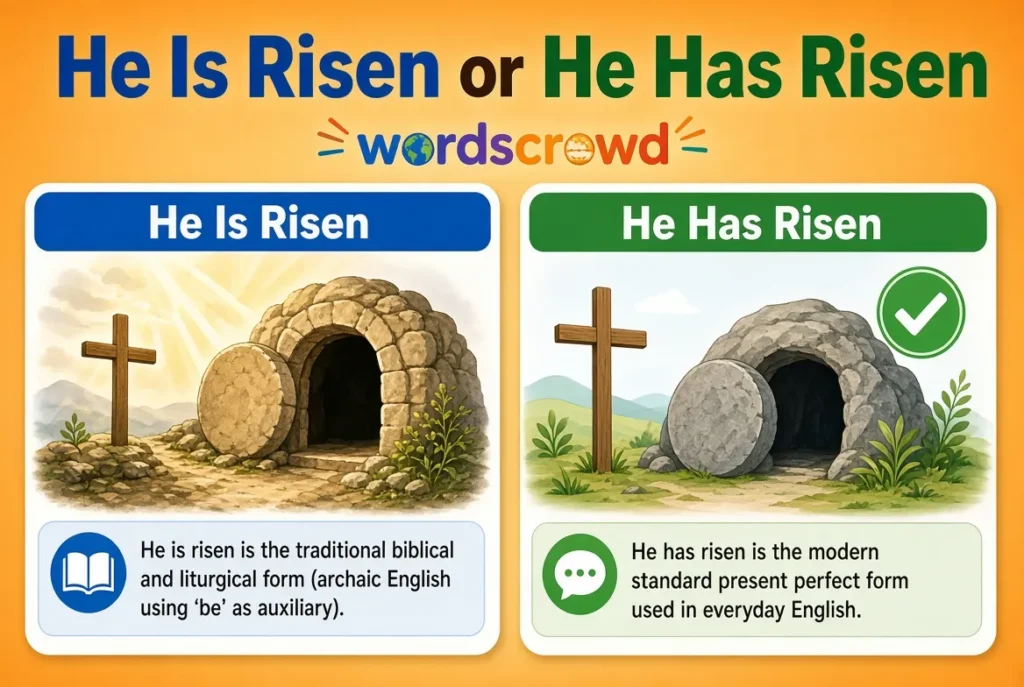
“He is risen” or “He has risen”—which one is correct? If you have heard both expressions around Easter, in church services, in Christian writing, or in Bible quotations, you may have wondered whether one is grammatically right and the other is wrong.
The confusion is understandable. In everyday modern English, we normally say “He has risen.” We use the present perfect tense to describe an action that has happened and has a result or importance in the present.
So why do millions of English speakers recognize “He is risen” as a perfectly meaningful expression?
The answer lies in the history of English grammar, religious language, and the way the verb rise has been used over time.
“He has risen” is the ordinary modern construction, while “He is risen” is a traditional, literary, and religious form strongly associated with the resurrection of Jesus Christ.
The two expressions point to the same basic event, but they do not have exactly the same grammatical form or stylistic effect.
In this guide, you will learn the difference between he is risen and he has risen, why both expressions exist, which one is more natural in modern English, how the grammar works, where each expression is appropriate, and what to use in everyday, academic, professional, and religious writing.
Quick Answer
Both “he is risen” and “he has risen” can be correct, but they belong to different styles of English.
- He has risen is the normal modern English construction using the present perfect tense.
- He is risen is a traditional, archaic-sounding, and strongly religious expression.
- In ordinary modern conversation and general writing, “He has risen” is usually the better choice.
- In Christian worship, Easter greetings, hymns, traditional Bible language, and religious quotations, “He is risen” is entirely appropriate.
Quick rule: Use “He has risen” for normal modern English. Use “He is risen” when you intentionally want traditional or religious language.
He Is Risen vs. He Has Risen: Comparison Table
| Feature | He is risen | He has risen |
|---|---|---|
| Basic meaning | He has risen; he is in a risen state | He has risen |
| Grammar | Traditional/historical construction | Modern present perfect |
| Verb | is + risen | has + risen |
| Main tense/form | Historical use of be with an intransitive verb | Present perfect |
| Modern everyday usage | Uncommon | Common |
| Religious usage | Very common | Also common |
| Tone | Traditional, solemn, biblical, ceremonial | Modern, natural, direct |
| Formal writing | Appropriate in religious contexts | Appropriate generally |
| Conversation | Unusual outside religious contexts | Natural |
| Biblical associations | Very strong | Strong |
| Meaning difference | Usually little or none in the resurrection context | Usually little or none in the resurrection context |
| American English | Understood; strongly traditional | Standard modern form |
| British English | Understood; traditional/religious | Standard modern form |
| Should you avoid it? | Only if you do not want an old-fashioned/religious tone | No |
| Best general choice | Traditional contexts | Modern English |
The key point is simple: the difference is mainly grammatical form and style, not the basic event being described.
What Does “He Has Risen” Mean?
“He has risen” is the standard modern English form.
It uses the present perfect tense:
has + past participle
The verb rise has these important forms:
- Base form: rise
- Third-person singular present: rises
- Simple past: rose
- Past participle: risen
- Present participle: rising
So:
He has risen.
Here, has is the auxiliary verb, and risen is the past participle of rise.
Why Is “Has Risen” Grammatically Modern?
The present perfect connects a past event with the present.
When someone says:
He has risen.
the speaker is presenting the rising as something that has happened and is relevant now.
In the Christian resurrection context, the statement naturally communicates that Jesus rose from the dead and that this event has present significance.
The same grammatical pattern appears in ordinary sentences:
- The sun has risen.
- The temperature has risen.
- The river has risen after the storm.
- The child has risen from his chair.
- The curtain has risen.
- The price has risen again.
Nobody would normally say:
The price is risen.
Modern English uses has risen.
Is “He Has Risen” Correct?
Yes. “He has risen” is grammatically correct standard English.
It is especially appropriate when you are writing for a general audience and want your language to sound contemporary.
For example:
Christians around the world celebrate the belief that Jesus has risen from the dead.
This sentence sounds natural in modern English.
What Does “He Is Risen” Mean?
“He is risen” communicates essentially the same core idea in traditional Christian usage, but its grammatical history is different.
To a modern English speaker, the construction may look unusual because is normally combines with a present participle to create the progressive form:
He is rising.
Or it can combine with a past participle to create a passive construction:
He is invited.
So why do we have:
He is risen?
The explanation comes from an older stage of English.
“Is Risen” and Older English
In earlier English, certain verbs of movement or change of state could form perfect constructions with be rather than have.
This was not limited to rise.
Older forms of English could use constructions such as:
- He is come.
- She is gone.
- They are departed.
- He is fallen.
- The guests are arrived.
Some of these expressions survive in modern English, especially in fixed or literary forms.
For example, we still naturally say:
She is gone.
But modern English generally prefers:
She has gone.
Likewise:
He has risen
is the normal modern construction, while:
He is risen
retains an older linguistic pattern.
Why Does “He Is Risen” Sound Biblical?
Because it has been preserved in Christian religious language for centuries.
The phrase is especially familiar from traditional Bible translations and Easter liturgy. The wording has therefore developed a powerful association with the resurrection.
When people hear:
He is risen!
they usually do not hear it as an ordinary sentence about someone getting out of bed.
They hear it as a religious proclamation.
That gives the phrase a ceremonial, solemn, and traditional quality.
Why Are People Confused About “He Is Risen”?
There are several reasons.
1. Modern English Usually Uses “Have”
Modern speakers learn patterns such as:
He has arrived.
She has gone.
They have returned.
The bird has flown.
The sun has risen.
So “he is risen” can look grammatically strange.
2. “Risen” Is a Past Participle
The word risen is the past participle of rise.
Many learners expect a past participle after have:
has risen
That is indeed the normal modern pattern.
But historical English allowed certain intransitive verbs to use be in constructions where modern English generally uses have.
3. Religious Language Preserves Older Forms
Religious writing often retains expressions that are no longer common in everyday speech.
This happens with phrases such as:
- “Blessed are the meek.”
- “Thy kingdom come.”
- “Hallowed be thy name.”
- “He is risen.”
These expressions are recognizable partly because they preserve traditional linguistic patterns.
The Grammar of “He Has Risen”
Let’s examine the sentence closely.
Subject: “He”
He is a third-person singular pronoun.
It refers to a male person or, depending on context, a male animal or other entity.
Auxiliary Verb: “Has”
Has is the third-person singular form of have.
In this sentence, it functions as an auxiliary verb used to form the present perfect.
Compare:
- I have risen.
- You have risen.
- He has risen.
- She has risen.
- They have risen.
Past Participle: “Risen”
Risen is the past participle of rise.
The complete verb pattern is:
has + risen
This is the same structure as:
has gone
has arrived
has returned
has fallen
has changed
What Does the Present Perfect Emphasize?
The present perfect can emphasize the connection between a past event and the present.
Compare:
He rose.
This uses the simple past. It places the event in the past.
He has risen.
This uses the present perfect. It presents the completed event as relevant to the current situation.
In a resurrection context, that distinction can be especially meaningful.
The Grammar of “He Is Risen”
The grammar is more historical and stylistically marked.
“Is” as the Auxiliary
In modern English, is + past participle usually makes us think of a passive construction:
The door is closed.
The letter is written.
The book is published.
But rise is normally an intransitive verb.
That means it does not normally take a direct object.
You can say:
He rose.
But you cannot normally say:
He rose the chair.
Instead, you would use another verb:
He raised the chair.
This distinction is important because rise and raise are different verbs.
Rise vs. Raise
| Verb | Meaning | Example |
|---|---|---|
| rise | move upward by itself | The sun rises. |
| raise | cause something to move upward | She raised her hand. |
The forms are:
Rise
- rise
- rose
- risen
- rising
Raise
- raise
- raised
- raised
- raising
So:
He has risen.
is correct.
But:
He has raised.
would mean something different and normally requires an object or a context where the object is understood.
He Is Risen or He Has Risen: The Real Difference
The easiest way to understand the distinction is to think about time and style.
“He has risen” focuses on the event
It follows modern English grammar:
He has risen.
The construction tells us that the action has occurred.
“He is risen” focuses more on the resulting state
In traditional usage, is risen can be understood as presenting someone as having risen or being in the resulting risen state.
This is one reason the phrase became powerful in religious language.
It does not simply sound like a statement about an action. It sounds like a proclamation.
Compare the tone:
Jesus has risen from the dead.
This sounds explanatory and contemporary.
He is risen!
This sounds ceremonial, declarative, and traditional.
Both can communicate the resurrection, but they create different stylistic impressions.
Is “He Is Risen” Grammatically Correct?
Yes, in its traditional and religious use.
It would be misleading to call “he is risen” simply “bad grammar.”
The construction has a genuine historical basis in English.
However, there is an important distinction between grammatically defensible and normal in modern everyday English.
Today, if you are talking about someone getting up, you would normally say:
He has risen.
Or, depending on the meaning:
He got up.
You would not normally say:
He is risen.
unless you deliberately wanted an archaic, literary, biblical, or religious style.
Tip: A phrase can be historically grammatical while still sounding unusual in modern conversation.
When Should You Use “He Has Risen”?
Use “he has risen” when you want modern, natural English.
Everyday English
The sun has risen.
He has risen from his chair.
General Writing
The king has risen to power after years of political struggle.
Academic Writing
The study examines how the movement has risen in popularity over the past decade.
Journalism
The candidate has risen rapidly in the polls.
Business Writing
Demand for the product has risen significantly this year.
Religious Writing
Even in Christian writing, “he has risen” is perfectly appropriate:
Christians celebrate because Jesus has risen from the dead.
The phrase is clear, contemporary, and grammatically straightforward.
When Should You Use “He Is Risen”?
Use “he is risen” when you want a traditional or explicitly religious expression.
Easter Greetings
He is risen! Happy Easter!
This is one of the most familiar uses.
Church Services
The congregation proclaimed, “He is risen!”
Religious Art
The phrase may appear on Easter cards, church banners, posters, and devotional materials.
Traditional Christian Writing
Rejoice, for He is risen.
Here, the capitalization of He may be used as a religious style choice to refer to Jesus, although capitalization practices vary by publisher and tradition.
Biblical or Liturgical Style
If you are intentionally echoing traditional biblical wording, “He is risen” is often the expected form.
20 Real-Life Examples
The best way to understand this distinction is to see the expressions in context.
Everyday Conversation
- “Has the sun risen yet?”
This is the normal modern construction. - “He has risen from his seat and walked outside.”
Natural contemporary English. - “The temperature has risen since yesterday.”
Standard present perfect.
Religious Conversation
- “Christ has risen from the dead.”
Modern Christian English. - “He is risen!”
Traditional Easter proclamation. - “We celebrate because Jesus has risen.”
Contemporary religious writing. - “He is risen indeed.”
Traditional liturgical response.
Social Media
- “He is risen! Wishing everyone a joyful Easter.”
Traditional and celebratory. - “He has risen, and Easter reminds us of the hope that follows.”
Contemporary and reflective.
Text Message
- “He has risen! Happy Easter!”
Modern and natural. - “He is risen! 🙏 Happy Easter!”
Informal social messaging with a traditional religious phrase.
School Writing
- “The Gospel account states that Jesus has risen from the dead.”
Suitable for a modern school essay. - “The phrase ‘He is risen’ has a strong connection with traditional Easter language.”
Appropriate when discussing the expression itself.
Academic Writing
- “The phrase ‘He is risen’ reflects an older grammatical pattern preserved in religious English.”
- “Modern English generally uses the present perfect construction ‘has risen.’”
Business or Professional Writing
- “The price of wheat has risen sharply this quarter.”
Correct modern English. - “Consumer demand has risen since the campaign began.”
Correct modern English.
Literary Writing
- “At dawn, he is risen from the darkness, ready to face another day.”
Here, the writer intentionally creates an archaic or poetic effect.
Church Newsletter
- “He is risen! Join us this Sunday as we celebrate Easter together.”
Natural in a religious setting.
Modern Christian Article
- “The message of Easter is that Jesus has risen and that death does not have the final word.”
Natural contemporary prose.
Common Mistakes
Mistake 1: Saying “He has rose”
❌ He has rose.
This is incorrect because rose is the simple past form, not the past participle.
✅ He has risen.
Remember:
rise → rose → risen
Mistake 2: Confusing “Rise” and “Raise”
❌ He has raised from the dead.
In this meaning, raise is the wrong verb.
✅ He has risen from the dead.
Rise describes something moving upward by itself.
Raise means to cause something else to move upward.
Mistake 3: Assuming “He Is Risen” Is Always Wrong
❌ “He is risen is grammatically incorrect.”
That judgment is too broad.
The phrase has a historical grammatical basis and remains standard within traditional Christian usage.
A better explanation is:
“He is risen” is traditional and religious; “he has risen” is the normal modern construction.
Mistake 4: Using “He Is Risen” in Ordinary Modern Contexts
Imagine someone has just gotten out of bed.
“Where is Daniel?”
You probably would not answer:
“He is risen.”
That sounds dramatic, biblical, or humorous.
Instead:
“He has risen.”
Even that may sound formal for such a simple situation. In everyday conversation, the most natural answer might be:
“He’s up.”
Context matters.
Mistake 5: Treating the Two Expressions as Completely Different Events
They generally refer to the same basic idea in the resurrection context.
The difference is mainly grammatical, historical, and stylistic.
Is “He Is Risen” an Archaic Expression?
Yes, it can be described as archaic or archaizing in modern general English.
But that does not mean it is dead or obsolete.
An important distinction is:
- Obsolete: no longer normally used or understood.
- Archaic: associated with an older stage of language.
- Traditional: preserved because it has cultural or religious importance.
- Modern: normal for contemporary speakers.
“He is risen” is unusual in everyday modern English, but it remains highly recognizable and productive in Christian religious language.
That makes traditional a particularly useful description.
Why Does the Bible Say “He Is Risen”?
Traditional English Bible translations helped preserve this wording.
The famous Easter expression is associated particularly with traditional translations and Christian liturgical language.
For example, the King James Version uses the wording:
“He is risen.”
Modern Bible translations often use:
“He has risen.”
This difference does not mean that one Bible translation has a different resurrection theology simply because of the verb construction. The difference reflects changes in English usage and translation style.
Older English favored some constructions that sound unusual today.
Modern translators generally prefer language that contemporary readers understand naturally.
“He Is Risen” in Traditional Christian Language
There is another reason the phrase remains powerful: fixed expressions often survive long after their original grammar becomes unusual.
Think about expressions such as:
- “God be with you.”
- “Long live the king.”
- “Blessed be.”
- “Thy will be done.”
- “He is risen.”
People may not construct new sentences using the same grammar, but they recognize the established expressions immediately.
Religious language is particularly good at preserving these forms because worship, scripture, hymns, prayers, and traditions are repeated across generations.
Is “He Has Risen” Better Than “He Is Risen”?
Not absolutely.
It depends on what you mean by better.
Better for modern grammar?
He has risen.
Better for everyday conversation?
He has risen, although “he got up” or “he’s up” may be more natural depending on context.
Better for an Easter church greeting?
He is risen is extremely natural within traditional Christian usage.
Better for a modern explanatory article?
He has risen is usually clearer.
Better for a traditional religious poster?
He is risen may be the stronger choice.
Better for academic writing about grammar?
Either can be used, but the writer should explain the distinction if the wording itself is relevant.
Formal vs. Informal Usage
Neither phrase is simply “formal” or “informal.”
The more useful distinction is modern vs. traditional.
“He has risen”
This can appear in:
- everyday writing
- news writing
- educational texts
- modern religious writing
- academic writing
- general nonfiction
- conversation
“He is risen”
This is most strongly associated with:
- Easter
- church services
- Christian worship
- traditional prayers
- hymns
- religious art
- Bible quotations
- ceremonial language
- literary writing
So if you are choosing between the two, ask:
Do I want my sentence to sound contemporary or traditional?
That question will usually solve the problem.
American English vs. British English
There is no major US-versus-UK grammar difference that makes one expression American and the other British.
American and British speakers both understand:
He has risen.
Both also recognize:
He is risen.
The second expression simply carries a traditional or religious flavor in both varieties.
So this is not primarily a regional English issue.
It is better understood as a difference in historical usage and register.
Pronunciation
The pronunciation of the key forms is straightforward.
Risen
Risen is pronounced approximately:
RY-zən
The first syllable sounds like rise, followed by an unstressed second syllable.
“He has risen”
In careful speech:
hee haz RY-zən
In ordinary conversation, has is often reduced:
he’s risen
Be careful, though: he’s can mean either he is or he has, depending on what follows.
Compare:
He’s risen.
This can mean:
He has risen.
But:
He’s rising.
means:
He is rising.
Context tells you which auxiliary is intended.
“He’s Risen” Can Mean “He Has Risen”
This is a useful point for English learners.
The contraction he’s can represent:
- he is
- he has
For example:
He’s happy.
= He is happy.
But:
He’s finished the work.
= He has finished the work.
Likewise:
He’s risen.
can mean:
He has risen.
The following word or structure often makes the meaning clear.
What About “He Rose”?
“He rose” is also grammatically correct, but it has a different tense.
He rose.
is the simple past.
He has risen.
is the present perfect.
Compare:
Simple past:
Jesus rose from the dead.
Present perfect:
Jesus has risen from the dead.
The simple past presents the event as a completed past event.
The present perfect connects the completed event with the present.
In historical or narrative writing, “rose” can be completely appropriate.
Rise, Rose, Risen: The Complete Verb Family
Because rise is an irregular verb, learners often confuse its forms.
| Form | Example |
|---|---|
| Base form | He may rise. |
| Present | He rises early. |
| Simple past | He rose yesterday. |
| Past participle | He has risen. |
| -ing form | He is rising. |
The most important rule is:
Never use “rose” after “has,” “have,” or “had.”
Correct:
He has risen.
Incorrect:
He has rose.
Correct:
He had risen.
Incorrect:
He had rose.
Memory Tricks
Trick 1: Remember “Three R’s”
Think:
Rise → Rose → Risen
Like:
present → past → participle
So:
- Today: rise
- Yesterday: rose
- Has/have/had: risen
Trick 2: “Has” Wants “Risen”
When you see has, think:
has risen
not:
has rose
Examples:
- has risen
- has fallen
- has gone
- has spoken
- has written
Trick 3: “Is Risen” = Religious or Traditional
If the sentence sounds like an Easter proclamation, “He is risen” may be the traditional expression you are hearing.
Think:
Is risen = Easter language
Has risen = everyday modern grammar
This is not an absolute grammar rule, but it is a useful memory aid.
Trick 4: Ask Yourself What Tone You Want
Before choosing the phrase, ask:
Do I want modern English or traditional religious English?
If modern:
He has risen.
If traditional:
He is risen.
A Simple Decision Guide
Use this checklist when writing.
Choose “He has risen” if:
- You are writing modern English.
- You are explaining the event.
- You are writing an academic article.
- You are writing general nonfiction.
- You are speaking to a general audience.
- You want the grammar to sound contemporary.
- You are describing someone who has moved upward.
- You want to avoid an archaic tone.
Choose “He is risen” if:
- You are writing an Easter greeting.
- You are quoting traditional Christian language.
- You are writing a church announcement.
- You are creating a religious poster.
- You are writing a hymn or devotional piece.
- You want a solemn or ceremonial tone.
- You are deliberately echoing biblical English.
Frequently Asked Questions
Is “He is risen” grammatically correct?
Yes. “He is risen” is a historically established English construction that remains common in traditional Christian language. In ordinary modern English, however, “he has risen” is the standard form.
Is “He has risen” grammatically correct?
Yes. “He has risen” is the normal modern present perfect construction. It uses the auxiliary has plus the past participle risen.
Which is correct: “He is risen” or “He has risen”?
Both can be correct. “He has risen” is the normal modern form, while “he is risen” is traditional, literary, and especially associated with Christian Easter language.
Why do Christians say “He is risen”?
The expression comes from traditional Christian and biblical English. Older English allowed be to function as an auxiliary with some intransitive verbs of movement or change, and the phrase was preserved in religious tradition.
Is “He is risen” old-fashioned?
In general modern English, yes, it can sound old-fashioned or archaic. However, within Christian worship and Easter language, it sounds traditional rather than strange.
Should I write “He has risen” in an essay?
Usually, yes, especially if the essay is written in modern academic English. If you are discussing the traditional phrase itself, you can quote “He is risen” and explain its historical and religious usage.
Can “he’s risen” mean “he has risen”?
Yes. “He’s risen” can be a contraction of “he has risen.” The contraction he’s can represent either he is or he has, depending on the sentence.
Is “He rose” also correct?
Yes. “He rose” is the simple past form of rise. It is different from “he has risen,” which is present perfect. Both are grammatically correct when used in the right context.
What is the correct past participle of “rise”?
The correct past participle is risen.
The verb forms are:
rise → rose → risen
Therefore:
He has risen.
not:
He has rose.
Final Verdict: He Is Risen or He Has Risen?
So, he is risen or he has risen—which should you use?
The clearest answer is that both expressions are valid in the right context, but they belong to different styles of English.
“He has risen” is the standard modern English construction. It uses the present perfect tense:
has + risen
Choose it when you want contemporary, natural, broadly understood English.
“He is risen” is a traditional construction that has survived especially strongly in Christian language. It sounds solemn, ceremonial, biblical, and closely connected with Easter.
He is risen!
is therefore a perfectly recognizable and appropriate Easter proclamation.
The mistake is not using one instead of the other. The real mistake is assuming that they have identical stylistic functions.
Best choice at a glance
- Modern English: He has risen.
- Everyday conversation: He has risen, although “he got up” may be more natural depending on context.
- Academic writing: He has risen.
- Professional writing: He has risen.
- Modern religious writing: He has risen.
- Traditional Christian language: He is risen.
- Easter greeting: He is risen!
- Traditional church setting: He is risen.
- Historical or literary style: He is risen can work intentionally.
Bottom line: If you are unsure and simply need the modern grammatical form, choose “He has risen.” If you are writing an Easter greeting or deliberately using traditional Christian language, “He is risen” is not only acceptable—it is often the more familiar expression.
Understanding this distinction is a good example of why English cannot always be reduced to a simple “right versus wrong” rule. Grammar changes over time, but older forms sometimes remain alive in religion, literature, ceremony, and fixed expressions.
In modern English, “he has risen” is the safe everyday choice. In traditional Christian English, “He is risen” carries a long history and a distinctive sense of celebration and proclamation.
So when Easter comes around, you can confidently understand both:
He has risen. — modern English.
He is risen! — traditional Christian English.
And if someone asks which one is correct, the best answer is: context decides.

Elon Parker is a dedicated writer at Wordscrowd, creating clear, informative, and engaging content for readers.
With a focus on useful information, Elon aims to make every article simple, reliable, and easy to understand.