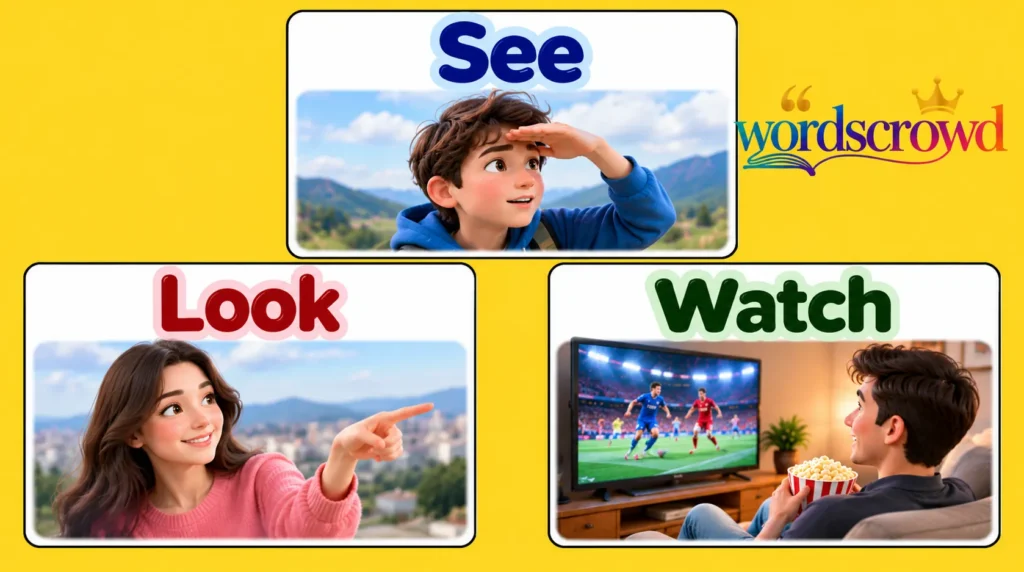
If you have ever wondered whether you should see, look, or watch something, you are not alone. These three English verbs are closely related because they all describe using your eyes, but they do not mean exactly the same thing.
The key difference is simple:
- See usually describes noticing or perceiving something with your eyes, often without trying.
- Look usually describes directing your eyes toward something intentionally.
- Watch usually describes paying attention to something that moves, changes, or continues over a period of time.
That small difference in intention and duration explains why we see a bird, look at a bird, but watch a bird fly.
This guide explains see vs look vs watch in detail, including grammar, pronunciation, common expressions, formal and informal usage, British and American English, common mistakes, and more than 20 original examples.
Quick Answer
See, look, and watch are all correct, but they are used differently.
- See = notice or perceive with your eyes: I saw a bird.
- Look = intentionally direct your eyes at something: Look at that bird!
- Watch = observe something carefully, especially when it moves or changes: We watched the bird fly away.
A useful shortcut is: see = notice, look = direct your eyes, watch = observe over time.
Quick rule: You don’t usually control seeing. You choose to look. You watch when you keep looking at something, especially something happening or moving.
See vs Look vs Watch: Comparison Table
| Feature | See | Look | Watch |
|---|---|---|---|
| Basic meaning | Perceive with the eyes | Direct your eyes toward something | Observe something for a period |
| Main idea | Notice | Aim your eyes | Follow and observe |
| Intention | Often unintentional | Usually intentional | Usually intentional |
| Duration | Often momentary | Often brief or unspecified | Usually longer |
| Movement required? | No | No | Often, but not always |
| Part of speech | Verb; also noun in some uses | Verb; also noun | Verb; also noun |
| Common pattern | see + object | look at + object | watch + object |
| Example | I saw Tom. | I looked at Tom. | I watched Tom play. |
| TV/movies | see a movie | look at the screen | watch TV / watch a movie |
| Direction | Not necessarily | Important | Important, with continued attention |
| Typical context | Perception, meetings, experiences | Visual direction, inspection | Events, sports, videos, movement |
| Formality | Neutral | Neutral | Neutral |
| Common mistake | — | look the picture ❌ | watch the picture ❌ |
| Easy memory | Notice | Aim | Follow |
What Does “See” Mean?
See generally means to perceive something with your eyes. It often happens without deliberate effort.
For example:
I saw a man outside the building.
The sentence tells us that the speaker perceived the man. It does not necessarily tell us that the speaker deliberately directed their eyes toward him.
You can see something because it is in your field of vision, because someone points it out, or because you happen to notice it.
Pronunciation of “See”
See is pronounced:
/siː/
It rhymes with me, be, and tree.
Grammar of “See”
See is an irregular verb:
- Present: see
- Third person singular: sees
- Past: saw
- Past participle: seen
- -ing form: seeing
Examples:
- I see the mountains.
- She sees her friends every Friday.
- We saw a fox yesterday.
- I have seen that movie before.
- He is seeing a doctor tomorrow.
Notice the difference between saw and seen:
I saw him yesterday.
I have seen him before.
You cannot normally say:
I have saw him. ❌
The correct form is:
I have seen him. ✅
When Do We Use “See”?
1. When you notice something
I can see a plane in the sky.
You are describing visual perception.
2. When something becomes visible
Can you see the sign from here?
The question asks whether the other person can visually perceive the sign.
3. When meeting someone
See has another important meaning: to meet or spend time with someone.
I saw Sarah at the conference.
This does not necessarily mean you simply noticed Sarah. It can mean you met or encountered her.
4. For appointments
English commonly uses see when talking about professional appointments.
I need to see my doctor.
She is seeing a lawyer tomorrow.
We saw a dentist last week.
Here, see does not simply mean “look at.” It means meet or consult.
5. For movies, shows, and performances
We often say:
Did you see that movie?
I saw a great play last night.
Have you seen the new documentary?
Here, see refers to experiencing a movie, play, performance, or similar work.
However, watch is also common when the emphasis is on the act of viewing:
We watched a movie last night.
Both can be correct, but the focus is slightly different.
6. For understanding
See is also used figuratively to mean understand.
Oh, I see what you mean.
I see why you’re worried.
In these sentences, see has nothing to do with physical vision.
Important Expressions With “See”
English contains many common expressions using see:
- see you later
- see you soon
- see what happens
- see the point
- see the difference
- see for yourself
- see a doctor
- see a movie
- see someone
- see if
- see whether
For example:
Let’s see what happens.
You should see for yourself.
I see your point.
These are normal modern English expressions.
What Does “Look” Mean?
Look usually means to deliberately direct your eyes toward something.
This is the most important distinction between see and look.
Compare:
I saw a dog in the street.
You noticed it.
I looked at the dog.
You intentionally directed your eyes toward it.
Pronunciation of “Look”
Look is pronounced:
/lʊk/
It has the same vowel sound found in words such as book, good, and put.
Grammar of “Look”
Look is a regular verb:
- look
- looks
- looked
- looking
Examples:
Look at this.
She looks tired.
He looked through the window.
They were looking for their keys.
One particularly important grammar point is the preposition at.
We normally say:
Look at the picture. ✅
Not:
Look the picture. ❌
When Do We Use “Look”?
1. To direct someone’s attention
Look at this!
Look over there!
Look at the sky.
You are asking someone to direct their eyes somewhere.
2. To examine something visually
She looked carefully at the document.
He looked at the map before leaving.
The action is deliberate.
3. To describe appearance
Look can also describe someone’s appearance.
You look tired.
She looks happy.
That looks expensive.
Here, look is a linking verb. It connects the subject with an adjective describing appearance.
4. With “for”
Look for means try to find.
I’m looking for my phone.
She is looking for a new job.
We looked for a quiet restaurant.
This does not mean simply directing your eyes at something. It means searching.
5. With “after”
Look after means take care of.
Can you look after my dog?
She looks after her younger brother.
This is another example showing why the surrounding words matter.
6. With “at” and an activity
Sometimes look at means examine or consider something.
Let’s look at the numbers again.
The manager looked at the proposal.
This can be literal or figurative.
Look vs See
The difference becomes clearer with a simple situation.
Imagine you are walking down a street.
You see a shop because you notice it.
Then you stop and look at the shop window because you are interested.
So:
I saw a shop.
means you noticed it.
I looked at the shop window.
means you intentionally directed your eyes toward it.
I watched the people inside.
means you continued observing what they were doing.
What Does “Watch” Mean?
Watch usually means to look at something carefully for a period of time, especially something that is moving, changing, or developing.
That is why we naturally say:
Watch the football match.
Watch the children play.
Watch the road.
Watch the video.
The action normally continues for some time.
Pronunciation of “Watch”
In British English:
/wɒtʃ/
In American English:
/wɑːtʃ/
The final -tch sound is the same in both varieties.
Grammar of “Watch”
Watch is a regular verb:
- watch
- watches
- watched
- watching
Examples:
I watch football every weekend.
She watches the news every evening.
We watched the children playing.
They were watching a movie.
Notice the spelling:
He watches TV. ✅
Not:
He watchs TV. ❌
The -es ending is used because watch ends in -ch.
When Do We Use “Watch”?
1. For moving things
We watched the birds flying.
She watched the car disappear around the corner.
They watched the waves.
The object is changing or moving, and your attention follows it.
2. For sports
We normally watch sports:
I watch cricket every weekend.
They watched the football match together.
Did you watch the game last night?
You can sometimes use see for a live sporting event:
We saw a cricket match in Lahore.
But watch emphasizes the act of observing the match.
3. For television
The standard expression is:
watch TV
watch television
watch a program
watch a video
For example:
I watched TV after dinner.
4. For films
Both see and watch can be used with movies.
We saw a movie at the cinema.
We watched a movie at home.
The difference is often contextual rather than a strict grammar rule.
See a movie often focuses on the experience of going to or experiencing the film.
Watch a movie emphasizes viewing it.
5. To be careful
Watch can also mean to be alert.
Watch your step.
Watch the traffic.
Watch out!
Here, the word means something closer to be careful or pay attention.
See vs Look vs Watch: The Key Differences
The easiest way to separate the three verbs is to think about intention and duration.
1. See = perception
You receive visual information.
I saw a bird.
You did not necessarily plan to see it.
2. Look = direction
You intentionally direct your eyes.
Look at the bird.
You choose where your eyes go.
3. Watch = continued observation
You intentionally keep your eyes and attention on something.
Watch the bird.
You are paying attention to what it does.
A Simple Three-Step Example
Imagine a football match:
- You see the players when you notice them.
- You look at the players when you direct your eyes toward them.
- You watch the players when you follow the match and their actions over time.
That is the central distinction.
Grammar: See, Look, and Watch Are Not Interchangeable
Although all three verbs relate to vision, their grammar patterns differ.
“See” Usually Takes a Direct Object
I saw John.
She saw the accident.
We saw a beautiful sunset.
There is normally no at after see.
Incorrect:
I saw at John. ❌
Correct:
I saw John. ✅
“Look” Commonly Uses “At”
Look at me.
Look at the picture.
She looked at the screen.
This is one of the most important grammar patterns to remember.
“Watch” Usually Takes a Direct Object
Watch the game.
Watch the children.
Watch this video.
We generally do not need at:
Watch the movie. ✅
Not:
Watch at the movie. ❌
However, watch at can occur in other grammatical structures where at belongs to a different phrase, so the useful beginner rule is simply: watch something, but look at something.
See, Look, and Watch With Tenses
All three verbs can be used in different tenses, but their meanings can change with the tense.
Present simple
I see my neighbors every morning.
I look at the news online.
I watch cricket on weekends.
Present continuous
I’m looking at the menu.
We’re watching a documentary.
See is different because it is often treated as a stative verb when it means perception:
I see the problem. ✅
But seeing is also perfectly normal in particular meanings:
I’m seeing my doctor tomorrow.
I’m seeing what I can find.
They are seeing each other regularly.
So don’t assume that see can never appear in the continuous form.
See vs Watch a Movie
This is one of the most common areas of confusion.
Both can be correct:
I saw a movie last night.
I watched a movie last night.
The difference is usually one of focus.
See a movie often presents the movie as an experience or outing:
We went to the cinema and saw a movie.
Watch a movie emphasizes viewing:
We stayed home and watched a movie.
This is not an absolute rule. Native speakers can use either expression depending on context.
Tip: Don’t treat every difference between see and watch as a rigid grammar rule. Context matters.
See a Movie vs Watch a Movie vs Look at a Movie
These three expressions are particularly useful for learners.
See a movie
Natural:
I saw a movie at the cinema.
Watch a movie
Natural:
I watched a movie on my laptop.
Look at a movie
Usually unnatural if you mean “watch the movie from beginning to end.”
You might say:
I looked at the movie poster.
or:
I looked at a few scenes from the movie.
But normally:
I watched the movie. ✅
See a Picture vs Look at a Picture
Both can be correct, but they describe different actions.
I saw the picture.
This means you perceived or noticed it.
I looked at the picture.
This means you intentionally examined it.
For example:
I saw the picture on your desk, but I didn’t look at it closely.
This sentence makes the distinction extremely clear.
Watch a Picture?
Generally, watch is not the natural choice for a still picture.
You normally:
- look at a picture
- see a picture
- watch a video
Compare:
Look at this photo.
Did you see this photo?
Watch this video.
A photograph does not normally move or develop, so watch is usually inappropriate.
20+ Real-Life Examples of See vs Look vs Watch
Everyday Conversation
1.
I saw your brother at the supermarket.
You noticed or encountered him.
2.
Look at that beautiful sunset!
You are directing someone’s attention.
3.
We watched the sunset from the beach.
You observed it for a period of time.
4.
Did you see my keys?
You are asking whether the person noticed or found them.
5.
Look under the table.
You are telling someone where to direct their eyes.
6.
Watch the baby while I make dinner.
Here, watch means keep an eye on the baby.
School and Education
7.
I saw an interesting diagram in my textbook.
8.
Look at the example on the board.
9.
We watched a science video in class.
10.
Did you see the teacher’s announcement?
Business and Professional English
11.
I looked at your proposal this morning.
You intentionally reviewed it.
12.
I saw your email, but I haven’t had time to respond.
You noticed or received it.
13.
We watched the market closely throughout the day.
The observation continued over time.
14.
The manager asked me to look at the figures again.
Here, look at means examine.
Academic Writing
15.
The researchers observed changes in the data over time.
In formal academic writing, observe may sometimes be more precise than watch.
16.
As shown in Figure 2, we can see a clear increase.
Here, see means perceive or understand from the evidence.
17.
Students should look at the examples before completing the exercise.
Social Media and Text Messages
18.
Look at this meme!
19.
Did you see my post?
20.
Watch this video—it’s hilarious.
21.
Have you seen her latest photo?
Daily Life
22.
I saw a strange light outside.
23.
Look through the window.
24.
Watch the road carefully.
25.
I watched the children playing in the park.
These examples show that the choice depends on what the eyes are doing and how the speaker conceptualizes the action.
Common Mistakes With See, Look, and Watch
Mistake 1: “Look me.”
Incorrect:
Look me. ❌
Correct:
Look at me. ✅
Why?
The verb look normally requires at when you specify the thing receiving the visual attention.
Mistake 2: “Look this picture.”
Incorrect:
Look this picture. ❌
Correct:
Look at this picture. ✅
Mistake 3: “Watch at the TV.”
Incorrect:
Watch at the TV. ❌
Better:
Watch TV. ✅
or:
Watch the TV. ✅
The meaning changes slightly depending on context, but watch at is not the normal pattern.
Mistake 4: “I am seeing TV.”
Usually unnatural if you mean watching television.
Better:
I’m watching TV. ✅
Mistake 5: “I looked a movie.”
Incorrect:
I looked a movie. ❌
Depending on meaning, say:
I saw a movie. ✅
or:
I watched a movie. ✅
Mistake 6: “I watched the picture.”
Usually unnatural when you mean a photograph.
Better:
I looked at the picture. ✅
or:
I saw the picture. ✅
Mistake 7: “I saw at him.”
Incorrect:
I saw at him. ❌
Correct:
I saw him. ✅
Or, if you mean deliberate visual attention:
I looked at him. ✅
Mistake 8: “I watch a strange object.”
This sentence is not necessarily grammatically wrong, but it may be the wrong verb depending on meaning.
If you noticed it:
I saw a strange object.
If you deliberately examined it:
I looked at a strange object.
If you observed it continuously:
I watched the strange object.
Context determines the best choice.
Memory Tricks for See, Look, and Watch
Here are three simple ways to remember the difference.
Memory Trick 1: Notice → Aim → Follow
Think:
SEE → LOOK → WATCH
See = notice
Look = aim your eyes
Watch = follow what happens
Example:
I saw a dog.
I looked at the dog.
I watched the dog run.
Memory Trick 2: Camera Analogy
Imagine your eyes are a camera.
See = the camera captures something.
Look = you point the camera.
Watch = you keep the camera focused while the action continues.
This is not a perfect grammar rule, but it is an excellent way to remember the core difference.
Memory Trick 3: Time
Think about duration:
See → instant
Look → action
Watch → extended attention
For example:
I saw a bird.
A moment of perception.
I looked at the bird.
A deliberate visual action.
I watched the bird build a nest.
Continued observation.
See vs Look vs Watch in British and American English
There is no major British-American difference in the basic meanings of see, look, and watch.
Both British and American speakers use:
Look at this.
I saw him yesterday.
Watch the game.
I watched TV last night.
The pronunciation of watch differs somewhat between major varieties, but the grammar and core meaning remain essentially the same.
There can be differences in preferred vocabulary around particular activities, but learners should not think of see, look, and watch as British-versus-American alternatives.
They are standard in both varieties.
Are See, Look, and Watch Synonyms?
They are related verbs, but they are not fully interchangeable synonyms.
All three belong to the semantic field of visual perception, but they highlight different aspects of that experience.
- See emphasizes perception.
- Look emphasizes visual direction or deliberate attention.
- Watch emphasizes sustained observation.
Other related verbs include:
- observe
- view
- notice
- glance
- stare
- gaze
- inspect
- spot
- notice
These words have their own meanings.
For example:
I glanced at the clock.
means you looked quickly.
I stared at the painting.
means you looked for a relatively long time, often intensely.
I inspected the document.
means you examined it carefully.
So see vs look vs watch is only part of a much larger vocabulary system for visual attention.
See vs Look vs Watch: Common Collocations
Learning common combinations can make the distinction much easier.
Common collocations with “see”
- see a doctor
- see a dentist
- see a friend
- see a movie
- see a show
- see the difference
- see the problem
- see the point
- see what happens
- see for yourself
- see clearly
- see someone
Common collocations with “look”
- look at a picture
- look at the screen
- look around
- look inside
- look outside
- look up
- look down
- look for something
- look after someone
- look through a window
- look carefully
- look closely
Common collocations with “watch”
- watch TV
- watch a movie
- watch a video
- watch a game
- watch a match
- watch a show
- watch someone work
- watch children
- watch carefully
- watch closely
- watch out
- watch over someone
Knowing these patterns is often more useful than memorizing isolated dictionary definitions.
When “See” and “Watch” Both Work
English is flexible, and some situations allow both verbs.
Consider:
Did you see the football match?
and:
Did you watch the football match?
Both can be grammatical.
The first may focus on the experience of attending or viewing the event.
The second strongly focuses on observing the match.
Likewise:
Have you seen this documentary?
Have you watched this documentary?
Both can work.
The best choice depends on context, dialect, and what aspect of the experience the speaker wants to emphasize.
This is why learners should avoid overly rigid rules such as “always use watch for television and never use see.” Real English is more nuanced.
When “Look” Is the Best Choice
Use look when the main idea is directing your eyes somewhere.
Especially remember:
look at + noun
Examples:
Look at the clouds.
Look at this email.
Look at the results.
Look at the screen.
Look at me.
If someone says:
Look!
they are usually telling you to direct your attention toward something.
That is why look is common in instructions:
Look carefully.
Look over here.
Look inside.
Look down.
Look behind you.
When “Watch” Is the Best Choice
Use watch when you want to emphasize continued observation.
It is especially natural for:
- sports
- television
- videos
- performances
- people doing things
- moving objects
- events
- situations that develop over time
Examples:
Watch the match.
Watch this video.
Watch the children.
Watch what happens next.
Watch the car carefully.
The important idea is continued attention.
When “See” Is the Best Choice
Use see when you mean:
- perceive something
- notice something
- encounter someone
- attend or experience something
- understand something
- consult someone professionally
Examples:
I saw a bird.
I saw your message.
I saw Maria yesterday.
I need to see a doctor.
Did you see that movie?
I see what you mean.
A Fast Decision Test
When you are unsure which verb to choose, ask yourself these three questions:
Question 1: Did I simply notice it?
Use see.
I saw a strange car outside.
Question 2: Am I deliberately directing my eyes toward it?
Use look.
Look at that strange car.
Question 3: Am I observing it for a while or following what it does?
Use watch.
I watched the strange car leave.
This three-question test solves most everyday problems.
FAQ: See vs Look vs Watch
1. What is the main difference between see, look, and watch?
See means to perceive or notice something. Look means to intentionally direct your eyes toward something. Watch means to observe something for a period of time, especially when it moves, changes, or develops.
2. Is “look at” or “see” correct?
Both are correct, but they have different meanings.
I saw the painting.
means I perceived or noticed it.
I looked at the painting.
means I deliberately directed my attention toward it.
3. Should I say “watch TV” or “see TV”?
The normal expression is watch TV when you mean viewing television programs.
I watch TV every evening.
However, see can occur in expressions referring to a particular television program or appearance:
Did you see that program last night?
The choice depends on the intended meaning.
4. Is it “look the picture” or “look at the picture”?
The standard construction is:
Look at the picture.
Look normally uses at when identifying the object being viewed.
5. Is “watch a movie” correct?
Yes. Watch a movie is completely natural, particularly when emphasizing the act of viewing it.
We watched a movie at home.
See a movie is also correct:
We saw a movie at the cinema.
6. Can “see” mean “understand”?
Yes. See commonly has a figurative meaning of understanding.
Oh, I see.
I see what you mean.
This meaning is extremely common in everyday English.
7. Is “watch” only used for moving things?
No. Movement is a strong clue, but it is not an absolute requirement.
We can watch television, a movie, a performance, or a person. The central idea is continued attention or observation, not simply physical movement.
8. Are see, look, and watch interchangeable?
No. They overlap in meaning, but they are not fully interchangeable.
See focuses on perception, look on directing the eyes, and watch on sustained observation.
9. What is the easiest way to remember see vs look vs watch?
Remember:
See = notice
Look = aim
Watch = follow
If you simply perceive something, use see. If you direct your eyes toward it, use look. If you keep observing it, use watch.
Final Verdict: See vs Look vs Watch
There is no single winner because see, look, and watch are all correct English verbs. The right choice depends on what you mean.
Use SEE when:
- You notice or perceive something.
- Something enters your visual field.
- You mean meeting or consulting someone.
- You mean understanding.
- You talk about experiencing certain events, movies, or performances.
Example:
I saw a bird outside.
Use LOOK when:
- You intentionally direct your eyes.
- You tell someone where to direct their attention.
- You examine something visually.
- You describe appearance.
- You use expressions such as look for and look after.
Example:
Look at the bird.
Use WATCH when:
- You observe something for a period of time.
- Something is moving or changing.
- You follow an event.
- You view television, videos, sports, or performances.
- You keep an eye on someone or something.
Example:
We watched the bird fly away.
The Best Rule to Remember
SEE = notice it.
LOOK = direct your eyes at it.
WATCH = keep your attention on it.
Once you understand that difference, many confusing sentences become much easier.
You see something because you perceive it.
You look at something because you choose to direct your eyes toward it.
You watch something because you continue observing it.
And that is the essential difference between see vs look vs watch.

Elon Parker is a dedicated writer at Wordscrowd, creating clear, informative, and engaging content for readers.
With a focus on useful information, Elon aims to make every article simple, reliable, and easy to understand.