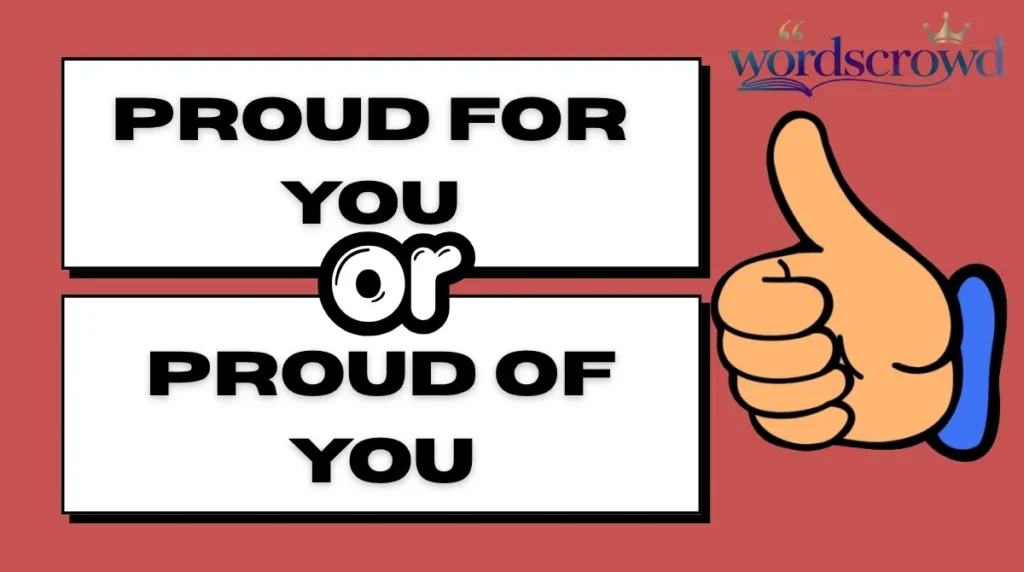
“Proud for you” or “proud of you”—which one should you use? If you have ever hesitated before sending a congratulatory message, you are not alone.
The two phrases look almost identical, but English normally uses them differently.
The simple answer is that “proud of you” is the standard, natural expression when you want to express admiration for someone’s achievement, effort, character, or progress.
For example, “I’m proud of you for passing your exam” sounds completely natural.
“Proud for you” is much less common. It can sometimes appear when a speaker means something like “I’m happy for you” or “I’m pleased on your behalf,” but it is not the usual choice for expressing personal admiration.
In most everyday, professional, academic, and formal situations, “proud of you” is the safer and more idiomatic phrase.
This guide explains exactly why the difference matters, how the prepositions of and for change the relationship between the speaker and the emotion, when “proud for you” may appear, and what a fluent English speaker would normally say instead.
Quick Answer
Use “proud of you” when you mean that you admire someone or feel pride because of what they have done or who they are.
- ✅ I’m proud of you. — Standard and natural.
- ⚠️ I’m proud for you. — Uncommon and potentially awkward.
- ✅ I’m happy for you. — Natural when you mainly mean that you share someone’s happiness.
- ✅ I’m proud of you for finishing the project. — Natural and grammatically sound.
If you are unsure, choose “proud of you.”
Proud for You vs Proud of You: Comparison Table
| Feature | Proud of You | Proud for You |
|---|---|---|
| Standard English | ✅ Yes | ⚠️ Limited/uncommon |
| Natural to most speakers | ✅ Very natural | ❌ Often sounds unusual |
| Main meaning | Personal pride or admiration | Possible happiness on someone’s behalf |
| Grammar pattern | proud + of + object | proud + for + person |
| Commonness | Very common | Rare |
| Everyday conversation | ✅ Recommended | ⚠️ Usually avoid |
| Professional writing | ✅ Appropriate when emotionally suitable | ❌ Usually avoid |
| Academic writing | Grammatically possible in a quoted context, but rarely needed | ⚠️ Usually replace |
| Social media | ✅ Common | Sometimes seen |
| Congratulating someone | ✅ Excellent | ⚠️ Better: “happy for you” |
| Describing someone’s achievement | ✅ “I’m proud of you for winning.” | ⚠️ “I’m proud for you” sounds awkward |
| Describing someone’s qualities | ✅ “I’m proud of you for being honest.” | ❌ Not the normal construction |
| Best alternative | — | “I’m happy for you” |
| Recommended choice | Use this | Usually avoid |
Quick rule: If you are expressing pride in the person or their achievement, use proud of you. If you simply mean sharing their happiness, say happy for you.
What Does “Proud of You” Mean?
“Proud of you” is the standard English expression used to communicate admiration, satisfaction, approval, or emotional pride toward another person.
The basic structure is:
Subject + linking verb + proud + of + person
For example:
I am proud of you.
The parts of the sentence are easy to identify:
- I = subject
- am = linking verb
- proud = adjective
- of = preposition
- you = object of the preposition
The phrase can stand alone:
I’m proud of you!
Or it can be expanded:
I’m proud of you for working so hard.
She’s proud of you for speaking up.
Your parents are proud of you for graduating.
We’re proud of you for never giving up.
The expression does not necessarily refer only to a major success. Someone can be proud of another person’s effort, courage, honesty, growth, kindness, patience, resilience, or progress.
Why “of” Works With “Proud”
English adjectives often develop conventional relationships with particular prepositions. These combinations are called collocations.
For example:
- afraid of
- ashamed of
- aware of
- fond of
- tired of
- proud of
That means fluent speakers do not normally choose the preposition after “proud” by translating the idea word-for-word. They learn the established pattern:
proud + of
This is one reason “I’m proud of you” feels natural while “I’m proud for you” may sound unusual.
What Can Come After “Proud Of”?
“Proud of” can be followed by much more than you.
A person
I’m proud of my daughter.
Yourself
You should be proud of yourself.
A group
The coach is proud of the team.
An achievement
She is proud of her degree.
An action
He is proud of finishing the race.
A quality
We’re proud of our honesty and commitment.
An organization or creation
They’re proud of their new business.
This flexibility makes proud of an important and widely used English pattern.
The Meaning of “Proud of You”
The emotional meaning can vary slightly depending on context.
Pride in Achievement
This is probably the most familiar use.
I’m proud of you for passing your exam.
The speaker admires the person’s success and likely recognizes the work behind it.
Pride in Effort
Success is not required.
I’m proud of you for trying again.
Here, the speaker focuses on determination rather than the final result.
Pride in Personal Growth
I’m proud of you for becoming more confident.
The expression recognizes development over time.
Pride in Character
I’m proud of you for telling the truth.
The person may not have achieved anything measurable, but their behavior reflects a quality the speaker admires.
Emotional Support
Whatever happens, I’m proud of you.
This can reassure someone that their worth is not dependent on winning or succeeding.
That is why “I’m proud of you” is more than a grammar pattern. It can communicate encouragement, affection, admiration, recognition, and emotional support.
Is “Proud for You” Wrong?
This question needs a more careful answer than simply labeling the phrase “wrong.”
“Proud for you” is not the normal idiomatic expression for telling someone that you admire them or their accomplishment. Most speakers would choose “proud of you.”
However, language is not always as simple as “correct” versus “incorrect.” The phrase “proud for you” can occasionally be found in informal or expressive English, particularly when a speaker intends something close to “happy for you” or “pleased on your behalf.” Some usage discussions therefore describe it as possible but uncommon rather than absolutely impossible.
That distinction matters.
If you write:
I’m proud for you.
A reader will probably understand your intention. But many fluent English speakers would naturally expect:
I’m proud of you.
Or, if your intended meaning is shared happiness:
I’m happy for you.
So the practical advice is straightforward:
“Proud for you” may be understandable, but “proud of you” is the standard choice for expressing pride.
Why “Proud for You” Sounds Unnatural
The problem is mainly collocation and meaning, not simply the individual word “for.”
The preposition for is perfectly normal after many adjectives and expressions:
- happy for you
- grateful for the opportunity
- thankful for your help
- excited for the future
- sorry for you
So an English learner might logically think:
happy for you → proud for you
But English does not always work by replacing one word with another. Each adjective has its own conventional patterns.
We naturally say:
I’m happy for you.
and:
I’m proud of you.
The two expressions are related emotionally, but they are not identical grammatical patterns.
Compare the Emotional Focus
I’m proud of you.
The speaker’s pride is directed toward the person and what they have done or represent.
I’m happy for you.
The speaker is sharing the person’s happiness or expressing pleasure about their good fortune.
That difference is subtle but useful.
What Does “For” Mean in “Happy for You”?
This is where many learners get confused.
Consider:
I’m happy for you.
The speaker is not necessarily saying that the person’s achievement makes the speaker proud. Instead, the speaker is expressing happiness on the person’s behalf.
For example:
“You got the job? I’m so happy for you!”
This is a natural congratulatory response.
Now compare:
“You worked incredibly hard for that job. I’m so proud of you.”
Here, the speaker is emphasizing admiration for the person’s effort.
Both sentences are positive. They simply highlight different emotions.
Proud of You vs Happy for You
This is often the most useful comparison for English learners.
| Expression | Main idea |
|---|---|
| I’m proud of you. | I admire you or what you have done. |
| I’m happy for you. | I’m pleased about your good news or happiness. |
| I’m excited for you. | I’m enthusiastic about what is happening to you. |
| I’m pleased for you. | I’m glad about your success or situation. |
| I admire you. | I respect your qualities or actions. |
| Congratulations! | I recognize and celebrate your achievement. |
Example
Your friend gets married.
You could say:
I’m happy for you!
This is completely natural.
You could also say:
I’m proud of you for building such a wonderful life.
That works when you are emphasizing the person’s journey or character.
But:
I’m proud for you!
may sound like an unusual mixture of the two expressions.
Grammar Breakdown of “Proud of You”
Understanding the sentence structure makes the choice much easier.
“Proud” Is an Adjective
Proud describes an emotional state or attitude.
Examples:
I am proud.
She feels proud.
They were proud.
It is not a verb in these sentences.
You do not normally say:
❌ I proud of you.
You need a suitable linking verb:
✅ I am proud of you.
✅ She is proud of you.
✅ They were proud of you.
“Of” Is a Preposition
In:
I’m proud of you.
of connects the adjective proud with its object, you.
The same structure appears in:
proud of my work
proud of her son
proud of the team
proud of their achievement
“You” Is the Object of the Preposition
In the sentence:
I’m proud of you.
“you” follows the preposition “of.”
That is why the phrase is structurally:
proud + of + noun/pronoun
Tense Can Change
The phrase itself stays the same while the verb changes.
Present:
I’m proud of you.
Past:
I was proud of you.
Future:
I’ll be proud of you.
Present perfect:
I’ve always been proud of you.
Conditional:
I would be proud of you.
The preposition remains of.
“Proud Of You For…”: Why Both “Of” and “For” Can Appear
This is an especially important point.
You may see:
I’m proud of you for finishing the marathon.
Some learners wonder why the sentence uses both of and for.
The structure is:
proud of + person + for + reason
Here:
- of you identifies the person receiving the pride.
- for finishing the marathon explains the reason for the pride.
More examples:
I’m proud of you for staying calm.
She’s proud of him for helping his brother.
We’re proud of the team for playing so well.
Your teacher is proud of you for improving your writing.
This is completely natural English.
Another Pattern: Proud of + Noun
You can also remove the person and focus directly on the achievement:
I’m proud of my progress.
She’s proud of her work.
They’re proud of their success.
So there are several useful patterns:
- proud of + person
- proud of + thing
- proud of + person + for + action
- proud of + gerund
Pronunciation Guide
Proud
Proud is pronounced approximately:
/praʊd/
It rhymes closely with:
- loud
- cloud
- crowd
“Proud of You”
In natural speech, the words may flow together:
proud of you
The phrase is often spoken smoothly rather than with a strong pause between every word.
For learners, the important point is that “proud” is one syllable.
proud — not “pro-ud”
“Proud for You”
The pronunciation is straightforward:
proud /praʊd/ + for /fɔːr/ or /fər/ + you /juː/
The issue is not pronunciation. The issue is natural usage and preposition choice.
Origin and History of “Proud”
The history of proud is interesting because the word has changed meaning over time.
English proud comes through Middle English from Old French forms related to prud, carrying senses associated with being valiant, brave, capable, or excellent. Over time, the word developed the modern emotional sense connected with satisfaction in one’s own achievements or the achievements and qualities of others.
Today, “proud” can be positive:
She is proud of her work.
But it can also describe excessive self-importance:
He was too proud to ask for help.
So context matters.
Positive “Proud”
I’m proud of you.
This expresses admiration.
Negative “Proud”
He was too proud to apologize.
This suggests excessive self-esteem or unwillingness to admit fault.
The phrase “proud of you”, however, is overwhelmingly positive when used as encouragement or congratulations.
When Should You Use “Proud of You”?
Use “proud of you” when you want to express genuine admiration or recognition.
Use It for Achievements
I’m proud of you for passing your driving test.
Use It for Effort
I’m proud of you for keeping going.
Use It for Courage
I’m proud of you for speaking honestly.
Use It for Personal Growth
I’m proud of you for becoming more confident.
Use It for Character
I’m proud of you for treating everyone with kindness.
Use It for Milestones
We’re proud of you for graduating.
Use It as Emotional Support
No matter what happens, I’m proud of you.
Professional Use: Is “Proud of You” Appropriate?
Yes, but context matters.
“Proud of you” is emotionally warm and personal. It can work well in professional settings when there is a supportive relationship.
For example, a manager might tell an employee:
“I’m proud of you for leading the presentation so confidently.”
That can sound encouraging and sincere.
However, in a formal business email, you may sometimes want a more neutral expression:
Your work on this project was excellent.
or:
I greatly appreciate your effort and professionalism.
or:
You handled the situation very effectively.
The issue is not that “proud of you” is grammatically informal. Rather, its emotional tone may be warmer and more personal than some business situations require.
Academic Writing: What Should You Use?
In academic writing, “proud of you” is grammatically correct but usually not the style you need.
Academic prose tends to focus on evidence, analysis, and objective claims.
Instead of:
I’m proud of you for completing this research.
a formal academic context might say:
Your research demonstrates considerable persistence and analytical skill.
But in a teacher’s personal message to a student, this is perfectly natural:
I’m very proud of you for completing your dissertation.
The relationship and purpose determine the appropriate tone.
Everyday Conversation Examples
Here are natural examples you might hear in real life:
“You did it! I’m so proud of you.”
“Your hard work really paid off. I’m proud of you.”
“I’m proud of you for trying something new.”
“You should be proud of yourself.”
“We’re incredibly proud of you.”
“I’m proud of you, no matter what.”
These sound natural because proud of is deeply established in everyday English.
25 Real-Life Examples
Conversation
- “I’m really proud of you for finishing the course.”
- “You handled that difficult conversation well. I’m proud of you.”
- “I’m proud of you for admitting your mistake.”
- “Your parents must be proud of you.”
- “You’ve come so far, and I’m proud of you.”
Text Messages
- “You got the job!!! So proud of you! 🎉”
- “Honestly, I’m so proud of you right now.”
- “Proud of you for not giving up ❤️”
School
- “Your teacher is proud of you for improving your grades.”
- “I’m proud of you for completing your assignment on time.”
- “We’re proud of you for representing the school so well.”
Business
- “I’m proud of you for taking the lead on this project.”
- “The entire team is proud of you for delivering such a strong presentation.”
- “You handled the client meeting professionally, and I’m proud of you.”
- “I’m very proud of you for the progress you have made this year.”
- “We are proud of you for completing this important milestone.”
Social Media
- “So proud of you for chasing your dreams!”
- “Proud of you for turning an idea into reality.”
- “Watching you grow has been amazing. Proud of you!”
Family
- “I’m proud of you for becoming the person you are today.”
- “Your grandparents would be proud of you.”
- “I couldn’t be more proud of you.”
Friendship
- “I’m proud of you for choosing what makes you happy.”
- “You took a huge risk, and I’m proud of you.”
- “I’m proud of you—not just for winning, but for how you played.”
Common Mistakes and How to Fix Them
Mistake 1: “I’m proud for you.”
❌ I’m proud for you.
If your intended meaning is admiration for the person, use:
✅ I’m proud of you.
If you mean shared happiness, use:
✅ I’m happy for you.
Mistake 2: “I’m proud for you for passing.”
❌ I’m proud for you for passing the exam.
The natural version is:
✅ I’m proud of you for passing the exam.
There are two different relationships here:
- proud of you = who you are proud of
- for passing = why you are proud
Mistake 3: “I am proud about you.”
❌ I’m proud about you.
The normal expression is:
✅ I’m proud of you.
Mistake 4: “I’m proud on you.”
❌ I’m proud on you.
Use:
✅ I’m proud of you.
Mistake 5: “I proud of you.”
❌ I proud of you.
Because proud is an adjective, it needs a linking verb:
✅ I am proud of you.
Mistake 6: “I’m proud with you.”
❌ I’m proud with you.
Use:
✅ I’m proud of you.
Mistake 7: Confusing “proud of” with “happy for”
❌ I’m proud for you!
If your meaning is simply “That makes me happy because it happened to you,” say:
✅ I’m happy for you!
If your meaning is “I admire you and what you accomplished,” say:
✅ I’m proud of you!
“Proud of Yourself” vs “Proud of You”
These phrases are closely related but have different subjects.
Proud of You
The speaker feels pride toward another person.
I’m proud of you.
Proud of Yourself
The person feels pride in their own achievement.
You should be proud of yourself.
Compare:
Your mother is proud of you.
You are proud of yourself.
Both are grammatically correct.
Important Point
Do not change the preposition:
❌ You should be proud for yourself.
✅ You should be proud of yourself.
The established pattern remains proud of.
“Proud of You for” vs “Proud of You Because”
Both can explain the reason for pride, but they work differently.
Proud of You for + -ing
I’m proud of you for working hard.
She’s proud of him for staying calm.
Proud of You Because + Clause
I’m proud of you because you worked so hard.
She’s proud of him because he stayed calm.
The first construction is usually shorter and more conversational.
Can You Say “I’m Proud of You for Your Success”?
Yes.
I’m proud of you for your success.
This is grammatically understandable, although depending on the context, a slightly more natural version may be:
I’m proud of you for all your hard work.
or:
I’m proud of you for what you’ve achieved.
The reason is that for can introduce the reason for the speaker’s pride.
“Proud of” With Things
The phrase is not limited to people.
I’m proud of my work.
She’s proud of her artwork.
They’re proud of their company.
He’s proud of his decision.
We’re proud of the team’s progress.
This shows why “proud of” is a broader grammatical pattern, not simply a special phrase used with “you.”
“Proud Of” and “Proud That”
English also allows another useful structure:
I’m proud that you kept trying.
Here, that introduces a clause.
Compare:
I’m proud of you for keeping trying.
and:
I’m proud that you kept trying.
Both can be correct, but the structures are different.
Pattern 1
proud of + noun/pronoun
I’m proud of you.
Pattern 2
proud of + noun/pronoun + for + -ing
I’m proud of you for trying.
Pattern 3
proud + that-clause
I’m proud that you tried.
Learning these patterns gives you much more flexibility than memorizing a single sentence.
Is “Proud of You” Formal or Informal?
It can be used across different levels of formality, but it is emotionally personal.
Informal
I’m so proud of you!
Very natural.
Neutral/supportive
I’m proud of you for handling the situation so well.
Natural in many relationships.
Professional
I’m proud of you for taking responsibility and leading the team.
Possible when the relationship supports that emotional tone.
Highly formal
In a formal report, a more objective alternative may be preferable:
Your performance was exemplary.
So “proud of you” is not simply “informal English.” Its suitability depends largely on relationship, audience, and purpose.
American English vs British English
There is no major US-versus-UK grammar difference here.
American and British speakers commonly use:
proud of you
The same basic construction appears in both varieties.
You may encounter occasional regional, dialectal, or individual variations involving proud for, but these do not make “proud for you” the standard equivalent of “proud of you.”
For international English, the safest choice remains:
I’m proud of you.
What Do Dictionaries Tell Us?
Major English dictionaries treat proud as an adjective and document the established proud of construction for expressing satisfaction or admiration.
Dictionaries such as Merriam-Webster, Cambridge Dictionary, Oxford English Dictionary, Oxford Learner’s Dictionaries, and Collins are useful references for understanding the word’s meanings, grammatical behavior, and historical development.
The important lesson is not simply to memorize a dictionary definition. English usage is also shaped by collocation—the combinations that speakers naturally use.
For this topic, the central collocation is:
proud of
That is why a sentence can be understandable yet still sound less natural when a different preposition is substituted.
Common Collocations With “Proud”
Learning these combinations can help you sound more fluent.
Proud of + Person
proud of you
proud of her
proud of my parents
Proud of + Achievement
proud of my achievement
proud of her success
proud of their progress
Proud of + Possession or Creation
proud of my work
proud of his invention
proud of our new project
Proud of + Quality
proud of her honesty
proud of his courage
proud of their dedication
Proud of + Action
proud of finishing
proud of helping
proud of speaking up
These patterns are more useful than trying to memorize isolated sentences.
Memory Tricks
Memory Trick 1: “Pride Points Toward Of”
Think:
Proud → of → the person or achievement
I’m proud of you.
Memory Trick 2: “Happy Takes For”
Remember the common pair:
happy for you
but:
proud of you
This is one of the easiest ways to separate the expressions.
Memory Trick 3: Ask One Question
Ask yourself:
Am I admiring the person, or am I sharing their happiness?
If you are admiring them:
I’m proud of you.
If you are sharing their happiness:
I’m happy for you.
Memory Trick 4: Learn the Collocation
Instead of memorizing only:
proud = feeling good
memorize:
proud of
That small habit will prevent many preposition mistakes.
Better Alternatives to “Proud for You”
If “proud for you” feels tempting, choose the alternative that matches your intended meaning.
If You Mean Admiration
I’m proud of you.
If You Mean Happiness
I’m happy for you.
If You Mean Excitement
I’m excited for you.
If You Mean Congratulations
Congratulations!
If You Mean Respect
I really admire you.
If You Mean Approval
You should be proud of what you accomplished.
Choosing the exact expression makes your English more precise and natural.
Frequently Asked Questions
Is “proud for you” grammatically correct?
It is not the standard expression for communicating pride in another person’s achievement. It may appear occasionally in informal or expressive usage, but “proud of you” is the normal choice.
Is “proud of you” correct English?
Yes. “Proud of you” is standard, natural English. It expresses admiration, satisfaction, or pride connected to another person’s actions, qualities, progress, or achievements.
Should I say “proud of you” or “happy for you”?
Use “proud of you” when you want to express admiration or pride. Use “happy for you” when you mainly want to express happiness about someone’s good news or success.
Can I say “I’m proud for you”?
You may encounter it, especially in informal speech or writing, but it is uncommon and can sound awkward. If you mean admiration, use “I’m proud of you.” If you mean shared happiness, “I’m happy for you” is usually better.
Why do we say “proud of you”?
Because proud conventionally combines with the preposition of when the object of the pride is identified. This established collocation gives us expressions such as “proud of you,” “proud of my work,” and “proud of her achievements.”
Can I say “proud of you for”?
Yes. This is a very common construction.
I’m proud of you for working so hard.
Here, of you identifies the person and for working so hard gives the reason for the pride.
Is “proud of yourself” correct?
Yes.
You should be proud of yourself.
This means that you feel pride in your own actions or achievements.
Is “proud of you” formal English?
It is grammatically standard English, but it has a warm and personal tone. It can work in professional contexts when appropriate, but very formal writing may use more objective expressions such as “Your work was excellent” or “Your performance was exemplary.”
A Simple Decision Guide
When you are writing a message, use this quick process:
- Do you admire the person or what they achieved?
- Say: I’m proud of you.
- Are you simply glad that something good happened to them?
- Say: I’m happy for you.
- Do you want to celebrate their achievement?
- Say: Congratulations!
- Do you admire their character?
- Say: I’m proud of you for being honest.
- Are you talking about your own achievement?
- Say: I’m proud of myself.
- Are you talking about a thing or project?
- Say: I’m proud of my work.
This approach is more useful than trying to decide whether for “looks right.”
Final Verdict: Proud for You or Proud of You?
When the question is “proud for you or proud of you?”, the best answer is clear:
Use “proud of you.”
It is the standard, natural, and widely accepted expression for telling someone that you admire them, their effort, their character, their progress, or their achievement.
“Proud for you” can sometimes be understood as an attempt to express happiness on someone’s behalf, and it does occur in real-world informal usage. But it is much less established and can sound awkward to many speakers. When you want clear, polished, natural English, it is better to choose “proud of you” or, when appropriate, “happy for you.”
The easiest rule to remember
Proud of you = admiration and pride.
Happy for you = shared happiness.
So if your friend graduates, your child reaches a goal, your colleague handles a difficult task, or someone you care about makes you genuinely proud, say:
“I’m proud of you.”
That is the phrase English speakers expect—and the one you can confidently use in conversation, messages, supportive comments, and most appropriate writing contexts.

Elon Parker is a dedicated writer at Wordscrowd, creating clear, informative, and engaging content for readers.
With a focus on useful information, Elon aims to make every article simple, reliable, and easy to understand.