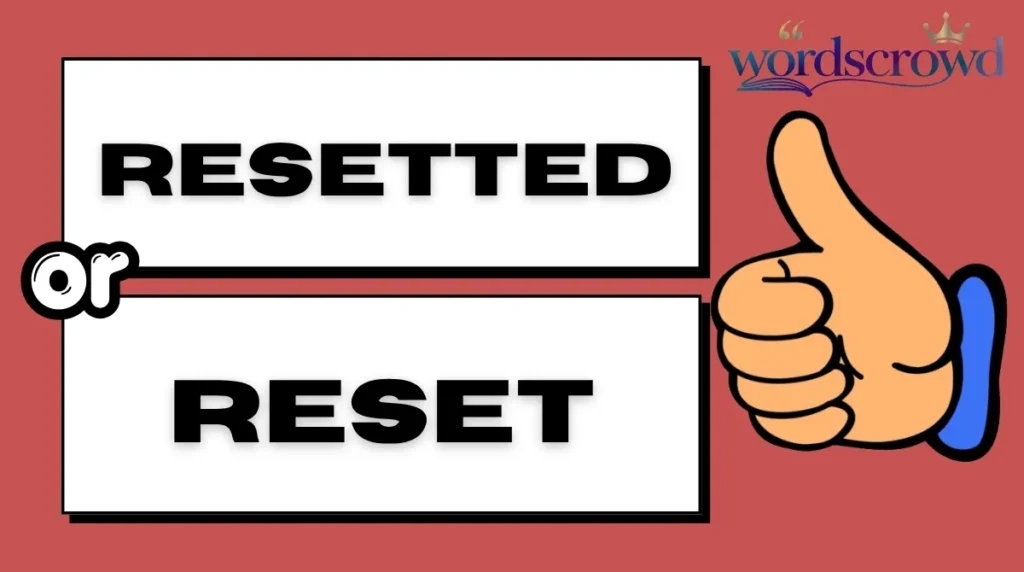
Have you ever written “resetted” and then stopped to wonder whether it actually sounds right? You are not alone.
English has thousands of verbs that form the past tense by adding -ed, so it is perfectly natural to think that reset should become resetted.
But English has a small surprise here: reset stays reset.
The correct past tense of reset is reset, not resetted. The same is true for the past participle. You can say, “I reset the router yesterday” and “I have reset the router several times.” The spelling does not change.
This can feel strange at first because the sentence gives you no visible -ed ending to show that something happened in the past.
However, reset belongs to the same broad pattern as verbs such as set, put, cut, hit, and shut, which also keep the same form in the past.
In this guide, you will learn exactly why “reset” is correct, why “resetted” is generally considered incorrect in standard English, how to use reset in every major tense, how it sounds in American and British English, and how to avoid the mistake in conversation, schoolwork, emails, business writing, and professional communication.
Quick Answer
Reset is correct. Resetted is not the standard past tense of reset.
- Present: I reset the device every week.
- Past: I reset the device yesterday.
- Past participle: I have reset the device already.
- Continuous: I am resetting the device now.
The verb reset keeps the same form for the base verb, simple past, and past participle.
Reset vs. Resetted: Comparison Table
| Feature | Reset | Resetted |
|---|---|---|
| Standard English | ✅ Correct | ❌ Generally incorrect |
| Base form | ✅ reset | ❌ |
| Simple past | ✅ reset | ❌ resetted |
| Past participle | ✅ reset | ❌ resetted |
| Present participle | resetting | ❌ |
| Part of speech | Verb; also noun | Not standard as the past form |
| Meaning | Set again, restore, adjust, or restart | Intended to mean “reset” |
| Pronunciation | /ˌriːˈset/ | Not normally used in standard English |
| Formal writing | ✅ Use | ❌ Avoid |
| Academic writing | ✅ Use | ❌ Avoid |
| Business writing | ✅ Use | ❌ Avoid |
| Everyday conversation | ✅ Use | ❌ Avoid |
| US English | ✅ | ❌ |
| UK English | ✅ | ❌ |
| Past example | “I reset the password.” | “I resetted the password.” ❌ |
| Past participle example | “She has reset the timer.” | “She has resetted the timer.” ❌ |
| Easy rule | Reset → reset → reset | Do not add -ed |
Quick rule: If you are talking about the past, do not automatically add -ed to reset. Say reset.
What Does “Reset” Mean?
Reset is a verb meaning to set something again, return something to a previous or desired state, adjust a setting, or make something ready to operate again.
Modern English uses reset in many contexts.
For example:
- Technology: reset a phone or router
- Settings: reset a password or thermostat
- Machines: reset a control
- Time: reset a clock or timer
- Medicine: reset a broken bone
- Figurative language: reset your priorities or mindset
- Business: reset expectations or strategy
- Sports: reset after a poor performance
Merriam-Webster defines reset as setting something again or anew and also records uses involving changing a reading or setting. Its entry gives reset as the past form and resetting as the -ing form.
Oxford likewise lists the forms reset – reset – reset, with resetting as the present participle.
Examples of “Reset”
- Please reset the router.
- I reset the router yesterday.
- She has reset her password.
- We need to reset the timer.
- The technician reset the machine.
- He wants to reset his priorities.
- The alarm was reset after the inspection.
Notice that the verb itself does not tell you whether the action is happening now or happened in the past. Context and auxiliary verbs do that job.
Why Is “Reset” the Correct Past Tense?
The simplest explanation is that reset is an irregular verb with an unchanged past form.
Many English verbs are regular:
- walk → walked
- work → worked
- clean → cleaned
- open → opened
- repair → repaired
Because this pattern is extremely common, learners naturally expect:
reset → resetted
But English does not work that way for every verb.
Some verbs keep the same spelling in their base and past forms:
- set → set
- put → put
- cut → cut
- hit → hit
- shut → shut
- let → let
- reset → reset
The verb reset is closely connected to set, and its unchanged form follows that pattern.
The Three Main Forms
The easiest way to understand the verb is to memorize its three principal forms:
| Verb form | Correct form |
|---|---|
| Base form | reset |
| Simple past | reset |
| Past participle | reset |
| Present participle | resetting |
So:
reset → reset → reset → resetting
Not:
reset → resetted → resetted
That is the key grammar rule.
What Does “Resetted” Mean?
Resetted is the form people sometimes create when they apply the regular -ed rule to reset.
In standard edited English, it should normally be treated as an incorrect or nonstandard formation, not as the correct past tense of reset.
For example:
❌ I resetted my phone yesterday.
Correct:
✅ I reset my phone yesterday.
Similarly:
❌ The administrator has resetted the account.
Correct:
✅ The administrator has reset the account.
The fact that you may occasionally encounter resetted online does not make it the preferred form in standard English. For school assignments, professional emails, reports, documentation, websites, and formal writing, use reset.
Cambridge Dictionary explicitly lists reset as both the past tense and past participle, while Oxford gives the same verb pattern.
Why Do People Say “Resetted”?
There is a very understandable reason.
English learners often learn a useful rule:
For many regular verbs, add -ed to form the simple past.
For example:
- reset? → resetted?
- restart → restarted
- update → updated
- repair → repaired
- restart → restarted
The problem is that reset looks like a modern technical verb, and many people assume it behaves like newer regular verbs.
There is also a visual reason. The word reset ends in set, and the familiar verb set does not change in the past:
- I set the alarm.
- Yesterday, I set the alarm.
- I have set the alarm.
Because reset contains set, the same unchanged pattern applies:
- I reset the alarm.
- Yesterday, I reset the alarm.
- I have reset the alarm.
A Useful Pattern
Think:
SET does not become SETTED.
Therefore:
RESET does not become RESETTED.
That is not a perfect rule for every word in English, but it is an excellent practical memory aid for this one.
How to Pronounce “Reset”
The pronunciation of reset is generally the same whether it is used in the present, simple past, or past participle.
Oxford gives the pronunciation as approximately /ˌriːˈset/.
The important point is that the past tense does not receive an extra -ed sound.
Compare:
- Present: reset
- Past: reset
- Past participle: reset
- Continuous: resetting
For example:
“I reset the password yesterday.”
The word reset is still pronounced as reset. You do not pronounce an imaginary -ed ending.
How “Reset” Works in Different Tenses
One of the best ways to master resetted or reset is to see the verb in different grammatical structures.
Simple Present
Use reset for habits, routines, facts, and repeated actions.
- I reset my alarm every night.
- We reset the system after each test.
- They reset the machine every morning.
With third-person singular subjects, the form becomes resets:
- She resets the timer.
- He resets his password regularly.
- The program resets automatically.
Simple Past
Use reset for an action completed in the past.
- I reset the router last night.
- She reset the password yesterday.
- We reset the clock before the meeting.
- The technician reset the system.
This is where people often incorrectly write resetted.
Present Perfect
Use has/have + reset.
- I have reset the device.
- She has reset her password.
- They have reset the system.
- We have reset the settings.
Not:
❌ I have resetted the device.
Past Perfect
Use had + reset.
- I had reset the computer before the technician arrived.
- She had reset the timer before the race began.
- They had reset the system before testing it.
Future
Use will + reset.
- I will reset the router tonight.
- We will reset the settings tomorrow.
- The technician will reset the machine.
Present Continuous
Here the verb does change:
reset → resetting
- I am resetting the device.
- She is resetting the password.
- They are resetting the system.
Notice the difference:
Past: reset
Continuous: resetting
That distinction is important.
Reset Verb Forms at a Glance
| Tense/Form | Example |
|---|---|
| Base | I need to reset it. |
| Simple present | I reset it regularly. |
| Third-person present | She resets it regularly. |
| Simple past | I reset it yesterday. |
| Past participle | I have reset it. |
| Past perfect | I had reset it already. |
| Future | I will reset it tomorrow. |
| Present continuous | I am resetting it now. |
| Past continuous | I was resetting it when you called. |
| Future continuous | I will be resetting it later. |
| Gerund | Resetting the device may solve the problem. |
Key Differences Between “Reset” and “Resetted”
The difference is actually simple.
1. “Reset” is the standard form
Use reset as the base form, past tense, and past participle.
2. “Resetted” is not the standard past tense
Do not use resetted when writing standard English.
3. The meaning is not different
This is not a situation like affect vs. effect, where two legitimate words have different meanings.
There is no standard-English meaning distinction between reset and resetted.
Instead, the issue is primarily verb form.
4. Context shows the tense
Compare:
I reset my password every month.
This is present tense.
I reset my password yesterday.
This is past tense.
I have reset my password twice.
This is present perfect.
The spelling remains the same, but the surrounding grammar makes the tense clear.
5. “Resetting” is the correct -ing form
When you need the progressive form, use:
resetting
not:
❌ reseting
So the complete pattern is:
reset → reset → reset → resetting
Is “Reset” a Regular or Irregular Verb?
In standard grammar descriptions, reset is treated as an irregular verb because its past tense does not follow the regular -ed pattern.
A regular verb normally behaves like:
work → worked → worked
But reset behaves like:
reset → reset → reset
This is sometimes described as an unchanged, zero-change, or invariant verb pattern.
You do not need to memorize the terminology to use the verb correctly.
Just remember the form.
Compare These Verbs
| Base | Past | Past Participle |
|---|---|---|
| work | worked | worked |
| play | played | played |
| open | opened | opened |
| set | set | set |
| put | put | put |
| cut | cut | cut |
| hit | hit | hit |
| reset | reset | reset |
The pattern makes reset much easier to remember.
Real-Life Examples of “Reset”
Here are more than 20 original examples across everyday, professional, academic, and digital contexts.
Everyday Conversation
- I reset my alarm after realizing I had set it for the wrong time.
- She reset the kitchen timer because dinner needed another ten minutes.
- I forgot the password, so I reset it this morning.
- We reset the clock when we arrived at the new time zone.
Technology
- I reset the router, and the internet started working again.
- The technician reset my laptop before checking the software.
- Have you reset the device since installing the update?
- The phone reset itself after the battery problem.
Business
- The manager reset the team’s priorities after reviewing the new targets.
- We reset our expectations after receiving the latest sales figures.
- The company has reset its strategy for the next quarter.
- Our team reset the project timeline after the supplier reported a delay.
Professional Email
- I reset the account password and confirmed that the login now works.
- The system has been reset and is ready for another test.
- We reset the meeting schedule to accommodate the new deadline.
School and Academic Writing
- The student reset the calculator before beginning the experiment.
- The researcher reset the equipment before collecting the next set of measurements.
- After the error occurred, the technician reset the instrument.
Social Media
- Sometimes you just need to reset and start again.
- I took a weekend off to reset my mind.
- New week, new goals, time to reset.
Workplace Conversation
- Can you reset the printer before the presentation starts?
- I already reset the system, so try logging in again.
- We reset the plan after the client changed the requirements.
Figurative Use
- After a stressful month, she decided to reset her priorities.
- The short vacation helped me reset mentally.
- The team needed a chance to reset after the disappointing result.
Common Mistakes With “Resetted”
Mistake 1: Adding -ed to the Past Tense
❌ I resetted my phone yesterday.
Why is it wrong?
Because reset already has an unchanged past form.
Correct:
✅ I reset my phone yesterday.
Mistake 2: Using “Resetted” After “Have”
❌ I have resetted the router.
The present perfect requires the past participle. The past participle of reset is reset.
Correct:
✅ I have reset the router.
Mistake 3: Using “Resetted” After “Had”
❌ She had resetted the account before the meeting.
Correct:
✅ She had reset the account before the meeting.
Mistake 4: Confusing “Reset” and “Resetting”
❌ I am reset the computer now.
Correct:
✅ I am resetting the computer now.
After am/is/are in a progressive construction, use the -ing form.
Mistake 5: Writing “Reseting”
❌ I am reseting the device.
Correct:
✅ I am resetting the device.
The final consonant is doubled:
reset → resetting
Mistake 6: Assuming Every Verb Takes -ed
The rule “add -ed for the past” works for regular verbs, but English contains many irregular verbs.
Compare:
- walk → walked
- call → called
- clean → cleaned
- reset → reset
- set → set
- put → put
Learning common irregular patterns is more useful than trying to force every verb into one rule.
“Reset” in Professional and Academic Writing
If you are writing a report, application, essay, business email, technical manual, or academic paper, use reset.
For example:
The device was reset before the second experiment.
This is clear, concise, and grammatically standard.
Avoid:
The device was resetted before the second experiment.
The same principle applies to workplace communication:
I reset the account and sent you the updated login instructions.
This sounds natural and professional.
Why Correct Verb Forms Matter
A single incorrect verb form may not prevent readers from understanding you, but repeated grammar errors can affect how your writing is perceived.
In professional English, especially in technical documentation or formal communication, consistency and accuracy matter.
Reset is the safe choice in every standard variety of English.
Is “Reset” the Same in American and British English?
Yes.
There is no major US-versus-UK difference here.
Both American English and British English use:
reset – reset – reset
Cambridge lists the same past and past-participle form for its UK and US entries.
Oxford also gives reset as the past simple and past participle.
So you do not need to choose between reset and resetted based on geography.
American English
I reset the router yesterday.
British English
I reset the router yesterday.
The verb form is the same.
What About Formal vs. Informal English?
This is not really a formal-versus-informal choice.
You should not think:
“Resetted is informal, while reset is formal.”
That would give the wrong impression.
The better rule is:
Use reset in standard English regardless of whether the context is formal or informal.
You can use reset in:
- a text message
- a casual conversation
- a university essay
- a business report
- a technical manual
- an email
- a news article
- a formal presentation
For example:
Casual:
I reset my phone. It works now.
Professional:
The device was reset and tested before delivery.
Both use the same correct verb form.
The Grammar Behind “Reset”
Understanding the parts of speech makes this even clearer.
Verb
Reset is primarily a verb.
Please reset the machine.
Noun
Reset can also function as a noun.
The system needs a reset.
Here, reset is not a past tense at all. It is a noun describing the act or process of resetting.
Adjective
In some contexts, reset can appear as a participial adjective:
The reset device was ready for testing.
However, context determines the grammatical role.
Present Participle
The -ing form is:
resetting
She is resetting the computer.
Third-Person Singular
In the simple present:
reset → resets
He resets the machine every Friday.
This is one place where the form does change.
Does “Reset” Have a Past Tense?
Yes.
This is one of the most important points.
Some learners mistakenly think that because reset looks identical in the present and past, it does not technically have a past tense.
It does.
The simple past form is reset.
For example:
Today I reset the clock.
Yesterday I reset the clock.
The verb’s spelling is identical, but the grammatical tense is different.
The time expression today/yesterday and the sentence context help establish the tense.
Cambridge explicitly identifies reset as the past tense and past participle.
How to Tell Whether “Reset” Is Present or Past
When the form does not change, look at the surrounding words.
Look for time expressions
I reset the password every month.
Present.
I reset the password yesterday.
Past.
Look at auxiliary verbs
I have reset the password.
Present perfect.
I had reset the password.
Past perfect.
I will reset the password.
Future.
Look at the wider conversation
“Why isn’t the router working?”
“I reset it ten minutes ago.”
The phrase ten minutes ago makes the past meaning clear.
Memory Tricks for “Resetted or Reset”
If you frequently forget the correct form, use one of these simple tricks.
Memory Trick 1: Remember “Set”
Think:
Set never becomes setted.
Therefore:
Reset never becomes resetted.
Memory Trick 2: Three Resets
Memorize:
Reset – Reset – Reset
Base → Past → Past participle.
Memory Trick 3: “No Extra ED”
Think:
Reset needs no extra ED.
When you are talking about the past, do not add -ed.
Memory Trick 4: The “Set Family”
Remember this group:
- set → set
- reset → reset
- upset → upset
The unchanged pattern can help you recognize similar forms.
Memory Trick 5: Use a Past-Time Word
If you are unsure, make a sentence with yesterday:
Yesterday, I reset it.
If resetted sounds tempting, remember that the correct sentence still uses reset.
Is “Resetted” Ever Acceptable?
For standard modern English, especially in edited writing, the practical answer is no: use reset instead.
You may encounter resetted in:
- user-generated posts
- forums
- informal online writing
- learner writing
- software-related discussions
- typos
- nonstandard usage
Seeing a form online does not automatically make it standard English.
Language changes over time, and real-world usage can be messy. But when you need a reliable form for an essay, exam, professional email, website, report, or formal document, reset is the correct choice.
Best practice: If you are writing for a general English-speaking audience, choose reset every time you need the past tense or past participle.
Historical Note: Where Does “Reset” Come From?
The verb reset is built from re-, meaning roughly “again” or “back,” plus set.
The idea is therefore straightforward:
re + set = set again
The word has a much longer history than its modern association with computers and smartphones might suggest.
Merriam-Webster records the first known use of reset in the sense listed in its dictionary as dating to 1628.
Today, however, the word is strongly associated with technology:
- reset a password
- reset a phone
- reset a router
- reset a computer
- reset a device
- reset a timer
The figurative meaning has also become common:
- reset your priorities
- reset your expectations
- reset your mindset
- reset your routine
- reset after a difficult experience
Common Collocations With “Reset”
Learning common word combinations can make correct usage feel natural.
Technology
- reset a password
- reset a device
- reset a phone
- reset a router
- reset a computer
- reset an account
- reset the system
- reset the settings
Time and Controls
- reset the clock
- reset the timer
- reset the thermostat
- reset the controls
- reset the counter
Business
- reset expectations
- reset priorities
- reset strategy
- reset targets
- reset the schedule
- reset the timeline
Figurative English
- reset your mindset
- reset your routine
- reset your goals
- reset emotionally
- reset mentally
- reset after a setback
These combinations are useful because they let you see how native speakers naturally use the verb.
“Reset” in Passive Voice
The passive voice is another place where learners sometimes accidentally write resetted.
Remember that passive constructions use the past participle.
Because the past participle is reset, say:
The computer was reset.
Not:
The computer was resetted.
More examples:
- The router was reset.
- The account was reset.
- The timer was reset.
- The system has been reset.
- The machine had been reset before testing.
The pattern is:
was/were + reset
or:
has/have/had been + reset
“Reset” in Questions
Questions do not change the past form.
Present
Do you reset the machine every morning?
Past
Did you reset the machine yesterday?
Notice the important grammar point:
After did, use the base form:
Did you reset it?
Not:
❌ Did you resetted it?
The auxiliary did already carries the past tense.
Present Perfect
Have you reset the password?
Past Perfect
Had you reset the device before restarting it?
“Reset” in Negative Sentences
The same principle applies to negatives.
Present
I do not reset the system often.
Past
I did not reset the system yesterday.
Not:
❌ I did not resetted the system yesterday.
After did not, use the base form reset.
Present Perfect
I have not reset the device yet.
Past Perfect
I had not reset the system before the test.
A Simple Decision Guide
When you are unsure about resetted or reset, follow these steps.
- Are you using the verb “reset”?
- Yes → continue.
- Are you talking about a completed past action?
- Use reset.
- Are you using “have,” “has,” or “had”?
- Use reset.
- Are you using “am,” “is,” “are,” “was,” or “were” for a continuous action?
- Use resetting.
- Are you using “did” or “did not”?
- Use reset.
- Are you tempted to write “resetted”?
- Stop and change it to reset.
People Also Ask: Resetted or Reset FAQs
Is “resetted” grammatically correct?
No. Reset is the standard past tense and past participle of the verb reset. In standard English writing, use reset, not resetted.
What is the past tense of reset?
The past tense is reset.
Yesterday, I reset my password.
The spelling does not change.
What is the past participle of reset?
The past participle is also reset.
I have reset the device.
Can I say “I resetted my phone”?
It is best to avoid it. The standard form is:
I reset my phone.
Why doesn’t reset become resetted?
Because reset is an irregular, unchanged-form verb. It follows a pattern similar to set → set rather than regular verbs such as walk → walked.
Is “reset” the same in British and American English?
Yes. Both British and American English use reset as the past tense and past participle. Cambridge lists the same form for its UK and US pronunciation entries.
Is “resetting” correct?
Yes. Resetting is the correct present participle and gerund.
I am resetting the router.
Be careful not to write reseting.
What is the difference between reset and resetting?
Reset is the base, simple past, and past participle form. Resetting is the -ing form used in continuous tenses and as a gerund.
I reset it yesterday.
I am resetting it now.
Is reset a regular or irregular verb?
Reset is generally treated as an irregular verb because its past and past participle forms do not take the regular -ed ending. The principal forms are reset–reset–reset.
Final Verdict: Resetted or Reset?
If you only remember one thing from this article, remember this:
The correct past tense of “reset” is “reset,” not “resetted.”
Use:
- I reset the computer yesterday. ✅
- She has reset the password. ✅
- We had reset the system before testing. ✅
- The technician reset the machine. ✅
- I am resetting the router now. ✅
Avoid:
- I resetted the computer yesterday. ❌
- She has resetted the password. ❌
- We had resetted the system. ❌
- I am reseting the router. ❌
The easiest pattern to memorize is:
Reset → Reset → Reset → Resetting
The first three forms stay the same. Only the -ing form changes.
So, when someone asks “resetted or reset?”, the answer is clear: choose reset. Whether you are writing a school essay, sending a business email, documenting software instructions, or simply talking about your phone, reset is the standard English form.
One final memory line:
You can set it, you can reset it, and you can reset it again—but you don’t “resetted” it.
That simple rule will keep your English accurate in both everyday conversation and professional writing.

Elon Parker is a dedicated writer at Wordscrowd, creating clear, informative, and engaging content for readers.
With a focus on useful information, Elon aims to make every article simple, reliable, and easy to understand.