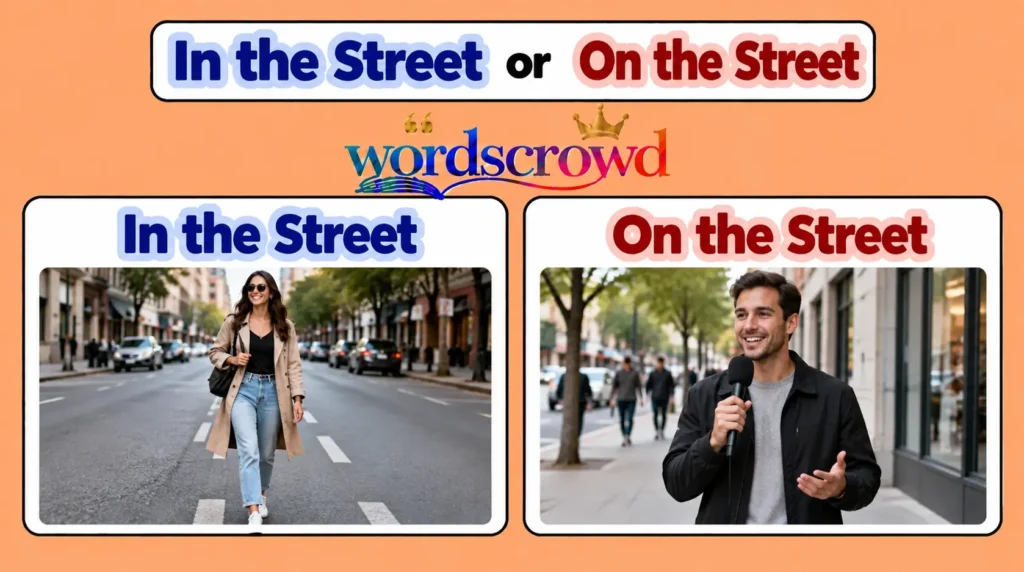
Should you say “in the street” or “on the street”? Both phrases are grammatically correct, but they do not always describe exactly the same situation.
That small preposition—in or on—can change the mental picture your sentence creates.
This is why the choice can feel confusing. English speakers use on the street very often when talking about a street as a location, address, or general place.
In the street, however, is also natural, especially when someone or something is physically within the roadway or when British English usage is involved.
For example, compare these sentences:
- I saw Sarah on the street.
- The children were playing in the street.
Both are correct. The first usually presents the street as a general location. The second emphasizes the children being physically in the roadway or street area.
So, is in the street or on the street correct? Both are correct, but the best choice depends on what you mean and, in some cases, where you use English.
This guide explains the difference clearly, including grammar, meaning, American and British usage, addresses, everyday conversation, formal writing, common mistakes, and more than 20 real-life examples.
Quick Answer
“On the street” is usually the safer and more common choice when you mean located somewhere along a street or at a particular street address.
“In the street” is also correct when you mean physically within the street or roadway, especially when contrasting the street with the sidewalk or pavement.
The easiest rule
On the street = along or at a street.
In the street = physically within the street/roadway.
However, this is a useful guideline rather than an absolute rule. Regional English, especially British English, allows in the street in situations where American English may prefer on the street.
In the Street or On the Street: Comparison Table
| Feature | In the street | On the street |
|---|---|---|
| Basic idea | Inside or within the street area | Located along or at a street |
| Part of speech | Prepositional phrase | Prepositional phrase |
| Main preposition | In | On |
| Common meaning | Physically within the roadway/street | At or along the street |
| Example | The children were playing in the street. | I met him on the street. |
| Address use | Less common in standard address expressions | Very common |
| American English | Correct, but often more specific | Very common |
| British English | Very natural in many contexts | Also common |
| Physical location | Strong emphasis on being inside the street area | General location |
| Formal writing | Correct when the meaning requires it | Common and natural |
| Everyday conversation | Common in specific contexts | Extremely common |
| Typical contrast | Street vs sidewalk | Street as a location |
| Example with address | Less natural: She lives in the street. | Natural: She lives on Oak Street. |
| Example with roadway | Natural: A car stopped in the street. | Possible, but less precise for this meaning |
| Common mistake | Assuming “in” is always wrong | Assuming “on” always means physically standing on the road |
| Best memory aid | In = inside the street area | On = along/at the street |
What Does “On the Street” Mean?
On the street is one of the most common English expressions for describing a location associated with a street.
It can mean that someone is at, along, or somewhere on a particular street. It does not necessarily mean that the person is standing directly on the asphalt.
For example:
I saw my neighbor on the street this morning.
The sentence normally means that the speaker encountered the neighbor somewhere along the street. The person might have been walking on a sidewalk, entering a shop, standing outside a building, or simply somewhere in the street area.
When should you use “on the street”?
Use on the street when you are talking about:
- A general location
- A person’s whereabouts
- A street address
- A business location
- Something situated along a street
- A person encountered while out in public
- Street activity in a general sense
Examples
- She lives on King Street.
- There is a bakery on this street.
- I ran into Tom on the street.
- The hotel is on Main Street.
- We found a small café on the next street.
In these examples, on treats the street as a line, route, or surface along which places and people are located.
“On the street” for addresses
This is one of the clearest situations where on is preferred.
I live on Green Avenue.
Their office is on Park Road.
The restaurant is on King Street.
You would normally say on when giving the name of a street.
However, there is an important distinction between a street name and a complete address:
I live on Oak Street.
I live at 25 Oak Street.
The preposition at is generally used for a specific address, while on identifies the street.
“On the street” does not necessarily mean “on the road”
Consider:
I saw David on the street.
David could have been walking on the sidewalk.
Now compare:
David was standing in the street.
This strongly suggests that David was physically within the roadway or street itself.
That difference is subtle but important.
What Does “In the Street” Mean?
In the street generally emphasizes physical position within the street area, especially the roadway.
Imagine looking down from above. If someone is standing between the curbs where vehicles normally travel, in the street is a natural description.
For example:
A dog was lying in the street.
The sentence creates a picture of the dog being physically in the roadway.
Another example:
The children were playing in the street.
Here, the phrase highlights the physical space occupied by the children.
When should you use “in the street”?
Use in the street when the meaning involves:
- Being physically inside the roadway
- Something occupying the street
- An object blocking traffic
- People playing or standing in the roadway
- A physical event happening within the street
- A contrast between the street and the sidewalk
Examples
- There was a fallen tree in the street.
- A cyclist stopped in the street.
- Someone left a box in the street.
- The children were playing in the street.
- A large hole appeared in the street.
The word in helps create the idea of something being contained within a space.
A useful contrast
Consider this pair:
The woman was walking on the street.
This sounds like a general statement about her location, although many speakers would more naturally say on the sidewalk if that is what they mean.
Now:
The woman was standing in the street.
This gives a much stronger impression that she was actually standing in the roadway.
That is why in can carry a more physical meaning.
In the Street or On the Street: The Key Difference
The difference becomes much easier when you stop thinking about in and on as interchangeable prepositions.
Think about the picture each one creates.
“On the street” focuses on location
On the street often identifies where something or someone is located without emphasizing the exact physical position.
I met Emma on the street.
The important information is that the meeting happened somewhere along the street.
“In the street” focuses on physical position
In the street often tells us that something is physically within the street itself.
A car broke down in the street.
The car is occupying the roadway, potentially affecting traffic.
Compare these sentences
There is a restaurant on the street.
The restaurant is located along that street.
There is a table in the street.
The table is physically occupying the street.
The preposition changes the image dramatically.
Why Do People Confuse “In” and “On”?
The confusion comes partly from the fact that English prepositions do not always follow simple logical rules.
English learners often learn:
- in = inside
- on = touching a surface
That rule is useful, but it is not enough for location expressions.
We say:
- in a room
- in a box
- in a building
But we also say:
- on a street
- on a road
- on an avenue
- on a highway
A street is not literally a flat surface in every context, yet English commonly uses on to describe someone’s location relative to a street.
Prepositions are strongly influenced by conventional usage, meaning the combinations that English speakers have traditionally adopted.
That is why learning common phrases as complete expressions is often more effective than trying to translate every preposition word-for-word.
Grammar: Why “In” and “On” Work Differently
Both in and on are prepositions.
A preposition connects a noun or noun phrase to another part of a sentence and expresses a relationship such as location, time, direction, or position.
In these phrases:
- in the street
- on the street
the noun phrase is the street.
The preposition tells us how the subject relates spatially to the street.
“In” suggests containment or inclusion
The basic spatial idea of in is that something exists within a defined area.
Examples:
- in the room
- in the garden
- in the building
- in the street
With in the street, the street is being viewed as an area or physical space.
“On” suggests a surface, route, or position along something
The basic idea of on often involves contact with a surface or position along a route or line.
Examples:
- on the table
- on the wall
- on the road
- on the street
With on the street, the street can be viewed as a route or location along which people, buildings, and businesses are situated.
Prepositions are not mathematical formulas
One of the biggest mistakes English learners make is assuming that every location must follow one simple rule.
English does not work that way.
Native usage determines many preposition choices.
For example:
- on the bus
- in the car
- on the train
- in a taxi
These combinations make sense only when you understand how English conventionally describes different spaces and forms of transport.
The same principle applies to in the street and on the street.
American English vs British English
Regional usage matters here.
Both American English and British English use on the street, particularly when referring to a street as a location or street address.
However, in the street can be especially natural in British English in situations where American speakers might be more likely to use on the street or another expression depending on context.
For example, British English commonly uses:
The children were playing in the street.
This is completely natural.
American English also uses in the street, especially when the physical roadway is intended:
The children were playing in the street.
So this is not a simple case of “in = British” and “on = American.”
Both varieties use both expressions.
The important regional point
The difference is more about context and conventional phrasing than a strict US-versus-UK grammar rule.
If you are writing for an international audience, on the street is generally a safe choice for general location, while in the street is excellent when you want to emphasize physical presence within the street.
Is “In the Street” Grammatically Correct?
Yes.
“In the street” is grammatically correct English.
It is especially natural when something is physically located within the street or roadway.
Examples:
- There is a car in the street.
- The children were playing in the street.
- A cyclist fell in the street.
- A branch is lying in the street.
It can also occur in established expressions and regional varieties of English.
The important point is that in the street is not a grammatical error.
Is “On the Street” Grammatically Correct?
Yes.
“On the street” is also fully grammatical and extremely common.
Examples:
- She lives on Maple Street.
- I met him on the street.
- There is a pharmacy on this street.
- We found a quiet café on the street.
In many situations, particularly when referring to an address or a general street location, on the street is the natural choice.
When “On the Street” Is the Better Choice
Choose on the street when you mean:
1. A street address
My office is on Washington Street.
2. A business located along a street
There is a new bookstore on this street.
3. A general public location
I saw your brother on the street yesterday.
4. Something located along a street
Several trees were planted on the street.
5. A person’s general whereabouts
She is somewhere on the street.
The exact meaning depends on the surrounding sentence, but on often gives a broad location rather than a precise physical position.
When “In the Street” Is the Better Choice
Choose in the street when you want to emphasize physical presence within the roadway.
1. Something blocks traffic
A truck is parked in the street.
2. Something has fallen into the roadway
A branch fell in the street.
3. People are physically in the roadway
The protesters were standing in the street.
4. Children are playing in the roadway
The children were playing in the street.
5. An object occupies the street
Someone left a chair in the street.
In these examples, in gives the reader a stronger spatial image.
25 Real-Life Examples of “In the Street” and “On the Street”
Here are practical examples from everyday speech, school, work, business, social media, and professional writing.
Everyday Conversation
1. “I saw your sister on the street this morning.”
The phrase gives her general location.
2. “Why is there a bicycle in the street?”
The bicycle is physically in the roadway.
3. “There’s a great coffee shop on the street behind the library.”
The shop is located along that street.
4. “A dog suddenly ran into the street.”
Here, into indicates movement from another place into the street.
5. “Be careful—the road is blocked, and there’s a truck in the street.”
The truck occupies the roadway.
School and Academic Contexts
6. “The students observed traffic patterns on the street outside the school.”
This describes the location generally.
7. “The researchers counted the number of vehicles traveling on the street.”
The street is treated as a route used by vehicles.
8. “The accident created a large obstruction in the street.”
The obstruction physically occupies the roadway.
Business and Professional Writing
9. “Our new branch is located on King Street.”
This is a standard location statement.
10. “Several customers reported standing water in the street after the storm.”
The water is physically present in the roadway.
11. “The company operates a small office on Market Street.”
The street identifies the office’s location.
12. “A delivery vehicle was temporarily stopped in the street.”
The vehicle is physically in the roadway.
Email Writing
13. “Our building is on Green Avenue, next to the public library.”
This is natural address-related language.
14. “Please note that construction equipment may be placed in the street tomorrow.”
Here, the physical roadway is the focus.
Text Messages
15. “I’m on the street. Where are you?”
This means the person is outside or somewhere along the street.
16. “There’s a huge puddle in the street.”
The puddle occupies the roadway.
Social Media
17. “Found the cutest little bookstore on this street! 📚”
The phrase identifies the general location.
18. “Street festival vibes! Everyone is dancing in the street. 🎉”
The people are physically using the street as an event space.
Professional and Formal Writing
19. “The proposed development is located on Riverside Road.”
The street name identifies the location.
20. “Temporary barriers will be installed in the street during construction.”
The barriers will occupy the roadway.
Natural Daily English
21. “I left my umbrella somewhere on the street.”
The phrase gives a broad location.
22. “There was broken glass in the street.”
The glass is physically on or within the roadway.
23. “She owns a small apartment on the same street as her parents.”
The apartment is located along that street.
24. “Someone was sitting in the street.”
This strongly suggests the person was actually sitting in the roadway.
25. “We found a nice restaurant on the street near the station.”
The restaurant is situated along the street.
“In the Street” vs “On the Street” With People
This is where the difference becomes especially interesting.
Consider:
I saw John on the street.
This normally means you encountered John somewhere along the street or in the surrounding street area.
Now:
I saw John in the street.
This sounds more specific. It suggests that John was actually within the roadway.
That can make the second sentence sound unusual or alarming depending on context.
For example:
I found my brother on the street.
This could simply mean you encountered him outside.
But:
I found my brother in the street.
The listener may imagine him physically sitting or standing in the roadway.
This is a perfect example of how a tiny preposition can influence the mental picture created by a sentence.
“In the Street” vs “On the Street” for Things
The same distinction applies to objects.
General location
There is a new sign on the street.
The sign is associated with the street.
Physical roadway
There is a large sign in the street.
The sign appears to physically occupy the roadway.
Another pair:
A restaurant is on the street.
The restaurant is located along the street.
A restaurant table is in the street.
The table has been placed physically in the roadway.
The second sentence is much more spatially specific.
What About “On the Street” for Homelessness?
There is another important meaning of on the street.
The phrase can be idiomatic and mean without a permanent home.
For example:
The charity provides meals for people living on the street.
Here, on the street does not simply mean someone is standing on a road. It refers to living without stable housing.
Similarly:
He spent several months on the streets.
The plural form the streets is also common in this sense.
This is an important semantic difference because the phrase has moved beyond simple physical location.
Does “in the street” have the same meaning?
Generally, no.
In the street usually retains its literal spatial meaning.
Therefore:
- living on the street → can mean being homeless
- standing in the street → physically standing in the roadway
Context determines meaning.
Common Mistakes
Mistake 1: Thinking “in the street” is always wrong
Incorrect assumption:
“You must always say on the street.”
That is false.
Correct:
The children were playing in the street.
When the roadway itself is the intended location, in can be exactly right.
Mistake 2: Using “in” for a street address
Less natural:
I live in Green Street.
More natural:
I live on Green Street.
For a named street, on is normally preferred.
For a complete address:
I live at 25 Green Street.
Mistake 3: Assuming “on the street” means directly on the asphalt
Not necessarily.
I met Sarah on the street.
Sarah may have been on the sidewalk.
The phrase often means somewhere along or around the street.
Mistake 4: Confusing “in the street” with “into the street”
These have different functions.
The ball is in the street.
The ball is already there.
The child ran into the street.
The child moved from outside the street to inside it.
Mistake 5: Ignoring context
Instead of asking:
“Which preposition is always correct?”
Ask:
“What location am I trying to describe?”
If the answer is a general street location, choose on in many cases.
If the answer is physically within the roadway, in may be better.
In the Street vs Into the Street
This distinction deserves special attention.
In = location
In the street describes where something is.
The ball is in the street.
Into = movement
Into the street describes movement toward or inside the street.
The ball rolled into the street.
Compare:
- The dog is in the street.
- The dog ran into the street.
The first tells us the dog’s location.
The second tells us how the dog moved.
This is a basic but useful preposition distinction.
In the Street vs On the Street vs At the Street
These three can sometimes confuse learners.
On the street
Used for a general location along a street.
She lives on Pine Street.
In the street
Used for physical presence within the street or roadway.
A car is blocking traffic in the street.
At the street
At the street is less common when simply naming a street location, but at can identify a point or meeting location.
For example:
Meet me at the corner of Pine Street and First Avenue.
Or:
There is a traffic light at the street entrance.
For a complete address, at is standard:
The company is located at 18 Pine Street.
So remember:
on + street name
at + specific address
in + physical street area
These are useful patterns, though actual usage depends on context.
Why “On a Street” Is So Common
English often conceptualizes roads and streets as routes or lines.
Buildings sit along them.
People travel along them.
Businesses are located along them.
That makes on a natural preposition:
- on the street
- on the road
- on the highway
- on the avenue
- on the boulevard
This does not mean the speaker is making a literal claim that a person is standing directly on the road surface.
It is a conventional way of describing a location.
Why “In the Street” Can Sound More Physical
When speakers use in, the street is often treated as an area or bounded space.
That is particularly noticeable when something should not normally be there.
For example:
There is a sofa in the street.
The sentence sounds surprising because the sofa is occupying the roadway.
Compare:
There is a furniture store on the street.
That is completely ordinary.
The choice of preposition therefore helps communicate not only location but also how the speaker conceptualizes that location.
Memory Tricks
Here are several simple ways to remember the difference.
Memory Trick 1: “On = along”
Think:
On the street = along the street.
If you could replace the phrase with along the street, on is often a good choice.
There is a shop on the street.
→ There is a shop along the street.
Memory Trick 2: “In = inside the roadway”
Think of in as placing something inside the physical street space.
The car is in the street.
Picture the car between the curbs.
Memory Trick 3: Addresses usually take “on”
Remember:
I live on Oak Street.
But:
I live at 50 Oak Street.
Memory Trick 4: Ask yourself one question
Before choosing the preposition, ask:
Am I describing the street as a location, or am I putting something physically inside it?
Location → often on
Physical roadway → often in
This simple question solves many cases.
A Quick Decision Guide
When you’re unsure, follow these steps.
Step 1: Is it a street name?
Use on.
The office is on Baker Street.
Step 2: Are you giving a complete address?
Usually use at.
The office is at 42 Baker Street.
Step 3: Are you describing something physically occupying the roadway?
Use in.
A truck is in the street.
Step 4: Are you describing someone’s general location?
Use on in many everyday contexts.
I saw her on the street.
Step 5: Are you describing movement into the roadway?
Use into.
The child ran into the street.
Style and Professional Writing
In professional writing, precision matters more than choosing whichever preposition sounds familiar.
Consider this sentence:
Construction materials will be placed in the street.
This clearly communicates that the materials will occupy the roadway.
Now:
The construction company is located on the street.
This describes the company’s location.
A professional editor should therefore avoid replacing in with on automatically.
The right question is always:
What relationship between the subject and the street does the sentence need to communicate?
Academic writing
Academic writing may use either expression depending on the subject.
Pedestrian activity on the street increased during the study period.
This treats the street as a setting or route.
The researchers recorded several objects left in the street.
This emphasizes physical placement.
Business writing
Business writing commonly uses on for addresses and locations:
Our headquarters are on Jefferson Avenue.
But in remains appropriate for physical conditions:
Temporary equipment may remain in the street during construction.
Are “In the Street” and “On the Street” Interchangeable?
Sometimes, but not always.
They may overlap when describing a broad public location, particularly in conversational English.
However, changing the preposition can change the image.
Compare:
I saw a man on the street.
General location.
I saw a man in the street.
More specific physical location, often suggesting the roadway.
Likewise:
There is a market on the street.
A market is located along the street.
There is a market in the street.
This may suggest that the market itself occupies the roadway, perhaps during a street festival.
Therefore, the expressions are not completely interchangeable.
Which One Sounds More Natural?
For general location, on the street is often the safer choice.
For physical presence within the roadway, in the street is often more precise.
For street names:
on + street name
is the standard pattern.
For specific addresses:
at + street address
is standard.
Quick examples
| Intended meaning | Natural choice |
|---|---|
| Located along Oak Street | on Oak Street |
| At a specific address | at 20 Oak Street |
| Standing in the roadway | in the street |
| General public location | on the street |
| Object blocking traffic | in the street |
| Business location | on the street |
| Movement toward roadway | into the street |
Frequently Asked Questions
Is “in the street” correct English?
Yes. In the street is completely correct. It commonly describes something physically located within the street or roadway, such as a car, object, or person.
Is “on the street” grammatically correct?
Yes. On the street is very common and is especially useful for general locations, street addresses, businesses, and places situated along a street.
Which is correct: “in the street” or “on the street”?
Both are correct. The choice depends on meaning. On the street often indicates a general location or position along a street, while in the street often emphasizes physical presence within the roadway.
Should I say “I live in the street” or “I live on the street”?
Usually say “I live on the street” when referring to a named street:
I live on Main Street.
For a complete address, use at:
I live at 25 Main Street.
Is “in the street” British English?
It can be especially natural in British English, but it is not exclusively British. American English also uses in the street, particularly when referring to something physically in the roadway.
Do Americans say “on the street”?
Yes. On the street is extremely common in American English, particularly for general location and street addresses.
What is the difference between “in the street” and “into the street”?
In the street describes location:
The ball is in the street.
Into the street describes movement:
The ball rolled into the street.
Should I say “on the street” for an address?
For a street name, yes:
She lives on Oak Street.
For a complete address, use at:
She lives at 100 Oak Street.
Is “on the street” always about a physical road?
No. It can have broader or idiomatic meanings. For example, living on the street can refer to homelessness rather than simply standing on a road.
Final Verdict: In the Street or On the Street?
So, in the street or on the street—which one should you use?
The answer is simple: both are correct, but they serve different purposes.
Use on the street when you are talking about a street as a general location, route, or address.
- She lives on King Street.
- I saw him on the street.
- There is a café on this street.
Use in the street when you want to emphasize that someone or something is physically within the street or roadway.
- The children were playing in the street.
- A car stopped in the street.
- There is debris in the street.
And remember a third useful pattern:
- on Oak Street = the street
- at 25 Oak Street = the specific address
- in the street = physically within the street/roadway
- into the street = movement toward or inside the street
The best rule to remember
ON = location along a street.
IN = physical presence within the street.
There is no need to label either expression as “wrong.” Good English depends on meaning, context, regional usage, and conventional grammar. Once you picture what you are trying to describe, choosing between in the street or on the street becomes much easier.

Elon Parker is a dedicated writer at Wordscrowd, creating clear, informative, and engaging content for readers.
With a focus on useful information, Elon aims to make every article simple, reliable, and easy to understand.