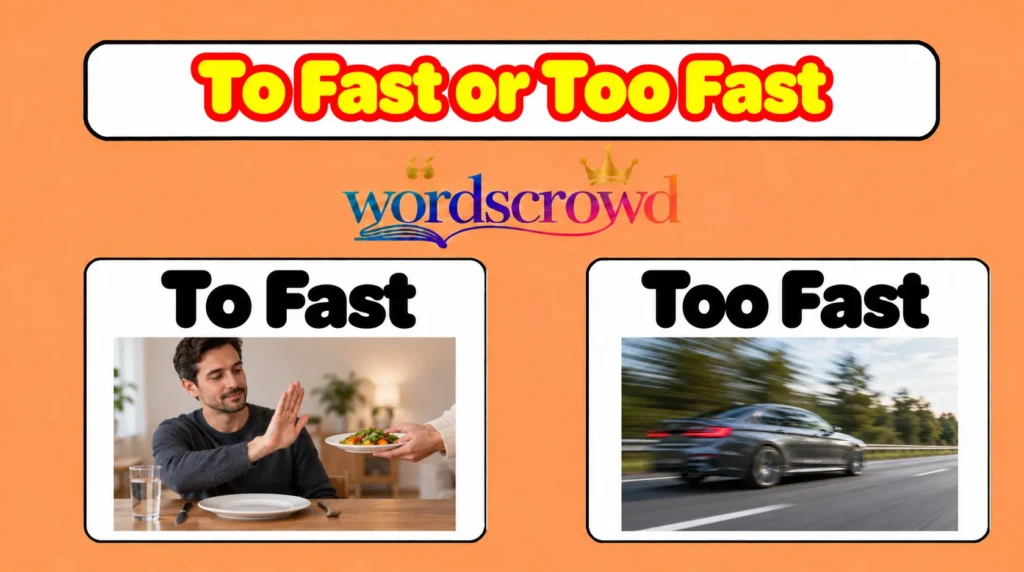
Have you ever written “to fast” and wondered whether it should actually be “too fast”? You are not alone.
These two expressions look almost identical, but the tiny difference between to and too changes the grammar, meaning, and even the entire sentence.
The confusion happens because to and too sound alike in many varieties of English. When we hear someone say “too fast,” there is no visual clue telling us which spelling to choose.
As soon as we write the sentence, however, the difference becomes important.
The good news is simple: “too fast” is usually the phrase you need when you mean “faster than is desirable, safe, reasonable, or necessary.”
For example, “You are driving too fast.” On the other hand, “to fast” can be grammatically correct when fast is being used as a verb, meaning to go without food.
For example, “I decided to fast for one day.”
This guide explains to fast or too fast from every useful angle: meaning, grammar, pronunciation, sentence structure, everyday conversation, formal writing, common mistakes, examples, memory tricks, and the subtle difference between the two expressions.
Quick Answer
“Too fast” is correct when you mean “excessively fast” or “faster than appropriate.”
- Too fast: “The car is going too fast.”
- To fast: “She plans to fast tomorrow.”
So, both can be correct, but they have completely different grammatical jobs and meanings.
Quick tip: If you mean “excessively fast,” use “too fast.” If you mean “to go without eating,” use “to fast.”
To Fast or Too Fast: The Key Difference
| Feature | To fast | Too fast |
|---|---|---|
| Main meaning | To go without food | Faster than desired or appropriate |
| Grammar | to + verb | too + adverb/adjective |
| Part of speech | fast = verb | too = adverb; fast = adverb |
| Pronunciation | Usually /tə fæst/ in connected speech | Usually /tuː fæst/ |
| Example | “I want to fast tomorrow.” | “You are walking too fast.” |
| Common context | Food, fasting, personal practice | Speed, movement, speech, change |
| Meaning of “fast” | Abstain from food | Quickly / at high speed |
| Formal writing | Correct when the intended meaning is fasting | Correct when excessive speed is intended |
| Everyday use | Less common | Very common |
| Common mistake | Using it when “excessively fast” is intended | Writing “to fast” when “too fast” is intended |
| Memory clue | To + verb | Too = more than needed |
| US English | Correct | Correct |
| UK English | Correct | Correct |
The most important point is that these are not alternative spellings of the same expression. They are two different grammatical constructions.
What Does “To Fast” Mean?
To fast means to deliberately avoid eating, usually for a period of time.
Here, fast is a verb.
The word to is the infinitive marker that appears before the base form of a verb:
- to eat
- to sleep
- to walk
- to study
- to fast
Examples of “To Fast”
- “I plan to fast tomorrow.”
- “She wants to fast before the procedure.”
- “They decided to fast for twelve hours.”
- “He chose to fast during the day.”
- “It can be difficult to fast for a long period.”
In each sentence, fast describes an action.
Why Is “To Fast” Grammatically Correct?
English commonly uses to + base verb to create an infinitive.
For example:
I want to learn.
She needs to rest.
They decided to leave.
Similarly:
I want to fast.
Here, fast is a verb, not a description of speed.
That distinction is the key.
The Meaning of “Fast” in “To Fast”
The word fast has several meanings in English.
One meaning is to move quickly:
“The horse runs fast.”
Another meaning is to abstain from food:
“I will fast tomorrow.”
The second meaning is the one used in to fast.
This is why the phrase can initially look confusing. The word fast can function as both an adverb and a verb.
“Fast” as a Verb
When fast means to abstain from food, it can appear in different forms:
- fast
- fasts
- fasted
- fasting
Examples:
- “I fast every Monday.”
- “She fasts regularly.”
- “He fasted yesterday.”
- “They are fasting today.”
So:
“I need to fast.”
is structurally similar to:
“I need to exercise.”
The word to introduces the verb.
When Should You Use “To Fast”?
Use to fast when the sentence means to abstain from food.
Common situations
Personal plans
“I intend to fast tomorrow.”
Religious or cultural contexts
“They decided to fast during the observance.”
Medical contexts
“You may be instructed to fast before certain tests.”
General discussion
“Some people choose to fast for personal reasons.”
The exact reason for fasting can vary, but the grammar remains the same.
Tip: Replace “fast” with another obvious verb. If the sentence still works with to + verb, “to fast” may be correct.
For example:
“I want to fast.”
Compare:
“I want to rest.”
Both have the same basic infinitive structure.
What Does “Too Fast” Mean?
Too fast means faster than is desirable, appropriate, safe, comfortable, or necessary.
In this expression, too is an adverb meaning something like excessively or more than is appropriate.
The word fast describes the speed of an action.
For example:
“You are driving too fast.”
This means:
You are driving at a speed that is higher than is appropriate.
Examples of “Too Fast”
- “You are walking too fast.”
- “The car was moving too fast.”
- “He speaks too fast for me to understand.”
- “The water is flowing too fast.”
- “The project is moving too fast.”
- “She learned the material too fast to remember everything.”
In these sentences, too modifies fast.
Why Does “Too Fast” Mean “Excessively Fast”?
The word too often indicates an amount or degree that goes beyond what is wanted or acceptable.
Compare:
- very fast = at a high speed
- too fast = at an excessively high speed
For example:
“The runner is very fast.”
This is generally positive or neutral.
“The runner is too fast for me.”
This indicates a problem or limitation.
The runner’s speed exceeds what the speaker can comfortably handle.
Very Fast vs. Too Fast
This is an important distinction.
Very fast simply emphasizes speed.
Too fast suggests that the speed has crossed a limit.
Compare:
“The train is very fast.”
The train travels at a high speed.
“The train is too fast for this track.”
The speed is considered excessive for the situation.
Why People Confuse “To” and “Too”
The biggest reason is pronunciation.
In many sentences, to and too can sound similar, especially in natural speech.
For example:
“I want to fast.”
and
“You are too fast.”
When spoken quickly, the distinction between to and too may not be obvious to a learner.
Writing removes that ambiguity.
The Third Word: “Two”
There is also a third homophone:
two = the number 2
So English has three commonly confused words:
- to — preposition or infinitive marker
- too — also / excessively
- two — the number 2
Examples:
“I went to school.”
“The car is too fast.”
“I bought two books.”
They can sound similar, but their meanings and grammatical functions are different.
“To Fast” vs. “Too Fast” in Grammar
The easiest way to understand the difference is to identify what fast is doing.
In “to fast”
fast = verb
to = infinitive marker
Structure:
to + verb
Example:
“She wants to fast.”
Here, fast is the action she wants to perform.
In “too fast”
too = adverb
fast = adverb
Structure:
too + adverb
Example:
“She is walking too fast.”
Here, fast describes how she is walking, while too tells us that the degree of speed is excessive.
Is “Fast” an Adjective or an Adverb?
Fast can function as both an adjective and an adverb, depending on the sentence.
Fast as an adjective
“That is a fast car.”
Here, fast describes the noun car.
Fast as an adverb
“That car moves fast.”
Here, fast describes the verb moves.
Unlike many adverbs, the adverb fast does not normally take the ending -ly when referring to speed.
We say:
“The car moves fast.”
Not:
“The car moves fastly.”
Fast as a verb
“They decided to fast.”
Here, fast means to abstain from food.
This three-way flexibility is one reason the word deserves careful attention.
To Fast or Too Fast: A Simple Sentence Test
When you are unsure which expression to use, ask:
Question 1: Do I mean “abstain from food”?
If yes, use:
to fast
Example:
“I need to fast before the test.”
Question 2: Do I mean “excessively quickly”?
If yes, use:
too fast
Example:
“You are driving too fast.”
Question 3: Can “excessively” replace “too”?
Try replacing the phrase.
“The car is excessively fast.”
If that captures your intended meaning, too fast is probably what you need.
Question 4: Is “fast” an action?
If fast is the action of abstaining from food, use to fast.
Key Differences Between “To Fast” and “Too Fast”
Here is the difference in the simplest possible form:
- To fast = to abstain from eating.
- Too fast = excessively quickly.
- To often introduces a verb.
- Too expresses excess or, in other contexts, “also.”
- Fast is a verb in to fast.
- Fast is normally an adverb in too fast when it describes speed.
- Both expressions are grammatically correct.
- Neither spelling should automatically replace the other.
- The intended meaning determines the correct choice.
- “Too fast” is much more likely when talking about speed.
Remember: The difference is not simply one letter. The grammatical function changes.
To Fast or Too Fast in Everyday English
Talking about driving
“You are going too fast.”
This means the vehicle’s speed is excessive.
You would not normally write:
“You are going to fast.”
That changes the phrase into an infinitive construction and does not fit the intended meaning.
Talking about speaking
“You’re talking too fast.”
The speaker is saying that the other person is speaking at an excessive speed.
Talking about learning
“The class is moving too fast.”
The pace is higher than the student can comfortably follow.
Talking about walking
“You’re walking too fast.”
Again, the problem is excessive speed.
Talking about fasting
“I need to fast before the appointment.”
Here, the meaning has nothing to do with speed.
To Fast or Too Fast in Professional Writing
The same distinction applies in business and professional English.
Professional examples with “too fast”
“The approval process is moving too fast.”
“The team is making decisions too fast without reviewing the data.”
“The system is processing requests too fast for the current monitoring setup.”
Professional examples with “to fast”
“The patient was instructed to fast before the examination.”
“Participants were asked to fast before the scheduled procedure.”
The surrounding context makes the intended meaning clear.
To Fast or Too Fast in Academic Writing
Academic writing often requires careful attention to meaning.
“Too fast”
“The reaction occurs too fast under these conditions to measure manually.”
“The population is changing too fast for the existing model to remain accurate.”
Here, too fast expresses an excessive rate.
“To fast”
“Participants were instructed to fast overnight before the assessment.”
Here, to fast is an infinitive phrase.
The distinction is grammatical, not a matter of American versus British spelling.
To Fast or Too Fast in Emails
Example 1: Workplace email
“I think we’re moving too fast with this proposal.”
The writer means the process is proceeding excessively quickly.
Example 2: Medical instruction
“Please remember to fast before your appointment if instructed to do so.”
Here, to fast means not to eat.
Example 3: Feedback to a colleague
“Could we slow down? We’re moving too fast.”
The phrase refers to speed or pace.
20+ Real-Life Examples of “To Fast” and “Too Fast”
The following examples show how context determines the correct expression.
Everyday Conversation
- “You’re walking too fast. Wait for me.”
- “I need to fast before my appointment.”
- “That motorcycle is going too fast.”
- “She decided to fast for a day.”
- “Don’t read too fast; I want to follow the story.”
School and Study
- “The teacher is speaking too fast for some students.”
- “I need to fast before the medical test.”
- “The lesson moved too fast for me.”
- “He wants to fast tomorrow.”
- “You are writing too fast and making mistakes.”
Business
- “The company is expanding too fast.”
- “We should not make this decision too fast.”
- “The process is moving too fast without enough review.”
- “The employee was instructed to fast before the examination.”
Text Messages
- “U r driving too fast 😂.”
- “I have to fast tomorrow.”
- “Slow down! You’re typing too fast.”
- “I’m going to fast tomorrow.”
This last sentence can be correct if the writer means “I am going to fast tomorrow” = “I am going to abstain from food tomorrow.” The surrounding structure matters.
Social Media
- “Life is moving too fast lately.”
- “Trying to fast for the first time.”
- “This year is going too fast!”
- “I can’t believe how fast time is moving.”
Professional Writing
- “The project is progressing too fast to complete a full review.”
- “Patients may be instructed to fast before certain procedures.”
Academic Writing
- “The process occurs too fast for conventional observation.”
- “Participants were required to fast before testing.”
A Particularly Important Sentence: “I’m Going to Fast”
This sentence deserves special attention because it contains both grammar and meaning.
I’m going to fast tomorrow.
This can be grammatically correct.
Why?
Because going to is a future construction:
am/is/are + going to + base verb
The base verb is fast.
So:
I am going to fast tomorrow.
means:
I intend to abstain from food tomorrow.
Do not confuse this with:
“I’m going too fast.”
That means:
I am moving at an excessive speed.
The difference is substantial.
Compare
I’m going to fast.
= I intend to abstain from food.
I’m going too fast.
= I am moving excessively quickly.
Only one extra o completely changes the meaning.
Common Mistakes With “To Fast” and “Too Fast”
Mistake 1: Writing “to fast” when you mean excessive speed
❌ “You are driving to fast.”
Why is it wrong?
The intended meaning is “You are driving excessively quickly.” Therefore, too is required.
✅ “You are driving too fast.”
Mistake 2: Writing “too fast” when you mean abstaining from food
❌ “I need too fast before the test.”
Why is it wrong?
The intended meaning is an action: to abstain from food.
✅ “I need to fast before the test.”
Mistake 3: Thinking “to” and “too” are interchangeable
They are not.
Compare:
“I want to fast.”
“I am walking too fast.”
The first uses to as part of an infinitive. The second uses too as an adverb indicating excessive speed.
Mistake 4: Adding “-ly” to fast
❌ “He runs too fastly.”
✅ “He runs too fast.”
When fast refers to speed, it commonly functions as an adverb without -ly.
Mistake 5: Assuming “too” always means “excessively”
Too can also mean also.
For example:
“I want to come too.”
Here, too means also.
But in:
“You are driving too fast.”
it means excessively.
Context determines the meaning.
How “Too” Works in English
Understanding too makes “too fast” easier to remember.
Too = excessively
“The soup is too hot.”
“The bag is too heavy.”
“He speaks too quickly.”
“The car is too fast.”
In each case, too suggests that the degree is beyond what is suitable or wanted.
Too = also
“I want one too.”
“She is coming too.”
“I like that movie too.”
So too fast uses the excessive degree meaning of too, not the “also” meaning.
How “To” Works in English
The word to has several grammatical functions.
To as an infinitive marker
“I want to sleep.”
“She hopes to win.”
“They decided to leave.”
“He plans to fast.”
To as a preposition
“I went to school.”
“Give it to me.”
“We traveled to London.”
Therefore, to has a broad grammatical role, while too has a different one.
Pronunciation: “To” vs. “Too”
Pronunciation is one reason learners confuse these words.
“Too”
Too is generally pronounced with a long /uː/ sound:
/tuː/
It sounds like two.
“To”
The pronunciation of to varies according to stress.
When emphasized, it may be pronounced:
/tuː/
In ordinary connected speech, it is often reduced to:
/tə/
For example:
“I want to go.”
The to may sound more like “tuh” in natural speech.
This reduction makes spelling from sound especially difficult for English learners.
A useful writing rule
Don’t decide between to and too by sound alone.
Decide by meaning and grammar.
US English vs. UK English
There is no meaningful American-versus-British spelling difference between to fast and too fast.
Both forms are standard in both varieties.
American English
“You’re driving too fast.”
British English
“You’re driving too fast.”
Likewise:
“I need to fast before the procedure.”
works in both varieties.
The distinction is based on grammar and meaning, not regional English.
Formal vs. Informal Usage
Neither to fast nor too fast is inherently informal.
Both can appear in formal writing.
Formal
“Participants were instructed to fast before testing.”
Formal
“The reaction occurred too fast for accurate manual measurement.”
Informal
“You’re going too fast!”
“I have to fast tomorrow.”
The surrounding sentence and context determine formality.
Historical Background of “Fast”
The word fast has a long history in English and has developed several related meanings over time.
The adjective fast has historically carried meanings connected with firmness, security, and quickness. The idea of being firmly fixed can still be seen in expressions such as hold fast.
The food-related verb fast has a separate historical development associated with abstaining from food. It has been used in English for centuries, especially in religious and cultural contexts.
Modern English therefore inherited several meanings under the same spelling.
This is an example of polysemy: one word can have multiple related or distinct meanings depending on context.
Why Context Matters So Much
Consider this sentence:
“I am going to fast.”
Now consider:
“I am going too fast.”
They differ by only one letter, but they communicate entirely different ideas.
Sentence A
I am going to fast.
Meaning:
I intend to abstain from food.
Sentence B
I am going too fast.
Meaning:
I am moving at an excessive speed.
This is why proofreading matters. A spelling mistake involving to and too can change the meaning of a sentence rather than merely making it look incorrect.
Memory Tricks for “To Fast” vs. “Too Fast”
Trick 1: “Too” has an extra O
Think:
Too = extra
The extra O can remind you that too means more than enough.
too fast = more fast than appropriate
Trick 2: “To” goes before verbs
Remember:
to + action
Examples:
- to run
- to sleep
- to eat
- to fast
If fast is the action of abstaining from food, use to fast.
Trick 3: Replace “too” with “excessively”
Try this:
“The car is too fast.”
Replace too:
“The car is excessively fast.”
The meaning remains.
But:
“I want to fast.”
cannot be replaced with “excessively.”
Trick 4: Think “too much”
Too often signals more than is appropriate:
- too loud
- too cold
- too expensive
- too difficult
- too quickly
- too fast
So:
too fast = more speed than wanted
A Quick Decision Guide
When you’re writing to fast or too fast, follow these steps.
- Ask what you mean by “fast.”
- If it means abstain from food, choose to fast.
- If it means move or happen at excessive speed, choose too fast.
- If you mean “excessively,” use too.
- If to introduces the verb fast, use to.
- Read the entire sentence again to make sure the meaning is clear.
Examples
I need ___ fast before the appointment.
Answer: to
“I need to fast before the appointment.”
You’re driving ___ fast.
Answer: too
“You’re driving too fast.”
The process is moving ___ fast.
Answer: too
“The process is moving too fast.”
They decided ___ fast tomorrow.
Answer: to
“They decided to fast tomorrow.”
Frequently Asked Questions
Is “too fast” grammatically correct?
Yes. Too fast is grammatically correct when too means excessively and fast describes speed or rate.
“The car is going too fast.”
Is “to fast” grammatically correct?
Yes. To fast is correct when fast is a verb meaning to abstain from food.
“I plan to fast tomorrow.”
Is “to fast” or “too fast” correct?
Both are correct, but they mean different things. To fast means to abstain from food, while too fast means excessively quickly.
Is “too fast” one word?
No. Too fast is always written as two separate words.
Does “too fast” mean “very fast”?
Not exactly. Very fast simply emphasizes speed. Too fast suggests that the speed is excessive or unsuitable for the situation.
Why do people write “to fast” instead of “too fast”?
The most common reason is that to and too can sound similar in speech. Writers may also confuse them because they are homophones in many contexts.
Is “I’m going to fast” correct?
Yes, if you mean “I intend to abstain from food.”
“I’m going to fast tomorrow.”
Do not confuse it with:
“I’m going too fast.”
The second sentence is about speed.
Is “too fast” used in American and British English?
Yes. Too fast is standard in both American and British English. There is no regional spelling difference here.
Can “fast” be a verb?
Yes. Fast can be a verb meaning to abstain from food.
“Some people fast for a period of time.”
Related Expressions You Should Know
Once you understand to fast and too fast, several related expressions become easier.
Too quickly
“He is speaking too quickly.”
This has a similar meaning to too fast when discussing speech.
Very fast
“The athlete runs very fast.”
This emphasizes speed without necessarily saying the speed is excessive.
So fast
“Time is going so fast.”
This expresses strong emphasis or surprise.
Fast enough
“Are you moving fast enough?”
This asks whether the speed meets a required level.
Not fast enough
“The computer isn’t processing the files fast enough.”
This means the speed is insufficient.
“Too Fast,” “Very Fast,” “So Fast,” and “Fast Enough”
These expressions are related but not identical.
| Expression | Meaning | Example |
|---|---|---|
| too fast | Excessively fast | “You’re driving too fast.” |
| very fast | Extremely/highly fast | “She runs very fast.” |
| so fast | Highly fast, often with emotion | “The year went by so fast!” |
| fast enough | Sufficiently fast | “The machine isn’t fast enough.” |
| not fast enough | Less fast than required | “The response isn’t fast enough.” |
This distinction is useful because English speakers choose these forms based on what they want to communicate about speed.
When “Too Fast” Is a Warning
In many real-life situations, too fast does more than describe speed. It can communicate a warning.
For example:
“You’re driving too fast.”
This is not merely an observation. It often means:
“Slow down.”
Similarly:
“You’re talking too fast.”
can mean:
“Please speak more slowly.”
And:
“The project is moving too fast.”
may imply:
“We need more time to review it.”
So too fast often carries an implied judgment that the speed has passed an acceptable limit.
When “To Fast” Is Part of a Larger Verb Phrase
You will often see to fast after verbs that commonly take infinitives.
Want to fast
“I want to fast tomorrow.”
Need to fast
“I need to fast before the test.”
Decide to fast
“They decided to fast.”
Plan to fast
“She plans to fast.”
Choose to fast
“He chose to fast.”
Try to fast
“They are trying to fast for a longer period.”
In every case, to fast follows the normal to + base verb pattern.
A Note About “Fasting”
If you want to describe the activity itself, fasting is often the natural noun or present participle.
Examples:
“Fasting is common in many cultures.”
“She is fasting today.”
“They discussed fasting before the procedure.”
Compare:
“She plans to fast.”
The two forms are related but have different grammatical structures.
A Note About “Fast” as a Noun
Fast can also be used as a noun referring to a period of abstaining from food.
For example:
“He ended his fast in the evening.”
Here, fast is a noun.
This gives us several grammatical forms:
- fast — verb: “I fast.”
- to fast — infinitive: “I want to fast.”
- fasting — noun/participle: “Fasting can be difficult.”
- a fast — noun: “He completed a fast.”
By contrast, in:
“The car is too fast.”
fast describes speed.
Which One Should You Use?
Use this simple rule:
Choose to fast when:
- You mean abstain from food.
- Fast is functioning as a verb.
- You have an infinitive structure.
- Another verb comes before it, such as want, need, plan, decide, or choose.
Example:
“I need to fast before the examination.”
Choose too fast when:
- You mean excessively quickly.
- You are describing speed or rate.
- Too means more than is appropriate.
Example:
“The car is going too fast.”
Final Verdict: To Fast or Too Fast?
The answer is straightforward once you focus on meaning rather than pronunciation.
To fast and too fast are both correct English expressions, but they are not interchangeable.
Use to fast when fast is a verb meaning “to abstain from food.”
“She plans to fast tomorrow.”
Use too fast when you mean “excessively quickly” or “at a speed that is greater than appropriate.”
“You are driving too fast.”
The easiest memory trick is this:
TO + VERB → to fast
TOO + SPEED → too fast
And remember that too has an extra O—just as too fast can mean there is an extra amount of speed.
So if you’re writing a sentence about a car, runner, speaker, computer, project, or anything moving faster than it should, the correct choice is almost certainly “too fast.”
If you’re talking about deliberately going without food, choose “to fast.”
Once you learn that difference, to fast or too fast becomes one of those English questions you rarely have to think about again.

Elon Parker is a dedicated writer at Wordscrowd, creating clear, informative, and engaging content for readers.
With a focus on useful information, Elon aims to make every article simple, reliable, and easy to understand.