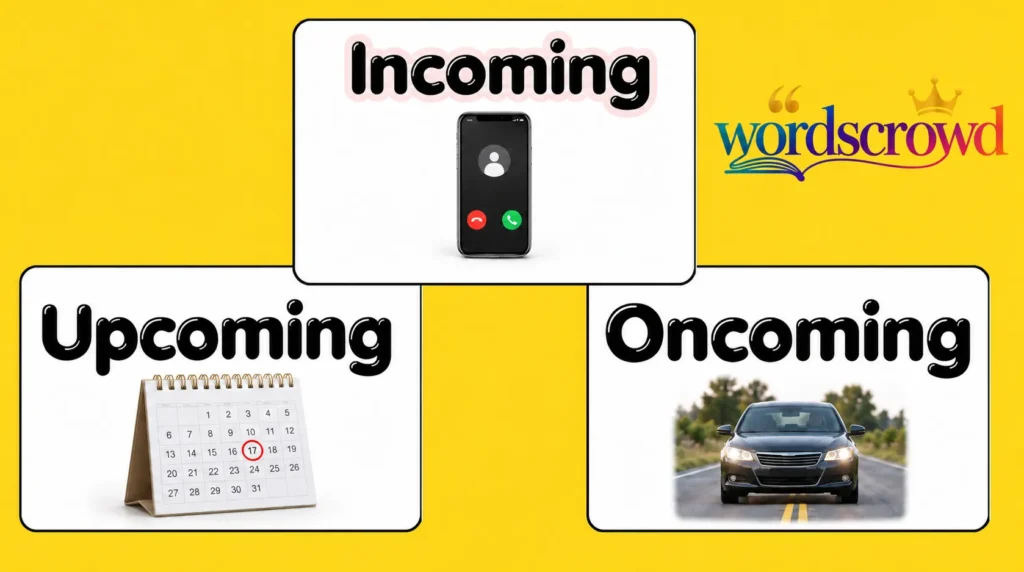
English has a funny habit of making three words look almost interchangeable when they are actually pointing in different directions.
Incoming, upcoming, and oncoming all contain coming, and all can describe something that is approaching in some sense.
That is why learners—and even fluent speakers—sometimes hesitate before choosing the right word.
But the distinction becomes much easier once you focus on what is coming, where it is coming, and how you are viewing it.
Incoming usually means something is arriving into a place, system, position, or role. An incoming call is a call you receive.
An incoming flight is a flight arriving at an airport. An incoming president is someone about to take office.
Upcoming means something is going to happen soon. An upcoming exam, upcoming meeting, or upcoming holiday is simply an event in the near future.
Cambridge notes that upcoming is mainly used in American English, while British English often prefers forthcoming in this sense.
Oncoming means something is moving toward you or approaching you, often from the opposite direction.
An oncoming car is a car traveling toward you; oncoming traffic is traffic approaching from the opposite direction.
This guide explains exactly when to use each word, why they are confused, how they work in American and British English, and how to avoid the most common mistakes.
Quick Answer
Incoming = arriving or coming into a place, system, or role.
Upcoming = happening soon in the future.
Oncoming = moving toward you, often from the opposite direction.
Easy rule:
Incoming comes in. Upcoming comes soon. Oncoming comes toward you.
So:
- incoming email ✅
- upcoming exam ✅
- oncoming vehicle ✅
They are not normally interchangeable.
Incoming or Upcoming or Oncoming: Comparison Table
| Feature | Incoming | Upcoming | Oncoming |
|---|---|---|---|
| Core meaning | Arriving or entering | Happening soon | Moving toward you |
| Main idea | Coming in | Coming soon | Coming toward |
| Part of speech | Adjective; also noun in some contexts | Adjective | Adjective |
| Typical position | Before a noun | Before a noun | Before a noun |
| Common examples | incoming call, incoming mail | upcoming event, upcoming exam | oncoming car, oncoming traffic |
| Future events? | Sometimes, especially roles | Yes | Sometimes, but usually not simply “future” |
| Physical movement? | Yes | Not usually | Yes, strongly |
| Direction important? | Toward/into a destination | No physical direction required | Toward the observer or another point |
| Communication | incoming message | upcoming meeting | rarely used |
| Travel | incoming flight | upcoming trip | oncoming train |
| Jobs/roles | incoming manager | upcoming manager ❌ in this sense | oncoming manager ❌ |
| Events | incoming administration | upcoming election | oncoming crisis |
| Traffic | incoming traffic can occur in technical contexts | upcoming traffic ❌ | oncoming traffic ✅ |
| Formality | Neutral | Neutral | Neutral |
| US English | Common | Very common | Common |
| UK English | Common | Used, but forthcoming is often preferred for future events | Common |
| Best memory clue | IN | SOON | TOWARD YOU |
Quick decision:
If something is entering or arriving, choose incoming.
If something is scheduled or expected to happen soon, choose upcoming.
If something is approaching you, choose oncoming.
What Does “Incoming” Mean?
Incoming describes something that is arriving, entering, or coming toward a particular place or position. It can also describe a person who is about to take over a job or role.
Cambridge gives examples such as incoming mail, incoming phone calls, incoming flights, and an incoming government.
The central idea is arrival into a destination or position.
Incoming: The Basic Meaning
Think of an arrow pointing into something:
outside → IN → destination
That is the mental picture behind incoming.
For example:
- An incoming call comes to your phone.
- An incoming email reaches your inbox.
- An incoming flight arrives at an airport.
- An incoming student is entering a new school or college group.
- An incoming president is about to take office.
The word does not necessarily mean that something is physically moving through a doorway. The idea of entering a system, place, role, or position is enough.
Incoming as an Adjective
The most common grammatical use is as an adjective placed before a noun.
Examples:
- incoming message
- incoming payment
- incoming passenger
- incoming flight
- incoming request
- incoming data
- incoming government
- incoming president
Incoming in Technology
Incoming is especially common in digital and technical language.
You may see:
- incoming call
- incoming email
- incoming message
- incoming connection
- incoming request
- incoming data
- incoming traffic
An incoming email is one that is being received rather than sent.
Compare:
I received an incoming call from an unknown number.
with:
I made an outgoing call to the customer.
Here, incoming contrasts naturally with outgoing.
Incoming in Professional English
Incoming is very useful when talking about people who are taking over a position.
For example:
The incoming director will begin work next Monday.
The director has already been selected but has not necessarily started the job yet.
Likewise:
The incoming government has promised several reforms.
The phrase describes a government that is about to assume power.
This is different from upcoming government, which sounds unnatural if you mean the government that is about to take office.
Incoming in Everyday English
Common everyday combinations include:
- incoming call
- incoming text
- incoming email
- incoming package
- incoming student
- incoming flight
- incoming payment
These phrases focus on something reaching a destination or recipient.
Incoming: Pronunciation
Incoming is pronounced approximately:
/ˈɪnˌkʌmɪŋ/
The first part sounds like in, which provides a useful memory clue.
A Simple Test
Ask:
Is it coming in?
If yes, incoming may be the right choice.
I have an incoming email.
The email is coming into my inbox.
What Does “Upcoming” Mean?
Upcoming means happening soon.
Unlike incoming, it does not normally focus on something physically entering a place. Unlike oncoming, it does not normally describe something traveling toward you.
It focuses on time.
Cambridge defines upcoming as something that is happening soon and identifies it as mainly American English; British English commonly uses forthcoming for this meaning.
Upcoming: The Basic Meaning
Think of a timeline:
NOW → → → UPCOMING EVENT
The event has not happened yet, but it is expected relatively soon.
Examples include:
- upcoming exam
- upcoming election
- upcoming meeting
- upcoming holiday
- upcoming concert
- upcoming wedding
- upcoming deadline
- upcoming movie
- upcoming trip
- upcoming conference
For example:
I’m studying for my upcoming exam.
The exam is not arriving at a physical location. It is simply scheduled to happen soon.
Upcoming Is About Time
This is the biggest difference between upcoming and incoming.
Compare:
We have an incoming flight.
This focuses on a flight arriving at the airport.
We have an upcoming flight.
This focuses on a flight that will happen soon, perhaps one you are scheduled to take.
Both sentences can be grammatically correct, but their meanings differ.
Incoming Flight vs Upcoming Flight
Imagine you work at an airport.
Incoming flight: A flight is arriving at the airport.
Imagine you are a passenger checking your travel schedule.
Upcoming flight: A flight you are going to take soon.
The same flight could potentially be described using either word, but the speaker’s perspective changes.
Upcoming in American English
Upcoming is especially common in American English.
Examples:
The company announced its upcoming product launch.
I’m excited about the upcoming election.
Have you seen the trailer for their upcoming movie?
Cambridge specifically labels upcoming as mainly US and notes that British English usually uses forthcoming in this sense.
That does not mean British speakers never use upcoming. It simply means forthcoming is often the more traditional British choice.
Upcoming in Professional Writing
Upcoming is common in:
- business announcements
- event calendars
- marketing
- news writing
- entertainment
- school communications
- websites
- social media
- newsletters
Examples:
Please review the schedule for our upcoming meetings.
We are preparing for the upcoming conference.
Details about the upcoming product release will be announced soon.
Upcoming: Pronunciation
Upcoming is pronounced approximately:
/ˈʌpˌkʌmɪŋ/
The word begins with up, but do not interpret that literally as physical upward movement.
In modern usage, upcoming primarily signals nearness in time.
What Does “Oncoming” Mean?
Oncoming describes something moving toward you or coming nearer, especially something approaching from the opposite direction.
Cambridge gives examples involving an oncoming truck, oncoming vehicle, and oncoming traffic.
This word has the strongest sense of physical direction among the three.
Oncoming: The Basic Meaning
Imagine yourself standing beside a road:
YOU ← 🚗
The car is moving toward you.
That is an oncoming car.
Common expressions include:
- oncoming traffic
- oncoming car
- oncoming vehicle
- oncoming train
- oncoming bus
- oncoming wave
- oncoming storm
- oncoming cyclist
- oncoming driver
The word is particularly common when something presents a possible collision or direct approach.
Oncoming Traffic
Oncoming traffic is one of the most familiar expressions.
It means vehicles traveling toward you, usually in the opposite direction.
For example:
The driver accidentally crossed into oncoming traffic.
This does not mean “future traffic.”
It means traffic approaching from the opposite direction.
That distinction is crucial.
Oncoming Does Not Simply Mean “Future”
A common mistake is to use oncoming as a general synonym for upcoming.
For example:
❌ I am preparing for my oncoming exam.
This sounds unnatural if you simply mean an exam that will happen soon.
Better:
✅ I am preparing for my upcoming exam.
But oncoming can sometimes be used metaphorically:
The country is preparing for an oncoming crisis.
Here, the crisis is imagined as something approaching.
Even so, upcoming crisis is generally the straightforward choice when the main idea is simply that the crisis will happen soon.
Oncoming: Pronunciation
Oncoming is pronounced approximately:
/ˈɒnˌkʌmɪŋ/ in British English
/ˈɑːnˌkʌmɪŋ/ in American English
The exact vowel varies between accents.
Incoming vs Upcoming vs Oncoming: The Key Differences
The three words overlap because they all contain the idea of coming, but their perspectives are different.
1. Incoming = coming in
Use incoming when something is arriving at a place, system, person, or position.
- incoming call
- incoming email
- incoming flight
- incoming payment
- incoming president
2. Upcoming = coming soon
Use upcoming when something is scheduled or expected to happen soon.
- upcoming exam
- upcoming meeting
- upcoming election
- upcoming holiday
- upcoming concert
3. Oncoming = coming toward you
Use oncoming when something is approaching you or moving in your direction.
- oncoming car
- oncoming traffic
- oncoming train
- oncoming wave
- oncoming storm
The three-word formula:
INcoming = into
UPcoming = soon
ONcoming = toward you
Grammar: How Are Incoming, Upcoming, and Oncoming Used?
All three words are commonly used as adjectives.
They normally appear before the noun they describe.
Incoming
an incoming call
Upcoming
an upcoming meeting
Oncoming
an oncoming vehicle
They are generally not comparative adjectives in ordinary use.
You would not normally say:
more incoming
or
most upcoming
or
more oncoming
The meanings are generally categorical rather than degrees of a quality.
Are They Verbs?
The words are related historically and grammatically to the present participles of come:
- come
- coming
But incoming, upcoming, and oncoming function as established adjectives in many modern constructions.
You should not treat them as interchangeable forms of the verb come.
For example:
The upcoming election is important.
Here, upcoming modifies election.
It does not function as the main verb.
Do They Need Hyphens?
Normally, these words are written as single words:
- incoming
- upcoming
- oncoming
Do not normally write:
- in-coming
- up-coming
- on-coming
in standard modern usage.
Real-Life Examples: Incoming, Upcoming, and Oncoming
Here are 25 original examples showing the differences in realistic situations.
Everyday Conversation
- I missed an incoming call while I was in the shower.
- Are you excited about the upcoming weekend?
- Watch out for the oncoming cyclist.
- My phone keeps showing incoming messages.
- We’re making plans for the upcoming holiday.
School and Education
- The teacher sent a reminder about the upcoming exam.
- Incoming students will receive their schedules by email.
- The school is preparing for the upcoming academic year.
- The coach warned us about the oncoming storm before practice.
Notice that upcoming exam is correct because the exam is a future event.
Business
- Please respond to all incoming customer requests.
- The team is preparing for an upcoming product launch.
- The incoming manager will meet the staff tomorrow.
- Our system automatically filters incoming emails.
- We discussed the company’s upcoming expansion.
Travel
- The incoming flight has been delayed by twenty minutes.
- I’m checking the schedule for my upcoming trip.
- The driver slowed down when he saw an oncoming bus.
- Passengers should wait for the incoming train to stop completely.
Email Writing
- Please make sure all incoming applications are recorded.
- We will discuss this issue at our upcoming meeting.
- The incoming director will review the proposal next week.
Academic Writing
- The study considers the effects of the upcoming policy changes.
- Researchers must account for incoming data before drawing conclusions.
Social Media
- Can’t wait for this weekend’s upcoming concert!
- That oncoming wave looked huge from the shore!
Incoming vs Upcoming: Why They Are Confused
These two are especially easy to confuse because both can describe something that has not happened yet.
Compare:
incoming president
and
upcoming election
Both refer to future situations, but the words focus on different ideas.
Incoming focuses on arrival or taking a position.
Upcoming focuses on time.
Compare These Pairs
The incoming CEO starts Monday.
The CEO is coming into the role.
The upcoming meeting starts Monday.
The meeting is happening soon.
Another pair:
We received an incoming message.
The message reached us.
We are preparing for an upcoming meeting.
The meeting has not happened yet.
Upcoming vs Oncoming: Why They Are Confused
These words are sometimes confused because both can suggest that something is approaching.
But approaching in time and approaching physically are not the same.
upcoming wedding
The wedding will happen soon.
oncoming vehicle
The vehicle is physically moving toward you.
You can think of upcoming as a calendar word and oncoming as a direction word.
Calendar vs Direction
Upcoming:
📅 Soon → future event
Oncoming:
🚗 → You → physical approach
That simple distinction solves many usage problems.
Incoming vs Oncoming: Why They Are Confused
These two are closer because both can describe movement.
Consider:
incoming aircraft
and
oncoming aircraft
The first emphasizes an aircraft arriving at a destination.
The second emphasizes an aircraft approaching from your direction or toward you.
The context determines which perspective matters.
Think About the Destination
If the question is:
Where is it going?
and the answer is:
Into this place/system/role
then incoming is often appropriate.
If the question is:
What direction is it moving?
and the answer is:
Toward me/us
then oncoming is often appropriate.
Common Mistakes
Mistake 1: “Upcoming Call”
❌ I received an upcoming call.
If you mean a call that is currently arriving on your phone, incoming call is the natural expression.
✅ I received an incoming call.
However, upcoming call can be possible in a different context—for example, a scheduled call that will happen later.
✅ I have an upcoming call with my manager.
The distinction is timing and perspective.
Mistake 2: “Incoming Exam”
❌ I’m nervous about my incoming exam.
If you mean an exam that will happen soon, use upcoming.
✅ I’m nervous about my upcoming exam.
An exam does not normally “come into” you or your location.
Mistake 3: “Upcoming Traffic”
❌ Slow down because of the upcoming traffic.
If vehicles are approaching from the opposite direction, use oncoming traffic.
✅ Slow down because of the oncoming traffic.
Mistake 4: “Oncoming Meeting”
❌ We discussed the oncoming meeting.
Use upcoming meeting if you mean a meeting scheduled for the near future.
✅ We discussed the upcoming meeting.
Mistake 5: “Upcoming President”
❌ The upcoming president will take office next month.
This may be understandable, but incoming president is normally more precise when you mean the person who has been elected or selected and is about to take office.
✅ The incoming president will take office next month.
Mistake 6: “Incoming Holiday”
❌ We’re planning an incoming holiday.
Use upcoming holiday.
✅ We’re planning for the upcoming holiday.
Better Alternatives in British English
One important regional point concerns upcoming.
Cambridge identifies upcoming as mainly American English and says British English usually uses forthcoming for the meaning “happening soon.”
So you may see:
American English
the upcoming election
British English
the forthcoming election
Both are understandable across English-speaking regions.
Forthcoming is not, however, simply another version of incoming or oncoming. It has its own meanings, including “happening soon,” and it can also describe someone who is willing to provide information.
For global writing, upcoming is widely understood and very natural, especially in international digital content.
Formal vs Informal Usage
None of these three words is inherently slang or highly informal.
They are all standard English.
However, their preferred contexts differ.
Incoming
Especially common in:
- business
- technology
- telecommunications
- politics
- administration
- transportation
Upcoming
Especially common in:
- everyday conversation
- advertising
- social media
- entertainment
- business
- education
- event announcements
Oncoming
Especially common in:
- driving
- transportation
- safety instructions
- physical movement
- weather
- journalism
- descriptive writing
Common Collocations
Learning collocations is one of the fastest ways to understand these words naturally.
Common Incoming Collocations
- incoming call
- incoming email
- incoming message
- incoming mail
- incoming flight
- incoming passenger
- incoming payment
- incoming data
- incoming request
- incoming government
- incoming president
- incoming manager
Common Upcoming Collocations
- upcoming event
- upcoming meeting
- upcoming exam
- upcoming election
- upcoming holiday
- upcoming concert
- upcoming movie
- upcoming trip
- upcoming deadline
- upcoming conference
- upcoming project
- upcoming release
Common Oncoming Collocations
- oncoming traffic
- oncoming car
- oncoming vehicle
- oncoming train
- oncoming bus
- oncoming driver
- oncoming wave
- oncoming storm
- oncoming cyclist
- oncoming danger
- oncoming crisis
The collocations themselves can often tell you which word belongs in a sentence.
Memory Tricks That Actually Work
Trick 1: IN = Into
INcoming contains IN.
Think:
Something is coming IN.
So:
incoming email
incoming call
incoming flight
Trick 2: UP = Soon
For upcoming, think:
Something is coming up.
In everyday English, something that is “coming up” can mean something that will happen soon.
So:
upcoming exam
upcoming meeting
upcoming holiday
Trick 3: ON = Toward You
For oncoming, imagine something moving on toward you.
🚙 → 👤
That gives you:
oncoming car
oncoming traffic
oncoming train
The Three-Second Rule
When choosing between the three, ask:
- Is it coming into something? → Incoming
- Is it happening soon? → Upcoming
- Is it moving toward me/us? → Oncoming
If you can answer that question, you can usually choose correctly.
Can “Incoming” and “Upcoming” Ever Both Be Correct?
Yes.
The same noun can sometimes work with either word, but the meaning or perspective changes.
Consider flight:
The incoming flight is from London.
The flight is arriving.
My upcoming flight is at 8 p.m.
The flight is scheduled for the near future.
The first sentence focuses on arrival.
The second focuses on time.
This is a useful example because it shows that these words are not always competitors. Sometimes they describe different aspects of the same thing.
Can “Upcoming” and “Oncoming” Both Be Correct?
Occasionally, especially with metaphorical language.
For example:
The country faces an upcoming crisis.
This simply says the crisis is expected soon.
The country faces an oncoming crisis.
This presents the crisis as something approaching, almost like a force moving toward the country.
The second version is more directional and metaphorical.
For ordinary future events, upcoming is usually the safer and more natural choice.
Can “Incoming” and “Oncoming” Both Be Correct?
Sometimes.
Consider a vehicle:
The incoming train is arriving at Platform 4.
Here, the train is coming into the station.
The oncoming train forced the workers to move away from the track.
Here, the train is approaching them.
The words describe different viewpoints.
This is why context matters more than simply memorizing definitions.
Which Word Should You Use in Professional Writing?
Use the word that communicates the intended relationship most precisely.
For emails and messages
Use incoming for things you receive:
incoming emails
incoming requests
incoming calls
Use upcoming for scheduled events:
upcoming meeting
upcoming deadline
upcoming presentation
For business announcements
Use upcoming for future launches, events, and projects:
our upcoming product launch
Use incoming for people assuming positions:
the incoming CEO
For safety instructions
Use oncoming for approaching physical objects:
Watch for oncoming traffic.
Stay clear of the oncoming vehicle.
Precision matters more than trying to sound sophisticated.
Which Word Is More Common?
The answer depends heavily on the noun and context.
There is no universal winner.
You would naturally say:
- incoming call, not normally upcoming call when the call is arriving
- upcoming meeting, not incoming meeting
- oncoming traffic, not upcoming traffic
- incoming president, not usually oncoming president
- upcoming election, not normally incoming election
- oncoming car, when the car is approaching you
So rather than asking, “Which word is more common?”, ask:
Which relationship am I trying to describe?
That is the better grammar question.
Frequently Asked Questions
Is “incoming” the same as “upcoming”?
No. Incoming usually means arriving or entering, while upcoming means happening soon. An incoming call is being received; an upcoming meeting will happen soon.
Is “upcoming” the same as “oncoming”?
No. Upcoming normally describes something that will happen soon. Oncoming describes something moving toward you, especially physically.
upcoming exam
oncoming traffic
Is “incoming exam” correct?
Usually not if you mean an exam that will happen soon. Upcoming exam is the natural expression.
I’m preparing for my upcoming exam.
Is “upcoming call” correct?
It can be correct if you mean a call that is scheduled to happen soon. But if your phone is ringing and you are receiving the call, use incoming call.
Is “oncoming traffic” correct?
Yes. Oncoming traffic means vehicles approaching from the opposite direction. It is one of the most common uses of oncoming
Is “incoming traffic” correct?
It can be correct in contexts where traffic is arriving at or entering a particular place, system, or route. But when you mean traffic traveling toward you from the opposite direction, oncoming traffic is the standard choice.
Is “upcoming” American or British English?
Upcoming is especially common in American English. Cambridge notes that British English usually uses forthcoming for “happening soon,” although upcoming is also understood and used in British English.
Is “incoming president” correct?
Yes. Incoming president refers to someone who has been selected or elected and is about to assume the presidency.
Which is correct: “upcoming event” or “incoming event”?
Upcoming event is correct when you mean an event that will happen soon. Incoming event is not the normal choice for an ordinary future event.
Final Verdict: Incoming vs Upcoming vs Oncoming
The three words are all correct, but they are not interchangeable.
The easiest way to remember the distinction is to focus on the type of “coming” involved.
Use incoming when something is coming in.
- incoming call
- incoming email
- incoming flight
- incoming payment
- incoming president
Use upcoming when something is coming soon.
- upcoming exam
- upcoming meeting
- upcoming election
- upcoming holiday
- upcoming concert
Use oncoming when something is coming toward you.
- oncoming traffic
- oncoming car
- oncoming train
- oncoming vehicle
- oncoming wave
Best memory formula:
Incoming = INTO
Upcoming = SOON
Oncoming = TOWARD YOU
If you are writing a business email, preparing an academic paper, creating social media content, or simply trying to sound natural in everyday English, this three-way distinction will keep your wording precise.
And remember one final point: do not choose these words just because they all contain “coming.”
Choose them according to the relationship between the thing and the speaker—arrival, time, or direction.
That small shift in perspective makes the difference between a sentence that merely sounds understandable and one that sounds genuinely natural.
Image ALT text: Incoming or upcoming or oncoming comparison showing the difference between arriving, happening soon, and moving toward you.

Elon Parker is a dedicated writer at Wordscrowd, creating clear, informative, and engaging content for readers.
With a focus on useful information, Elon aims to make every article simple, reliable, and easy to understand.