Listen to Music or Listen to the Music: Which Is Correct?

Should you say “I like to listen to music” or “I like to listen to the music”? Both sentences are grammatically possible, but they do not always mean the same thing. This small difference causes confusion because music can be used as a general, uncountable noun, while the music usually points to particular music that the speaker and listener can identify. The choice of article can therefore change the focus of a sentence. For example, if you are talking about music as an activity or something you enjoy in general, you would normally say, “I listen to music every evening.” … Read more

Entwined or Intertwined: What’s the Difference?

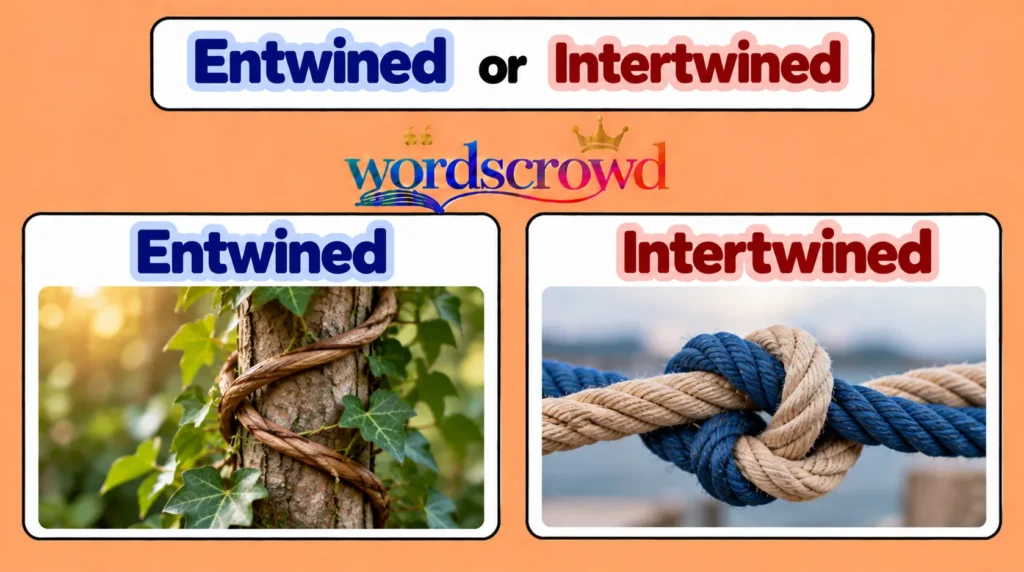
Have you ever written a sentence and stopped at “entwined or intertwined” because both words seemed to fit? You are not alone. These two words are extremely close in meaning, and in many sentences, either one can describe things that are twisted, connected, or closely mixed together. The confusion comes from the fact that entwined and intertwined share the same basic idea: things becoming closely connected by winding, twisting, mixing, or linking together. However, they are not always identical in tone or emphasis. Entwined can suggest that two or more things are closely connected or wrapped around each other, while … Read more

If He Was or If He Were: Which Is Correct?

When should you say “if he was”, and when should you say “if he were”? This small difference causes a surprisingly large amount of confusion, especially because both forms can sound natural in conversation. The key is not simply to memorize that one is “right” and the other is “wrong.” The choice depends on what you mean. Are you talking about a real or possible situation in the past? Or are you imagining a situation that is hypothetical, unlikely, or contrary to fact? For example, compare these two sentences: The first sentence considers whether something actually happened. The second imagines … Read more

Tomatos or Tomatoes: Which Spelling Is Correct?

Is the plural of tomato spelled tomatos or tomatoes? If you have ever hesitated before typing a recipe, school assignment, grocery list, blog post, or social media caption, you are not alone. The spelling looks simple, but English has several plural patterns, and words ending in -o do not always behave in exactly the same way. Here is the important part: tomatoes is the standard and correct plural spelling of tomato. Tomatos is generally considered a misspelling when you mean more than one tomato. Why does this mistake happen? The usual English plural is formed by adding -s, as in … Read more

Combating or Combatting: Which Spelling Is Correct?

If you have ever typed combating and wondered whether it should have two ts—combatting—you are not alone. This is one of those English spelling questions that can make an otherwise simple sentence feel strangely uncertain. Both forms look plausible, both appear in published English, and both are connected to the verb combat. So, combating or combatting—which is correct? The short answer is reassuring: both are correct. Combating and combatting are accepted forms of the present participle and gerund of combat. Major dictionaries, including Oxford, Cambridge, and Collins, list both spellings. The real question, then, is not simply which spelling is … Read more

People Do or People Does? The Correct Grammar

Have you ever stopped while writing a sentence and wondered, “Should I say people do or people does?” It is a small grammar question, but it causes a surprisingly large number of mistakes. The confusion usually happens because people refers to more than one person, while does is the form of the verb do that we normally use with singular third-person subjects such as he, she, and it. Once you understand how subject-verb agreement works, the answer becomes much easier. The correct choice in standard English is “people do.” For example, we say, “People do strange things sometimes,” not “People … Read more

Headed or Heading: What’s the Difference?

Headed or heading may look like a simple choice, but the two words perform different grammatical jobs. They come from the same verb, head, yet their meanings and sentence roles can change depending on context. For example, you might say, “We are heading home,” but “We are headed home.” Both can be correct, although they can emphasize slightly different ideas. You might also see “a page heading” in one context and “a letter headed ‘Important Notice’” in another. That is why this pair can cause confusion. The difference is not simply about spelling or pronunciation. It is mainly about verb … Read more

Damnit or Dammit: Which Spelling Is Correct?

If you have ever typed “damnit” or “dammit” and stopped to wonder which one is actually correct, you are certainly not alone. These forms look almost identical, sound essentially the same, and are both used by English speakers. That makes this a surprisingly tricky spelling question—especially when you are writing quickly and your spell-checker suddenly disagrees with you. The short answer is that dammit is the safest and most widely established single-word spelling. However, damnit is also recognized as a variant by the Cambridge Dictionary, so simply calling it “wrong” is too absolute. The original expression is damn it, written … Read more

Eventhough or Even Though: Which Is Correct?

Have you ever written “eventhough” and then stopped to wonder whether it should actually be “even though”? You are not alone. This is a surprisingly common English spelling and grammar question because the phrase is pronounced almost like one continuous unit in everyday speech. The confusion becomes even stronger when you see similar words such as although, though, and even if. Since English contains many compounds and words that began as separate expressions, it can feel reasonable to assume that eventhough is simply another combined word. But there is an important distinction: “even though” is the standard and correct form … Read more

Assist With or Assist In: Which Is Correct?

Assist with or assist in—which phrase should you use? If you have ever hesitated before writing a sentence such as “She assisted with the project” or “She assisted in completing the project,” you are not alone. Both constructions are grammatically correct, but they do not always work in exactly the same situations. The confusion comes from the fact that assist can be followed by different prepositions, and the choice often depends on what comes next. Assist with commonly introduces a task, activity, project, or thing that someone helps with. Assist in often introduces an activity or process, especially when it … Read more