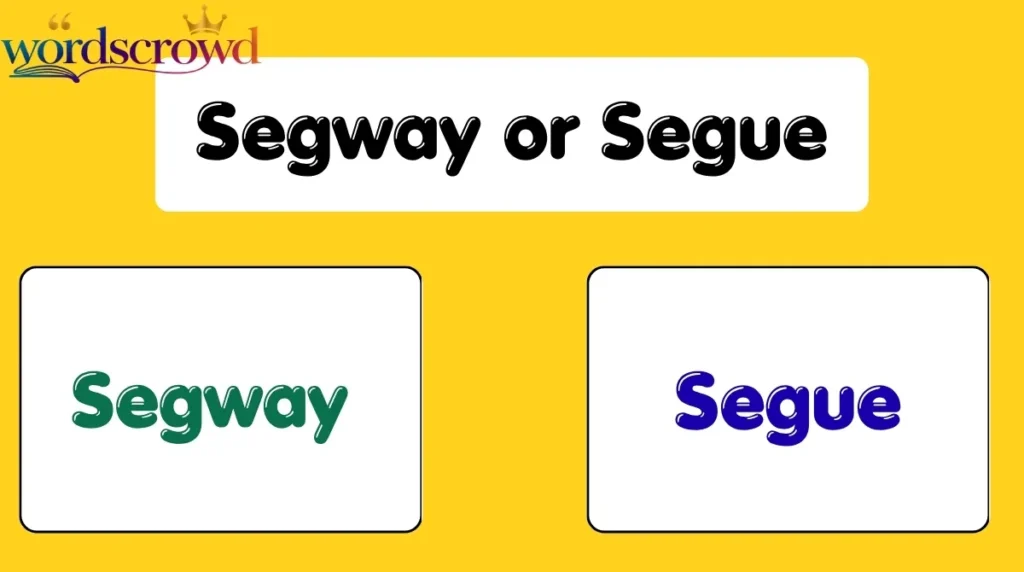
Have you ever been writing a sentence and suddenly wondered whether you should type “segway” or “segue”? You are not alone.
These two words look and sound closely related, and their pronunciations can make the confusion even stronger.
But despite their similarity, segway and segue do not normally mean the same thing.
The confusion happens because segue is pronounced roughly like “SEG-way,” while Segway is also pronounced “SEG-way.”
One is a regular English word used to describe a smooth transition from one subject, activity, or part of a conversation to another.
The other is a brand name associated with a type of two-wheeled personal transporter.
So, if you are talking about moving smoothly from one topic to another, segue is the word you want. If you are referring to the self-balancing vehicle, Segway is the proper name.
In this guide, you will learn exactly when to use “segue” and when to use “Segway,” how they differ in meaning and grammar, how they are pronounced, why people confuse them, and how to avoid the mistake in everyday, academic, business, and professional writing.
Quick Answer
Segue is the correct word when you mean a smooth transition from one subject, activity, idea, or section to another.
Segway is a trademarked brand name for a type of self-balancing personal transporter.
Examples:
- “The speaker used a clever segue from technology to education.”
- “They toured the city on a Segway.”
Easy rule: A segue is a transition; a Segway is a vehicle.
Segway or Segue: The Difference at a Glance
| Feature | Segue | Segway |
|---|---|---|
| Basic meaning | A smooth transition | A branded personal transporter |
| Part of speech | Usually noun or verb | Proper noun; commonly a brand name |
| Pronunciation | /ˈseɡ.weɪ/ | /ˈseɡ.weɪ/ |
| Sounds like | “SEG-way” | “SEG-way” |
| Meaning related to conversation? | Yes | No |
| Meaning related to transportation? | No | Yes |
| Common use | Writing, speaking, presentations, media | Travel, recreation, transportation |
| Example | “That was a natural segue.” | “We rented a Segway.” |
| Capitalization | Usually lowercase | Usually capitalized as Segway |
| Formal writing | Common and acceptable | Used when referring to the brand |
| Common mistake | Writing “segway” for a transition | Using “Segway” when you mean transition |
| Memory clue | Segue = transition | Segway = vehicle |
| US vs UK | Used in both | Brand name used in both |
| Are they interchangeable? | No | No |
Quick Tip: If you can replace the word with “transition,” use segue. If you are talking about a personal transporter, use Segway.
What Does “Segue” Mean?
Definition of Segue
Segue means to move smoothly and naturally from one thing to another.
It can describe a transition between:
- Topics
- Ideas
- Conversations
- Activities
- Scenes
- Musical sections
- Speeches
- Presentation topics
- Sections of written or spoken material
As a noun, segue refers to the transition itself.
Example:
“The interview made a natural segue from politics to economics.”
As a verb, segue means to transition smoothly into something else.
Example:
“The presenter segued from the introduction into the main discussion.”
The key idea is smooth movement from one thing to another.
Is “Segue” a Noun or a Verb?
It can be both.
Segue as a noun
When segue is a noun, it refers to a transition.
- “That was an excellent segue.”
- “The speaker created a smooth segue between the two subjects.”
- “There was no clear segue from the first section to the second.”
Segue as a verb
When segue is a verb, it means to transition smoothly.
- “She segued into the next topic.”
- “The presenter segued from the introduction to the results.”
- “The discussion segued into a debate about education.”
This flexibility makes segue especially useful in professional communication, journalism, presentations, podcasts, interviews, and everyday conversation.
How Do You Pronounce “Segue”?
Segue is pronounced:
SEG-way
Its pronunciation is approximately /ˈseɡ.weɪ/.
This pronunciation is one of the biggest reasons people spell it incorrectly.
You might hear someone say:
“That was a great SEG-way into the next topic.”
A listener who has never seen the word written may naturally assume it is spelled segway.
But the standard spelling for the transition is segue.
Where Does “Segue” Come From?
The word segue comes from Italian. In Italian, segue is related to the verb meaning “to follow.”
The term entered English through musical usage. It originally indicated that one musical passage should continue directly into another without a break.
Over time, its meaning expanded beyond music.
Today, segue can describe a smooth transition in:
- Conversation
- Public speaking
- Writing
- Television
- Radio
- Podcasts
- Film
- Journalism
- Presentations
- Everyday speech
That history helps explain why segue has a meaning connected to moving naturally from one idea to another.
Common Collocations With “Segue”
Some natural expressions include:
- a smooth segue
- a natural segue
- a clever segue
- a seamless segue
- a good segue
- a segue into
- a segue from one topic to another
- segue into the next section
- segue from one subject to another
Examples:
“That question provides a natural segue into our next topic.”
“The host used humor as a clever segue into the serious discussion.”
What Does “Segway” Mean?
Definition of Segway
Segway is a brand name associated with a self-balancing, two-wheeled personal transporter.
Unlike segue, which describes a transition, Segway refers to a physical transportation product or, in common usage, a vehicle of that general type.
For example:
“The tourists explored the historic district on Segways.”
The word is generally capitalized when it refers specifically to the Segway brand.
Is “Segway” a Noun?
Yes.
In sentences such as:
“We rented a Segway for the afternoon.”
Segway functions as a noun.
It identifies the vehicle or product being used.
You might encounter the word in contexts involving:
- City tours
- Tourist attractions
- Outdoor recreation
- Guided tours
- Personal transportation
- Mobility products
Why Is “Segway” Capitalized?
Segway originated as a brand name, so the capital letter matters when you are referring to the trademarked product or company.
Compare:
- “The tour group used Segways.”
- “The presenter made a smooth segue.”
The capitalization helps distinguish the brand from the ordinary English word segue.
How Do You Pronounce “Segway”?
Segway is also pronounced approximately:
SEG-way
So:
- segue → SEG-way
- Segway → SEG-way
The pronunciation is essentially the same.
That is why spelling is the real problem.
Segway or Segue: Why Are They So Easy to Confuse?
The answer is simple: they sound almost identical.
Imagine hearing this sentence:
“That was a great SEG-way into the next topic.”
Without seeing the spelling, you have no obvious way to know whether the speaker means:
- segue, the transition, or
- Segway, the vehicle.
The confusion becomes even stronger because segway looks like a perfectly logical spelling of the pronunciation.
English contains many words whose spellings do not match what a learner expects. Segue is an especially memorable example because its spelling comes from its Italian origin rather than from the modern English pronunciation.
The Most Common Mistake
A very common error is:
“Let me segway into my next point.”
In standard edited English, the intended word here is:
“Let me segue into my next point.”
The problem is not pronunciation. The problem is spelling and meaning.
Key Differences Between Segue and Segway
The easiest way to separate them is to focus on what they represent.
1. Segue means a transition
Use segue when one idea, subject, scene, or activity flows into another.
“The documentary segued from history into modern politics.”
2. Segway refers to a vehicle or brand
Use Segway when you are talking about the personal transporter.
“The tourists traveled around the park on Segways.”
3. They have the same basic pronunciation
Both are pronounced approximately SEG-way.
4. Their spellings are different
- segue = transition
- Segway = personal transporter
5. Capitalization can help
Segue is normally lowercase unless it begins a sentence.
Segway is capitalized when used as the brand name.
6. They are not interchangeable
You cannot normally substitute one for the other.
❌ “That was a smooth Segway into the next subject.”
✅ “That was a smooth segue into the next subject.”
And:
❌ “We rented a segue for the city tour.”
✅ “We rented a Segway for the city tour.”
Grammar: How to Use “Segue” Correctly
Because segue can function as both a noun and a verb, understanding its grammar makes your writing much easier.
“Segue” as a Noun
Use segue when you are naming the transition.
Common structures include:
a segue + into + topic
“The question provided a segue into the next discussion.”
a segue + from + topic + to + topic
“The presenter created a smooth segue from marketing to sales.”
a natural/smooth/clever segue
“That joke was a clever segue into the next part of the presentation.”
“Segue” as a Verb
Use segue when someone or something makes the transition.
Common structures include:
segue into + topic
“She segued into the final section.”
segue from + topic + into/to + topic
“The speaker segued from the introduction into the main argument.”
segue from + one thing + to + another
“The conversation segued from travel to food.”
Is “Segue” a Regular Verb?
In modern English, segue behaves as a regular verb in its ordinary forms.
Common forms include:
- Base form: segue
- Third-person singular: segues
- Present participle: segueing / seguing can appear, though careful writers may avoid awkward forms by restructuring the sentence
- Past tense: segued
- Past participle: segued
Examples:
“The host segues into the next segment.”
“The conversation segued into another subject.”
For polished professional writing, a simple construction such as “moved into” can sometimes be clearer than forcing an unusual verb form.
When Should You Use “Segue”?
Use segue when you mean a smooth or natural transition.
In conversations
“That reminds me of something else.”
You could describe this transition as a segue.
“That question was a nice segue into the next subject.”
In presentations
“Now that we have discussed the problem, let’s move to the solution.”
A presenter could say:
“This gives us a natural segue into our proposed solution.”
In essays
A writer might move from one related argument to another:
“This discussion provides a useful segue into the economic effects of the policy.”
In journalism
A journalist may transition from one part of a story to another:
“The report then segues into the community’s response.”
In podcasts
Podcast hosts frequently move between topics:
“And speaking of travel, that’s a perfect segue into today’s next story.”
In business writing
“The sales figures provide a useful segue into our discussion of next quarter’s strategy.”
In creative writing
The word can describe a smooth shift between scenes or ideas:
“The final shot segues into a quiet morning scene.”
When Should You Use “Segway”?
Use Segway when the subject is the personal transporter or the company/product associated with the name.
Examples:
“The hotel offers Segway tours.”
“We learned how to operate a Segway before the tour began.”
“The guide led the group through the park on Segways.”
You should not use Segway merely because you hear the pronunciation “SEG-way.”
20+ Real-Life Examples of Segue and Segway
Here are practical examples across different situations.
Everyday Conversation
- “That reminds me of something else—a perfect segue into our weekend plans.”
- “Before we talk about dinner, let me segue into the question of where we’re going.”
- “Her comment created an easy segue into the travel discussion.”
Business
- “The sales report provides a useful segue into our marketing strategy.”
- “After reviewing the budget, the manager segued into next year’s hiring plans.”
- “That point is a natural segue into our discussion of customer retention.”
Presentations
- “This chart gives us a clear segue into the next section.”
- “The speaker used a personal story as a segue into the main argument.”
- “I’ll now segue from the background information to the results.”
Academic Writing
- “The historical discussion creates a useful segue into the social consequences.”
- “The final paragraph segued naturally into the study’s broader implications.”
- “This finding offers a logical segue to the next stage of the analysis.”
Professional Email
- “The attached figures provide a useful segue into our discussion during tomorrow’s meeting.”
- “With the schedule confirmed, we can segue into planning the remaining tasks.”
Social Media
- “Talking about coffee is the perfect segue into my morning routine.”
- “One travel photo later, and somehow we’re discussing food again. What a segue!”
Tourism
- “We explored the city on a Segway.”
- “The tour company offers guided Segway rides.”
- “Everyone received a safety briefing before riding a Segway.”
Casual Writing
- “That joke was such a good segue into the next story.”
- “The host made a funny segue from sports to movies.”
- “We rented a Segway and explored the waterfront.”
Media and Entertainment
- “The film uses a quiet visual segue between the two scenes.”
- “The host’s final question was a clever segue into the next interview.”
Common Mistakes With Segway and Segue
Mistake 1: Using “Segway” for a transition
Wrong:
“Let me Segway into my next point.”
Correct:
“Let me segue into my next point.”
Why?
You are describing a transition, not a vehicle.
Mistake 2: Writing “segway” as a lowercase transition word
Incorrect in standard usage:
“The presenter used a clever segway.”
Correct:
“The presenter used a clever segue.”
The pronunciation may sound like “segway,” but the spelling is segue.
Mistake 3: Using “segue” for the vehicle
Wrong:
“We rode a segue around the city.”
Correct:
“We rode a Segway around the city.”
Here you are referring to the branded personal transporter.
Mistake 4: Thinking “segue” is pronounced like “seeg”
A reader who encounters the word for the first time might try to pronounce it according to its letters.
That produces a pronunciation that is not standard.
Segue is pronounced approximately SEG-way.
Mistake 5: Assuming identical pronunciation means identical meaning
English has many words that sound alike or nearly alike but differ in spelling and meaning.
The pronunciation of segue and Segway does not make them interchangeable.
Memory Tricks: How to Remember the Difference
If you regularly confuse these words, use one of these simple tricks.
Memory Trick #1: Segue = Smooth Transition
Think:
SEGUE → Smoothly Goes Elsewhere
This is not the historical origin of the word, but it is a useful memory device.
When your idea smoothly goes elsewhere, you need segue.
Memory Trick #2: Segway Has Wheels
Think:
Segway = something you ride.
If people are:
- Riding it
- Touring on it
- Traveling on it
- Standing on it
you probably mean Segway.
Memory Trick #3: Topic or Transport?
Ask yourself:
Am I moving between topics, or am I moving on a vehicle?
- Moving between topics → segue
- Moving on a vehicle → Segway
Memory Trick #4: The Capital Letter
Remember:
Segway = Brand
segue = Transition
The capital S can remind you that Segway is a proper brand name.
Quick Memory Box:
Segue = transition.
Segway = transporter.
Is “Segway” Ever Correct as a Regular English Word?
This is where precision matters.
Segway is a proper name associated with the Segway brand. In casual language, people may use segway generically to describe similar self-balancing vehicles, but in careful writing, especially when referring specifically to the product or brand, Segway is the standard capitalization.
It should not be used as the ordinary spelling of the transition word.
So this is the important distinction:
segue = transition
Segway = branded personal transporter
Even if people occasionally lowercase the vehicle name or use it generically, that does not make segway the correct spelling for a transition.
Segue in Formal and Informal Writing
Segue is perfectly acceptable in professional English.
You can find it in contexts such as:
- Business presentations
- Essays
- Journalism
- Speeches
- Academic discussions
- Interviews
- Podcasts
- Reports
- Marketing copy
However, there is a small style consideration.
Because segue is somewhat specialized, the simpler word transition may sometimes be clearer for a general audience.
Compare:
“The final paragraph provides a segue into the conclusion.”
and:
“The final paragraph provides a transition into the conclusion.”
Both can work. Transition is more direct and familiar, while segue often emphasizes a smooth, natural flow.
Segue vs. Transition: Are They Synonyms?
They are closely related, but they are not always perfect substitutes.
A transition is a broad term for movement from one state, subject, stage, or idea to another.
A segue often suggests that the movement is smooth, connected, or natural.
For example:
“The transition from school to university can be difficult.”
Here, segue would sound unusual because the sentence describes a major life change rather than a smooth conversational or artistic movement.
But:
“The host made a smooth segue from sports to politics.”
Here, segue is natural.
Simple distinction
Transition = general change or movement.
Segue = smooth movement from one idea, subject, or part to another.
US vs. UK English
There is no major American-versus-British spelling difference here.
Segue is used in both American and British English with the same basic meaning.
Segway is likewise associated with the same brand/product in both varieties of English.
The key issue is not regional English. It is meaning and spelling.
So you do not need to change segue to another spelling simply because you are writing for a British audience.
Is “Segue” Appropriate in Academic Writing?
Yes, but use it naturally.
Academic writers frequently need to describe relationships between ideas, arguments, sections, or topics. Segue can work when the transition is smooth.
For example:
“This discussion provides a useful segue into the methodological limitations of the study.”
However, transition may be preferable when clarity is the main concern:
“This discussion provides a useful transition to the methodological limitations of the study.”
Neither is automatically better. Choose the word that fits your audience and tone.
Is “Segue” Appropriate in Business Writing?
Yes.
It can be useful in presentations, reports, speeches, and meetings.
For example:
“That brings us to a natural segue into our customer-service strategy.”
But don’t use segue simply to sound sophisticated. If move to, turn to, or transition to communicates the idea more clearly, choose the simpler expression.
Good professional writing is not about using the fanciest word. It is about choosing the clearest appropriate word.
How to Use “Segue” in a Sentence
Here are several useful sentence patterns.
Pattern 1: A segue into something
“That provides a smooth segue into the next topic.”
Pattern 2: A segue from one topic to another
“The question created a natural segue from history to economics.”
Pattern 3: Segue into something
“The presenter then segued into the final section.”
Pattern 4: Segue from something into something else
“The conversation segued from work into family life.”
Pattern 5: A natural segue
“The story was a natural segue into the discussion.”
These patterns cover most everyday uses.
How to Use “Segway” in a Sentence
When referring to the vehicle, use it as a noun.
Examples:
“The guide demonstrated how to ride a Segway.”
“We booked a Segway tour.”
“She rented a Segway for the afternoon.”
“The group traveled through the park on Segways.”
Notice that the context involves physical movement, not movement between ideas.
Quick Decision Guide: Which One Should You Choose?
When you are unsure, ask these questions:
- Am I talking about changing subjects?
→ Use segue. - Am I describing a smooth connection between ideas?
→ Use segue. - Am I talking about a presentation moving to another section?
→ Use segue. - Am I talking about a vehicle?
→ Use Segway. - Am I talking about a guided ride?
→ Use Segway. - Can I replace the word with “transition”?
→ Use segue. - Can I replace the word with “personal transporter”?
→ Use Segway.
Frequently Asked Questions
Is “segway” or “segue” correct for a transition?
Segue is correct when you mean a smooth transition between subjects, ideas, activities, or sections.
For example:
“That is a natural segue into our next topic.”
Is “Segway” a misspelling of “segue”?
Not exactly. Segway is the name of a personal transporter brand. However, using Segway when you mean a transition is a spelling mistake.
Why are segue and Segway pronounced the same?
Segue entered English from Italian, while Segway was created as a brand name. Their spellings developed differently, but their pronunciations are essentially the same.
How do you pronounce segue?
Segue is pronounced approximately “SEG-way.”
It is not normally pronounced by sounding out every letter.
How do you pronounce Segway?
Segway is also pronounced approximately “SEG-way.”
That shared pronunciation is why the two words are often confused.
Can I write “segway into” instead of “segue into”?
In standard edited English, no. When you mean transition into, write “segue into.”
Correct:
“She segued into the next topic.”
Is segue formal or informal?
Segue is acceptable in both professional and conversational English. It can sound somewhat polished or specialized, so transition, move to, or turn to may sometimes be clearer.
Is segue used in British English?
Yes. Segue is used in both American and British English. There is no major regional spelling distinction between the two.
What is an easy way to remember segue vs. Segway?
Remember:
Segue = transition.
Segway = something you ride.
If you are moving between ideas, use segue. If you are moving on a vehicle, use Segway.
Final Verdict: Segway or Segue?
The answer depends entirely on what you mean.
Use segue when you mean a smooth transition.
- “The speaker made a smooth segue into the next topic.”
- “The conversation segued from travel to food.”
- “That question provides a natural segue into the final section.”
Use Segway when you mean the personal transporter or the brand associated with it.
- “We took a Segway tour.”
- “The tourists rode Segways through the city.”
- “He learned how to operate a Segway.”
The most important point is that segue and Segway sound alike but have different meanings and spellings. If you remember only one thing, remember this:
Segue = transition. Segway = transporter.
So the next time you want to write “Let me ___ into my next point,” don’t let the pronunciation trick you. The correct choice is segue.
And if you’re actually talking about something you can ride, Segway is the word you’re looking for.

Elon Parker is a dedicated writer at Wordscrowd, creating clear, informative, and engaging content for readers.
With a focus on useful information, Elon aims to make every article simple, reliable, and easy to understand.