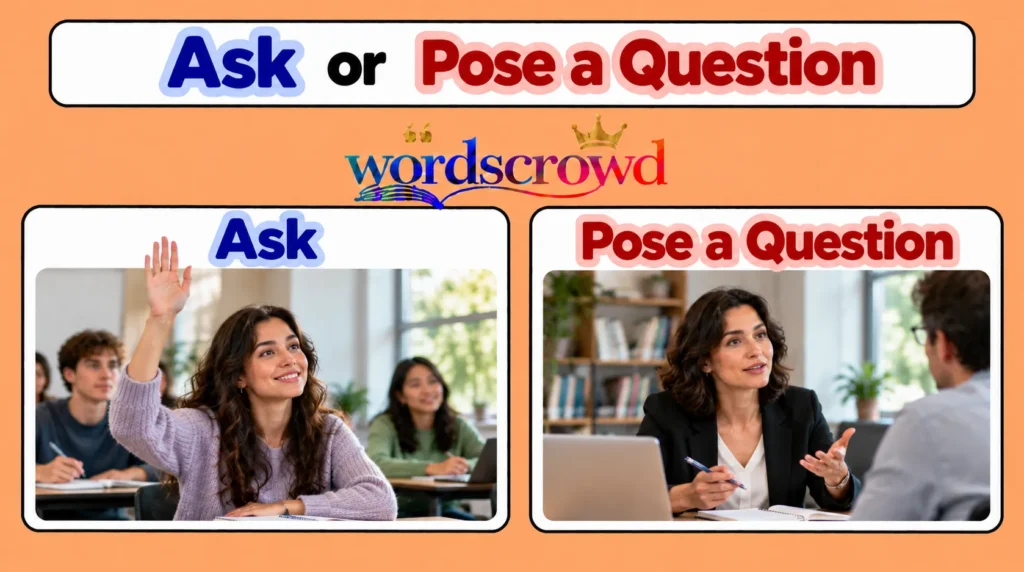
Both phrases are correct, and both involve presenting a question to someone. However, they do not always sound the same.
The difference mainly comes down to context, tone, and purpose.
In everyday English, people usually ask a question. You ask a friend what time it is, ask your teacher for help, or ask a customer whether they need assistance.
The phrase is simple, natural, and suitable in almost every situation.
Pose a question, on the other hand, sounds more formal, deliberate, and intellectual. Writers, teachers, researchers, speakers, and journalists often use it when introducing a question for people to consider or discuss.
That small difference matters. Choosing the wrong phrase will not usually make your sentence grammatically incorrect, but it can make your writing sound overly formal, unnatural, or less precise.
This guide explains ask or pose a question in clear English. You will learn the meaning of both phrases, the grammar behind them, their origins, differences in tone, professional and academic usage, common mistakes, and more than 20 real-life examples.
By the end, you will know exactly when to ask a question and when to pose a question.
Quick tip: In most everyday situations, use ask a question. Use pose a question when you are presenting a question for serious thought, discussion, analysis, or debate.
Quick Answer
Both ask a question and pose a question are correct.
- Ask a question is the natural and common choice in everyday conversation.
- Pose a question is more formal and often suggests presenting a question for thought or discussion.
- You can ask someone directly, but you may pose a question to a group, audience, reader, or field of study.
Best general rule: If you are simply requesting information, ask a question. If you are introducing an idea for people to consider, pose a question.
Ask or Pose a Question: Comparison Table
| Feature | Ask a Question | Pose a Question |
|---|---|---|
| Main meaning | Request information | Present a question for consideration |
| Commonness | Extremely common | Less common |
| Tone | Neutral and natural | Formal or thoughtful |
| Everyday conversation | Very common | Usually uncommon |
| Academic writing | Common | Very suitable |
| Business writing | Common | Suitable in formal contexts |
| Direct communication | Often used | Less often used |
| Discussion or debate | Possible | Especially suitable |
| Typical purpose | Get an answer | Encourage thought or discussion |
| Part of speech | Ask = verb | Pose = verb |
| Pronunciation | /ɑːsk/ or /æsk/ | /pəʊz/ or /poʊz/ |
| Example | “Can I ask a question?” | “The article poses an important question.” |
| Formality | Neutral | More formal |
| Best for | Conversations and information | Analysis, discussion, and reflection |
| Common mistake | Using it too vaguely | Using it in casual situations where it sounds stiff |
| US vs UK | Common in both | Common in both |
| Easy memory clue | Ask = seek an answer | Pose = place before people to consider |
What Does “Ask a Question” Mean?
To ask a question means to use words to request information, clarification, permission, or an answer.
It is one of the most common communication actions in English.
When you do not know something, you ask.
When you need clarification, you ask.
When you want permission, you ask.
When you want another person to respond, you ask.
Grammar of “Ask”
Ask is a verb.
It can be used in several patterns:
- Ask a question
- Ask someone a question
- Ask someone about something
- Ask whether something is true
- Ask if something is possible
- Ask for something
- Ask someone to do something
Examples:
- I want to ask a question.
- She asked the teacher a question.
- They asked about the new policy.
- He asked whether the meeting was canceled.
- I asked for help.
The past tense is asked, and the past participle is also asked.
- Yesterday, I asked a question.
- She has asked several questions.
The Meaning Behind “Ask”
The central idea of ask is that someone wants information, an answer, a response, permission, or something else.
For example:
“May I ask you something?”
The speaker expects the other person to listen and possibly answer.
That direct relationship is important. Ask often involves communication between people.
Where Does “Ask” Come From?
Ask is an old English verb with deep roots in the Germanic languages. It has been part of English for centuries and has remained one of the basic verbs used for requesting information or making a request.
Because it is so old and common, ask appears in many everyday expressions:
- Ask a question
- Ask for advice
- Ask for help
- Ask permission
- Ask the teacher
- Ask the customer
- Ask around
- Ask someone out
The phrase ask a question is therefore the ordinary and natural choice for most speakers.
Pronunciation of “Ask”
The pronunciation can vary by accent.
In American English, it is often pronounced approximately as:
ask — /æsk/
In many British accents, it may sound closer to:
ask — /ɑːsk/
Both are normal pronunciations depending on the speaker’s accent.
When to Use “Ask a Question”
Use ask a question when:
- You want information.
- You are speaking directly to someone.
- You are in an everyday conversation.
- You want clarification.
- You are speaking in a meeting.
- You are communicating by email.
- You are participating in a class.
- You simply want an answer.
Examples:
- Can I ask a question?
- Please ask your manager if the deadline has changed.
- The student asked a question about the assignment.
- I need to ask you something important.
“Ask a Question” in Professional Writing
The phrase works perfectly well in professional English.
For example:
Please feel free to ask questions during the presentation.
This sounds friendly and natural.
You might also write:
If you have any questions, please contact our support team.
In business communication, simple language is often better than unnecessarily formal language. You usually do not need to replace ask with pose just to sound professional.
“Ask a Question” in Academic Writing
Academic writing also uses ask.
For example:
The researchers asked whether the results could be replicated.
This study asks an important question about language development.
However, academic writing may also use pose when emphasizing the intellectual presentation of a problem or issue.
Common Mistakes With “Ask a Question”
A common mistake is using ask to a question.
❌ I asked to a question.
✔ I asked a question.
Another mistake is:
❌ I asked a question from my teacher.
More natural choices include:
✔ I asked my teacher a question.
✔ I asked a question about the lesson.
Tip for Using “Ask”
Use ask when you imagine a person actively seeking an answer.
If the situation involves direct communication and a response is expected, ask is usually your best choice.
What Does “Pose a Question” Mean?
To pose a question means to present, raise, or put forward a question for someone to consider.
The phrase often appears in formal, academic, analytical, or intellectual contexts.
For example:
The professor posed a difficult question to the class.
The professor may expect answers, but the focus is not simply on requesting information. The question itself is being presented as an issue for thought.
Grammar of “Pose”
Pose is also a verb.
In this meaning, it can be followed by:
- A question
- A problem
- A challenge
- A threat
- An issue
Examples:
- The report poses an important question.
- The discovery poses new challenges.
- The situation poses a serious problem.
The past tense is posed, and the past participle is also posed.
- The speaker posed a question.
- The article has posed an interesting problem.
The Meaning Behind “Pose”
The key idea of pose is to put something before others.
When you pose a question, you are not always asking for immediate information.
You may be inviting people to:
- Think
- Reflect
- Debate
- Analyze
- Discuss
- Investigate
For example:
The documentary poses an uncomfortable question: How much privacy are we willing to give up?
The documentary is not literally speaking to one person and waiting for an answer. Instead, it presents an important issue for the audience to consider.
That is where pose a question differs from ask a question.
Origin and Development of “Pose”
The verb pose entered English through French and developed several meanings. One of its important uses is the idea of placing or presenting something.
That underlying idea still appears in modern expressions such as:
- Pose a question
- Pose a problem
- Pose a challenge
- Pose a threat
The meaning is broader than simply requesting information. Something is being put forward for attention or consideration.
Pronunciation of “Pose”
Pose is pronounced:
- /poʊz/ in American English
- /pəʊz/ in British English
It rhymes with words such as:
- Goes
- Shows
- Knows
When to Use “Pose a Question”
Use pose a question when:
- You are writing formally.
- You are introducing a topic for discussion.
- You are presenting a difficult issue.
- You are writing academic content.
- You are giving a speech.
- You are leading a debate.
- You are discussing philosophy, research, ethics, or policy.
- You want readers or listeners to reflect.
Examples:
- The researcher posed an important question.
- The article poses the question of whether technology improves learning.
- The teacher posed a challenging question to the class.
- The debate posed several difficult questions about public policy.
“Pose a Question” in Professional Writing
This phrase can work well in reports, presentations, and strategic discussions.
For example:
This data poses an important question for our leadership team.
This sounds more analytical than:
This data asks an important question for our leadership team.
The second sentence is possible in some contexts, but poses is often more precise because the data is presenting an issue rather than literally asking someone.
“Pose a Question” in Academic Writing
Academic writing frequently uses pose when introducing a research issue.
For example:
These findings pose an important question about the reliability of the model.
The study poses a broader question about how children acquire language.
Here, pose helps the writer frame the question as an intellectual problem.
Common Mistakes With “Pose a Question”
The biggest mistake is using pose simply because it sounds more sophisticated.
For example:
❌ Excuse me, may I pose a question about where the restroom is?
This is grammatically correct, but it sounds unusually formal for a simple everyday situation.
A more natural sentence is:
✔ Excuse me, may I ask where the restroom is?
Another awkward example:
❌ I posed my friend what time it was.
Use:
✔ I asked my friend what time it was.
Tip for Using “Pose”
Use pose when the question itself is an idea, issue, or problem placed before people for consideration.
Ask or Pose a Question: The Key Differences
The easiest way to understand ask or pose a question is to focus on purpose.
1. Ask Is More Direct
When you ask, you usually communicate directly with someone.
I asked Sarah a question.
Sarah is the person expected to answer.
With pose, the audience may be broader:
The speaker posed a question to the audience.
The audience may discuss, think about, or answer the question.
2. Pose Is More Formal
Ask is neutral.
Pose often sounds formal, academic, thoughtful, or rhetorical.
Compare:
- Can I ask a question? — natural in almost every setting.
- I would like to pose a question. — more formal and deliberate.
3. Ask Usually Seeks Information
The purpose of ask is often to get an answer.
I asked what time the train leaves.
The speaker needs information.
4. Pose Often Introduces an Issue
The purpose of pose is often to make people think.
The situation poses a difficult question.
The question may not have an easy answer.
5. Ask Is More Common in Conversation
In ordinary speech, ask is overwhelmingly more natural.
You would normally say:
- Ask me anything.
- I want to ask a question.
- Did you ask the teacher?
- Why didn’t you ask?
Using pose in every situation can make ordinary speech sound overly formal.
6. Pose Works Especially Well With Abstract Subjects
Inanimate things can pose a question, pose a problem, or pose a challenge.
For example:
Artificial intelligence poses difficult questions about responsibility.
Artificial intelligence is not literally speaking. It is creating an issue that people must consider.
This makes pose particularly useful in analytical writing.
Grammar Explanation: Ask vs. Pose
Both ask and pose are verbs, but their sentence patterns are different.
Ask + Person + Question
A common pattern is:
ask + someone + something
Examples:
- Ask the teacher a question.
- Ask your manager for advice.
- Ask me what happened.
Ask + Question Word
You can also use:
ask + what/why/how/when/whether/if
Examples:
- She asked why I was late.
- He asked whether the report was ready.
- They asked how the system worked.
Pose + Question or Problem
A common pattern is:
pose + a question/problem/challenge + to someone
Examples:
- She posed a question to the class.
- The problem poses a challenge for researchers.
- The speaker posed an issue to the audience.
Notice the difference:
Ask someone a question is a common direct structure.
Pose a question to someone is the more typical structure with pose.
Tense Forms
| Verb | Present | Past | Past Participle | -ing Form |
|---|---|---|---|---|
| Ask | ask/asks | asked | asked | asking |
| Pose | pose/poses | posed | posed | posing |
Examples:
- She asks good questions.
- Yesterday, she asked several questions.
- She is asking for clarification.
- The article poses an interesting question.
- The article posed an important issue.
- The report is posing new challenges.
Articles and Nouns
Both phrases commonly use the article a:
- Ask a question
- Pose a question
You may also use the when referring to a specific question:
- Ask the question.
- Pose the question to the audience.
Plural forms are also natural:
- Ask questions.
- Pose questions.
However, ask questions is far more common in everyday English.
Capitalization
Neither ask nor pose needs capitalization unless it begins a sentence or appears in a title.
✔ Please ask a question.
✔ The speaker posed a question.
✔ Ask or Pose a Question: Which Should You Use?
Punctuation
If the entire sentence is a direct question, use a question mark.
Can I ask a question?
If the sentence only reports that someone asked a question, use a period.
She asked a question about the project.
This distinction matters:
She asked, “When does the meeting start?”
The quotation contains the direct question.
But:
She asked when the meeting started.
This is an indirect question, so it normally ends with a period.
Ask or Pose a Question in Different Contexts
Everyday Conversation
Use ask almost every time.
Natural:
Can I ask you something?
Less natural:
Can I pose something to you?
The second sentence may work in a formal discussion, but it is not the ordinary conversational choice.
Classroom and Education
Both phrases can work.
A student might say:
May I ask a question?
A teacher might say:
Let me pose a question to the class.
This difference is natural because the student wants information, while the teacher may be introducing a problem for everyone to think about.
Business Meetings
Both can also work.
For direct clarification:
I’d like to ask a question about the budget.
For strategic discussion:
I’d like to pose a question about our long-term strategy.
The second sounds more deliberate and analytical.
Academic Writing
Both are useful, but pose often fits theoretical discussions.
This research asks whether early exposure affects language development.
This research poses an important question about how language develops.
The first focuses on the research question itself. The second frames the question as an intellectual issue.
Journalism and Public Speaking
Pose a question is common when introducing a topic.
The speaker posed a simple question: What kind of future do we want?
This structure creates a rhetorical effect.
Social Media
In most cases, ask sounds more natural.
Let me ask you a question: What is your favorite book?
However, pose may be useful when creating a serious or reflective tone.
Let me pose a question: Are we spending too much time online?
20+ Real-Life Examples
Here are original examples showing when to use ask a question and when to pose a question.
Conversation Examples
- Ask: “Can I ask you a question about your new job?”
- Ask: “Why didn’t you ask me before making the decision?”
- Ask: “I asked him where he bought his laptop.”
- Pose: “Let me pose a question: What would you do in the same situation?”
- Pose: “The host posed a question that made everyone pause.”
Email Examples
- Ask: “I am writing to ask a question about my application.”
- Ask: “Please feel free to ask any questions before Friday.”
- Pose: “I would like to pose a question for discussion at our next meeting.”
- Pose: “The report poses an important question regarding customer retention.”
School Examples
- Ask: “The student raised her hand to ask a question.”
- Ask: “Our teacher asked us why the experiment failed.”
- Pose: “The professor posed a difficult question to the class.”
- Pose: “The essay poses the question of whether technology changes memory.”
Business Examples
- Ask: “May I ask a question about the sales figures?”
- Ask: “The manager asked the team for feedback.”
- Pose: “The decline in sales poses a serious question for the company.”
- Pose: “The CEO posed a challenge to the leadership team.”
Social Media Examples
- Ask: “Quick question: What is one skill you wish you had learned earlier?”
- Ask: “Can I ask my followers for some advice?”
- Pose: “Here is a question I want to pose to everyone: What does success mean to you?”
Text Message Examples
- Ask: “Hey, can I ask you something?”
- Ask: “I forgot to ask what time we’re meeting tomorrow.”
- Pose: “Random thought: let me pose a question—would you move to another country if you could?”
Professional Writing Examples
- Ask: “Before approving the proposal, I would like to ask several questions.”
- Pose: “The findings pose questions that require further investigation.”
- Pose: “This development poses a challenge for future policy.”
Academic Examples
- Ask: “The study asks whether social context influences language choice.”
- Pose: “The evidence poses a broader question about human behavior.”
- Ask: “The researcher asked participants to explain their choices.”
- Pose: “The theory poses an interesting problem for traditional grammar.”
Daily Speaking Examples
- “Don’t be afraid to ask questions.”
- “Can I ask the doctor a question?”
- “The documentary posed an interesting question about modern life.”
- “I need to ask you whether you’re available tomorrow.”
- “The situation poses a difficult question for everyone involved.”
Common Mistakes When Using Ask or Pose a Question
Mistake 1: Using “Pose” for Every Question
❌ I posed my mom what was for dinner.
Why it is wrong: This sentence uses the wrong structure. Pose does not normally work like ask someone something in ordinary conversation.
✔ I asked my mom what was for dinner.
Better alternative: Just use ask for everyday questions.
Mistake 2: Using “Pose” to Sound More Intelligent
❌ Can I pose a question about the bathroom?
This is not grammatically wrong, but it sounds unnecessarily formal.
✔ Can I ask where the bathroom is?
Better alternative: Match the formality of the situation.
Mistake 3: Saying “Ask to a Question”
❌ I asked to a question.
Why it is wrong: Ask can take a question directly.
✔ I asked a question.
Mistake 4: Confusing “Ask” and “Tell”
❌ I asked him that the meeting was canceled.
Use:
✔ I told him that the meeting was canceled.
Or:
✔ I asked him whether the meeting was canceled.
Why: Ask requests information or action. Tell gives information.
Mistake 5: Using “Pose” Without an Object
Sometimes pose needs a clear object.
Awkward:
❌ The speaker posed to the audience.
Better:
✔ The speaker posed a question to the audience.
Mistake 6: Using a Question Mark After an Indirect Question
❌ She asked where the office was?
✔ She asked where the office was.
The sentence reports a question; it is not itself a direct question.
Mistake 7: Thinking “Pose” Always Means “Ask”
The words overlap, but they are not identical.
A person can ask for information.
A book can pose a philosophical question.
That distinction is useful in precise writing.
Memory Tricks for Ask or Pose a Question
Memory Trick 1: Ask = Answer
Both words begin with the letter A.
Ask → Answer
If you mainly want an answer, use ask.
Example:
I asked her what happened.
Memory Trick 2: Pose = Put Forward
Think:
Pose = place or put forward
You pose a question by putting it in front of people for consideration.
Memory Trick 3: Ask a Person, Pose an Idea
This is not a perfect grammar rule, but it is a useful guide.
- Ask often connects directly to a person.
- Pose often connects to an idea, issue, problem, or discussion.
Examples:
Ask Maria a question.
Pose a question to the audience.
Memory Trick 4: Everyday vs. Debate
Imagine two settings:
Coffee shop: Ask a question.
University debate: Pose a question.
Again, both can work in both places, but this image helps you remember the difference in tone.
Quick Summary: If you are unsure, choose ask. It is the safer and more natural option in ordinary English.
Formal vs. Informal Usage
The difference between ask and pose is partly about register.
Register means the level or style of language used in a particular situation.
Neutral Register
Use ask.
- Ask a question.
- Ask for help.
- Ask for information.
Formal or Academic Register
Consider pose when presenting an issue.
- Pose a question.
- Pose a problem.
- Pose a challenge.
- Pose an ethical dilemma.
Can “Ask” Be Formal?
Absolutely.
Ask is not informal. It is neutral, which means it works in both casual and formal writing.
For example:
We would like to ask whether you are available for an interview.
This is perfectly professional.
Do not assume that longer or less common words automatically make writing better.
Clear writing is usually better writing.
Ask or Pose a Question in American and British English
Both ask a question and pose a question are used in American and British English.
There is no major US vs. UK rule that says one country prefers one phrase and the other country prefers the other.
The main difference is register, not region.
In both varieties of English:
- Ask a question is more common in everyday speech.
- Pose a question sounds more formal or analytical.
Pronunciation differs somewhat by accent, but the grammar and general meaning remain the same.
Style Guides and Professional Editing
Major dictionaries and style traditions recognize the normal use of ask for requesting information and pose for presenting a question, problem, or challenge.
Professional editing generally favors the word that best matches the context.
For example, in plain-language writing:
Ask yourself this question.
may be better than:
Pose the following question to yourself.
The first is shorter and more direct.
However, in academic analysis:
The findings pose a significant question about causation.
may be more precise because the findings are presenting an intellectual issue.
Writers working with style traditions such as AP Style or The Chicago Manual of Style should remember a simple principle: formal writing does not require unnecessarily formal vocabulary. Choose the clearest word for the intended meaning.
Dictionary resources such as Merriam-Webster, Cambridge Dictionary, Oxford Dictionary, and Collins Dictionary can be useful for checking definitions and examples, but context remains essential.
The best word is not always the fanciest word. It is the word that sounds natural and communicates the exact idea.
When Should You Use “Ask” Instead of “Pose”?
Use ask when you:
- Want a direct answer.
- Speak to another person.
- Request information.
- Need clarification.
- Want permission.
- Have an everyday conversation.
- Write a simple email.
- Ask someone to explain something.
Examples:
Can I ask a question?
I asked the receptionist where the elevator was.
Please ask if you need help.
She asked whether the report was finished.
When Should You Use “Pose” Instead of “Ask”?
Use pose when you:
- Introduce a serious question.
- Present an issue for discussion.
- Write academic content.
- Lead a debate.
- Give a speech.
- Discuss a philosophical problem.
- Describe a challenge created by a situation.
- Want to emphasize reflection rather than a simple answer.
Examples:
The author poses an important question about identity.
The discovery poses new challenges for scientists.
Let us pose a question for discussion.
Can You Use Both in the Same Situation?
Sometimes, yes.
Compare these sentences:
The teacher asked the class a question.
The teacher posed a question to the class.
Both are grammatically correct.
But the feeling is slightly different.
The first sentence is simple and neutral. The teacher wanted to ask something.
The second sentence sounds more deliberate. The teacher presented a question for the class to consider.
The difference becomes even clearer here:
I asked my friend what time it was.
Using posed here would sound unnatural.
Now compare:
The report asks whether current policies are effective.
The report poses the question of whether current policies are effective.
Both can work, but poses the question gives the sentence a more analytical tone.
A Simple Decision Guide
If you are unsure whether to ask or pose a question, follow these steps:
- Do you want information from someone?
Use ask. - Are you speaking casually?
Use ask. - Are you presenting an issue for people to think about?
Consider pose. - Are you writing academic or analytical content?
Both may work, but pose can emphasize reflection. - Does “pose” sound too formal for the situation?
Use ask. - Are you still unsure?
Choose ask. It is the safest general choice.
Frequently Asked Questions
Is it correct to say “pose a question”?
Yes. Pose a question is grammatically correct and commonly used in formal, academic, analytical, and discussion-based contexts. It usually means to present a question for others to consider.
Is “ask a question” or “pose a question” more common?
Ask a question is much more common in everyday English. It is the natural choice for ordinary conversations, emails, classrooms, and direct requests for information.
What is the difference between asking and posing a question?
To ask a question usually means to seek information or an answer. To pose a question means to present a question for thought, discussion, analysis, or debate.
Can I say “I would like to pose a question”?
Yes. The sentence is correct and sounds formal. It works well in meetings, presentations, academic discussions, and debates. In casual conversation, I would like to ask a question usually sounds more natural.
Is “pose a question” too formal?
Not necessarily, but it can sound formal in everyday conversation. Use it when the question is important, analytical, rhetorical, or intended for discussion.
Can a book or article pose a question?
Yes. In fact, pose works especially well with inanimate subjects.
For example:
The article poses an important question about privacy.
The article is presenting an issue for readers to consider.
Can a teacher ask or pose a question?
Yes. Both are correct.
- A teacher can ask students a question.
- A teacher can pose a question to the class.
The first is more neutral. The second sounds more deliberate and discussion-focused.
Is “ask or pose a question” a grammar issue?
It is partly a usage and vocabulary choice issue rather than a strict grammar rule. Both phrases are grammatically correct. The best choice depends on tone, context, and what you want the question to do.
What should I use in professional writing?
Use ask for direct communication and requests for information. Use pose when presenting a strategic issue, challenge, or discussion point.
For example:
I would like to ask about the deadline.
But:
This proposal poses an important question for the management team.
Final Verdict: Ask or Pose a Question?
Both ask a question and pose a question are correct, but they are best used in different situations.
Use “Ask a Question” When:
- You want information.
- You expect an answer.
- You are speaking directly to someone.
- You are having an everyday conversation.
- You want the most natural and common expression.
Use “Pose a Question” When:
- You are presenting an idea for consideration.
- You want people to think or debate.
- You are writing academically or analytically.
- You are introducing a serious issue or challenge.
- A formal or reflective tone fits the situation.
The best practice is simple: If you are directly seeking information, ask a question. If you are putting an important question before an audience, reader, class, or group for thought and discussion, pose a question.
When in doubt, choose ask. It is natural, clear, and appropriate in almost every situation. Choose pose when you specifically want to emphasize reflection, analysis, or formal discussion.
In other words, you ask when you want an answer—but you pose when you want people to think.

Elon Parker is a dedicated writer at Wordscrowd, creating clear, informative, and engaging content for readers.
With a focus on useful information, Elon aims to make every article simple, reliable, and easy to understand.