Agreed or Agree: Which One Should You Use?
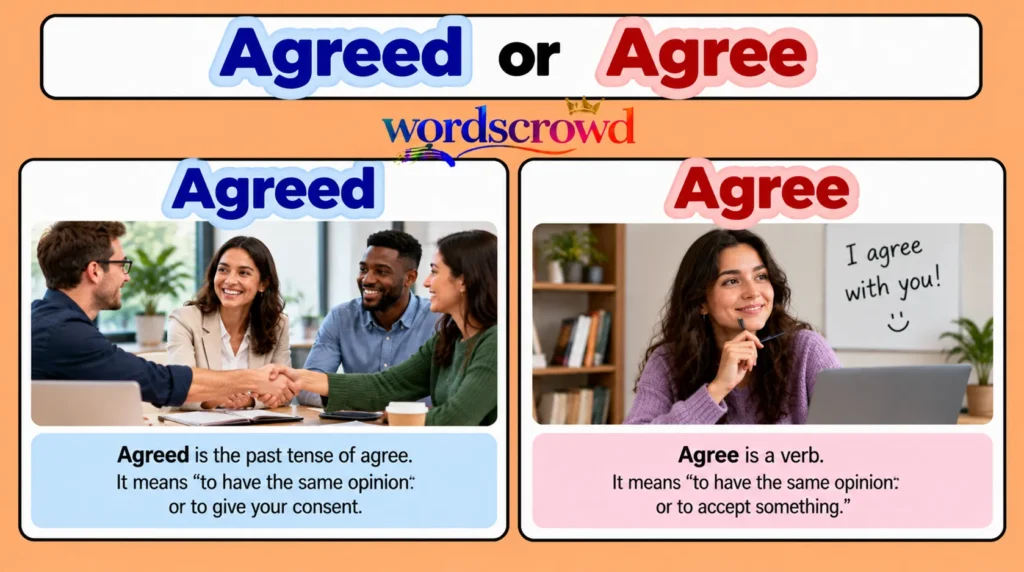
English can be surprisingly tricky when two forms come from the same verb. Agreed or agree is a perfect example. Both words are correct, both are extremely common, and both come from the same verb—but they do not always work in the same sentence. The confusion usually appears when someone wants to say that they share an opinion, accept a suggestion, or have reached a decision. Should you write “I agree” or “I agreed”? Is “agreed” simply a more formal version of “agree”? Can you say “Agreed!” by itself? And why does changing one word sometimes change the entire time … Read more
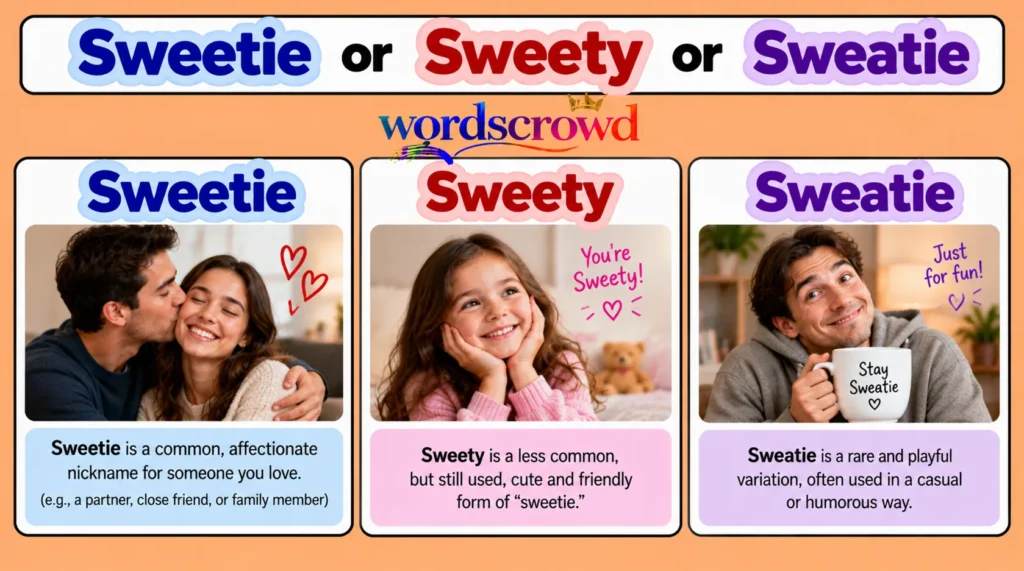
Sweetie or Sweety or Sweatie: Which Is Correct?

Have you ever typed “sweetie,” “sweety,” or “sweatie” and suddenly wondered whether you chose the right spelling? You are not alone. These three forms look almost identical, and they sound nearly the same when spoken. That makes this a surprisingly common English spelling question. The good news is that the answer is fairly simple: sweetie is the standard and safest spelling, while sweety is also a legitimate alternative spelling. Sweatie, however, is generally not the spelling you want when you mean a person you love, a kind person, or a friendly term of address. Major dictionaries support this distinction. Merriam-Webster … Read more

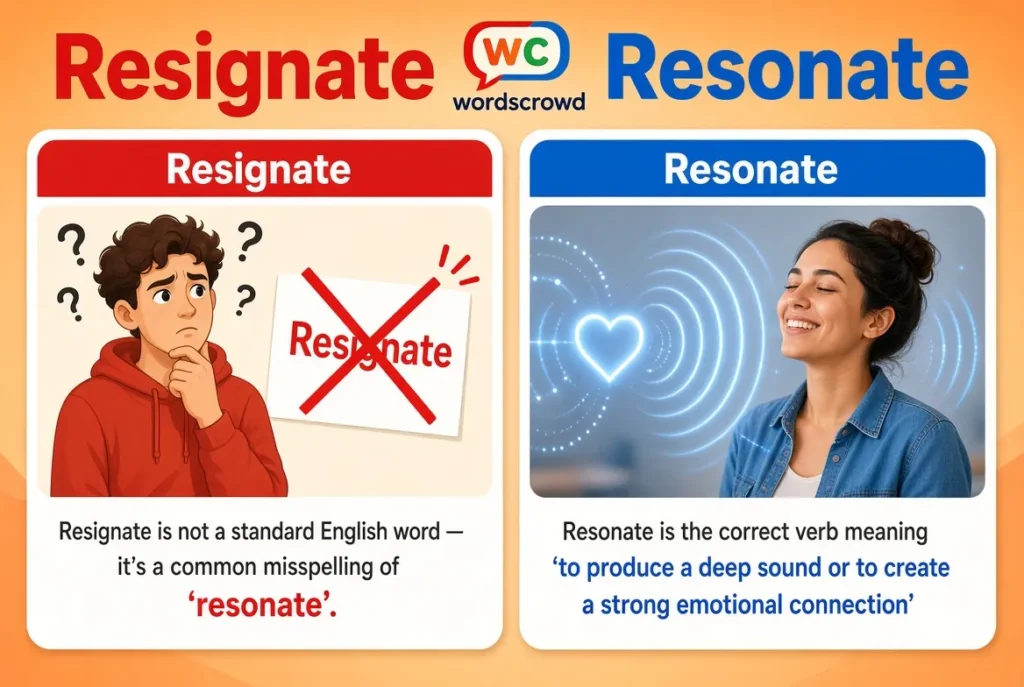
Resignate or Resonate? Which Word Is Correct?

Have you ever written “resignate” and then stopped to wonder, “Wait—is that actually the right word?” You are not alone. The confusion between resignate or resonate is surprisingly common because the two words look and sound similar, especially when spoken quickly. But there is an important difference: resonate is the standard English word used when something creates a strong emotional, personal, intellectual, or auditory effect. For example, you can say, “Her story resonated with me” or “The music resonated throughout the hall.” Major dictionary sources recognize resonate as an established English verb. Resignate, on the other hand, is not the … Read more

Its Self or Itself? The Correct Usage Explained

Have you ever typed “its self” and then stopped to wonder whether it should actually be “itself”? It is an easy mistake to make. English already has forms such as myself, yourself, himself, and herself, so it may seem logical that the reflexive form of it should be “its self.” In standard modern English, however, the normal reflexive form is “itself”—one word. We use itself when it refers back to the subject of a sentence, as in “The cat cleaned itself” or “The computer restarted itself.” Cambridge Grammar lists itself as the reflexive form corresponding to it, and major dictionaries … Read more

Copy That or Roger That: What’s the Difference?

“Copy that” and “roger that” sound almost identical when you hear them in movies, video games, military scenes, police dramas, or radio conversations. Both are short, confident ways to acknowledge what someone has said. So it is easy to wonder: Are copy that and roger that the same? Which one is correct? Does either phrase mean “yes” or “I will do it”? The short answer is that both phrases are correct, but their history, tone, and traditional radio meanings are not exactly the same. In ordinary conversation, people often use them interchangeably to mean “I received your message,” “I understand,” … Read more

Disoriented or Disorientated: Which Is Correct?

Have you ever written “I felt disoriented” and wondered whether it should be “I felt disorientated” instead? You are not alone. These two forms look almost identical, sound similar, and describe essentially the same experience: being confused, lost, or unsure of where you are or what to do. The good news is that both “disoriented” and “disorientated” are correct English. The main difference is not meaning but regional preference. Disoriented is especially common in American English, while disorientated is especially common in British English. Both forms are recognized by major dictionaries, and neither should automatically be treated as a spelling … Read more

There Have Been or There Has Been? The Correct Grammar

There have been or there has been—which one should you use? If you have ever paused while writing a sentence such as “There has been several changes” or “There have been a problem,” you are not alone. This is one of those English grammar questions that looks easy until a longer noun phrase gets in the way. The good news is that the basic rule is simple: “there has been” normally goes with a singular or uncountable subject, while “there have been” goes with a plural subject. The word there does not determine whether you need has or have. The … Read more

Sustain or Substain: Which Is Correct?

Have you ever written “substain” and then wondered whether it should actually be “sustain”? You are not alone. These two spellings look remarkably similar, and the pronunciation of sustain can make the spelling feel less obvious than it really is. The good news is simple: sustain is the correct English word. “Substain” is generally a misspelling of sustain. If you are writing an email, school assignment, business report, academic paper, social media post, or professional document, sustain is the spelling you should use. But spelling is only part of the story. Sustain has several important meanings. It can mean to … Read more

On the Plane or in the Plane? The Correct Choice ✈️

You are sitting inside an airplane, so it seems logical to say, “I’m in the plane.” But if you listen to native English speakers, you will usually hear, “I’m on the plane.” So which one is actually correct? The answer is that both “on the plane” and “in the plane” can be grammatically correct, but they are not equally natural in every situation. When you mean that you are traveling as a passenger or are aboard an aircraft, “on the plane” is the normal and preferred expression. When you want to emphasize the physical interior of the aircraft, “in the … Read more

Most Importantly or Most Important: Which Is Correct?

If you have ever written a sentence such as “Most importantly, we need to stay focused” and wondered whether it should actually be “Most important, we need to stay focused,” you are not alone. The two expressions look almost identical, sound natural in many of the same situations, and are both widely used in modern English. That makes most importantly or most important a surprisingly common grammar and style question. The good news is that you do not have to memorize a complicated rule. In most cases, most importantly is the traditional adverbial form used to introduce or emphasize an … Read more