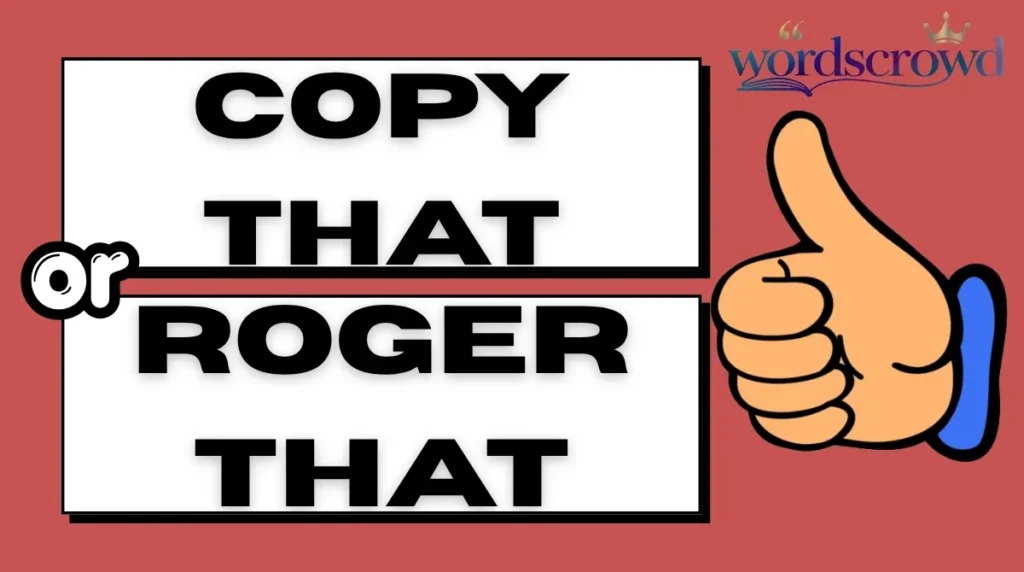
“Copy that” and “roger that” sound almost identical when you hear them in movies, video games, military scenes, police dramas, or radio conversations.
Both are short, confident ways to acknowledge what someone has said. So it is easy to wonder: Are copy that and roger that the same? Which one is correct? Does either phrase mean “yes” or “I will do it”?
The short answer is that both phrases are correct, but their history, tone, and traditional radio meanings are not exactly the same.
In ordinary conversation, people often use them interchangeably to mean “I received your message,” “I understand,” or simply “Got it.” In specialized radio communication, however, the distinction can matter.
“Roger” has a particularly interesting history. It was once the code word for the letter R in an older phonetic alphabet, where R represented received.
“Copy,” meanwhile, developed from the idea of receiving and recording a transmitted message.
There is another important point that is often missed: neither “copy that” nor “roger that” automatically means “I agree” or “I will comply.”
In formal aviation phraseology, roger acknowledges receipt, while wilco means that the message has been received, understood, and will be complied with.
This guide explains copy that or roger that from every useful angle: meaning, pronunciation, grammar, history, tone, modern usage, professional communication, aviation, military language, texting, social media, common mistakes, and real-life examples.
Quick Answer
“Copy that” and “roger that” are both correct expressions used to acknowledge a message.
- Copy that usually means “I received and understood that information.”
- Roger that traditionally means “I received your transmission.”
- In everyday English, the two are often used interchangeably.
- Neither phrase necessarily means “I agree” or “I will do it.”
- If you specifically need to promise compliance in radio terminology, “wilco” has that meaning.
Quick rule: In casual conversation, either can mean “Got it.” In specialized radio communication, use the established terminology for that field rather than relying on casual phrases.
Copy That or Roger That: Comparison Table
| Feature | Copy That | Roger That |
|---|---|---|
| Basic meaning | I received/understood your message | I received your transmission |
| Main function | Acknowledgment | Acknowledgment |
| Part of speech | Fixed conversational phrase | Fixed conversational phrase |
| Pronunciation | KOP-ee that | ROJ-er that |
| Tone | Direct, modern, casual | Radio-style, military, sometimes playful |
| Formal English | Usually not appropriate in formal prose | Usually not appropriate in formal prose |
| Everyday conversation | Common | Common, but more marked |
| Texting | Yes | Yes |
| Workplace chat | Sometimes | Sometimes, often humorous |
| Military/radio flavor | Strong | Very strong |
| Aviation relevance | Informal/non-standard in some contexts | Established radio terminology |
| Means “yes”? | Not necessarily | Not necessarily |
| Means “I agree”? | Not necessarily | Not necessarily |
| Means “I will comply”? | Not inherently | Not inherently |
| Can be humorous? | Very easily | Very easily |
| Best everyday equivalent | “Got it.” | “Understood.” |
| Traditional radio emphasis | Message received/copied | Transmission received |
| Recommended in formal academic writing? | No | No |
The most important distinction is context. In casual English, the semantic gap is small. In professional radio communication, precise terminology matters much more.
What Does “Copy That” Mean?
Definition of “Copy That”
“Copy that” is an informal acknowledgment meaning roughly:
“I received your message and understand what you said.”
The word copy has a special communication-related sense here. It does not mean making a duplicate of a document. In radio and telecommunications contexts, copy can refer to receiving or recording a transmitted message. The expression eventually became a familiar way of saying that a speaker’s message was received.
For example:
“The meeting has moved to Room 4.”
“Copy that.”
The response tells the speaker that the information was received.
Is “Copy That” Grammatically Correct?
Yes.
“Copy that” is a grammatically acceptable elliptical expression. In other words, it leaves out words that can be understood from context.
The full idea could be expressed as:
“I copy that message.”
or more naturally in ordinary English:
“I received and understood that.”
In radio communication, brevity is useful, so the shorter expression became conventional.
Pronunciation of “Copy That”
Copy that is pronounced approximately:
KOP-ee that
The stress falls naturally on the first syllable of copy.
When Should You Use “Copy That”?
Use it when you want to acknowledge information quickly.
It works especially well in:
- Casual conversation
- Team communication
- Text messages
- Online gaming
- Workplace chats
- Informal instructions
- Radio-style dialogue
- Jokes and playful conversations
For example:
“Please send the revised file before lunch.”
“Copy that.”
In everyday conversation, this is basically:
“Got it.”
“Copy That” in Professional Communication
The phrase can work in an informal workplace, particularly when colleagues already have a relaxed communication style.
For example:
Manager: “The client meeting is now at 2:30.”
Employee: “Copy that.”
However, in a formal email, “copy that” may sound overly casual or radio-like.
Instead, write:
- “Understood.”
- “Noted.”
- “Thank you. I’ve received the update.”
- “Understood. I’ll make the change.”
- “Thanks for letting me know.”
Compare:
Casual workplace chat:
“Copy that—I’ll update the spreadsheet.”
Formal email:
“Understood. I’ll update the spreadsheet accordingly.”
Both communicate clearly, but the second fits professional written English better.
“Copy That” in Academic Writing
Generally, avoid it in academic prose.
Academic writing usually requires complete, explicit statements rather than conversational radio expressions.
Instead of:
“Copy that.”
write:
“The information has been received and noted.”
or simply explain the relevant point directly.
Does “Copy That” Mean “I Will Do It”?
Not necessarily.
This is one of the most important distinctions.
If someone says:
“Send me the report by 4 p.m.”
and you reply:
“Copy that.”
you have acknowledged the instruction, but the phrase itself does not formally guarantee that you will complete it.
If you want to be completely clear, say:
“Understood. I’ll send it by 4 p.m.”
That removes ambiguity.
Tip: In everyday speech, listeners may interpret “copy that” as implying cooperation. But the phrase itself is primarily an acknowledgment, not a formal promise.
What Does “Roger That” Mean?
Definition of “Roger That”
“Roger that” is a traditional radio expression used to acknowledge receipt of a message.
In standardized aviation terminology, roger means that the speaker has received the last transmission. It should not be used as an answer to a yes-or-no question.
In modern everyday English, however, “roger that” is often understood more broadly as “Got it,” “Understood,” or “Message received.”
Why Is It Called “Roger”?
The history of roger is one of the most interesting parts of this comparison.
In an older phonetic alphabet, Roger represented the letter R. In radio communication, R was associated with received. As a result, “Roger” became a convenient way to indicate that a message had been received.
The expression later became familiar outside technical radio communication. NASA’s Apollo-era broadcasts helped expose phrases such as “Roger that” to a huge public audience, and the expression became part of popular English.
The modern NATO phonetic alphabet uses Romeo for R, not Roger, but the older expression roger that survived as a phrase.
Pronunciation of “Roger That”
Roger that is pronounced approximately:
ROJ-er that
The first syllable of Roger receives the main stress.
What Does “Roger That” Sound Like?
Outside actual radio communication, “roger that” can have a distinctive personality.
It may sound:
- Military
- Tactical
- Serious
- Confident
- Old-fashioned
- Playful
- Dramatic
For example:
“Please take out the trash before dinner.”
“Roger that, commander.”
The second speaker is probably joking. The phrase makes the simple instruction sound like a military operation.
Is “Roger That” Formal?
Not usually in ordinary English.
It comes from a formalized communication tradition, but that does not make it appropriate for formal business writing.
This distinction is important:
Formal origin ≠ formal modern English.
“Roger that” has a military and aviation background, but in a modern office it may sound casual, theatrical, or humorous.
For example:
“Roger that, sir. I shall proceed with the quarterly report.”
This sounds intentionally dramatic.
A normal professional version would be:
“Understood. I’ll proceed with the quarterly report.”
Does “Roger That” Mean “Yes”?
No—not automatically.
This is especially important in aviation and other structured radio communication.
If someone asks:
“Do you have the runway in sight?”
replying:
“Roger.”
does not provide a clear yes-or-no answer.
In standardized aviation phraseology, affirmative and negative are used for yes/no responses, while roger acknowledges receipt of the transmission.
Copy That or Roger That: The Key Differences
The difference becomes much easier once you stop treating these phrases as exact synonyms.
1. Their histories are different
Roger comes from historical radio phonetic terminology associated with R = received.
Copy developed from the practice of receiving, copying, or recording transmitted information.
Both became associated with acknowledgment, but they did not begin as identical expressions.
2. “Roger” has a stronger military-radio flavor
Compare:
“Copy that.”
with:
“Roger that.”
The first often sounds like ordinary modern teamwork.
The second immediately evokes:
- Pilots
- Soldiers
- Radio operators
- Mission control
- Police dispatch
- Action movies
- Video games
3. “Copy that” often sounds more modern
People use copy that casually to mean:
“Got it.”
For example:
“Bring your laptop tomorrow.”
“Copy that.”
It does not necessarily sound like you are pretending to be a pilot.
4. “Roger that” can sound playful
Because of its strong association with military and aviation dialogue, people often use it for humor.
“Your mission is to buy milk.”
“Roger that.”
The speaker is not necessarily communicating in an actual radio system. They are borrowing the style for fun.
5. Neither phrase should automatically be interpreted as agreement
This is the point many simplified explanations get wrong.
Acknowledgment is not the same as agreement.
If someone says:
“I think we should cancel the meeting.”
and you reply:
“Roger that.”
you have not necessarily said:
“I agree.”
You have acknowledged the statement.
If you mean agreement, say:
“I agree.”
or:
“That makes sense.”
6. Neither phrase automatically guarantees compliance
If someone gives you an instruction, these phrases can acknowledge it without explicitly stating that you will perform the task.
For clear modern communication:
“Understood. I’ll do it.”
is much more precise.
A Crucial Distinction: “Roger” vs. “Wilco”
If you have encountered roger, you may also have heard wilco.
These are not identical.
Roger = the transmission was received.
Wilco = the message was received, understood, and will be complied with.
The term wilco comes from “will comply.” Official aviation terminology distinguishes it from roger.
Example
Instruction:
“Proceed to the next checkpoint.”
Acknowledgment:
“Roger.”
This confirms receipt.
Compliance:
“Wilco.”
This indicates understanding and intended compliance.
In real aviation communication, however, specific instructions may require an appropriate readback rather than relying on a short acknowledgment. The FAA emphasizes appropriate acknowledgment and readback procedures because radio communication must avoid ambiguity.
Warning: Do not treat movie-style radio language as a substitute for actual aviation or emergency-service communication procedures.
Copy That or Roger That in Everyday English
Outside radio communication, the difference becomes much less rigid.
People frequently use both expressions to mean:
- Got it.
- Understood.
- I hear you.
- Message received.
- Okay, understood.
- I know what you mean.
Which Sounds More Natural?
For many modern casual situations:
“Copy that” sounds more contemporary.
“Roger that” sounds more stylized.
That does not mean “roger that” is wrong. It simply carries more cultural baggage.
Compare:
Friend: “Pick me up at seven.”
You: “Copy that.”
Natural and casual.
Friend: “Pick me up at seven.”
You: “Roger that.”
Also understandable, but slightly more dramatic.
Grammar: Are “Copy That” and “Roger That” Complete Sentences?
In conversational grammar, yes, they can function as stand-alone utterances.
They are examples of elliptical expressions: the full grammatical structure is shortened because the missing information is obvious from context.
“Copy That”
Historically, copy is functioning as a verb in this expression.
The implied structure is something like:
“I copy that.”
The object that refers to the message just transmitted.
But modern speakers generally do not analyze the phrase word by word. They treat copy that as a fixed expression.
“Roger That”
Roger functions as an acknowledgment term rather than as the ordinary personal name.
In:
“Roger that.”
the word that points back to the preceding transmission or message.
Again, the expression works as a fixed conversational unit.
Capitalization
At the beginning of a sentence:
Copy that.
Roger that.
In the middle of a sentence, lowercase is normal:
He replied, “roger that,” before leaving.
When Roger is being used as the radio term rather than the person’s name, capitalization can vary by editorial context. In ordinary published prose, writers often retain Roger because of its historical connection with the name, while style may depend on the publication.
Punctuation
As standalone acknowledgments, a period is standard:
Copy that.
Roger that.
An exclamation mark can add energy or humor:
Roger that!
In dialogue, punctuation depends on the surrounding sentence.
20 Real-Life Examples of “Copy That” and “Roger That”
1. Everyday Conversation
“Call me when you get home.”
“Copy that.”
Meaning: I understand.
2. Friendly Instruction
“Don’t forget your keys.”
“Roger that.”
Meaning: Got it.
3. Workplace Chat
“The presentation starts at 10 instead of 10:30.”
“Copy that. Thanks for the update.”
4. Team Project
“You handle the introduction, and I’ll do the conclusion.”
“Copy that.”
5. Text Message
“Bring two bottles of water.”
“Roger that.”
The expression may sound intentionally playful in texting.
6. Gaming
“Stay behind the team until the next checkpoint.”
“Copy that.”
This fits gaming communication naturally.
7. Social Media
“Rule number one: never trust the group chat.”
“Roger that 😂”
Here, the phrase adds humor rather than technical meaning.
8. Parent and Child
“Please clean your desk before dinner.”
“Copy that.”
This can sound playful or slightly sarcastic.
9. Friend Giving Directions
“Turn left after the pharmacy.”
“Roger that.”
The speaker is acknowledging the directions.
10. Business Chat
“Please update the figures in the final column.”
“Copy that. I’ll take care of it.”
Notice that the second sentence explicitly states the intended action.
11. Customer Service Team
“The customer has requested a callback tomorrow.”
“Copy that. I’ll add it to the schedule.”
12. Informal Email
“The deadline has moved to Friday.”
“Understood. Thanks for letting me know.”
This example shows that understood is usually better than “roger that” in formal email.
13. Academic Group Work
“Everyone needs to submit their section by Wednesday.”
“Copy that.”
Acceptable in conversation, but not ideal for an academic paper.
14. Teacher and Student
“Please bring your assignment tomorrow.”
“Roger that.”
The student is probably being playful.
15. Social Media Comment
“No spoilers until everyone finishes the episode.”
“Copy that!”
16. Family Group Chat
“Dinner is at 8 tonight.”
“Roger that.”
17. Office Instructions
“Please save the document under the new filename.”
“Copy that. I’ll update it now.”
18. Radio-Style Dialogue
“Unit three, proceed to the northern entrance.”
“Roger.”
This has a distinctly radio-oriented tone.
19. Clear Professional Response
Instead of:
“Roger that.”
a professional email might say:
“Understood. I’ll complete the requested changes today.”
20. Clear Commitment
Instead of relying on either phrase:
“Copy that.”
use:
“Understood. I’ll send the report before 4 p.m.”
This is better when the exact action matters.
Common Mistakes With “Copy That” and “Roger That”
Mistake 1: Thinking “Roger” means “Yes”
Wrong assumption:
Roger = Yes.
Better understanding:
Roger = Message received.
In formal radio communication, roger should not answer a question requiring yes or no.
Use:
“Yes.”
or, in standardized aviation terminology:
“Affirmative.”
Mistake 2: Thinking “Roger” Means “I Agree”
Someone says:
“I think your plan is too expensive.”
Replying:
“Roger that.”
does not clearly mean:
“I agree with you.”
If you agree, say:
“I agree.”
Mistake 3: Thinking “Copy That” Guarantees Action
Someone says:
“Send me the document tonight.”
You answer:
“Copy that.”
This acknowledges the request, but it does not clearly promise completion.
Better:
“Understood. I’ll send it tonight.”
Mistake 4: Using “Roger That” in Every Professional Situation
“Roger that” is correct English, but that does not make it appropriate for every setting.
Avoid it in:
- Formal reports
- Academic essays
- Legal documents
- Formal business letters
- Research papers
- Serious professional correspondence
Use:
- “Understood.”
- “Acknowledged.”
- “Noted.”
- “I confirm receipt.”
- “I understand.”
- “I’ll proceed accordingly.”
Mistake 5: Assuming “Copy That” Is Always More Correct
There is no universal rule saying copy that is the “correct” phrase and roger that is incorrect.
Both are established expressions.
The appropriate choice depends on context, tone, and communication system.
Mistake 6: Saying “Roger, Wilco” Without Understanding the Terms
Historically and conversationally, you may hear:
“Roger, wilco.”
But technically, the two terms overlap because wilco already includes receipt and understanding along with compliance. In standardized communication, the terms have distinct meanings.
Copy That vs. Roger That in Formal and Informal English
| Situation | Better Choice |
|---|---|
| Texting a friend | Copy that |
| Joking with friends | Roger that |
| Online gaming | Either |
| Casual workplace chat | Copy that |
| Formal business email | Understood |
| Academic essay | Neither |
| Academic presentation | Understood |
| Military-style dialogue | Roger that |
| Fictional radio dialogue | Roger that / Copy that |
| Aviation communication | Follow approved phraseology |
| Emergency communication | Follow official procedure |
| Confirming an email | “I received your email.” |
| Promising an action | “I’ll do that.” |
The central lesson is simple: correct English is not always the same as appropriate English.
Why Do People Confuse “Copy That” and “Roger That”?
There are several reasons.
They perform the same basic conversational job
Both phrases can acknowledge another person’s message.
Movies use them interchangeably
Action films, military dramas, television shows, and video games often use radio expressions for atmosphere. This can blur technical distinctions.
Both come from communication technology
Their histories are connected to radio and telecommunications, so they naturally appear in similar situations.
Everyday English has softened the distinction
Outside technical environments, speakers often use both simply to mean:
“Got it.”
That is why a strict dictionary-style separation can sometimes be less useful than explaining how people actually use the phrases.
Are “Copy That” and “Roger That” Slang?
They are informal expressions, but calling them simply “slang” can be misleading.
Both have roots in specialized communication systems, particularly radio language. Their modern conversational uses can be informal, but their histories are more technical than ordinary slang.
A useful classification is:
- Radio terminology
- Informal expression
- Conversational acknowledgment
- Military/aviation-associated language
- Popular-culture expression
Are They American or British English?
Neither phrase is exclusively American English.
Both are widely recognizable in English-speaking culture, especially because radio, aviation, military media, films, television, and gaming have spread them internationally.
However, the exact frequency and preferred terminology can differ between professional communication systems and countries.
For learners, the safest rule is:
Treat both as internationally recognizable informal expressions, not as formal universal substitutes for “yes,” “understood,” or “I will comply.”
When Should You Avoid Both Phrases?
Avoid both when clarity is more important than style.
For example, if your manager says:
“Please send the signed contract to the client by 3 p.m.”
Instead of:
“Roger that.”
say:
“Understood. I’ll send the signed contract by 3 p.m.”
The second response clearly communicates:
- You received the instruction.
- You understood it.
- You intend to complete it.
- You know the deadline.
That is much more useful in professional communication.
Better Alternatives to “Copy That” and “Roger That”
Depending on what you actually mean, choose a more precise phrase.
If you mean “I heard you”
Say:
- “I hear you.”
- “Got it.”
- “I received your message.”
If you mean “I understand”
Say:
- “Understood.”
- “I understand.”
- “Got it.”
If you mean “I agree”
Say:
- “I agree.”
- “Absolutely.”
- “That makes sense.”
If you mean “I will do it”
Say:
- “I’ll do that.”
- “Understood. I’ll take care of it.”
- “I’ll handle it.”
If you mean “I received the email”
Say:
- “I received your email.”
- “Thank you. I’ve received the document.”
- “Confirmed receipt.”
If you mean “I will comply” in specialized radio terminology
Wilco may be appropriate where that terminology is actually prescribed. In aviation, however, follow the applicable communication procedures rather than relying on casual radio expressions.
Memory Tricks
You do not need to memorize complicated definitions.
Memory Trick 1: Copy = Capture
Think:
Copy = I got the message.
You “copy” information when you receive it.
Memory Trick 2: Roger = Received
Think:
Roger → Received.
Historically, the R in the older radio alphabet was associated with received.
Memory Trick 3: Wilco = Will Comply
This one is especially easy:
Wilco = Will Comply.
So:
- Copy → message received/understood
- Roger → transmission received
- Wilco → received + understood + will comply
Memory Trick 4: Think of the Tone
If you want something that sounds modern and casual:
Copy that.
If you want something that sounds like a radio operator:
Roger that.
If you want to state a clear commitment:
I’ll do it.
That last option is often the best in ordinary professional English.
Frequently Asked Questions
Is “copy that” the same as “roger that”?
They are very similar, especially in casual conversation. Both acknowledge a message. Traditionally, roger specifically acknowledges receipt of the last transmission, while copy is associated with receiving or recording a transmitted message. In everyday English, speakers often use them interchangeably.
Which is more common: “copy that” or “roger that”?
Both are recognizable, but their usage depends heavily on context. Copy that often feels more modern and conversational, while roger that has a stronger military, aviation, or radio flavor.
Does “roger that” mean “yes”?
No. In standardized radio communication, roger means that the previous transmission was received. It should not be used as an answer to a yes-or-no question.
Does “copy that” mean “I agree”?
No. It primarily acknowledges information. If you want to express agreement, say “I agree,” “Absolutely,” or another clear agreement phrase.
Does “roger that” mean “I will do it”?
Not by itself. In aviation terminology, wilco indicates that a message has been received, understood, and will be complied with.
Is “copy that” formal English?
It is correct but generally informal. It works in casual speech, team chats, gaming, and radio-style conversation. For formal emails and academic writing, understood, noted, or a complete sentence is usually better.
Is “roger that” still used today?
Yes. It remains recognizable in radio communication and is also widely used in popular culture, casual conversation, movies, television, gaming, and humorous situations. Its historical radio meaning has survived even though the older phonetic alphabet that used “Roger” for R has been replaced.
Can I use “copy that” in an email?
You can, especially in an informal workplace email or internal message, but it may sound casual. For a professional email, “Understood,” “Noted,” or “Thanks, I’ll take care of it” usually sounds more natural.
Which phrase should English learners use?
For ordinary conversation, “Got it” or “Understood” is often the safest choice. Use copy that when you want a casual radio-style acknowledgment, and roger that when you deliberately want that military or radio flavor.
Final Verdict: Copy That or Roger That?
So, copy that or roger that—which one should you use?
The answer is: both are correct, but neither is universally better.
Copy that is a conversational acknowledgment that generally means “I received and understood that information.” It sounds relatively modern, direct, and casual.
Roger that comes from older radio communication and traditionally acknowledges receipt of a transmission. In everyday English, it can also mean “Got it” or “Understood,” but it often carries a stronger military, aviation, or playful tone.
The biggest mistake is assuming either phrase automatically means “yes,” “I agree,” or “I will do it.” Those meanings require clearer language when precision matters.
The easiest rule to remember
- Copy that = “Got it.”
- Roger that = “Message received.”
- I agree = “I agree.”
- I’ll do it = “I’ll do it.”
- Wilco = “I understand and will comply” in established radio terminology.
For casual conversation, copy that is often the more natural modern choice.
For a playful military or radio tone, roger that is perfect.
For formal business, academic writing, or situations where misunderstanding could matter, skip both and say exactly what you mean.
In other words, the real lesson behind copy that or roger that is not simply choosing one phrase. It is understanding that good communication depends on context, precision, and intent. When “Got it” is enough, either expression can work. When the stakes are high, clear language beats radio-style shorthand every time.

Elon Parker is a dedicated writer at Wordscrowd, creating clear, informative, and engaging content for readers.
With a focus on useful information, Elon aims to make every article simple, reliable, and easy to understand.