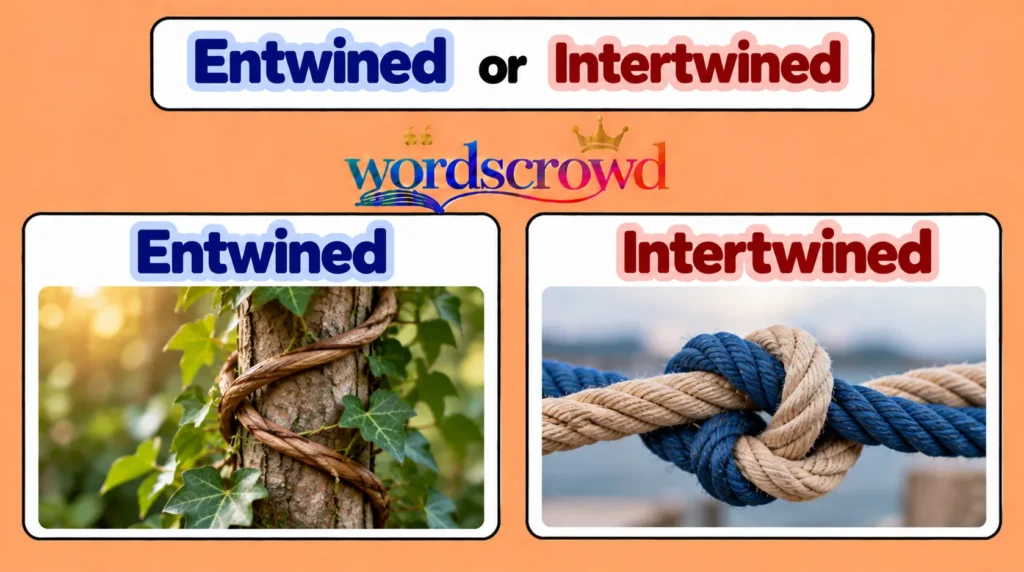
Have you ever written a sentence and stopped at “entwined or intertwined” because both words seemed to fit? You are not alone.
These two words are extremely close in meaning, and in many sentences, either one can describe things that are twisted, connected, or closely mixed together.
The confusion comes from the fact that entwined and intertwined share the same basic idea: things becoming closely connected by winding, twisting, mixing, or linking together.
However, they are not always identical in tone or emphasis. Entwined can suggest that two or more things are closely connected or wrapped around each other, while intertwined often emphasizes the idea of things being woven or mixed together with one another.
For example, you might say that two vines are entwined around a tree, while two cultures have become intertwined over centuries.
Both choices are grammatically correct, but the second word often feels especially natural when discussing relationships, histories, ideas, systems, or abstract connections.
This guide explains entwined or intertwined in plain English. You will learn what each word means, how the words differ, how they are pronounced, where they come from, which one sounds more natural in different situations, and how to use them in everyday, academic, professional, and creative writing.
Quick Answer
Entwined and intertwined are both correct words. They are closely related and can sometimes be used interchangeably.
- Entwined usually means closely twisted, wrapped, or connected.
- Intertwined usually emphasizes two or more things being woven, mixed, or connected with one another.
- Use entwined naturally for physical wrapping and close personal connections.
- Use intertwined especially often for ideas, histories, lives, cultures, systems, and relationships.
Neither word is incorrect. The best choice depends on context and the emphasis you want.
Entwined or Intertwined: At a Glance
| Feature | Entwined | Intertwined |
|---|---|---|
| Basic meaning | Closely twisted, wrapped, or connected | Twisted, woven, or closely connected with one another |
| Part of speech | Verb form / adjective | Verb form / adjective |
| Base verb | Entwine | Intertwine |
| Pronunciation | /ɪnˈtwaɪnd/ | /ˌɪntərˈtwaɪnd/ |
| Physical use | Very common | Very common |
| Abstract use | Common | Extremely common |
| Relationships | Natural | Natural |
| Ideas | Possible | Especially natural |
| Histories | Possible | Especially natural |
| Cultures | Possible | Especially natural |
| Formal writing | Appropriate | Appropriate |
| Creative writing | Very common | Very common |
| Everyday conversation | Natural | Natural |
| Meaning of physical wrapping | Strong | Strong |
| Emphasis on mutual connection | Moderate to strong | Strong |
| US English | Correct | Correct |
| UK English | Correct | Correct |
| Spelling difference by region | None | None |
| Is one wrong? | No | No |
| Are they interchangeable? | Sometimes | Sometimes |
| Best memory | “Wrapped or closely connected” | “Woven together” |
Bottom line: There is no universal winner. Entwined and intertwined overlap heavily, but intertwined often works better when you want to emphasize mutual connection, while entwined can feel more direct, compact, or physical.
What Does “Entwined” Mean?
Entwined is the past participle and past-tense form of the verb entwine. It means that something has been twisted, wrapped, or closely connected with something else.
The word can describe both physical objects and abstract relationships.
Simple Definition of Entwined
Entwined means twisted, wrapped, or closely connected together.
Consider these examples:
- The branches were entwined above the garden path.
- Their fingers were entwined as they walked.
- Their lives became entwined after years of friendship.
- The story is entwined with the history of the town.
In the first two examples, the connection is physical. In the last two, entwined is metaphorical.
Entwined as a Verb Form
The base verb is entwine.
Common forms include:
- entwine — present/base form
- entwines — third-person singular
- entwined — past tense
- entwined — past participle
- entwining — present participle
Examples:
The vines entwine around the fence.
The vine entwines around the old post.
The branches entwined as they grew.
The plants have entwined themselves around the railing.
Entwined as an Adjective
Entwined can also function as an adjective.
For example:
They sat beneath the entwined branches.
Here, entwined describes the branches.
This is common in descriptive and literary writing because the word creates a strong visual image.
The Physical Meaning of Entwined
The most literal sense involves things that are physically twisted or wrapped together.
Think about:
- vines around a tree
- fingers held together
- strands of hair
- branches
- ropes
- wires
- roots
- ribbons
- arms
For example:
The two climbing plants were entwined around the wooden frame.
The image is easy to visualize: the plants have grown around and through each other.
The Abstract Meaning of Entwined
English speakers also use entwined metaphorically.
Things do not have to be physically twisted to be entwined.
You can have:
- entwined lives
- entwined destinies
- entwined stories
- entwined emotions
- entwined relationships
- entwined histories
For example:
Their careers became entwined after they started working together.
No physical twisting is involved. The word means their careers became closely connected.
Is “Entwined” Formal or Informal?
Entwined works in both formal and informal English.
It can appear in:
- everyday conversation
- novels
- journalism
- academic writing
- business writing
- historical writing
- poetry
- speeches
Its tone can sometimes feel literary or expressive, particularly when it describes emotions, love, fate, or relationships.
For example:
Their fates were forever entwined.
This sounds more literary than:
Their lives became closely connected.
Origin of Entwined
Entwine is formed from en-, meaning roughly “in” or “into,” and twine, referring to twisting or winding things together.
The word is related to twine, which also gives English words such as twisted and twining. Its history reflects the physical idea of winding one thing around another.
That physical meaning later developed naturally into metaphorical uses involving relationships, stories, histories, and ideas.
What Does “Intertwined” Mean?
Intertwined is the past participle and past-tense form of intertwine. It means twisted or woven together, especially so that the parts are closely connected with one another.
Like entwined, it has both literal and figurative meanings.
Simple Definition of Intertwined
Intertwined means closely woven, mixed, twisted, or connected with one another.
Examples include:
- The branches were intertwined.
- Their fingers were intertwined.
- The two stories are intertwined.
- Economics and politics are deeply intertwined.
- Their histories are intertwined.
The word is particularly useful when several elements influence or connect with each other.
Intertwined as a Verb Form
The base verb is intertwine.
Its common forms are:
- intertwine
- intertwines
- intertwined
- intertwining
Examples:
The roots intertwine beneath the soil.
The two paths intertwined near the river.
Their stories have become intertwined.
The traditions are intertwining in unexpected ways.
Intertwined as an Adjective
Like entwined, intertwined can work as an adjective.
For example:
The novel follows two intertwined families.
The word describes the families as closely connected.
The Physical Meaning of Intertwined
The literal meaning involves things crossing, winding, or weaving together.
Examples include:
- intertwined branches
- intertwined roots
- intertwined wires
- intertwined threads
- intertwined vines
- intertwined fingers
For example:
The tree had a network of intertwined roots beneath the surface.
The roots are not simply next to each other. They cross and wind among one another.
The Abstract Meaning of Intertwined
This is where intertwined becomes especially useful.
English commonly uses it for concepts that are strongly connected:
- intertwined cultures
- intertwined histories
- intertwined economies
- intertwined identities
- intertwined interests
- intertwined traditions
- intertwined stories
- intertwined lives
- intertwined relationships
- intertwined causes
For example:
Technology and education have become increasingly intertwined.
The sentence does not mean that technology and education physically twist together. It means they are closely connected and affect one another.
Why “Intertwined” Often Sounds More Natural for Ideas
The prefix inter- carries the idea of between, among, or mutually.
That makes intertwined particularly effective when several things are connected with each other.
Compare:
The histories of the two countries are entwined.
This is perfectly acceptable.
The histories of the two countries are intertwined.
This often gives a stronger sense that the histories developed together and affected each other.
That distinction is subtle rather than absolute.
Origin of Intertwined
Intertwine combines inter-, meaning “between” or “among,” with twine, referring to twisting or winding.
Its structure therefore reinforces the modern meaning: things become twisted or woven together with one another.
This is one reason intertwined is so effective when describing reciprocal relationships.
Entwined vs Intertwined: The Key Differences
The difference is not a strict grammar rule. Instead, it is mainly about emphasis, imagery, and context.
1. Entwined Can Emphasize Wrapping or Close Attachment
Entwined often creates an image of one thing being wrapped around another.
The ivy was entwined around the wall.
The image is direct and physical.
2. Intertwined Can Emphasize Mutual Connection
Intertwined often suggests that two or more things are woven together.
Their professional lives became intertwined.
The emphasis is on the relationship between the two lives.
3. Intertwined Is Especially Strong for Abstract Concepts
You will frequently see intertwined with words such as:
- history
- culture
- politics
- economics
- identity
- society
- technology
- tradition
- relationships
- fate
For example:
Science and technology are deeply intertwined.
4. Entwined Can Feel More Literary
Entwined is particularly common in creative descriptions.
Their hands remained entwined as the music played.
Two lovers walked beneath the entwined branches.
It can create a romantic, poetic, or visual tone.
5. Both Can Describe People and Relationships
Both words can be used for emotional or personal connections.
Their lives became entwined.
Their lives became intertwined.
Both sentences are correct.
The second may slightly emphasize the idea that their lives became woven together through shared experiences.
6. Neither Word Is the “Correct” One in Every Situation
This is the most important point.
Do not think:
entwined = correct
intertwined = incorrect
or:
intertwined = modern
entwined = outdated
That is not how the distinction works.
Both are standard English words.
The choice depends on the sentence and the effect you want.
Grammar: How to Use Entwined and Intertwined Correctly
Both words are related to verbs and can function as participles or adjectives.
Verb Structure
The basic patterns are:
entwine + object
The vines entwined the fence.
intertwine + object
The vines intertwined the branches.
However, both verbs are also frequently used with with or around, depending on the intended meaning.
“Entwined With”
This structure is common when describing close connection.
Her personal story was entwined with the history of the village.
Their future became entwined with the company’s success.
“Entwined Around”
Use around when something wraps around something else.
The vines were entwined around the tree.
A scarf was entwined around her neck.
“Intertwined With”
This is extremely common for relationships and abstract connections.
The two traditions are deeply intertwined with each other.
His career became intertwined with the development of the industry.
“Intertwined With Each Other”
This phrase emphasizes mutual connection.
Their stories became intertwined with each other.
Often, however, with each other is unnecessary because intertwined already suggests a mutual relationship.
A cleaner version is:
Their stories became intertwined.
Can You Say “Intertwined Together”?
You will sometimes encounter intertwined together, especially in casual or descriptive writing.
However, intertwined already contains the idea of things being woven or twisted together. Therefore, together can be redundant.
Instead of:
Their lives were intertwined together.
Prefer:
Their lives were intertwined.
Or:
Their lives became closely intertwined.
Entwined or Intertwined in American and British English
There is no major US-versus-UK spelling difference between these words.
American English uses:
- entwined
- intertwined
British English also uses:
- entwined
- intertwined
The distinction is therefore not like color/colour or center/centre.
Writers in both varieties of English use both words.
Is One More American?
No clear regional rule says that entwined belongs to American English while intertwined belongs to British English, or vice versa.
Both are standard in both varieties.
Is One More Formal?
Neither is inherently formal or informal.
However, intertwined can be especially common in formal explanatory writing because it works well for abstract relationships.
For example:
Economic development is closely intertwined with infrastructure investment.
That sounds natural in an academic or professional context.
Real-Life Examples of Entwined and Intertwined
The easiest way to understand the difference is to see the words in different settings.
Everyday Conversation
- Our fingers were entwined as we walked through the park.
- The cables became entwined behind the desk.
- The two vines are completely intertwined.
- Their lives have been intertwined for years.
Text Messages
- Our plans are so intertwined that changing one affects everything else.
- Those headphone wires are totally entwined again!
Social Media
- Two journeys, one beautiful story—our lives are forever entwined.
- Coffee, books, and rainy mornings: three things permanently intertwined.
School Writing
- The novel shows how the characters’ lives become intertwined.
- The roots were entwined around the rocks.
Academic Writing
- Economic growth and environmental policy are closely intertwined.
- The development of language is deeply intertwined with social change.
- The country’s political and cultural histories are intertwined.
Business Writing
- Customer satisfaction and employee engagement are closely intertwined.
- The company’s growth is intertwined with changes in consumer behavior.
Professional Communication
- Our two projects have become increasingly intertwined.
- The team’s goals are closely intertwined with the organization’s long-term strategy.
Creative Writing
- Moonlight fell across the entwined branches.
- Their destinies seemed entwined from the moment they met.
- Two ancient trees stood with their trunks and roots intertwined.
Historical Writing
- The histories of the neighboring communities are deeply intertwined.
- Trade and migration became entwined over several centuries.
Relationships
- Their families have been intertwined for generations.
- The couple’s lives became deeply entwined after years of shared experiences.
Technology
- Modern education and digital technology are increasingly intertwined.
- Our personal and professional lives are often intertwined by technology.
Entwined or Intertwined With: Which Sounds Better?
Both structures are correct, but context can influence which sounds more natural.
Use “Entwined With” for Close Attachment
Her identity was entwined with the traditions of her hometown.
This suggests a deep personal connection.
Use “Intertwined With” for Mutual Relationships
The two economies are intertwined with one another.
This strongly suggests reciprocal influence.
Compare:
His story is entwined with the town’s history.
This sounds natural and somewhat literary.
The town’s history is intertwined with its economic development.
This sounds especially natural in analytical or academic writing.
Common Mistakes With Entwined and Intertwined
Because the meanings overlap, most mistakes involve word choice, redundancy, or awkward sentence structure rather than basic grammar.
Mistake 1: Treating One Word as Incorrect
Incorrect assumption:
“Intertwined” is correct, but “entwined” is wrong.
Why it is wrong:
Both words are standard English.
Better understanding:
Both entwined and intertwined are correct; context determines which is more suitable.
Mistake 2: Adding Unnecessary “Together”
Awkward:
Their lives were intertwined together.
Better:
Their lives were intertwined.
The word intertwined already conveys the idea of being woven or connected together.
Mistake 3: Using “Intertwined” When You Mean Simple Contact
Weak:
The two books were intertwined on the table.
If the books are merely touching, intertwined is probably too strong.
Better:
The two books were lying beside each other.
Use intertwined when there is a meaningful crossing, weaving, mixing, or close connection.
Mistake 4: Using “Entwined” for a Simple Association
Awkward:
The two departments are entwined because they share an office.
Sharing an office does not necessarily mean the departments are deeply connected.
Better:
The two departments work closely together.
Or, if their functions genuinely depend on each other:
The two departments are closely intertwined.
Mistake 5: Confusing “Entwine” With “Entwined”
Wrong:
Their lives have entwine.
Correct:
Their lives have entwined.
Or:
Their lives have become entwined.
After have/has/had, use the past participle entwined.
Mistake 6: Confusing “Intertwine” With “Intertwined”
Wrong:
The two stories are intertwine.
Correct:
The two stories are intertwined.
After are, the adjective/past participle intertwined is appropriate here.
Mistake 7: Overusing Both Words in the Same Sentence
Awkward:
The intertwined and entwined branches were woven together.
This piles up several expressions that communicate almost the same idea.
Better:
The branches were tightly intertwined.
Or:
The branches were entwined around the old tree.
Entwined vs Intertwined in Professional Writing
When writing reports, essays, articles, proposals, or business documents, choose the word that communicates the relationship most precisely.
Choose “Intertwined” for Systems
Marketing and product development are closely intertwined.
This works well because the two areas influence each other.
Choose “Intertwined” for Multiple Factors
Several factors are intertwined in the decision-making process.
This suggests a network of connected influences.
Choose “Entwined” for a Strong Narrative Connection
The company’s history is entwined with the development of the region.
This can sound more elegant and narrative-driven.
Academic Writing Tip
In academic writing, intertwined is often a strong choice for describing complex relationships.
For example:
Language, identity, and culture are deeply intertwined.
The word immediately tells the reader that the concepts cannot easily be separated.
However, do not choose it simply because it sounds academic. Precision matters more than formality.
Entwined vs Intertwined in Creative Writing
Creative writing gives you more freedom.
Entwined can create a vivid image:
Their fingers remained entwined beneath the table.
It can also suggest romance or destiny:
Their lives seemed destined to remain entwined.
Intertwined can create a richer sense of multiple elements weaving together:
Their memories became intertwined with the sounds of the old house.
The choice depends on the image and emotional effect you want.
Which Sounds More Romantic?
Both can sound romantic.
However, entwined often has a slightly more poetic or intimate feel.
Compare:
Their hands were entwined.
with:
Their hands were intertwined.
Both are natural. Entwined can feel softer and more literary, while intertwined can emphasize the physical weaving.
Common Collocations With “Entwined”
A collocation is a word combination that commonly appears together in natural English.
Useful combinations include:
- entwined branches
- entwined vines
- entwined roots
- entwined fingers
- entwined hands
- entwined arms
- entwined lives
- entwined destinies
- entwined stories
- entwined histories
- closely entwined
- deeply entwined
- forever entwined
- emotionally entwined
- tightly entwined
Examples:
Their fingers were tightly entwined.
The two families became deeply entwined.
Common Collocations With “Intertwined”
Common combinations include:
- intertwined roots
- intertwined branches
- intertwined vines
- intertwined fingers
- intertwined lives
- intertwined stories
- intertwined histories
- intertwined cultures
- intertwined traditions
- intertwined relationships
- intertwined interests
- intertwined systems
- intertwined economies
- intertwined identities
- intertwined causes
- intertwined factors
- deeply intertwined
- closely intertwined
- increasingly intertwined
- inextricably intertwined
Examples:
The two cultures have deeply intertwined traditions.
The issues are closely intertwined.
Technology and communication are increasingly intertwined.
Synonyms for Entwined and Intertwined
Depending on context, you may be able to replace either word with:
- woven together
- connected
- linked
- joined
- twisted together
- wrapped around
- interconnected
- mixed
- merged
- bound together
- closely related
- interlocked
But these are not perfect synonyms in every situation.
For example:
The vines were intertwined.
You could say:
The vines were twisted together.
But:
Economics and politics are intertwined.
is more precise than:
Economics and politics are twisted together.
The metaphor changes, so choose the synonym carefully.
What Is the Opposite of Entwined or Intertwined?
The opposite depends on the context.
Possible alternatives include:
- separate
- detached
- disconnected
- independent
- divided
- isolated
- untangled
- disentangled
- unconnected
For physical objects:
The wires were intertwined.
Opposite:
The wires were separated.
For abstract concepts:
Their interests were intertwined.
Opposite:
Their interests were independent.
Memory Tricks for Entwined vs Intertwined
If you keep mixing up these words, use one of these simple tricks.
Memory Trick 1: “Inter” Means Between
Think of inter- as meaning between or among.
So:
inter + twine → intertwine
Imagine several things weaving between and among one another.
That makes intertwined a great choice for:
- systems
- cultures
- histories
- ideas
- relationships
- factors
Memory Trick 2: “Twine” Means Twist
Both words contain twine.
Think:
twine = twist
So both entwined and intertwined involve some kind of twisting or close connection.
Memory Trick 3: Entwined = Wrapped
Remember:
ENTWINED → wrapped or closely attached
Think of a vine wrapping around a tree.
Memory Trick 4: Intertwined = Woven Together
Remember:
INTERTWINED → woven together
Think of two or more threads crossing each other repeatedly.
The Easiest Rule
If you need one quick rule, use this:
Entwined = closely wrapped or connected.
Intertwined = closely woven or mutually connected.
But remember that this is a practical guide, not an absolute grammar rule.
When Should You Use “Entwined”?
Choose entwined when:
- You are describing something physically wrapped around something else.
- You want a vivid or literary image.
- You are describing close personal attachment.
- You are talking about lives or destinies.
- You want a shorter alternative to intertwined.
- The relationship feels intimate or tightly connected.
Examples:
The ivy was entwined around the balcony.
Their fingers were entwined.
Their destinies became entwined.
When Should You Use “Intertwined”?
Choose intertwined when:
- Two or more things are woven together.
- Several factors influence one another.
- You are describing systems or processes.
- You are discussing cultures or histories.
- You are writing analytically or academically.
- You want to emphasize mutual or reciprocal connection.
Examples:
Politics and economics are deeply intertwined.
The two histories are intertwined.
Several causes are intertwined in this problem.
Can Entwined and Intertwined Be Interchanged?
Sometimes, yes.
Consider:
Their lives became entwined.
and:
Their lives became intertwined.
Both are natural.
Likewise:
The vines were entwined around the tree.
and:
The vines were intertwined around the tree.
Both can work, although the exact imagery and preferred phrasing may vary.
The important point is that interchangeability depends on context.
When Interchanging Them Changes the Feel
Compare:
Their destinies were entwined.
This has a poetic, almost romantic tone.
Their destinies were intertwined.
This also sounds natural, but may place slightly more emphasis on how the two paths became connected.
Now consider:
Economic policy and social welfare are intertwined.
This sounds highly natural.
Economic policy and social welfare are entwined.
This is grammatical, but it can sound more literary and less analytical.
A Simple Decision Guide
When you are unsure which word to use, follow these steps.
Step 1: Are Things Physically Twisted Together?
If yes, either may work.
The vines were entwined.
The vines were intertwined.
Step 2: Is One Thing Wrapped Around Another?
Entwined is often a particularly natural choice.
The vine was entwined around the fence.
Step 3: Are Several Ideas or Systems Connected?
Prefer intertwined.
Technology and education are intertwined.
Step 4: Are You Writing About Lives, Love, or Fate?
Either can work.
For a poetic feel, entwined can be excellent.
Their lives were forever entwined.
For emphasis on shared development, intertwined also works:
Their lives became deeply intertwined.
Step 5: Are You Writing Academic or Analytical Prose?
Intertwined is often the safer stylistic choice when discussing complex relationships.
Culture and language are closely intertwined.
Quick Examples: Which One Would You Choose?
| Sentence | Best Natural Choice | Why |
|---|---|---|
| The vines were ___ around the tree. | Entwined | Strong wrapping image |
| Politics and economics are ___. | Intertwined | Mutual abstract relationship |
| Their fingers were ___. | Entwined | Intimate physical image |
| The two cultures are deeply ___. | Intertwined | Cultural connection |
| Their destinies were forever ___. | Entwined | Poetic tone |
| The roots were ___. | Either | Both describe physical crossing |
| Their stories became ___. | Either | Both express close connection |
| Several factors are ___. | Intertwined | Multiple connected factors |
| The branches were ___. | Either | Both are natural |
| Her life was ___ with the history of the town. | Entwined | Literary close connection |
Frequently Asked Questions
Is entwined or intertwined correct?
Both are correct. They are standard English words with closely related meanings. Entwined often suggests being wrapped or closely connected, while intertwined often emphasizes things being woven or connected with one another.
Is intertwined a stronger word than entwined?
Not necessarily. Intertwined can emphasize mutual or complex connection, especially with abstract concepts, while entwined can emphasize close attachment or wrapping. Neither is simply a “stronger” version.
Can I use entwined and intertwined interchangeably?
Sometimes. In sentences such as “Their lives were entwined/intertwined,” both choices are natural. However, the preferred word can change depending on whether you want to emphasize wrapping, intimacy, mutual influence, or complex connection.
Is entwined a real word?
Yes. Entwined is the past tense and past participle of entwine, and it can also function as an adjective. It is a standard English word.
Is intertwined more formal than entwined?
Neither word is strictly formal or informal. However, intertwined is especially common in academic, analytical, and professional writing when discussing connected systems, ideas, cultures, histories, or factors.
What is the difference between entwined and intertwined lives?
There is very little difference in basic meaning. Entwined lives can sound more literary or intimate, while intertwined lives can emphasize how the lives became closely woven together through shared experiences.
Should I say “intertwined together”?
Usually, simply saying intertwined is cleaner. Because intertwined already expresses the idea of things being woven or twisted together, together can be unnecessary.
Is “entwined with” grammatically correct?
Yes. Entwined with is a standard construction.
For example:
Her story was entwined with the history of the city.
Is “intertwined with” grammatically correct?
Yes. Intertwined with is also standard and very common.
For example:
Economic development is closely intertwined with education.
Which is better for academic writing: entwined or intertwined?
Intertwined is often the more natural choice for academic writing when discussing relationships among ideas, systems, historical events, or social factors. However, entwined is not incorrect and can be appropriate when its tone and meaning fit the context.
Final Verdict: Entwined or Intertwined?
So, entwined or intertwined—which should you use?
The answer is: both are correct, but they are not always equally natural in every context.
Use entwined when you want to emphasize something being wrapped, closely attached, or poetically connected. It works especially well with physical objects, fingers, vines, branches, lives, and destinies.
Use intertwined when you want to emphasize things being woven together or mutually connected. It is especially useful for histories, cultures, economies, systems, ideas, identities, relationships, and multiple factors.
The Best Practical Rule
Choose “entwined” for close wrapping or an intimate/literary connection.
Choose “intertwined” for mutual, complex, or woven connections.
But do not worry if you occasionally switch them. Their meanings overlap substantially, and native speakers use both in many of the same contexts.
Final Quick Summary
- Entwined = twisted, wrapped, or closely connected.
- Intertwined = twisted, woven, or closely connected with one another.
- Both are grammatically correct.
- Neither is a misspelling of the other.
- Neither is specifically American or British.
- Entwined can sound more poetic or intimate.
- Intertwined is especially natural for abstract relationships and complex systems.
- For academic and analytical writing, intertwined is often a strong choice.
- For creative and romantic writing, entwined can create a beautiful, vivid effect.
- When both fit, choose the one that best matches the image, tone, and relationship you want to express.
In short, don’t ask which word is universally “correct.” Ask what you want the reader to picture. If you mean wrapped or closely attached, entwined may be the perfect choice. If you mean woven together or mutually connected, intertwined will often sound more precise.

Elon Parker is a dedicated writer at Wordscrowd, creating clear, informative, and engaging content for readers.
With a focus on useful information, Elon aims to make every article simple, reliable, and easy to understand.