Have you ever written sun when you meant son, or wondered whether these two words have the same meaning? You’re not alone.
Sun vs son is a common English word comparison because both words sound exactly alike but describe completely different things.
The confusion happens because sun and son are homophones. They share the same pronunciation, but their spelling, meanings, and uses are different.
One is the bright star that gives Earth light and warmth. The other describes a male child in relation to their parent.
Although the difference seems simple, choosing the wrong word can completely change your sentence.
For example, saying “My sun is five years old” instead of “My son is five years old” creates a very different meaning!
In this guide, you’ll learn what sun and son mean, how to pronounce them, where they came from, and when to use each one. You’ll also discover practical examples, common spelling mistakes, grammar tips, and easy memory tricks to help you remember the difference.
Quick Answer
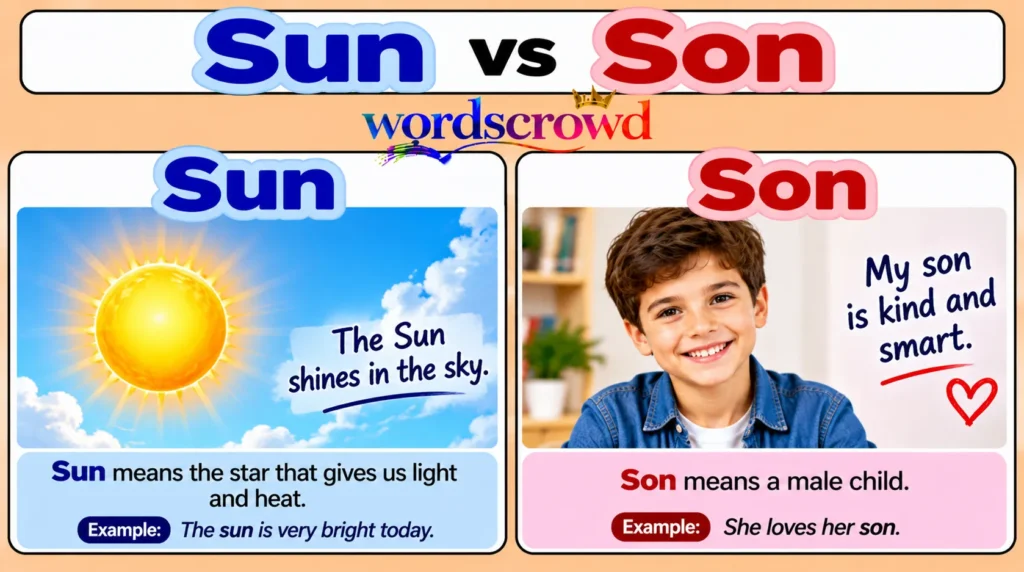
Sun refers to the star at the center of our solar system that provides Earth with light and heat.
Son refers to a male child in relation to one or both parents.
Both words are pronounced the same way: /sʌn/. However, they have different spellings, meanings, and grammatical uses.
Example:
- The sun is shining brightly today.
- Their son loves playing football.
Remember: The sun lights up the sky, while your son is a member of your family.
Sun vs Son: Comparison Table
| Feature | Sun | Son |
|---|---|---|
| Meaning | The star at the center of our solar system | A male child |
| Part of speech | Noun | Noun |
| Pronunciation | /sʌn/ | /sʌn/ |
| Sound | Sun | Sun |
| Spelling | S-U-N | S-O-N |
| Syllables | One | One |
| Word type | Common noun | Common noun |
| Main use | Astronomy and everyday descriptions | Family and relationships |
| Grammar | Countable or uncountable depending on context | Countable noun |
| Plural | Suns | Sons |
| Possessive | Sun’s | Son’s |
| Formality | Standard English | Standard English |
| Tone | Scientific, descriptive, everyday | Personal, familial, everyday |
| Origin | Old English sunne | Old English sunu |
| Homophone | Yes | Yes |
| Interchangeable? | No | No |
| Example | The sun is very bright. | My son is very kind. |
The main difference: Sun names a star, while son identifies a male child. Neither word is a misspelling of the other.
What Does Sun Mean?
Sun is a noun that refers to the star at the center of our solar system. It provides the light and energy that make life on Earth possible.
We see the sun during the daytime. It influences Earth’s climate, supports plant growth, and helps regulate natural cycles.
In everyday English, people also use sun to describe sunshine, sunny weather, or the light coming from the star.
Definition of Sun
Sun (noun): The star at the center of our solar system that produces light and heat.
Simple examples:
- The sun rises in the east.
- I enjoy sitting in the sun.
- The sun disappeared behind the clouds.
- Plants need sunlight to grow.
Origin and History of Sun
The word sun has a long history in the English language.
It comes from Old English sunne, which developed from the Proto-Germanic word sunnōn. Its older linguistic roots are also connected to the reconstructed Proto-Indo-European root sóh₂wl̥, associated with the sun.
Related words appear in several languages:
- German: Sonne
- Dutch: zon
- Old English: sunne
- Latin: sol
- Spanish: sol
These similarities show that the word has ancient linguistic roots.
Over time, its spelling changed into the modern English form sun. Its central meaning, however, remained connected to the bright star in the sky.
Pronunciation of Sun
The word sun is pronounced:
/sʌn/
It sounds like:
- Fun
- Run
- Bun
- Done
It contains one syllable.
To pronounce it correctly:
- Start with the /s/ sound.
- Make the short vowel sound /ʌ/, as in cup.
- Finish with the /n/ sound.
Say it naturally: sun.
The pronunciation is the same in standard American and British English.
Grammar and Usage of Sun
Sun is a noun. It can appear in several grammatical structures.
1. As a common noun
Use it when talking about the star in ordinary sentences.
Example:
- The sun is extremely hot.
2. As an uncountable noun
When referring to sunlight or sunshine in a general sense, sun is commonly uncountable.
Examples:
- We need more sun.
- She enjoys sitting in the sun.
- The flowers need some sun.
3. As a countable noun
The word can also have a plural form when referring to multiple stars like our Sun.
Example:
- Scientists study distant suns in other solar systems.
4. In compound words
Sun appears in many common English words:
- Sunlight
- Sunshine
- Sunrise
- Sunset
- Sunburn
- Sunflower
- Sunbeam
- Sunbathing
- Sunroof
- Sunglasses
These words are connected to sunlight, the star, or its effects.
Common Situations Where You Use Sun
Use sun when discussing:
Weather
- The sun is shining today.
- We are expecting plenty of sun tomorrow.
Science and astronomy
- The sun is a star.
- Earth revolves around the sun.
Nature
- Sunlight helps plants grow.
- The sun warms the ocean.
Outdoor activities
- We spent the afternoon sitting in the sun.
- Don’t forget your sunglasses in the bright sun.
Daily conversation
- Is the sun out yet?
- Let’s go outside and enjoy the sun.
Professional and Academic Use of Sun
The word sun is common in scientific, educational, professional, and everyday writing.
In astronomy, it refers to the star around which Earth and the other planets in our solar system orbit.
Example:
“The Sun is approximately 150 million kilometers from Earth.”
In scientific writing, the Sun is often capitalized when referring specifically to our own star as an astronomical object.
In ordinary writing, the sun is also widely accepted.
In academic writing, use the capitalization convention required by your subject, publication, or style guide.
Common Mistakes With Sun
Incorrect: My sun is going to school.
Correct: My son is going to school.
Why? The sentence refers to a male child, not the star.
Another example:
Incorrect: The son is shining brightly.
Correct: The sun is shining brightly.
Why? The sentence describes daylight, so sun is the correct word.
What Does Son Mean?
Son is a noun that describes a male child in relation to one or both parents.
It is a family relationship term. A person can be called a son regardless of their age.
For example, a newborn boy, a teenager, and a grown man can all be someone’s son.
Definition of Son
Son (noun): A male child in relation to their parent or parents.
Simple examples:
- He is my youngest son.
- Their son lives in London.
- My son enjoys reading books.
- She is proud of her son.
Origin and History of Son
The word son comes from Old English sunu, meaning a male child or descendant.
It developed from the Proto-Germanic word sunuz and has connections to older Indo-European language roots.
Related words include:
- German: Sohn
- Dutch: zoon
- Old English: sunu
- Swedish: son
- Danish: søn
These words share historical linguistic connections.
The spelling gradually developed into the modern English form son.
Unlike sun, which refers to a celestial object, son has consistently been associated with family relationships and male descendants.
Pronunciation of Son
The word son is pronounced:
/sʌn/
It sounds exactly like:
- Sun
- Fun
- Run
- Bun
It has one syllable.
To pronounce it correctly:
- Begin with the /s/ sound.
- Add the short /ʌ/ vowel.
- Finish with the /n/ sound.
The result is son.
Both American and British English speakers generally pronounce son and sun identically.
Grammar and Usage of Son
Son is a countable noun. It refers to a male child or descendant.
It can be used in singular, plural, and possessive forms.
1. Singular form
Use son when referring to one male child.
Examples:
- My son is intelligent.
- Their son plays basketball.
- She has one son.
2. Plural form
The plural of son is sons.
Examples:
- They have three sons.
- Both sons attend the same school.
- Her sons love football.
3. Possessive form
Use son’s when something belongs to one son.
Examples:
- My son’s bicycle is new.
- Her son’s name is Daniel.
- I attended my son’s graduation.
Use sons’ when something belongs to multiple sons.
Example:
- The sons’ bedrooms are upstairs.
4. Compound and related expressions
Some common expressions include:
- Son-in-law
- Grandson
- Stepson
- Godson
- Only son
- Youngest son
- Eldest son
- Adopted son
These terms describe different family relationships.
Common Situations Where You Use Son
Use son in the following situations.
Family relationships
- My son is very helpful.
- She introduced her son to us.
School and education
- Their son attends university.
- My son passed his examination.
Personal conversations
- How old is your son?
- My son loves playing video games.
Family celebrations
- We celebrated our son’s birthday.
- Her son graduated last weekend.
Formal communication
- Please contact my son regarding the arrangements.
- Their son has been selected for the scholarship.
Professional and Academic Use of Son
The word son is frequently used in personal, legal, educational, and professional communication.
It can describe family relationships in official documents, applications, family histories, and personal records.
Examples:
- The applicant is the son of the registered property owner.
- Their son has been admitted to the university.
- The son is listed as the primary family contact.
In religious contexts, Son can also appear with a capital letter as part of a specific religious title, such as the Son in Christian references to Jesus Christ.
This is different from the ordinary lowercase noun son.
Common Mistakes With Son
Incorrect: My sun is studying medicine.
Correct: My son is studying medicine.
Why? The sentence describes someone’s child.
Another example:
Incorrect: She has two sun.
Correct: She has two sons.
Why? The plural form of son is sons, not sun.
Sun vs Son: 10 Key Differences Explained
Although both words sound identical, their meanings and grammatical functions are different.
Here are the most important differences to remember.
1. Meaning
Sun refers to a star.
Son refers to a male child.
Examples:
- The sun looks beautiful at sunset.
- Her son looks happy today.
2. Spelling
The words differ by just one letter.
- Sun: S-U-N
- Son: S-O-N
The middle vowel changes from U to O, but the pronunciation remains the same.
3. Pronunciation
Both words have the same pronunciation: /sʌn/.
This makes them homophones.
4. Grammar
Both words function as nouns.
However, they describe different categories of things:
- Sun: A celestial object.
- Son: A family relationship.
5. Plural Forms
Their plural forms are different.
- Sun → Suns
- Son → Sons
Examples:
- Scientists observe distant suns.
- The family has four sons.
6. Possessive Forms
Both words can show possession.
- Sun’s: The sun’s rays are powerful.
- Son’s: My son’s shoes are missing.
7. Capitalization
Normally, both words begin with lowercase letters.
However, Sun is often capitalized in astronomical writing when referring specifically to our star.
Son may be capitalized in particular religious titles, such as the Son.
8. Context
The surrounding words help readers understand which meaning is intended.
Example:
- The sun is bright. (Weather or astronomy)
- The son is bright. (A male child is intelligent)
9. Word Associations
Sun is associated with:
- Light
- Heat
- Solar energy
- Summer
- Daytime
- Astronomy
Son is associated with:
- Parents
- Family
- Children
- Relationships
- Parenthood
- Generations
10. Interchangeability
Neither word can replace the other without changing the meaning.
For example:
“The sun is playing outside.”
This sentence is unusual because a star cannot play outside.
“The son is playing outside.”
This sentence makes sense because it describes a child.
Are Sun and Son Homophones?
Yes! Sun and son are homophones because they have the same pronunciation but different meanings and spellings.
Homophones are words that sound alike but have different written forms and meanings.
They can create confusion in speaking, listening, spelling, and writing.
Other common English homophone pairs include:
| Word 1 | Word 2 |
|---|---|
| Their | There |
| Two | Too |
| Sea | See |
| Right | Write |
| Flower | Flour |
| Pair | Pear |
| One | Won |
| Knight | Night |
| Hear | Here |
| Male |
For example:
- I can see the sea.
- Write the correct answer on the right side.
- Their house is over there.
Like these pairs, sun and son sound alike but have different meanings.
Why Do Sun and Son Sound the Same?
Their pronunciation comes from the development of English vowel sounds.
Although the spelling uses different letters, both words contain the same vowel sound, /ʌ/.
This is the short vowel sound heard in words such as:
- Cup
- Bus
- Love
- Luck
- Run
The spelling does not always tell you exactly how a word sounds in English.
That is why two words can have different spellings but identical pronunciation.
Grammar Rules: How to Use Sun and Son Correctly
Understanding the basic grammar rules makes it easier to choose the right word.
1. Noun Usage
Both sun and son are nouns.
Examples:
- The sun is setting.
- My son is sleeping.
Neither word is normally used as a standard English verb.
2. Articles: A, An, and The
Use articles according to the sentence.
With sun, we commonly use the when talking about our star.
Example:
- The sun is shining.
With son, use an article when the sentence requires one.
Examples:
- He is a loving son.
- She has a son.
3. Plural Forms
The plural of sun is suns.
The plural of son is sons.
Examples:
- The planets orbit different stars and suns.
- The couple has two sons.
4. Possessive Forms
Add an apostrophe and s to show singular possession.
Examples:
- The sun’s energy supports life.
- My son’s school is nearby.
For plural possession:
- The suns’ positions were studied.
- The sons’ rooms are upstairs.
5. Sentence Position
Both words can appear as subjects or objects.
As subjects:
- The sun provides light.
- My son enjoys music.
As objects:
- We watched the sun disappear.
- I called my son yesterday.
6. Capitalization
Use lowercase sun and son in ordinary sentences unless a capitalization rule applies.
Examples:
- The sun is bright.
- My son is happy.
Capitalize Sun when required by an astronomical convention or a publication’s style.
Capitalize Son in specific religious titles when appropriate.
7. Punctuation
Both words follow ordinary English punctuation rules.
Examples:
- The sun is beautiful.
- My son, Daniel, is visiting us.
- The sun’s rays are warm.
- My son’s birthday is tomorrow.
8. American vs British English
There is no spelling difference between American and British English.
Both varieties use:
- Sun
- Son
Their standard pronunciation is also the same.
You do not need to choose a regional spelling.
25 Real-Life Examples of Sun vs Son
The best way to understand the difference is to see both words in natural sentences.
Here are 25 original examples from everyday life, education, business, conversations, and professional communication.
Everyday Conversation Examples
- The sun is shining beautifully this morning.
- My son wants to learn how to ride a bicycle.
- We went outside to enjoy the warm sun.
- Her son helped her carry the shopping bags.
- The sun disappeared behind the mountains.
Family and Personal Examples
- My son is turning ten next month.
- Their son is studying engineering at university.
- She always encourages her son to follow his dreams.
- The sun made the garden look beautiful.
- His son surprised him with a birthday gift.
School and Academic Examples
- Students learned how the sun produces energy.
- My son received an excellent grade in mathematics.
- The teacher explained why the sun appears to move across the sky.
- Her son won the school science competition.
- The research examines the sun’s influence on Earth’s climate.
Business and Professional Examples
- The company plans to invest in solar energy from the sun.
- His son recently joined the family business.
- The report explains how sunlight can reduce energy costs.
- Their son will attend the company’s annual meeting.
- The sun’s position was recorded during the experiment.
Social Media and Text Message Examples
- “Enjoying the sunshine and making beautiful memories!”
- “Proud of my son every single day.”
- “Nothing beats a sunny afternoon.”
- “My son is growing up way too fast!”
- “Chasing sunsets with my favorite people.”
Notice: The correct word depends on the meaning of the sentence, not how the word sounds.
Common Sun vs Son Mistakes to Avoid
Because these words sound identical, people sometimes choose the wrong spelling when writing quickly.
Here are some common errors and their corrections.
| Incorrect Sentence | Correct Sentence | Reason |
|---|---|---|
| My sun is sleeping. | My son is sleeping. | Refers to a child. |
| The son is shining. | The sun is shining. | Refers to the star. |
| I have two sun. | I have two sons. | Incorrect plural. |
| My son’s are happy. | My sons are happy. | No apostrophe needed for a simple plural. |
| The suns birthday is today. | My son’s birthday is today. | Possessive form is needed. |
| The son’s rays are hot. | The sun’s rays are hot. | Refers to sunlight. |
| We enjoyed the warm son. | We enjoyed the warm sun. | Refers to sunlight. |
| Her sun is very talented. | Her son is very talented. | Refers to a male child. |
Why Do People Confuse Sun and Son?
There are several reasons.
1. Identical pronunciation
Both words sound the same, so listeners cannot always identify the spelling from pronunciation alone.
2. Different vowel letters
English spelling does not always follow simple sound patterns. The letters U and O can represent the same vowel sound in different words.
3. Fast typing
People sometimes select the wrong spelling when writing quickly, especially in text messages and social media posts.
4. Autocorrect mistakes
Some keyboards may suggest the wrong word depending on the sentence.
5. Limited context
A short message such as “I love my sun” might confuse a reader because the intended meaning is unclear.
How to Avoid These Mistakes
- Think about the meaning before choosing the spelling.
- Use sun when discussing light, heat, or astronomy.
- Use son when discussing a male child.
- Read your sentence again before sending it.
- Check possessive and plural forms carefully.
Easy Memory Tricks: How to Remember Sun vs Son
Still mixing up these words? These simple tricks can help you remember them.
1. U for Universe
Think of U in sun as the universe.
The sun is part of our universe.
Remember:
S-U-N = Star in the Universe.
This is a memory trick, not the actual historical origin of the word.
2. O for Offspring
Think of O in son as offspring.
A son is the male offspring of a parent.
Remember:
S-O-N = Male Offspring.
Again, this is simply a way to remember the spelling.
3. Picture the Difference
Imagine two pictures:
- A bright yellow sun in the sky.
- A happy boy standing with his parents.
The first picture represents sun.
The second represents son.
Visual associations make the difference easier to remember.
4. Remember These Two Sentences
The sun shines in the sky.
My son plays outside.
Repeat them a few times. The different meanings will become easier to recognize.
5. Use the One-Letter Test
If you’re unsure which spelling to use, check the middle letter.
- U = Sun = Star
- O = Son = Child
This simple trick works in most everyday situations.
When Should You Use Sun or Son?
Choosing the right word becomes easy when you understand the context.
Use sun in these situations:
- When talking about the star in our solar system.
- When describing sunshine or sunlight.
- When discussing solar energy.
- When describing sunrise or sunset.
- When talking about warmth from sunlight.
- When discussing astronomy or the solar system.
Use son in these situations:
- When describing a male child.
- When talking about your family.
- When discussing someone’s parents or children.
- When writing about family relationships.
- When describing a son in a school or legal document.
- When using family terms such as grandson or son-in-law.
Quick Decision Guide
Ask yourself one question:
Am I talking about a star or a child?
- A star? Choose sun.
- A male child? Choose son.
That’s the simplest way to make the correct choice.
Frequently Asked Questions About Sun vs Son
1. What is the difference between sun and son?
Sun refers to the star at the center of our solar system, while son refers to a male child in relation to their parent. Both words sound the same but have different meanings and spellings.
2. Are sun and son pronounced the same?
Yes. Both words are pronounced /sʌn/. They are homophones because they share the same pronunciation but have different spellings and meanings.
3. Is sun or son the correct spelling?
Both are correct English words. The correct choice depends on your intended meaning. Use sun for the star and son for a male child.
4. Is son a homophone of sun?
Yes. Son and sun are homophones. They sound identical but refer to different things. One describes a family relationship, while the other describes a celestial object.
5. What is the plural of sun and son?
The plural of sun is suns, while the plural of son is sons. For example, scientists study distant suns, and a family may have several sons.
6. Why do sun and son sound alike?
Both words contain the same vowel sound, /ʌ/. Their different spellings developed through the history of English, but their modern standard pronunciations are identical.
7. Is it my sun or my son?
Use my son when referring to your male child. For example, “My son is very intelligent.” The phrase my sun would normally refer to the star in a figurative or unusual context.
8. Is the sun capitalized in English?
It depends on the context and style guide. In ordinary writing, the sun is commonly lowercase. In astronomical writing, the Sun is often capitalized when referring specifically to our star.
9. Are sun and son different in American and British English?
No. Both American and British English use the spellings sun and son. Their standard pronunciations are also the same, so there is no regional spelling preference.
Final Verdict: Sun vs Son — Which Word Should You Use?
The difference between sun vs son is simple once you understand what each word represents.
Both are correct English words, but they cannot replace each other.
Choose sun when you’re talking about the star that provides Earth with light and warmth. Use it when discussing sunshine, sunlight, solar energy, weather, or astronomy.
Choose son when you’re referring to a male child or someone’s family relationship. Use it in conversations about parents, children, school, family, and personal relationships.
Here is the easiest way to remember:
- Sun = Star in the sky.
- Son = Male child in a family.
Both words sound the same, but their meanings are completely different.
The next time you write either word, think about what you’re describing before choosing the spelling. One small letter can make a big difference!
Enjoyed this English comparison? Explore more word differences and practical grammar guides to improve your everyday English and become a more confident writer.

Elon Parker is a dedicated writer at Wordscrowd, creating clear, informative, and engaging content for readers.
With a focus on useful information, Elon aims to make every article simple, reliable, and easy to understand.