Have you ever typed “ola” when you meant to say “hola”? You are not alone. These two words look almost identical, sound very similar in some contexts, and are especially easy to confuse when you are learning Spanish or encountering Spanish words in English conversations, texts, travel, or social media.
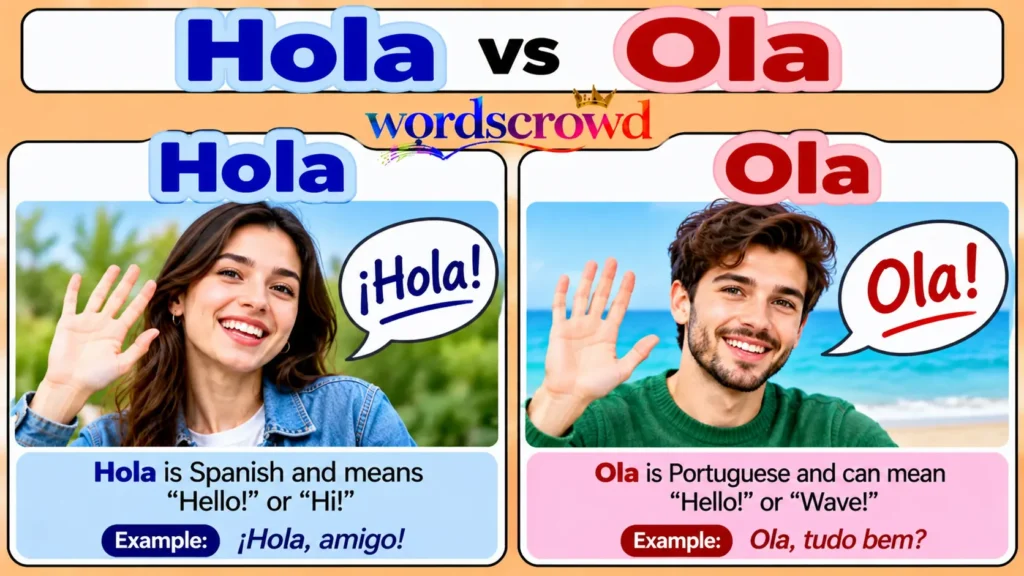
The important point is that hola and ola are not simply two different spellings of the same word. In standard Spanish, hola is the familiar greeting meaning “hello” or “hi,” while ola is a completely different noun meaning “wave,” as in a wave on the sea.
So, if you want to greet someone, the correct spelling is hola—with an h.
But there is more to the story. Why is the h silent? Is “ola” ever correct? Can you use “hola” in formal situations? How should an English speaker pronounce it? And why do people sometimes write “ola” in texts?
This complete guide to hola or ola answers all of those questions with clear rules, examples, pronunciation help, common mistakes, memory tricks, and real-life usage.
Quick Answer
Hola is the correct Spanish word for “hello” or “hi.”
Ola is also a correct Spanish word, but it means “wave.”
- Hola = hello / hi 👋
- Ola = wave 🌊
If you are greeting someone, write hola, not ola.
Hola or Ola: Quick Comparison
| Feature | Hola | Ola |
|---|---|---|
| Language | Spanish | Spanish |
| Main meaning | Hello, hi | Wave |
| Part of speech | Interjection | Noun |
| Pronunciation | Usually /ˈola/ | Usually /ˈola/ |
| Initial H pronounced? | No | Not applicable |
| Used as a greeting? | Yes | No |
| Refers to the sea? | No | Yes |
| Formal usage | Yes | Depends on context |
| Informal usage | Yes | Yes |
| English equivalent | Hello, hi | Wave |
| Example | Hola, ¿cómo estás? | La ola es grande. |
| Common mistake | Writing “ola” for “hello” | Treating “ola” as a greeting |
| Easy memory | H = hello | O = ocean wave |
Quick rule: If you mean “hello,” use hola. If you mean a “wave,” use ola.
What Does “Hola” Mean?
Hola is the standard Spanish greeting equivalent to “hello,” “hi,” or, depending on the situation, “hey.”
It is one of the most useful Spanish words for beginners because it works in a huge range of everyday situations.
You can say:
- Hola. — Hello.
- ¡Hola! — Hi!
- Hola, Ana. — Hello, Ana.
- Hola, ¿cómo estás? — Hi, how are you?
- Hola, mucho gusto. — Hello, nice to meet you.
Unlike some greetings that are limited to particular times of day, hola is not restricted to morning, afternoon, or evening.
Is “Hola” a Greeting?
Yes. Hola is a greeting.
It can be used when meeting someone, starting a conversation, answering someone informally, or opening a message.
For example:
Hola, Carlos. ¿Cómo estás?
This means:
“Hi, Carlos. How are you?”
Is “Hola” Formal or Informal?
Hola can be both informal and polite.
It is perfectly normal among friends and family:
¡Hola, María!
It is also acceptable when greeting someone you do not know:
Hola, señor.
However, the exact level of formality depends on the entire expression and situation. Spanish has other greetings and forms of address that can sound more formal, but hola itself is not inherently slang or inappropriate.
Can You Use “Hola” in Professional Communication?
Yes.
For example, in an email, you might write:
Hola, Laura:
Or:
Hola, equipo:
In a more formal professional environment, the greeting may be expanded:
Buenos días, señor García:
So hola is not automatically too casual for work. Context matters.
The Origin of “Hola”
The history of hola is more interesting than it first appears.
The Spanish greeting hola developed historically as an attention-getting or greeting expression. Its exact etymological history has been discussed by lexicographers and language historians, and it is connected with older Spanish interjections used to attract attention or initiate interaction.
One especially useful fact for learners is that the h in modern Spanish is silent.
That means the spelling hola does not produce an English-style “h” sound.
In standard Spanish pronunciation:
hola → approximately “OH-lah”
not:
“HOH-lah.”
Why Does “Hola” Have an H If You Cannot Hear It?
Spanish spelling preserves many historical h letters that are no longer pronounced.
The same general principle appears in other Spanish words:
- hablar — to speak
- hacer — to do/make
- hombre — man
- hoy — today
- hola — hello
The initial h is silent in standard modern Spanish.
That silent letter is one reason English speakers and beginning Spanish learners sometimes wonder whether hola and ola are pronounced differently.
Usually, they are not.
How Do You Pronounce “Hola”?
Hola is generally pronounced approximately:
OH-lah
The stress falls on the first syllable:
HO-la
Because the Spanish h is silent, the pronunciation begins with an o sound.
Pronunciation Breakdown
ho-la
- h = silent
- o = like the Spanish “o” sound
- l = clear Spanish l
- a = open Spanish “a” sound
A simple learner approximation is:
OH-lah
This is much closer to standard Spanish pronunciation than saying “HOH-lah” with an English h sound.
What Does “Ola” Mean?
Ola is a completely different Spanish word.
It means:
wave
Most commonly, it refers to a wave of water.
For example:
La ola es enorme.
This means:
“The wave is enormous.”
You might use ola when talking about:
- the ocean
- the sea
- surfing
- beaches
- storms
- swimming
- waves in a pool
- metaphorical waves
Examples of “Ola”
Una ola golpeó la roca.
A wave hit the rock.
La ola era muy alta.
The wave was very high.
Los surfistas esperan una buena ola.
The surfers are waiting for a good wave.
Mira esa ola.
Look at that wave.
In all of these examples, ola has nothing to do with saying hello.
Is “Ola” a Correct Spanish Word?
Absolutely.
This is an important distinction.
It would be wrong to say that ola is simply an incorrect version of hola. Ola is a legitimate Spanish noun.
The problem occurs when someone uses ola intending to say “hello.”
Compare:
Hola, Pedro.
Hello, Pedro.
with:
La ola llegó a la playa.
The wave reached the beach.
Both words are correctly spelled. They simply have different meanings.
Hola vs. Ola: The Key Difference
The easiest way to understand hola or ola is to focus on meaning rather than spelling.
Hola = Greeting
Use hola when you want to greet someone.
¡Hola! ¿Cómo estás?
Ola = Wave
Use ola when you are talking about a wave.
La ola es muy grande.
The One-Letter Difference Changes Everything
The only visible difference is the initial h:
hola
ola
But that one silent letter separates two different words.
This is a classic example of why spelling matters even when pronunciation does not clearly reveal the difference.
Why Do People Confuse Hola and Ola?
There are several reasons.
1. The H Is Silent
The biggest reason is pronunciation.
Because Spanish h is silent, hola and ola are generally pronounced the same.
That means someone learning Spanish by listening may not immediately know which spelling to choose.
2. They Look Almost Identical
The words differ by only one letter:
hola → ola
When typing quickly, it is easy to leave out the h.
3. English Speakers May Apply English Spelling Rules
In English, h is usually pronounced at the beginning of a word.
A learner may therefore expect the h in hola to have a sound.
Spanish does not work that way.
4. Texting Encourages Shortcuts
On social media and in casual messaging, people sometimes remove letters intentionally.
You may see informal spellings such as “ola” used online to represent “hola,” especially among people familiar with texting shortcuts.
However, that does not make ola the standard spelling of the Spanish greeting.
Is “Ola” an Incorrect Spelling of “Hola”?
The answer depends on what you mean.
If you mean “hello,” then yes, “ola” is incorrect in standard Spanish.
If you mean “wave,” then “ola” is correct.
So:
❌ Ola, ¿cómo estás? — incorrect if intended as “Hello, how are you?”
✅ Hola, ¿cómo estás? — correct.
But:
✅ La ola es enorme. — correct: “The wave is enormous.”
This distinction is essential because calling ola simply “wrong” would be misleading.
Grammar: Hola vs. Ola
The two words also belong to different grammatical categories.
“Hola” as an Interjection
Hola functions primarily as an interjection or greeting expression.
It does not behave like a normal noun or verb.
For example:
¡Hola!
You can use it independently.
You can also combine it with a person’s name:
Hola, Juan.
Or with a question:
Hola, ¿cómo te va?
Punctuation With Hola
In Spanish writing, hola may be followed by a comma when addressing someone directly:
Hola, Marta.
In an email:
Hola, Marta:
The exact punctuation can vary according to the type of writing and style convention.
“Ola” as a Noun
Ola is a feminine noun.
It commonly appears with the feminine article:
la ola — the wave
and:
una ola — a wave
Its plural is:
olas — waves
Examples:
La ola es grande.
Las olas son fuertes.
This is one of the clearest grammatical differences between the words.
| Word | Grammar | Example |
|---|---|---|
| hola | Interjection/greeting | ¡Hola! |
| ola | Feminine noun | La ola es alta. |
| olas | Plural noun | Las olas son enormes. |
Hola or Ola in Everyday Conversation
In everyday Spanish, hola is extremely useful.
You can use it when:
- meeting a friend
- answering a phone call
- starting a conversation
- entering a shop
- greeting a colleague
- meeting someone for the first time
- starting a casual message
- greeting someone online
Examples:
Hola, ¿qué tal?
Hola, mamá.
Hola, ¿todo bien?
¡Hola! Qué alegría verte.
The word is short, natural, and widely understood.
Hola in Text Messages
In texting, hola is one of the simplest ways to start a conversation.
For example:
Hola 😊 ¿Qué haces?
Hola, ¿ya llegaste?
¡Hola! Te quería preguntar algo.
You may encounter shortened or nonstandard spellings online, but if you are writing correctly, hola is the safe choice.
Hola on Social Media
On social platforms, hola can be used in captions, comments, direct messages, and casual posts.
Examples:
¡Hola, Madrid! 🇪🇸
Hola, amigos.
Hola desde la playa! 🌊
Notice something interesting: a beach post might contain both words:
¡Hola desde la playa! Las olas están increíbles.
That means:
“Hello from the beach! The waves are amazing.”
Here, hola means “hello,” while olas means “waves.”
Hola or Ola in Professional Writing
If you are writing professionally in Spanish, use hola when it functions as a greeting.
For example:
Hola, Carlos:
This can work in a friendly professional email.
For more formal correspondence, another greeting may be more suitable depending on the relationship and regional convention:
Estimado Sr. López:
The important lesson is that hola is not grammatically incorrect or automatically unprofessional.
Its appropriateness depends on the level of formality you need.
Hola or Ola in Academic Writing
Academic writing rarely uses hola unless the word itself is being discussed.
For example:
The Spanish greeting “hola” is commonly used in everyday conversation.
In a Spanish-language academic paper, however, you could discuss the word naturally as an object of linguistic analysis.
Ola can appear in academic writing whenever the subject involves water, geography, physics, surfing, literature, or another relevant topic.
For example:
La altura de la ola depende de varios factores.
“The height of the wave depends on several factors.”
20+ Real-Life Examples of Hola and Ola
The fastest way to master the difference is to see the words in context.
Conversation Examples
- ¡Hola! ¿Cómo estás?
Hello! How are you? - Hola, Luis. ¿Todo bien?
Hi, Luis. Everything okay? - ¡Hola, qué sorpresa verte aquí!
Hi, what a surprise to see you here! - Hola, ¿puedo sentarme aquí?
Hello, may I sit here?
Text Message Examples
- Hola 😊 ¿Estás despierto?
Hi 😊 Are you awake? - Hola, te llamo después.
Hi, I’ll call you later. - ¡Hola! ¿Ya estás en casa?
Hi! Are you home yet?
Business Examples
- Hola, Laura: Gracias por tu mensaje.
Hello, Laura. Thank you for your message. - Hola, equipo: Les envío el informe adjunto.
Hello, team. I am sending the attached report. - Hola, señor Martínez. Es un placer conocerlo.
Hello, Mr. Martínez. It is a pleasure to meet you.
School Examples
- Hola, profesora. Tengo una pregunta.
Hello, teacher. I have a question. - El estudiante escribió “hola” en la pizarra.
The student wrote “hello” on the board.
Wave Examples
- La ola llegó hasta la orilla.
The wave reached the shore. - Una ola enorme golpeó el barco.
A huge wave hit the boat. - Los niños saltaron sobre las olas.
The children jumped over the waves. - La ola era perfecta para surfear.
The wave was perfect for surfing. - Las olas estaban muy fuertes esta mañana.
The waves were very strong this morning.
Social Media Examples
- ¡Hola desde Barcelona! 🇪🇸
Hello from Barcelona! - Hola, mundo. 🌎
Hello, world. - Mira las olas detrás de nosotros. 🌊
Look at the waves behind us. - ¡Hola desde la costa! Las olas están increíbles.
Hello from the coast! The waves are amazing.
Professional Writing Examples
- Hola, Ana: ¿Podrías revisar este documento?
Hello, Ana. Could you review this document? - La fuerza de la ola causó daños en la estructura.
The force of the wave caused damage to the structure. - Hola, profesor. Adjunto mi trabajo final.
Hello, professor. I have attached my final assignment.
Common Mistakes With Hola and Ola
Mistake 1: Using “Ola” to Say Hello
❌ Ola, ¿cómo estás?
If your intended meaning is “Hello, how are you?”, the standard spelling is:
✅ Hola, ¿cómo estás?
The missing h changes the written word.
Mistake 2: Assuming “Ola” Is Always Wrong
❌ “Ola is not a Spanish word.”
That is false.
✅ Ola is a standard Spanish noun meaning “wave.”
The problem is only when it is used as the spelling of the greeting hola.
Mistake 3: Pronouncing the H
Some English speakers may pronounce:
❌ HO-la
with an audible English h.
Standard Spanish pronunciation is closer to:
✅ OH-la
The initial h is silent.
Mistake 4: Thinking the Words Have Different Standard Pronunciations
In ordinary Spanish pronunciation, hola and ola are generally pronounced alike.
The difference is primarily spelling and meaning, not sound.
Mistake 5: Treating Texting Shortcuts as Standard Spelling
A person might write “ola” casually online as a shortcut for “hola.”
That does not mean it is the standard spelling.
For school, work, formal communication, published writing, or language learning, use:
hola
How to Remember Hola vs. Ola
A simple memory trick can save you from this mistake forever.
Memory Trick 1: H = Hello
Think:
H = Hello → Hola
When you want to say hello, remember the H.
H → Hello → Hola
Memory Trick 2: O = Ocean
Think:
O = Ocean → Ola
A wave belongs in the ocean.
O → Ocean → Ola
So:
HOLA = HELLO 👋
OLA = OCEAN WAVE 🌊
Memory Trick 3: Picture the Meaning
Imagine this:
👋 Hola!
versus:
🌊 La ola
If you can connect the spelling to the picture, the difference becomes much easier to remember.
Tip: When in doubt, ask yourself: “Am I greeting someone or talking about water?”
Greeting → hola.
Wave → ola.
Are Hola and Ola Homophones?
For practical purposes, hola and ola are pronounced the same in standard Spanish.
That makes them homophones: words that have the same pronunciation but different meanings and spellings.
This is similar to English examples such as:
- flower / flour
- sea / see
- right / write
The important difference is that hola and ola also have different grammatical roles.
Hola functions as a greeting, while ola is a noun.
Does “Hola” Mean Anything in English?
In modern English, hola is widely recognized as a Spanish greeting.
English speakers sometimes use it playfully or naturally in multilingual conversations:
“Hola! How are you?”
However, in Spanish, hola is a normal everyday greeting rather than merely a borrowed foreign expression.
Is “Hola” Used in Latin America and Spain?
Yes.
Hola is widely understood throughout the Spanish-speaking world, including Spain and Latin America.
Regional differences exist in Spanish vocabulary, pronunciation, greetings, and levels of formality, but hola is one of the most broadly recognizable Spanish greetings.
You can safely learn it as a core Spanish word.
Hola in Different Contexts
Greeting a Friend
¡Hola, Pedro!
Natural and casual.
Meeting Someone New
Hola, mucho gusto.
Natural and polite.
Starting a Message
Hola, ¿cómo estás?
Very common.
Greeting a Group
Hola a todos.
This means:
“Hello everyone.”
Greeting a Professional Contact
Hola, Ana:
Appropriate in many friendly professional contexts.
A More Formal Alternative
Depending on the setting, you might choose:
Buenos días.
or:
Estimado señor López:
The choice depends on the relationship and level of formality—not on a rule that says hola is always informal.
What About “Ola” in Portuguese?
This is an interesting cross-language point.
In Portuguese, olá means “hello.”
Notice the accent:
Portuguese: olá
Spanish: hola
Meanwhile, Spanish ola means “wave.”
This creates an especially easy trap for people who encounter several Romance languages.
Compare:
| Language | Word | Meaning |
|---|---|---|
| Spanish | hola | hello |
| Spanish | ola | wave |
| Portuguese | olá | hello |
The accent in Portuguese is important because olá is not simply Spanish ola.
Spanish “Hola” vs. Portuguese “Olá”
If you are learning both languages, remember:
Spanish:
Hola = Hello
Portuguese:
Olá = Hello
Spanish:
Ola = Wave
The languages are related, but their spelling and vocabulary are not interchangeable.
Does Capitalization Matter?
Usually, hola is written in lowercase when it appears in the middle of a sentence.
At the beginning of a sentence, it is capitalized:
Hola, María.
As a standalone greeting:
¡Hola!
In a title, capitalization depends on the title style being used.
The key point is that capitalization does not change the meaning distinction between hola and ola.
Does the Accent Mark Matter?
Spanish hola does not take an accent mark.
Correct:
hola
Not:
holá
The word ola also normally has no accent:
ola
However, Portuguese has:
olá
That accent belongs to Portuguese, not standard Spanish.
Hola or Ola: Which One Should You Use?
Use this simple decision guide:
Use “hola” when:
- You are saying hello.
- You are greeting someone.
- You are starting a Spanish conversation.
- You are writing “hi” in Spanish.
- You are addressing a friend, colleague, or another person.
Use “ola” when:
- You mean a wave.
- You are talking about the sea.
- You are discussing surfing.
- You are describing water movement.
- You are using a metaphor involving a wave.
Do Not Use “ola” when:
- You mean “hello” in standard Spanish.
- You are writing a Spanish school assignment.
- You are writing a professional Spanish message.
- You are learning standard Spanish spelling.
- You want to demonstrate correct Spanish grammar.
Common Questions About Hola or Ola
Is “hola” or “ola” correct?
Both are correct Spanish words, but they have different meanings. Hola means “hello” or “hi,” while ola means “wave.” If you are greeting someone, use hola.
Is “ola” another way to spell “hola”?
Not in standard Spanish. Ola is a separate word meaning “wave.” People may sometimes use “ola” informally in online messages as a shortened version of “hola,” but hola is the correct standard spelling for the greeting.
Is the H in “hola” silent?
Yes. The Spanish h is normally silent, so hola is pronounced approximately OH-lah, not “HOH-lah” with an English h sound.
Are hola and ola pronounced the same?
Generally, yes. In standard Spanish, hola and ola are normally pronounced alike because the initial h in hola is silent.
What does “ola” mean in Spanish?
Ola means “wave,” usually a wave of water. For example, la ola means “the wave,” and las olas means “the waves.”
Is hola formal or informal?
Hola can be used in both casual and many polite situations. It is a very common greeting. The overall formality depends on the context and the rest of the greeting.
How do you say “hello” correctly in Spanish?
The standard Spanish spelling is hola. A simple pronunciation guide for English speakers is OH-lah.
Is “olá” Spanish?
If you mean the Portuguese greeting, olá is Portuguese for “hello.” In standard Spanish, the greeting is hola without an accent mark.
Why is there an H in hola if it is silent?
Spanish spelling preserves historical letters that are no longer pronounced. The h in hola is therefore written even though modern Spanish speakers do not normally pronounce it.
Final Verdict: Hola or Ola?
The answer is simple once you separate meaning from sound.
Hola is the correct Spanish greeting meaning “hello” or “hi.”
Ola is a completely different Spanish word meaning “wave.”
So if you are about to message a Spanish-speaking friend, write:
¡Hola! 👋
Not:
❌ ¡Ola!
But if you are standing on a beach and talking about the water, ola is exactly the word you want:
¡Mira la ola! 🌊
“Look at the wave!”
The easiest rule to remember is:
H = Hello → hola
O = Ocean → ola
Once you remember that connection, the hola or ola confusion becomes much easier to avoid.
Best practice: Use hola for greetings, ola for waves, and remember that both words are correctly spelled Spanish words with different meanings. The silent h is the key to understanding why they sound so similar while meaning completely different things.