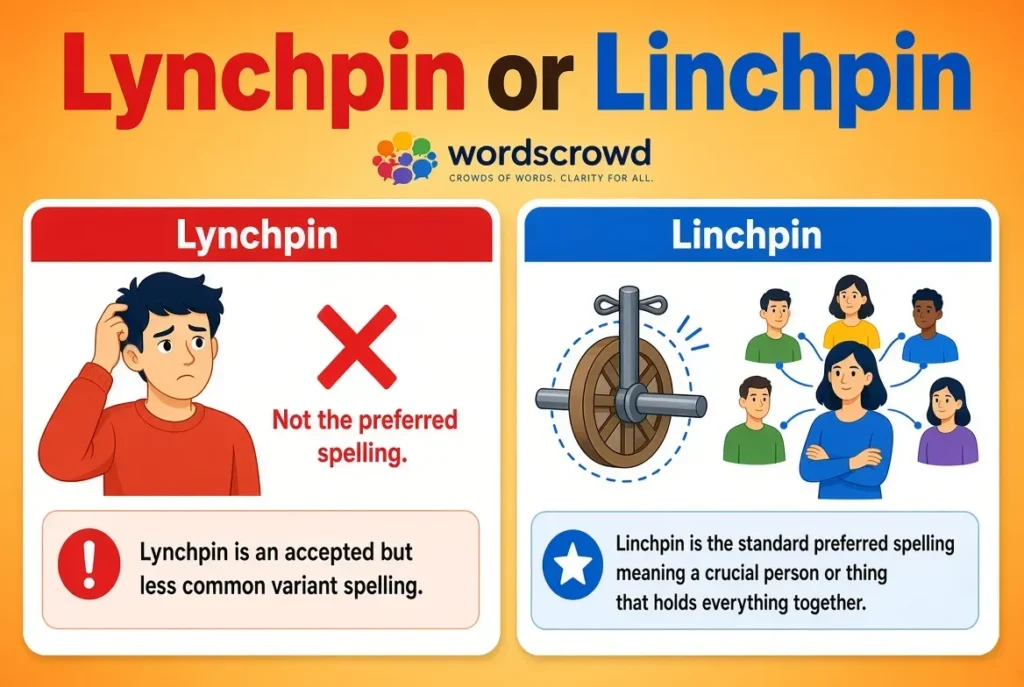
If you have ever written a sentence such as “She is the ___ of the entire project,” you may have paused over one surprisingly tricky spelling:
lynchpin or linchpin. Both forms appear in books, newspapers, business writing, and online publications, so it is easy to wonder whether one is wrong—or whether they are simply two spellings of the same word.
The good news is that the meaning is not the problem. Linchpin and lynchpin refer to the same idea: a person or thing that is essential to a group, plan, organization, or system because other parts depend on it. Major dictionaries recognize both spellings.
Cambridge lists linchpin as the main entry and gives lynchpin as an alternative, while Oxford likewise lists linchpin first and lynchpin as another form.
So, if both are accepted, which one should you actually use?
For most modern English writing, linchpin is the safest and most widely preferred choice. Lynchpin is a recognized variant, not simply a random spelling mistake.
The difference is therefore mainly one of spelling preference and convention—not meaning or grammar.
In this guide, you will learn exactly when to use linchpin, whether lynchpin is wrong, how the word is pronounced, where it came from, how it works grammatically, and how to use it naturally in everyday, academic, and professional writing.
Quick Answer
Linchpin is the preferred spelling in many modern dictionaries and is the best choice when you want the safest standard form. Lynchpin is also a recognized spelling variant and has the same meaning.
Both are pronounced /ˈlɪntʃ.pɪn/, roughly “LINCH-pin,” and both are nouns meaning a person or thing that is essential to keeping a system, group, or plan together.
Best practice: When you are unsure, write linchpin.
Linchpin vs. Lynchpin: At a Glance
| Feature | Linchpin | Lynchpin |
|---|---|---|
| Meaning | An essential person or thing | Same meaning |
| Part of speech | Noun | Noun |
| Pronunciation | /ˈlɪntʃ.pɪn/ | /ˈlɪntʃ.pɪn/ |
| Standard status | Preferred/main dictionary form | Accepted variant |
| Meaning difference | None | None |
| Grammar | Countable noun | Countable noun |
| Plural | linchpins | lynchpins |
| Typical phrase | the linchpin of the project | the lynchpin of the project |
| Professional writing | Recommended | Acceptable, but less conventional |
| Academic writing | Recommended | Acceptable if your style permits it |
| Everyday English | Common | Also used |
| US English | Used | Used |
| UK English | Used | Used |
| Formality | Neutral/formal | Neutral/formal |
| Best choice when uncertain | Yes | No |
| Is it a misspelling? | No | No |
| Does the meaning change? | No | No |
The simplest rule
If you need one spelling to remember, remember this:
Linchpin is the preferred form; lynchpin is an accepted variant.
That distinction is more useful than saying one is “correct” and the other is “incorrect.”
What Does “Linchpin” Mean?
A linchpin is a person or thing that plays such an important role in a system, organization, relationship, plan, or project that other parts depend on it.
For example:
Maria is the linchpin of our marketing team.
This means Maria is not merely a useful member of the team. She is central to its success or operation.
You can also use the word for an object, idea, policy, process, or institution:
Trust is the linchpin of a successful partnership.
Here, trust is described as the essential element holding the partnership together.
Oxford defines linchpin as a person or thing that is the most important part of an organization or plan because everything else depends on that person or thing.
Cambridge gives a closely related explanation: a linchpin is the most important member of a group or part of a system that holds the other members or parts together or enables them to work as intended.
Linchpin in simple English
You can think of a linchpin as:
- the key person
- the essential part
- the central element
- the main support
- the critical component
- the thing everything depends on
- the part that holds a system together
However, linchpin is usually stronger than simply saying “important.”
If someone is important, they matter.
If someone is the linchpin, their role is so central that removing them—or removing the relevant element—could seriously affect how the whole system works.
Why Do People Confuse “Linchpin” and “Lynchpin”?
The confusion is understandable because the two spellings sound exactly the same.
Both are pronounced:
/ˈlɪntʃ.pɪn/
In simple terms, it sounds like:
LINCH-pin
Cambridge gives the same pronunciation for both forms.
The spelling lynchpin can also look familiar because English speakers already know the word lynch. That familiar spelling may make lynchpin feel more intuitive to some writers.
But the history of the word is older and more complicated than that modern visual association suggests.
The Origin and History of “Linchpin”
The literal meaning of linchpin helps explain its modern figurative meaning.
Historically, a linchpin was a pin used to secure a wheel or other part of a vehicle or mechanism. The physical object was small, but its function was extremely important:
without the pin, an essential part could come loose.
That physical idea developed into the figurative meaning we use today.
Something can be small but essential.
A person can occupy only one position in a large organization but still be crucial to the organization’s success.
An idea can be only one part of a larger strategy but still hold the entire strategy together.
Oxford traces linchpin to Late Middle English, from Old English lynis in the sense of “linchpin” plus pin.
From mechanical part to figurative expression
The development is easy to understand:
- A linchpin was literally a fastening pin.
- The pin helped keep an important mechanical structure together.
- English speakers began using the word metaphorically.
- A person, idea, or component that holds something together became a linchpin.
- Today, the figurative meaning is much more common than the literal mechanical one.
This is why you can call a person the linchpin of a team even though no actual wheel or axle is involved.
Is “Lynchpin” Correct?
Yes.
Lynchpin is a recognized spelling variant of linchpin.
That point is important because many people assume that lynchpin must automatically be a spelling error.
It is not.
Cambridge lists lynchpin as an alternative form of linchpin.
Oxford also recognizes both forms, presenting linchpin as the main entry and lynchpin as an alternative.
So these sentences have the same meaning:
The manager was the linchpin of the project.
The manager was the lynchpin of the project.
Neither sentence changes meaning because of the spelling.
But are the two spellings equally preferable?
Not necessarily.
That is where practical writing advice matters.
Although lynchpin is accepted, linchpin is generally the better default if you are writing:
- an academic paper
- a business report
- a professional article
- a formal email
- a website
- a résumé
- a technical document
- educational material
- edited prose
Choosing the main dictionary form avoids unnecessary questions about spelling preference.
Editor’s Tip: If your goal is polished, conventional English, choose linchpin unless a publication or organization specifically uses lynchpin.
Linchpin: Definition, Grammar, and Usage
Definition
Linchpin is a noun meaning a person or thing that is essential to the functioning or success of a group, system, plan, or organization.
Part of speech
The word is a noun.
It can refer to:
- a person
- an idea
- a policy
- a process
- a system component
- a relationship
- a strategy
- an institution
- a physical object
Singular form
The coordinator is the linchpin of the event.
Plural form
The plural is:
linchpins
Example:
Several employees became linchpins of the new department.
The plural simply adds -s.
Common grammatical pattern
One of the most common structures is:
the linchpin of + noun
Examples:
- the linchpin of the team
- the linchpin of the strategy
- the linchpin of the economy
- the linchpin of the agreement
- the linchpin of the project
- the linchpin of the organization
You may also see:
a linchpin in + noun
For example:
She became a linchpin in the company’s expansion.
Both patterns are natural.
How to Pronounce “Linchpin”
Linchpin is pronounced:
/ˈlɪntʃ.pɪn/
A simple pronunciation guide is:
LINCH-pin
The first syllable is stressed.
Do not pronounce it like “line-chpin.”
The beginning sounds like linch, followed by pin.
What about “lynchpin”?
Exactly the same pronunciation:
/ˈlɪntʃ.pɪn/
The spelling changes, but the pronunciation does not. Cambridge lists the same pronunciation for linchpin and lynchpin.
How to Use “Lynchpin”
Because lynchpin is an accepted variant, you can use it in the same grammatical situations as linchpin.
For example:
The research department is the lynchpin of the company’s innovation strategy.
Or:
Her experience made her the lynchpin of the negotiation team.
The meaning remains exactly the same.
Why might someone choose “lynchpin”?
Several factors can influence spelling choice:
- personal writing habits
- exposure to the variant in books or journalism
- regional or editorial convention
- copying an established house style
- familiarity with the spelling “lynch”
- historical usage
The important point is that lynchpin is not a different word with a different definition.
It is a spelling variant of the same word.
Key Differences Between Linchpin and Lynchpin
The difference can be summarized very simply.
1. They mean the same thing
Both refer to a person or thing that is essential to a larger system or group.
2. They sound the same
Both are pronounced LINCH-pin.
3. They have the same grammatical function
Both are nouns.
4. They have the same plural meaning
The standard plural forms are linchpins and lynchpins.
5. “Linchpin” is the better default
Modern learner dictionaries such as Cambridge and Oxford give linchpin as the primary form and recognize lynchpin as an alternative.
6. “Lynchpin” is not simply wrong
Calling it an outright misspelling would be misleading.
7. Neither spelling is more formal in meaning
The spelling difference does not make the word more or less formal.
8. Context does not change the spelling rule
Whether you are discussing business, education, politics, sports, technology, or relationships, linchpin remains the safest default.
Is “Linchpin” More Correct Than “Lynchpin”?
If by “more correct” you mean the spelling you should choose when you want the most conventional modern form, then yes:
Choose linchpin.
If by “correct” you mean is lynchpin an acceptable English spelling?, the answer is also yes.
This is an important distinction.
Think of it this way
| Question | Answer |
|---|---|
| Is linchpin correct? | Yes |
| Is lynchpin correct? | Yes |
| Do they mean different things? | No |
| Are they pronounced differently? | No |
| Is one a verb and the other a noun? | No |
| Is lynchpin simply a typo? | No |
| Which is better as a default? | Linchpin |
So the best editorial recommendation is:
Use “linchpin” unless you have a reason to preserve the alternative spelling “lynchpin.”
Linchpin vs. Lynchpin in American and British English
You may wonder whether one spelling is American and the other British.
There is no simple US-versus-UK division here.
Both spellings occur in both varieties of English.
Oxford’s American English dictionary includes linchpin and identifies lynchpin as an alternative.
Cambridge likewise recognizes lynchpin as an alternative to linchpin in its English and Business English entries.
Therefore, it would be inaccurate to say:
“Linchpin is American, while lynchpin is British.”
That is not a reliable rule.
The practical US/UK rule
For both American and British English:
Linchpin is a strong default choice.
Lynchpin is an accepted alternative.
Common Collocations With “Linchpin”
Learning common word combinations makes your English sound more natural.
Here are some useful collocations:
- the linchpin of the project
- the linchpin of the team
- the linchpin of the strategy
- the linchpin of the economy
- the linchpin of the agreement
- the linchpin of the organization
- a key linchpin
- a central linchpin
- an important linchpin
- the critical linchpin
- serve as the linchpin
- become the linchpin
- act as a linchpin
- remain the linchpin
- the linchpin holding something together
A small style note
Because linchpin already means something highly important, phrases such as “key linchpin” can sometimes feel repetitive.
For example:
The director was a key linchpin of the project.
This is understandable, but:
The director was the linchpin of the project.
is usually cleaner and stronger.
Good editing often means removing unnecessary intensifiers.
20 Real-Life Examples of Linchpin and Lynchpin
The following examples show how the word works in different contexts.
Everyday conversation
- Sarah is the linchpin of our friendship group because she keeps everyone connected.
- That little charger is the linchpin of my travel setup.
- My brother became the linchpin of the family business after our father retired.
Workplace
- Our project manager is the linchpin of the entire development team.
- Reliable communication is the linchpin of successful remote work.
- The operations team became a linchpin in the company’s expansion.
Business writing
- Customer trust remains the linchpin of our long-term growth strategy.
- The new distribution center will serve as the linchpin of the company’s regional network.
- The partnership is a lynchpin of the firm’s international strategy.
Academic writing
- Public education became a linchpin of the reform movement.
- The study argues that social trust is a linchpin of effective institutions.
- Access to reliable data is a linchpin in modern scientific research.
School
- The science teacher was the linchpin of the school’s robotics program.
- Teamwork became the linchpin of our group project.
- Your feedback has been the linchpin of our revision process.
- The updated schedule is the linchpin of our plan for meeting the deadline.
Social media
- Coffee is the linchpin of my morning routine.
- My playlist was the linchpin of today’s road trip.
Professional writing
- Strong leadership is often the linchpin of organizational change.
- The agreement became the linchpin of the company’s recovery plan.
Notice that the word works naturally with both people and things.
Common Mistakes With Linchpin and Lynchpin
Mistake 1: Assuming “lynchpin” is always wrong
Incorrect assumption:
“Lynchpin is just a misspelling.”
Better understanding:
Lynchpin is a recognized variant.
Major dictionaries recognize it, although linchpin is the preferred/main form in the sources discussed above.
Mistake 2: Thinking the words have different meanings
Wrong idea:
Linchpin means a key person, while lynchpin means a key object.
No.
Both forms can refer to people or things.
Correct:
The manager was the linchpin of the team.
The policy was the linchpin of the reform.
Mistake 3: Pronouncing the two forms differently
Because the spellings look different, some writers assume the pronunciation changes.
It does not.
Linchpin: LINCH-pin
Lynchpin: LINCH-pin
Mistake 4: Writing “linch-pin”
The normal spelling is:
linchpin
not:
linch-pin
The word is conventionally written as one word.
Mistake 5: Treating “linchpin” as an adjective
Linchpin is a noun.
Incorrect:
The company adopted a linchpin strategy.
This may be understandable, but it is not the normal grammatical use of the noun.
Better:
The strategy became the linchpin of the company’s expansion.
Or, if you need an adjective, choose a suitable adjective such as:
central strategy
critical strategy
Mistake 6: Using “linchpin” when you only mean “important”
Not everything important is a linchpin.
Compare:
The new printer is important to the office.
with:
The new server is the linchpin of the company’s digital operations.
The second sentence suggests that the server plays a central, indispensable role.
When Should You Use “Linchpin”?
Use linchpin when you want to emphasize that a person or thing is essential to the operation, stability, success, or unity of something larger.
Good contexts include:
Business
The sales team is the linchpin of the company’s growth.
Leadership
She became the linchpin of the organization during the transition.
Relationships
Trust is the linchpin of a healthy partnership.
Technology
The central database is the linchpin of the platform.
Education
Teachers are a linchpin of effective education systems.
Politics and public policy
Economic stability became the linchpin of the government’s reform program.
Sports
The goalkeeper was the linchpin of the team’s defense.
When Should You Avoid “Linchpin”?
Avoid the word when a simpler expression communicates your meaning more naturally.
For example, instead of:
The meeting room is the linchpin of our office.
if you simply mean that everyone uses it, say:
The meeting room is an important part of our office.
Linchpin carries a stronger idea of dependence and central importance.
It is particularly useful when you want to emphasize:
“If this part fails or disappears, the whole system may struggle.”
Linchpin vs. Similar Words
Understanding related vocabulary can make the distinction even clearer.
Linchpin vs. key person
A key person is important.
A linchpin is central to keeping something functioning or connected.
She is a key person on the team.
She is the linchpin of the team.
The second statement usually carries greater emphasis.
Linchpin vs. cornerstone
A cornerstone often refers to a fundamental principle, idea, or part on which something is built.
A linchpin emphasizes something that holds a larger system together or is essential to its operation.
Linchpin vs. backbone
A backbone is the main support or strength of something.
A linchpin is the crucial element on which other parts depend.
These words overlap, but they are not perfect synonyms.
Linchpin vs. centerpiece
A centerpiece is the central or most noticeable feature.
A linchpin is central because other parts depend on it.
Something can be the centerpiece without being essential.
Grammar: How “Linchpin” Works in a Sentence
Because linchpin is a countable noun, you can use articles with it.
Singular
She is a linchpin of the department.
He became the linchpin of the campaign.
Plural
Several employees became linchpins of the new organization.
With possessives
Her leadership was the linchpin of the project.
The company’s technology became the linchpin of its strategy.
With prepositions
The most common combinations include:
- linchpin of
- linchpin in
- linchpin to
Examples:
Trust is the linchpin of the relationship.
She was a linchpin in the negotiation.
The agreement became a linchpin to the broader strategy.
Among these, “the linchpin of” is especially common and natural.
Does “Linchpin” Need a Hyphen?
Normally, no.
The standard form is:
linchpin
not:
linch-pin
Likewise:
lynchpin
not:
lynch-pin
Because the word functions as an established single noun, the closed spelling is the normal choice.
Does “Linchpin” Have a Capital Letter?
Normally, no.
Write:
She is the linchpin of the team.
not:
She is the Linchpin of the team.
Unless the word appears at the beginning of a sentence or is part of a title, linchpin is lowercase.
Memory Tricks for Linchpin vs. Lynchpin
The easiest way to remember the preferred spelling is to focus on the word’s history.
Memory Trick 1: Choose the “in” spelling
Think:
Linchpin = the standard “in” choice.
If you freeze while writing, choose linchpin.
Memory Trick 2: Think “pin”
The word ends in pin because its original literal sense involved a fastening pin.
So remember:
linch + pin = linchpin
Memory Trick 3: The safest spelling comes first in dictionaries
Oxford and Cambridge present linchpin as the main form and recognize lynchpin as an alternative.
So:
Linchpin first = first choice.
Memory Trick 4: Same sound, different spelling
Say both aloud:
linchpin
lynchpin
They sound the same.
Therefore, you do not need to learn two pronunciations or two meanings.
You only need to remember which spelling you prefer in polished writing.
Is “Lynchpin” Outdated?
Not necessarily.
It is better described as a recognized alternative spelling, rather than simply an obsolete form.
Cambridge provides examples of lynchpin in contemporary English sources, including formal and professional contexts.
So do not automatically “correct” every occurrence of lynchpin as though the writer has made an obvious spelling error.
However, if you are creating new content and have no house-style requirement, linchpin is generally the cleaner choice.
Is “Linchpin” More Formal Than “Lynchpin”?
No meaningful difference in formality exists between the two spellings.
Both can appear in:
- professional writing
- journalism
- academic prose
- business communication
- general English
The distinction is primarily spelling preference, not register.
If you want a more formal tone, the important thing is usually the surrounding sentence, not whether you choose linchpin or lynchpin.
Compare:
She’s the lynchpin of the whole thing.
with:
The director serves as the linchpin of the organization’s governance structure.
The second sounds more formal because of the vocabulary and sentence structure—not because linchpin is inherently more formal.
Which Spelling Should You Use in Professional Writing?
For professional writing, choose:
linchpin
This is especially sensible when you are writing for a broad audience and do not know which spelling a particular editor prefers.
Why?
Because linchpin:
- is recognized as the main dictionary form
- is widely understood
- is easy to recognize
- avoids unnecessary spelling questions
- works in both American and British English
- is suitable for formal and informal contexts
If your employer, publisher, or style guide consistently uses lynchpin, follow that established house style.
Consistency matters in edited writing.
Which Spelling Is Best for Academic Writing?
Again, linchpin is the safest choice.
For example:
Economic stability was the linchpin of the government’s reform program.
This looks natural in an academic context.
If you encounter lynchpin in a scholarly source, however, there is no need to assume that the author has made a spelling error. The variant is recognized by major dictionaries.
Academic writing tip
When writing for a university or journal, follow the publication’s preferred style if it specifies one.
Do not change a quoted source’s spelling merely because you personally prefer the alternative.
Should You Use “Linchpin” in Emails?
Yes.
For example:
Your analysis has been the linchpin of our decision-making process.
Or:
The revised schedule will be the linchpin of our effort to meet the deadline.
However, remember that linchpin is a relatively strong word.
In a casual email, “key part” or “essential part” may sometimes sound more natural.
Choose the word based on the tone and purpose of your message.
Frequently Asked Questions
Is “lynchpin” or “linchpin” correct?
Both are correct. Linchpin is the preferred/main form in major learner dictionaries, while lynchpin is recognized as an alternative spelling.
Is “lynchpin” a misspelling?
No. Lynchpin is a recognized variant of linchpin. It is not accurate to label every occurrence of it as an error.
What does “linchpin” mean?
A linchpin is a person or thing that is essential to a group, system, plan, or organization because other parts depend on it.
How do you pronounce “linchpin”?
It is pronounced /ˈlɪntʃ.pɪn/, approximately LINCH-pin. The spelling lynchpin has the same pronunciation.
Is “linchpin” one word or two?
It is normally written as one word: linchpin.
Is it “linch pin” or “linchpin”?
The standard form is linchpin, written as one word.
What is the plural of linchpin?
The plural is linchpins.
Example:
Several employees became linchpins of the organization.
Is linchpin American or British English?
It is used in both American and British English. It is not a simple US-versus-UK spelling distinction. Oxford’s American dictionary and Cambridge’s English dictionary both recognize the form.
What is a synonym for linchpin?
Depending on context, possible alternatives include key person, essential element, central figure, cornerstone, backbone, critical component, and main support. They are not always exact substitutes because each emphasizes a slightly different idea.
A Quick Editing Checklist
Before publishing, ask yourself:
- Do I mean an essential person or thing?
- If yes, linchpin is the safest spelling.
- Am I using it as a noun?
- Does the sentence suggest that other parts depend on it?
- Am I writing linchpin as one word?
- Have I avoided treating lynchpin as automatically incorrect?
- If I’m following a house style, have I used its preferred spelling consistently?
If the answer to these questions is yes, your usage is likely sound.
Final Verdict: Lynchpin or Linchpin?
Here is the answer you can confidently remember:
Linchpin and lynchpin are both recognized spellings of the same word, with the same meaning and pronunciation. However, linchpin is the preferred/main form in major modern dictionaries and is the best default choice for most writing.
Use linchpin when you want the safest, most conventional spelling.
Use lynchpin when you are following an existing spelling preference, preserving an original source, or simply choosing the recognized variant.
There is no difference in meaning between them.
There is no difference in pronunciation.
There is no special American-versus-British rule that makes one exclusively American and the other exclusively British.
And most importantly, lynchpin is not simply an incorrect spelling.
The one-line rule
When in doubt, choose “linchpin.”
It is the form most worth learning first, while lynchpin remains a legitimate alternative.
Whether you are writing an academic essay, business report, professional email, website article, social media post, or everyday sentence, linchpin will give you a clear and conventional choice.
Remember: one tiny pin can hold a whole structure together—and one tiny spelling choice can make your writing look much more polished.