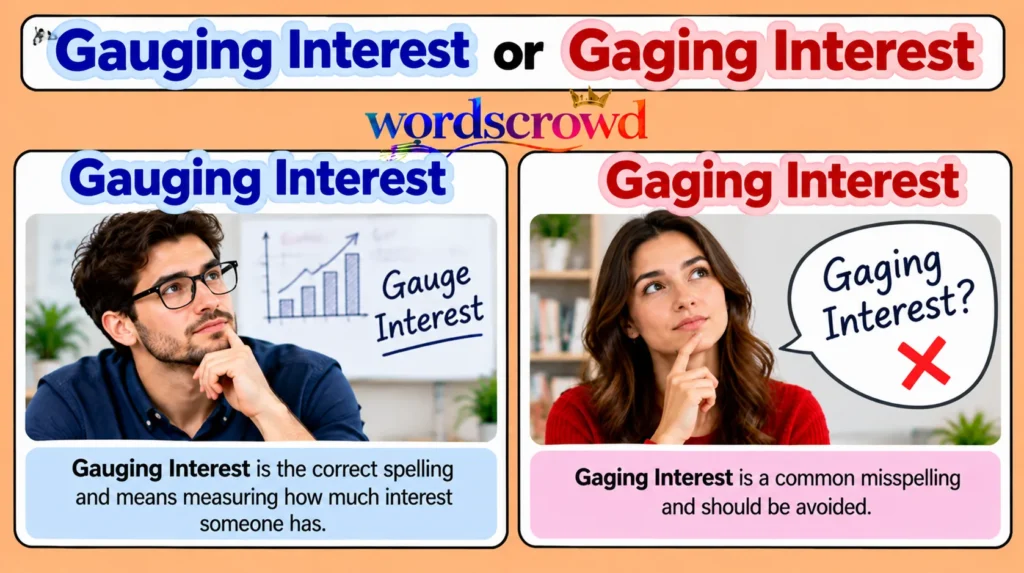
If you have ever typed “gauging interest” and then stopped to wonder whether it should actually be “gaging interest,” you are not alone.
The two forms look almost identical, sound the same, and come from related spellings of the verb gauge. That makes this a surprisingly easy spelling question—even for confident English speakers.
The good news is that the answer is straightforward: “gauging interest” is the preferred spelling in modern general English.
The spelling **“gaging” is not simply meaningless or impossible, however.
It is a recognized variant of gauging, derived from the alternative spelling gage. Major dictionaries, including Merriam-Webster, list gaging as a variant, while also making clear that gauge/gauging is by far the preferred form in general usage.
This distinction matters because “gauging interest” is a very common expression in business, marketing, sales, research, social media, education, and everyday conversation.
If you are writing an email, article, report, proposal, academic paper, or professional message, choosing the familiar spelling makes your writing clearer and more natural.
In this guide, we will explain exactly what gauging interest means, why gaging interest exists, whether either spelling is technically correct, how the phrase works grammatically, which version is preferred in American and British English, and how to use it naturally in real-life sentences.
Quick Answer
“Gauging interest” is the preferred and safest spelling.
It means trying to find out how interested people are in something. For example, “We are gauging interest in the new course” means “We are trying to determine how interested people are in the new course.”
“Gaging interest” is a recognized variant spelling, because gage is an alternative form of gauge. However, gauging is much more widely preferred in general writing. Merriam-Webster specifically identifies gaging as a variant but recommends gauge as the preferred general spelling.
Best choice: Use gauging interest in emails, academic writing, business documents, websites, articles, and most everyday writing.
Gauging Interest vs. Gaging Interest: Comparison Table
| Feature | Gauging Interest | Gaging Interest |
|---|---|---|
| Basic meaning | Determining or estimating someone’s level of interest | Same |
| Root verb | gauge | gage |
| Part of speech | Present participle/gerund phrase | Present participle/gerund phrase |
| Pronunciation | Same as “gaging” | Same as “gauging” |
| Standard general spelling | Preferred | Variant |
| Meaning difference | None in this context | None in this context |
| Formal writing | Recommended | Usually avoid unless a house style requires it |
| Business writing | Recommended | Less natural to most readers |
| Academic writing | Recommended | Better replaced with gauging |
| Everyday English | Very natural | Understandable but less common |
| US English | Preferred | Recognized variant |
| UK English | Preferred | Recognized but uncommon in general use |
| Technical contexts | Common | May occur, especially with gage terminology |
| Common mistake | Confusing the spelling of gauge | Assuming it is always a misspelling |
| Safest choice | Yes | No |
| Example | “We are gauging interest in the event.” | “We are gaging interest in the event.” |
The simple rule
If you need to choose one spelling and do not have a specific reason to use the variant, choose:
gauging interest
That is the form readers are most likely to expect.
What Does “Gauging Interest” Mean?
Gauging interest means assessing, estimating, measuring, or trying to determine how interested someone is in something.
The word gauge can refer to measuring something directly, but English also uses it figuratively. You can gauge a person’s reaction, gauge public opinion, gauge demand, gauge support, or gauge interest.
For example:
“The company is gauging interest in its new product.”
This does not necessarily mean the company is using a physical measuring device. Instead, it is trying to determine whether people are interested in buying the product.
Similarly:
“I’m gauging interest before I organize another workshop.”
This means the speaker wants to discover whether enough people would like to attend before committing time and resources.
Common meanings of “gauging”
Depending on context, gauging can mean:
- measuring something
- estimating something
- assessing something
- judging something
- evaluating something
- determining the extent of something
- checking someone’s reaction
- testing the level of support
- finding out how much demand exists
Merriam-Webster defines gauge as a verb that can mean to measure precisely, determine capacity or contents, or estimate or judge. Its examples include figurative uses involving moods, reactions, and economic conditions.
That figurative meaning is exactly what appears in gauging interest.
What Does “Gaging Interest” Mean?
Gaging interest has the same basic meaning as gauging interest.
The difference is spelling, not meaning.
The form gaging comes from the verb gage, which is an alternative spelling of gauge. Merriam-Webster lists gage as a variant of gauge and lists gaging alongside gauging as forms of the verb. At the same time, it states that gauge is by far the preferred spelling in general usage.
So this sentence:
“The team is gauging interest in the proposal.”
means essentially the same thing as:
“The team is gaging interest in the proposal.”
The first sentence is simply the better choice for most modern readers.
Is “gaging” a spelling mistake?
Not necessarily.
This is an important point.
It would be inaccurate to say that gaging is always wrong. It is a documented variant spelling. The American Heritage Dictionary, for example, lists gaging as a form associated with gage and gives gauge a person’s interest as an example of the verb’s figurative meaning.
However, being a legitimate variant does not mean that both spellings are equally useful.
Think of it this way:
Gaging = possible variant
Gauging = preferred general spelling
If you are writing for a broad audience, gauging is the sensible default.
Why Do People Confuse “Gauging” and “Gaging”?
The confusion comes from the unusual spelling of gauge.
English learners often expect a word ending in -e to behave in a predictable way when -ing is added. But gauge is not visually straightforward.
Compare:
- gauge → gauging
- age → aging
- rage → raging
- stage → staging
- page → paging
Because gauge contains the unusual letter sequence -auge, some writers instinctively remove the extra letters and produce gaging.
There is also a historical reason for the confusion: gage and gauge have both existed as spellings for centuries. Merriam-Webster notes that the noun gauge dates back to Middle English and that the spellings gauge and gage were historically both used. Over time, gauge became the preferred general form.
So modern writers are dealing with an old spelling variation rather than a completely invented error.
Gauging: Definition, Grammar, Pronunciation, and Usage
Definition
Gauging is the present participle of gauge.
It can mean:
measuring, estimating, assessing, or judging something.
In gauging interest, it means trying to determine someone’s level of interest.
Part of speech
Gauging can function in two closely related ways.
1. Present participle
It can be part of a progressive verb phrase:
“We are gauging customer interest.”
Here, are gauging is the verb phrase.
2. Gerund
It can function like a noun:
“Gauging customer interest takes time.”
Here, gauging customer interest is the subject of the sentence.
This distinction is useful because the spelling stays the same even though the grammatical role changes.
Pronunciation
Gauging and gaging are pronounced the same.
They are generally pronounced approximately:
/ˈɡeɪdʒɪŋ/
In simpler terms, it sounds like:
GAY-jing
The extra letters in gauging do not create an extra syllable.
Common collocations
The phrase gauging interest frequently appears with words such as:
- customer interest
- public interest
- consumer interest
- market interest
- audience interest
- reader interest
- investor interest
- buyer interest
- employee interest
- community interest
- potential interest
- level of interest
- demand
- support
- enthusiasm
- reactions
Examples:
“We are gauging customer interest in the service.”
“The survey is designed to gauge public interest.”
“She asked the question to gauge his reaction.”
These combinations sound natural because gauge commonly expresses the idea of assessing an intangible quantity.
Gaging: Definition, Grammar, Pronunciation, and Usage
Definition
Gaging is the present participle of gage, the variant form of gauge.
It can therefore mean:
- measuring
- estimating
- assessing
- judging
- evaluating
In the phrase gaging interest, it means the same thing as gauging interest.
Why is it less common?
The main issue is not grammar. It is standard spelling preference.
Modern general English overwhelmingly favors gauge over gage. Merriam-Webster explicitly notes that gage is a variant and that gauge is the preferred spelling in general usage.
That preference carries over naturally into the participle:
gauge → gauging
rather than:
gage → gaging
Where might you encounter “gaging”?
You may see gaging in:
- older publications
- specialized technical material
- documents using gage terminology
- historical texts
- some informal writing
- organizations that have adopted a particular technical or house style
That does not make it the best general-purpose choice.
Editor’s tip: If you encounter gaging in a document, do not automatically assume the writer has made a spelling error. Check the surrounding terminology and house style first. For ordinary modern prose, however, gauging will usually be the better editorial choice.
The Key Difference Between Gauging and Gaging
There is no meaningful difference in the phrase’s intended meaning.
The central distinction is spelling and preference.
In simple terms:
- Gauge is the preferred general spelling.
- Gage is a recognized variant.
- Gauging comes from gauge.
- Gaging comes from gage.
- Both can mean assessing or estimating interest.
- Gauging is the safer choice for general writing.
- Neither spelling changes the basic meaning of the expression.
- The pronunciation is essentially the same.
The practical decision
If you are writing:
- a blog post → use gauging
- an email → use gauging
- a university assignment → use gauging
- a business proposal → use gauging
- a resume → use gauging
- a marketing report → use gauging
- a social media post → use gauging
- a professional article → use gauging
Only use gaging when you have a specific reason to retain that variant.
Is “Gauging Interest” Grammatically Correct?
Yes.
“Gauging interest” is grammatically correct.
The phrase contains:
- gauging — present participle of gauge
- interest — noun functioning as the object of gauging
For example:
“We are gauging interest in the new program.”
The complete structure is:
subject + auxiliary verb + present participle + object + prepositional phrase
We + are + gauging + interest + in the new program.
Why do we say “gauging interest”?
Because interest can be something that is assessed or estimated.
You can:
- gauge interest
- gauge demand
- gauge support
- gauge enthusiasm
- gauge reaction
- gauge public opinion
- gauge sentiment
- gauge expectations
These are all natural combinations.
“Gauge interest” vs. “gauge the interest”
Both can be correct.
“We want to gauge interest in the course.”
This is very natural when speaking generally about interest.
You can also say:
“We want to gauge the interest of local residents.”
Here, the interest refers to a particular group’s interest.
The choice depends on the sentence, not on a special rule about gauge.
“Gauge Interest” vs. “Gauge Someone’s Interest”
These expressions are closely related but have slightly different emphasis.
Gauge interest
This often refers to general or collective interest.
“The company is gauging interest in the new service.”
The company wants to know whether people generally care about the service.
Gauge someone’s interest
This focuses on a particular person’s level of interest.
“I was trying to gauge Sarah’s interest in the position.”
Here, the speaker is assessing Sarah specifically.
Gauge their interest
This is common when the people have already been identified.
“Let’s send them a sample and gauge their interest.”
The meaning is clear from context.
Is “Gauging Interest” Formal or Informal?
Gauging interest is neutral.
It works in both casual and professional English.
Casual
“I’m just gauging interest before I book the trip.”
Business
“We are gauging interest among potential customers.”
Academic
“The researchers surveyed participants to gauge interest in future studies.”
Professional
“Before expanding the service, management wants to gauge market interest.”
The phrase is flexible because gauge is a normal English verb rather than slang or highly technical vocabulary.
Is “Gauging Interest” American or British English?
Gauging is standard in both American and British English.
It should not be treated as a UK-versus-US spelling difference like:
- color / colour
- organize / organise
- center / centre
The important distinction here is gauge versus gage, not American English versus British English.
Merriam-Webster, an American dictionary, recognizes gage as a variant but says gauge is the preferred spelling in general usage.
So writers in both major English varieties can safely use:
gauging interest
A common misconception
You may encounter claims that gauging is British while gaging is American.
That is too simplistic.
The evidence does not support treating the two as a clean US-versus-UK split. The variant gage has historical and specialized uses, and gaging can appear in American contexts, but gauge/gauging remains the preferred general spelling.
20+ Real-Life Examples of “Gauging Interest”
Here are original examples showing how gauging interest works in different contexts.
Everyday conversation
- “I’m gauging interest before I plan another dinner.”
- “She posted a poll for gauging interest in the trip.”
- “We’re gauging interest to see who wants to join us.”
- “He asked a few questions while gauging everyone’s interest.”
Business and marketing
- “The startup is gauging interest in its new subscription plan.”
- “We conducted a survey for gauging customer interest in the product.”
- “The sales team is gauging interest before setting a launch date.”
- “The company tested several advertisements while gauging consumer interest.”
- “Our preliminary campaign is mainly about gauging market interest.”
Professional emails
- “I’m writing to gauge interest in a possible partnership.”
- “We are contacting local businesses to gauge interest in the proposal.”
- “Before moving forward, we’d like to gauge your interest in the position.”
- “This message is intended to gauge interest rather than request a formal commitment.”
Academic writing
- “The survey was conducted to gauge student interest in the elective.”
- “Researchers used questionnaires to gauge participants’ interest in the program.”
- “The preliminary study helped gauge public interest in further research.”
Social media
- “Gauging interest: Who would join a weekend photography workshop?”
- “Just gauging interest—would anyone be interested in a second meetup?”
- “I’m gauging interest before ordering more shirts.”
School and education
- “The teacher is gauging interest in an after-school reading club.”
- “The university surveyed students to gauge interest in the new course.”
Professional and formal contexts
- “The committee is gauging interest among stakeholders before approving the proposal.”
- “The organization launched a pilot survey to gauge community interest.”
- “Management is gauging employee interest in flexible scheduling.”
- “The publisher is gauging reader interest before commissioning a second edition.”
Notice how naturally gauge interest fits many different settings. That versatility is one reason the expression is so common.
Common Mistakes With “Gauging Interest”
Mistake 1: Writing “gauging” as “guaging”
❌ “We are guaging interest in the event.”
This is a common spelling error.
The correct spelling is:
✅ “We are gauging interest in the event.”
The correct base word is gauge, not guage.
Mistake 2: Assuming “gaging” is always wrong
❌ “Gaging is never a real word.”
That statement is too absolute.
Gaging is a recognized variant connected to gage, although it is not the preferred general spelling.
Better:
“Gauging is the preferred general spelling; gaging is a recognized variant.”
Mistake 3: Assuming “gauging” is pronounced differently
❌ “Gauging has an extra sound because it has more letters.”
No.
Gauging and gaging are pronounced the same.
Mistake 4: Using “gaging” in formal writing without a reason
Even though it can be legitimate, it may look unusual to readers.
For a university paper, business report, website, or professional email, choose:
✅ gauging
Mistake 5: Confusing “gauge” with “gage”
If you are unsure which spelling to use, remember that gauge is the mainstream form.
How to Use “Gauging Interest” in a Sentence
A useful sentence pattern is:
Subject + gauge/gauging + interest + in + something
Examples:
“We are gauging interest in the new course.”
“The company wants to gauge interest in the service.”
“She is gauging interest in a possible collaboration.”
Another useful pattern is:
gauge + someone’s + interest + in + something
“The recruiter wanted to gauge the candidate’s interest in the role.”
You can also use whether:
“The survey will help us gauge whether customers are interested.”
Or how much/how strongly:
“The team is trying to gauge how much interest there is in the proposal.”
Better Alternatives to “Gauging Interest”
Although gauging interest is perfectly natural, you may sometimes want a different phrase for variety.
Useful alternatives include:
- assessing interest
- measuring interest
- evaluating interest
- determining interest
- testing interest
- estimating demand
- checking interest
- exploring demand
- assessing demand
- finding out whether people are interested
- seeing how interested people are
- testing the waters
Formal alternatives
For professional or academic writing:
“We are assessing interest in the proposed program.”
“The survey measures consumer interest.”
“The study evaluates public interest in the initiative.”
Casual alternatives
In conversation:
“I’m just seeing who’s interested.”
“We’re checking whether people want to join.”
“I’m testing the waters before I commit.”
The best choice depends on tone and context.
“Gauging Interest” vs. “Measuring Interest”
These expressions overlap, but they are not always identical.
Measuring interest can suggest a more systematic or numerical process.
For example:
“The survey measured interest among 2,000 participants.”
Gauging interest is broader and often suggests an estimate or assessment.
“The organizer is gauging interest before booking a venue.”
You do not necessarily need precise numbers to gauge interest.
That is one reason gauge works so well for early-stage decisions.
“Gauging Interest” vs. “Testing the Waters”
These phrases are similar but have different tones.
Gauging interest is neutral and professional.
“We are gauging interest in the new service.”
Testing the waters is informal and idiomatic.
“We’re testing the waters before launching the service.”
Both suggest finding out how people might respond before making a larger commitment.
For business reports, gauging interest is usually the safer choice.
Why “Gauge” Works With Abstract Ideas
One interesting feature of English is that gauge can describe both physical and abstract measurement.
You can gauge:
- temperature
- pressure
- distance
- thickness
But you can also gauge:
- interest
- mood
- reaction
- support
- confidence
- demand
- sentiment
- enthusiasm
- expectations
This is a form of figurative extension. The original idea of measuring something becomes a broader idea of assessing its level or extent.
So when someone says:
“I gauged his reaction.”
They are not literally measuring his reaction with a machine. They are carefully assessing it.
The same principle applies to:
“We are gauging interest.”
Historical Background: Gauge and Gage
The spelling question becomes easier to understand once you know that gage is not a modern invention.
Merriam-Webster traces gauge to Middle English and ultimately to Anglo-French forms associated with measurement. The word has a long history of spelling variation.
Historically, English spelling was much less standardized than it is today. Different writers could use different spellings for the same word without necessarily making what modern readers would consider a spelling mistake.
Over time, gauge became the dominant general spelling.
The shorter gage survived in some contexts, including technical and specialized terminology.
Merriam-Webster notes that modern uses of gage are relatively small compared with gauge, and that some specialized industries continue to use gage.
This historical background explains why dictionaries can simultaneously say:
- gaging exists
- gauging is preferred
Those statements are not contradictory.
Does the Meaning Change Between “Gauging Interest” and “Gaging Interest”?
No.
If gaging is being used as the variant form of gauging, the intended meaning is the same.
Compare:
“The company is gauging interest in the new product.”
and:
“The company is gaging interest in the new product.”
Both mean:
The company is trying to determine how interested people are in the new product.
The difference is primarily orthographic—that is, a difference in spelling.
What Should You Use in Professional Writing?
For most professional writers, the recommendation is simple:
Use gauging.
Choose gauging interest for:
- business proposals
- reports
- presentations
- websites
- blog posts
- newsletters
- marketing materials
- resumes
- cover letters
- emails
- academic papers
- professional correspondence
Why?
Because professional writing should generally favor the spelling that is most familiar to the widest audience.
Merriam-Webster’s guidance strongly supports this approach: while gaging is listed as a variant, gauge is by far the preferred spelling in general usage.
Professional writing tip: A word can be technically valid without being the best editorial choice. Good editing considers both correctness and reader expectations.
When Might “Gaging” Be Appropriate?
There are limited situations in which gaging may be retained.
1. A technical house style
A particular organization may consistently use gage and related forms.
If an established technical document uses:
“gage pressure”
it may also use:
“gaging equipment”
Changing the spelling without checking the organization’s terminology could create inconsistency.
2. Historical material
If you are reproducing or discussing an older text, preserving its original spelling may be appropriate.
3. A proper name or established term
Some companies, products, organizations, or technical expressions may deliberately use gage.
In such cases, follow the official terminology.
4. Specialized technical contexts
Certain industries have retained gage terminology. Merriam-Webster notes that gage appears in specialized and technical industries, including mechanical engineering, manufacturing, and electronics.
But for ordinary expressions such as gauging interest, the mainstream choice remains gauging.
Memory Tricks for Remembering “Gauging”
Here are several easy ways to remember the preferred spelling.
Memory Trick 1: Remember the base word
Do not build the word from sound.
Start with:
GAUGE
Then:
GAUGE + ING → GAUGING
The extra u stays.
Memory Trick 2: Think “gauge” first
If you can remember:
pressure gauge
you can remember:
gauging interest
Both come from the same base spelling.
Memory Trick 3: Gage is the variant
Think:
Gauge = general choice
Gage = alternative
That simple distinction is enough for most writing situations.
Memory Trick 4: “Gauge the interest”
Say the base phrase aloud:
gauge interest
Then convert it:
gauging interest
This prevents you from accidentally inventing guaging.
A Quick Editing Checklist
Before publishing your sentence, ask:
- Am I using the verb gauge?
- If I add -ing, have I written gauging?
- Am I using the phrase in general modern English?
- Does my organization have a special spelling preference?
- Am I writing for a professional or academic audience?
- If so, would gauging be clearer to the reader?
If there is no special house style, the answer is easy:
Use gauging.
Frequently Asked Questions
Is “gauging interest” correct?
Yes. Gauging interest is grammatically correct and is the preferred spelling in modern general English. It means assessing or determining how interested someone or a group of people is in something.
Is “gaging interest” correct?
Gaging interest can be correct as a variant spelling because gage is an alternative form of gauge. However, gauging interest is preferred in general writing, so it is usually the better choice.
Is “gaging” a misspelling of “gauging”?
Not necessarily. Gaging is a recognized variant, although it is much less preferred than gauging in general modern English.
Do “gauging” and “gaging” mean the same thing?
Yes, when gaging is being used as the variant form of gauging, the meaning is the same: measuring, estimating, or assessing something.
Is “gauging interest” formal English?
Yes. Gauging interest is neutral and works well in formal, professional, academic, and everyday contexts.
Is “gauging interest” American or British?
It is standard in both American and British English. It is not a simple case of British gauging versus American gaging. The spelling gaging is a recognized variant, but gauging is the preferred general form.
What is the correct spelling: “gauging” or “guaging”?
The correct preferred spelling is gauging.
Guaging is a misspelling of gauging.
Remember:
gauge → gauging
not:
guage → guaging
Can I use “gauging interest” in a business email?
Absolutely. It is natural and professional.
For example:
“I’m reaching out to gauge your interest in a potential collaboration.”
This is especially useful when you want to explore someone’s interest without asking them to make a firm commitment.
What is another way to say “gauging interest”?
Depending on the context, you can say assessing interest, measuring interest, evaluating interest, testing interest, checking demand, or seeing how interested people are.
Final Verdict: Gauging Interest or Gaging Interest?
If you came here wondering about gauging interest or gaging interest meaning, the practical answer is clear:
Use “gauging interest.”
Gauging interest means trying to determine, assess, estimate, or measure how interested someone or a group is in something.
Gaging interest can also carry that meaning because gage is a recognized variant of gauge. However, it is not the preferred general spelling. Major dictionary evidence supports gauge/gauging as the standard choice for general use.
So, when writing an email, essay, article, report, marketing campaign, business proposal, or social media post, choose:
“We are gauging interest in the new program.”
rather than:
“We are gaging interest in the new program.”
The key is not that gaging has no place in English. It is that gauging is the familiar, mainstream, and safest spelling for modern general writing.
The rule to remember
Gauge → gauging → preferred
Gage → gaging → recognized variant
And if you ever find yourself hesitating, remember the simplest version:
When in doubt, gauge it—and write “gauging.”

Elon Parker is a dedicated writer at Wordscrowd, creating clear, informative, and engaging content for readers.
With a focus on useful information, Elon aims to make every article simple, reliable, and easy to understand.